

What is Derive?
Derive is a decentralized derivatives exchange focused on options rather than perpetual futures. After connecting a wallet and depositing collateral, traders can buy and sell calls and puts on major crypto assets without handing custody to a company. Its matching engine fills orders at centralized-exchange speed.
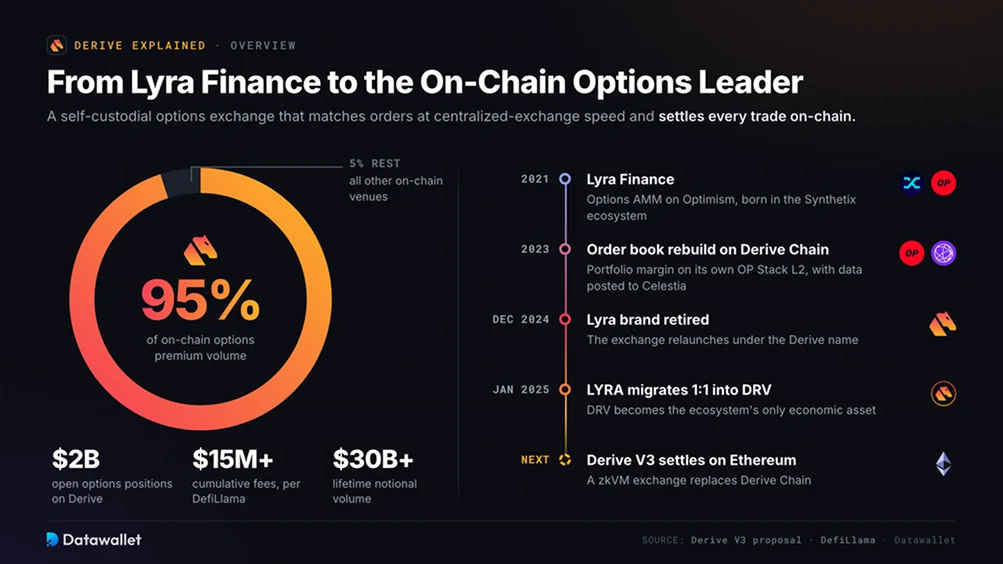
The project started as Lyra Finance in the Synthetix ecosystem, building one of the first options automated market makers on Optimism. That model priced trades through a pool formula instead of a live order book and struggled to attract professional liquidity. In 2023, the team rebuilt the protocol around a central limit order book with portfolio margin, which nets risk across an account instead of margining each position separately.
The rebuild required more block space than Optimism could provide. Derive launched its own Layer 2, Derive Chain, using the OP Stack with Conduit and posting transaction data to Celestia. The Lyra brand was retired in December 2024, followed by the one-to-one migration from LYRA to DRV in January 2025.
According to the team’s September governance proposal, Derive accounted for roughly 95% of on-chain options premium volume over the preceding 30 days. It held about $2 billion in open options positions against an estimated $40 billion market-wide. DefiLlama reports cumulative fees above $15 million, while lifetime notional volume has exceeded $30 billion.
How Does Derive Work?
Centralized servers operated by Lyra Technologies Corp handle order matching. Smart contracts manage collateral custody, margin checks and settlement, with no operator able to override those functions.
1. Off-Chain Matching, On-Chain Settlement
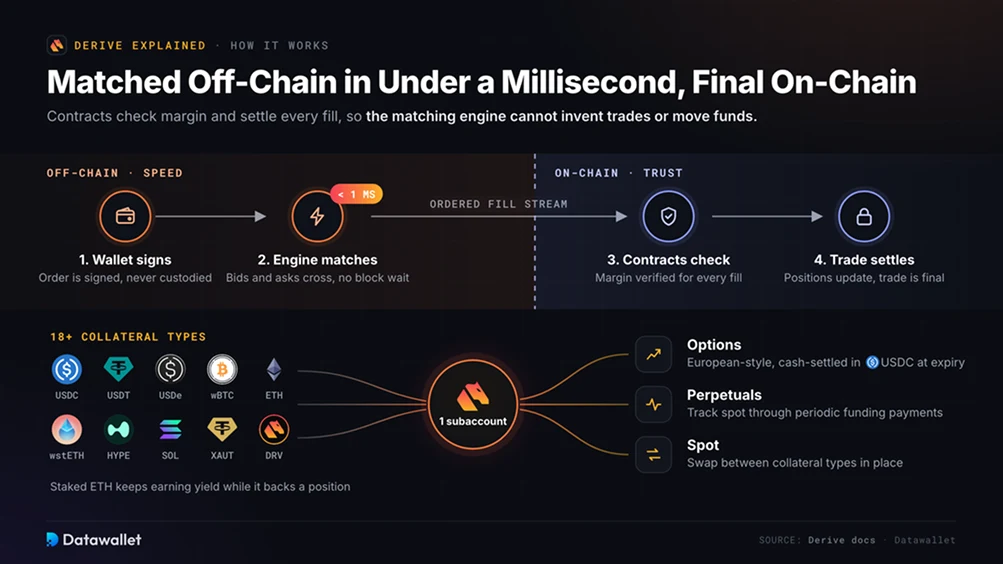
A trader signs an order with their wallet and sends it to Derive’s matching engine, where bids and asks cross in under a millisecond. Fills reach the protocol as an ordered stream. Smart contracts then check margin and update positions before finalizing each trade.
Placing or canceling an order does not require waiting for a block, but a trade becomes final only when it settles on-chain. The matching engine therefore cannot invent trades or move funds. Hyperliquid popularized this model for perpetuals; Derive applies it to the more complex margin calculations required by options.
All products settle into the same subaccount. European-style options cash-settle in USDC at expiry, while perpetuals track spot prices through periodic funding payments. Spot markets let traders change collateral without leaving the exchange.
More than 18 collateral types are supported, including USDC, USDT, USDe, wBTC, ETH, wstETH, HYPE, SOL, XAUT and DRV. Yield-bearing collateral, such as staked ETH, continues earning while backing a position.
2. Portfolio Margin and Risk Universes
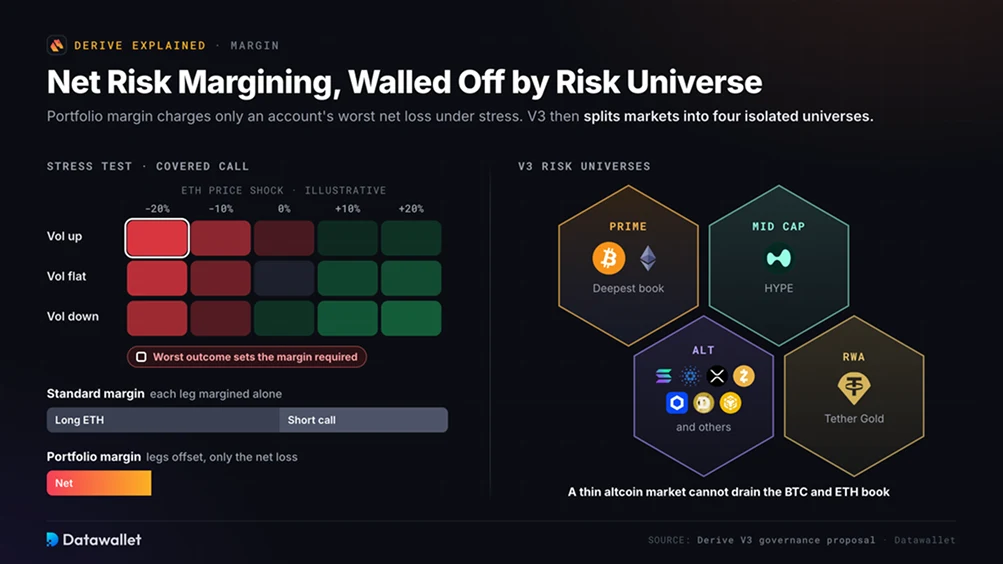
Standard margin assesses each position independently. Portfolio margin instead stress-tests the entire account against simulated price and volatility shocks, requiring collateral only for the net loss. Holding ETH and selling a call against it, for example, needs little extra margin because the two legs offset. A perpetual used to hedge an options position is recognized immediately.
V3 introduces risk universes, isolated groups of markets and collateral. The V3 governance proposal divides derivatives into Prime (ETH, BTC), Mid cap (HYPE), Alt (SOL, ADA, XRP, ZEC, LINK, DOGE, BNB and others) and RWA (XAUT). This separation prevents losses in a thin altcoin market from spreading into the BTC and ETH book, allowing new listings without adding risk to established markets.
3. RFQ Block Trading, Vaults and Builder Codes
Large or multi-leg trades use a request-for-quote system rather than the public order book. Traders specify a package, such as a call spread or hedged straddle, and market makers including FalconX return private quotes. The best quote executes atomically: every leg fills together or none do. Most institutional volume clears through RFQ, and two-leg spreads pay no fee on the cheaper leg.
Vault depositors receive shares tracking the value of a strategy run by a curator, such as selling covered calls or harvesting volatility. V3 adds permissionless vault creation and a protocol share of curator fees, as documented in the developer docs.
Introduced in February, builder codes allow third-party applications to attach an extra fee to users’ orders. More than 20 teams build on Derive, with products ranging from interfaces and trading tools to structured products.
4. Off-Exchange Custody for Institutions
Institutions rarely want to keep collateral in a protocol’s smart contract. Derive addressed this in January by launching off-exchange custody with Strands. Assets remain with a regulated custodian, while Strands issues a one-to-one on-chain proxy accepted by Derive as collateral.
BitGo integrated with Derive in August, allowing eligible clients to trade options and perpetuals while keeping collateral inside BitGo Bank & Trust. The national trust bank is regulated by the US Office of the Comptroller of the Currency. As in traditional markets, custody remains separate from execution.
Derive V3 and the Move to Ethereum
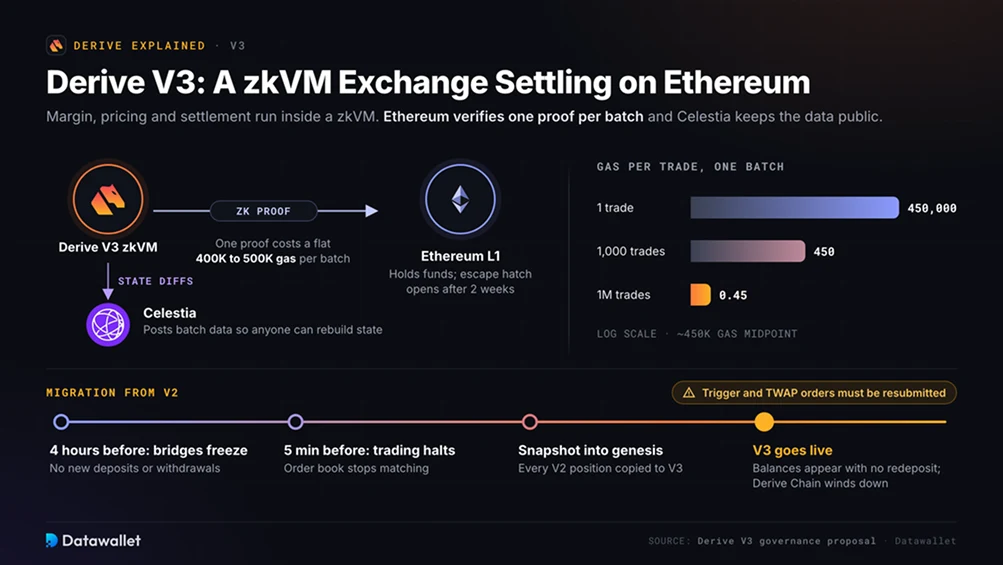
V3 represents Derive’s largest architectural change since the order book launched. On September 14, co-founder Dom Rom proposed deploying the exchange as a zkVM program settling on Ethereum mainnet. Every V2 position would migrate into its genesis state, and Derive Chain would be wound down.
A zkVM is a virtual machine that produces cryptographic proof that a computation was performed correctly. It runs the margin, pricing and settlement logic off-chain, leaving Ethereum to verify the proof. Verification costs a flat 400,000 to 500,000 gas whether the batch contains one trade or a million. Each batch’s state changes are posted to Celestia for data availability, allowing anyone to rebuild the exchange state.
The proposal sets out several changes to how the protocol is secured:
- Ethereum custody: User funds remain in a small set of Ethereum smart contracts and can be released only against a proof-committed withdrawal digest. No sequencer, operator or prover key can move tokens.
- Escape hatch: The sequencer must process withdrawal requests in order before accepting new deposits. If it stops, anyone can take over batch submission after a two-week window using the public exchange binary and Celestia data.
- Stage 1 target: Derive aims to reach L2Beat Stage 1, the classification under which users can exit without operator cooperation. Optimistic rollups such as the current Derive Chain rely on fraud proofs, which we compare in our guide to zk-rollups versus optimistic rollups.
- Ownership model: At launch, a multisig controlled by Derive Subsidiary (BVI) Ltd can update the state root and verifying key, subject to a timelock and a 6-of-8 bypass. A follow-up proposal is expected to transfer control to stDRV holders.
- Migration mechanics: Bridges freeze four hours before the snapshot, and trading halts five minutes before it. Balances appear in V3 without a redeposit, but trigger and TWAP orders must be resubmitted.
The proposal addresses the same question Lighter raised for perpetuals: can a zero-knowledge exchange settling on Ethereum match app-chain speed while retaining base-layer security? Derive’s team argues that a unified Ethereum liquidity pool is preferable to liquidity split across chains and that V3 will support hundreds of billions in daily notional.
How to Trade on Derive
Traders need an EVM wallet and collateral to get started. Derive supports self-hosted wallets such as MetaMask as well as embedded wallets created through email login. Individuals do not undergo identity verification.
A first trade works as follows:
- Confirm eligibility: Read the Terms of Use before connecting. The application excludes US persons, Australian tax residents and Ontario residents, and prohibits using a VPN to bypass geoblocking.
- Open the app: Visit app.derive.xyz directly and bookmark it. Fake interfaces targeting derivatives traders are common.
- Connect or create a wallet: Connect MetaMask, Rabby or a hardware wallet. Alternatively, sign in with email to create an embedded wallet with an exportable private key.
- Deposit collateral: Bridge USDC, ETH, wBTC or another supported asset from Ethereum, Arbitrum, Base, Optimism or Hyperliquid. Deposits finalize within a few minutes.
- Pick a margin mode: Use standard margin for simple directional trades. Portfolio margin suits spreads and hedged positions that benefit from netting.
- Select a market: Open the options chain for BTC, ETH, HYPE, SOL or XAUT. Choose an expiry and strike, then review each contract’s implied volatility, delta and open interest.
- Place the order: Submit a limit order to rest on the book as a maker or a market order for an immediate fill. Use the RFQ tab for multi-leg structures and large trades.
- Monitor margin: Track the maintenance margin ratio in the portfolio panel. Falling below it triggers a Dutch auction liquidation with a 10% fee on the liquidated value.
- Close or hold to expiry: Sell the option back before expiry to lock in the premium, or allow it to cash-settle automatically in USDC at expiration.
- Withdraw: Send collateral to any supported chain. Following the V3 launch, withdrawals settle to Ethereum mainnet under the escape hatch guarantees described above.
Derive Markets and Collateral
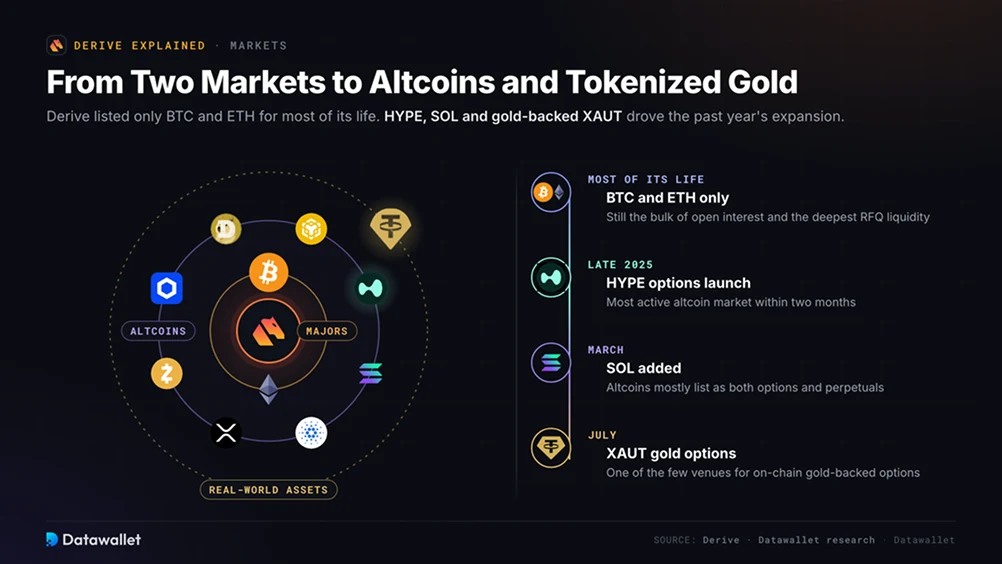
For most of its history, Derive listed only BTC and ETH. Expansion over the past year explains much of its recent growth. HYPE options launched in late 2025 and became the exchange’s most active altcoin market within two months.
The current market lineup covers three groups:
- Majors: BTC and ETH options, perpetuals and spot markets retain most of the open interest and the deepest RFQ liquidity.
- Altcoins: HYPE, SOL (added in March), ADA, XRP, ZEC, LINK, DOGE, BNB and several smaller assets. Most are available as both options and perpetuals.
- Real-world assets: Options on XAUT, Tether’s gold token, launched in July. Derive is one of the few venues offering on-chain gold-backed options.
Derive Fees
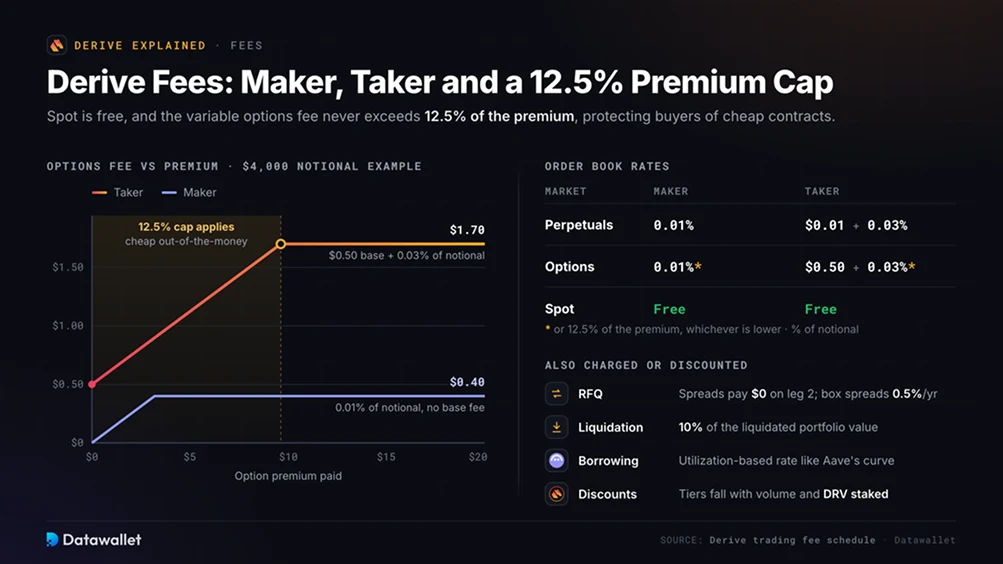
Spot trading is free. Options and perpetuals carry maker and taker fees, with a small fixed base fee on each taker order. The official fee schedule caps options fees at 12.5% of the premium, so buyers of cheap out-of-the-money contracts never pay more in fees than the option is worth.
Standard order book rates are:
- Perpetual taker: $0.01 plus 0.03% of notional per order that crosses the spread.
- Perpetual maker: 0.01% of notional on resting limit orders.
- Options taker: $0.50 plus the lower of 0.03% of notional or 12.5% of the option premium.
- Options maker: The lower of 0.01% of notional or 12.5% of premium, with no base fee.
- RFQ discounts: Two-leg spreads pay no fee on the second leg. Hedged options pay nothing on the cheaper of the option and perpetual leg, while box spreads carry a yield-spread fee of 0.5% annualized.
- Liquidation fee: 10% of the liquidated portfolio value, marked to market.
- Borrow interest: Negative USDC balances accrue interest at a utilization-based rate similar to Aave’s lending curve.
Higher trading volume and larger DRV stakes reduce fee tiers. Approved market makers also receive rebates through an institutional trading rewards program, which pays up to $500,000 in USDC and 1 million DRV per 28-day epoch.
Derive (DRV) Tokenomics & Supply
DRV is the only asset carrying economic rights in the Derive ecosystem. Intellectual property belongs to the Derive Foundation, which licenses it to operating entities. The team says contributors are aligned through the token rather than equity.
Supply and Allocation
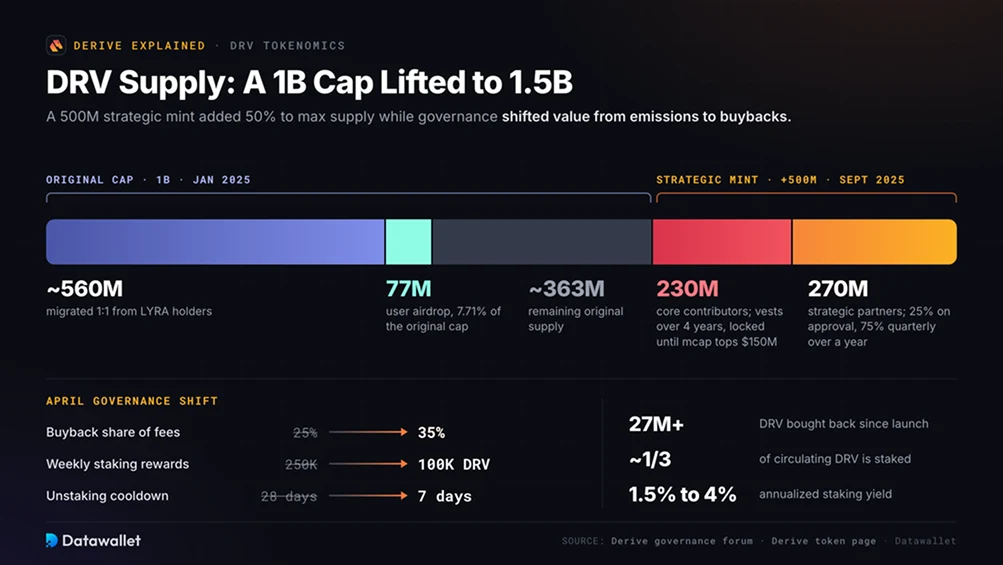
At its January 2025 launch, DRV had a 1 billion token cap matching LYRA’s former supply. Around 56% migrated from LYRA holders. Protocol users and partners received a 7.71% airdrop of about 77 million tokens, with a 25% bonus for those who staked immediately.
Governance increased the cap in September 2025 through the Strategic Mint for Institutional Expansion. It authorized 500 million new DRV, raising maximum supply by 50% to 1.5 billion.
The mint was structured with several conditions:
- Core contributors: 230 million tokens, or 46% of the mint, vest over four years from July 2025. Transfers are prohibited unless DRV’s 30-day average market cap exceeds $150 million.
- Strategic allocation: The remaining 270 million are reserved for market makers, prime brokers and institutional partners. Of that allocation, 25% vests on approval and 75% quarterly over the following year.
- Dilution ceiling: The Foundation estimated annual dilution for existing holders at no more than 8.25% over four years, leaving them with roughly 67% of supply after full release.
- Governance rights: Token holders can appoint or remove Foundation directors. The Foundation must act on passed proposals where legal in the Cayman Islands.
Trackers report different circulating supplies because they account for locked contributor tokens differently. DefiLlama counts roughly 1 billion DRV, compared with about 737.5 million on Coinbase. Buyers should check the supply figure behind any quoted market cap.
Utility
Staking converts DRV into stDRV. Holders can vote on governance proposals or delegate to as many as five representatives, and they earn weekly staking rewards. Trading fee discounts scale with the amount staked. A separate rewards program pays staked DRV to traders and vault depositors who generate protocol fees.
Because stDRV is non-transferable, governance power cannot be bought on the open market. DRV itself can also serve as trading collateral. It trades on Kraken, Gate.io, Coinbase and Upbit, as well as Aerodrome on Base and Derive’s spot market.
Buybacks and Emissions
Governance has progressively shifted value from emissions toward buybacks. An April proposal increased the buyback allocation from 25% to 35% of protocol fees and reduced weekly staking rewards from 250,000 to 100,000 DRV. It also shortened the unstaking cooldown from 28 days to 7.
The official token page now specifies monthly buybacks. By mid-September, more than 27 million DRV had been repurchased since the program began.
With weekly emissions fixed at 100,000 DRV and 35% of fees funding repurchases, trading volume and token price determine the net supply change. Roughly 305 million to 326 million DRV is staked, representing around a third of circulating supply. Annualized staking yields range from 1.5% to 4%, depending on the amount locked.
Derive Statistics & Trends
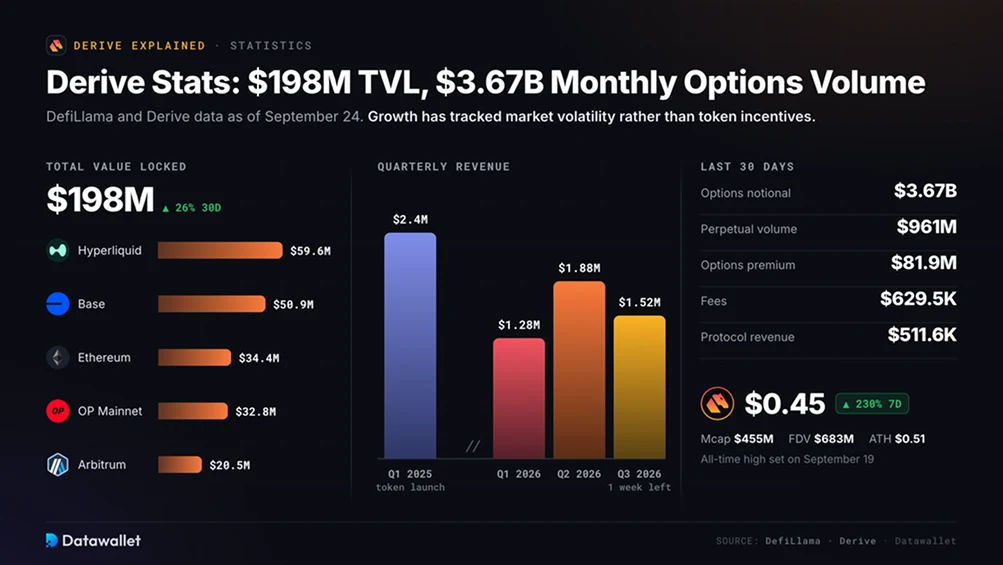
Most on-chain options protocols have struggled to reach meaningful volume, making Derive’s figures unusual for the category. The following data comes from DefiLlama and Derive’s reporting as of September 24.
Key metrics for Derive:
- Total value locked: $198 million, up about 26% over 30 days. This spans Hyperliquid L1 ($59.6 million), Base ($50.9 million), Ethereum ($34.4 million), OP Mainnet ($32.8 million) and Arbitrum ($20.5 million).
- Options premium volume: $81.9 million over 30 days and $649.5 million cumulative. Premium measures the dollars paid for contracts.
- Options notional volume: $3.67 billion over 30 days and $24.9 billion cumulative. Notional measures the value of the underlying assets referenced by those contracts.
- Perpetual volume: $961 million over 30 days and $15.2 billion cumulative, tracked in our perpetual futures statistics.
- Fees and revenue: Fees reached $629,507 and protocol revenue $511,579 over 30 days. Cumulative totals stand at $15.03 million in fees and $5.86 million in revenue.
- Quarterly revenue: Q3 has produced $1.52 million with a week remaining, after $1.88 million in Q2 and $1.28 million in Q1. These are the strongest quarters since the $2.4 million recorded during the token launch quarter in early 2025.
- Market share: About 95% of on-chain options premium volume in the 30 days to September 7, according to the V3 proposal. At the March peak, daily notional reached roughly 8% of Deribit’s.
- Token performance: DRV traded near $0.45, with a $455 million market cap and $683 million fully diluted valuation. It gained more than 230% over seven days after reaching an all-time high of $0.51 on September 19.
- Treasury: $220 million tracked, including $216.9 million in DRV itself and about $3.3 million in stablecoins.
Growth has followed market volatility rather than token incentives. During the March sell-off, Derive recorded $294 million in weekly options volume, a new high. Quarterly revenue has more than doubled in the year since the Synthetix deal collapsed.
Derive Restricted Countries
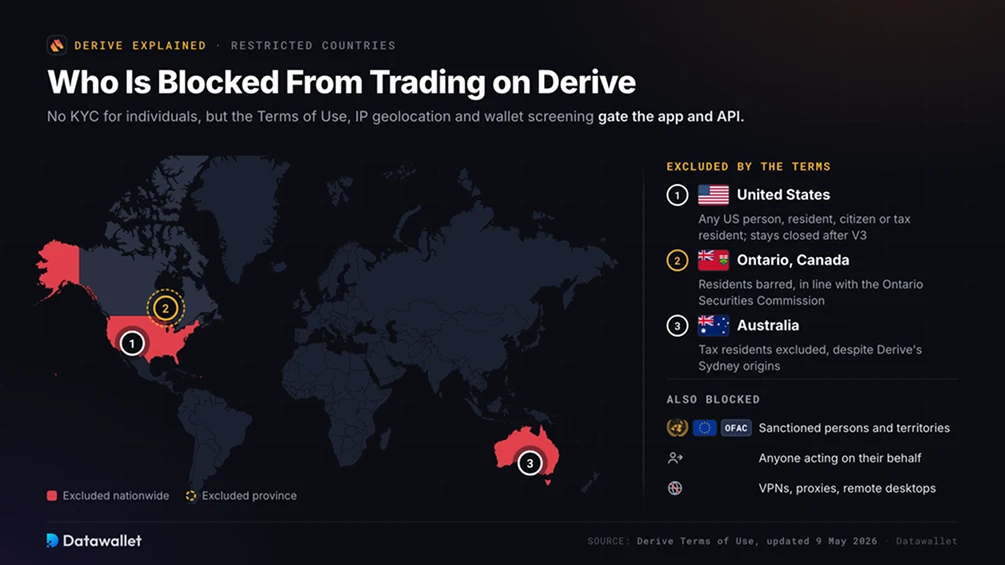
Individuals do not face identity checks, but Derive enforces eligibility through its Terms of Use, updated 9 May 2026, alongside IP geolocation and wallet screening. Lyra Technologies Corp operates the application, which provides one of several ways to access the smart contracts.
The eligibility clause excludes the following:
- United States: US persons, residents, citizens and tax residents are barred. The V3 proposal confirms that the exchange API and app will remain closed to US persons after migration.
- Australia: Australian tax residents are excluded despite the team’s Sydney origins. Australians can compare licensed alternatives in our best crypto exchanges in Australia guide.
- Ontario: Residents of the Canadian province cannot use Derive, in line with the Ontario Securities Commission’s position on unregistered crypto derivatives platforms.
- Restricted and Sanctioned Persons: Anyone listed under United Nations, US OFAC or European Union sanctions, or located in a comprehensively sanctioned territory, is prohibited regardless of residence.
- Acting on behalf of others: Users cannot access the platform on behalf of, or intend to transact with, anyone in the excluded categories.
VPNs, proxies, remote desktops and other tools used to disguise location are also prohibited. Derive may restrict access using confidential risk criteria supplied by third-party screening providers. Wallets flagged by blockchain analytics can be blocked without disclosure of the reason.
These restrictions cover the interface and API. The protocol contracts remain permissionless, but almost all liquidity passes through the operated matching engine, leaving blocked users unable to trade in practice. Traders in excluded markets can consult our guide to Deribit’s restricted countries and our ranking of crypto options exchanges.
Derive vs Deribit vs Hyperliquid
Derive competes with two distinct venues. Coinbase-owned Deribit holds most global crypto options open interest. Hyperliquid leads on-chain perpetuals but does not offer options.
Only Derive combines options trading with self-custody among these three exchanges. Deribit offers greater depth for large BTC and ETH positions, while Hyperliquid has the widest perpetual selection. We cover the latter in our decentralized perpetuals exchanges ranking.
Is Derive Safe?
Derive has operated for five years without a hack or insolvency event, a record the team cites to partners and investors. Its smart contract audits are available in Sigma Prime’s public repository, and the exchange maintains a public status page.
Public Dutch auctions handle liquidations, allowing anyone to bid. A security module funded by deposit and withdrawal fees covers shortfalls. These mechanisms remove some risks common to leveraged trading venues.
V3 removes trusted risk assessors who could manually extend margin, requiring every action to remain fully margined. It also divides the security module across risk universes, with weighting toward BTC and ETH.
Risks
Traders should weigh the following before committing capital:
- Centralized matching: A single company operates the servers supporting the order book, RFQ system and compliance checks. An outage stops trading, although funds remain withdrawable through the escape hatch.
- Migration risk: V3 rewrites every position into a new genesis state. If accounts would become liquidatable, the proposal includes fallback steps to pause genesis and resume V2. Moving $2 billion in open positions still carries execution risk.
- Multisig control: The Derive Subsidiary multisig can replace the state root and verifying key at launch. Users must trust that entity until control passes to stDRV holders through governance.
- Token dilution: The 500 million strategic mint increases the supply cap by 50% and grants the Foundation broad discretion over allocations.
- Treasury concentration: DRV accounts for roughly 98% of the tracked treasury. Operating runway depends on fee revenue and token liquidity rather than a stablecoin reserve.
- Options complexity: Losses from selling options can far exceed the premium received. Contracts approaching expiry are also highly sensitive to mark price and volatility inputs.
- Affiliate liquidity: The terms disclose that affiliated entity Derive Liquidity Co. Limited may trade as principal against users in the same markets.
- Regulatory exposure: Derive has no derivatives license in any major market. It relies primarily on geoblocking for compliance, while most jurisdictions have yet to settle their rules for on-chain derivatives.
Derive Founders and Team
Nick Forster and Dom Rom founded Derive in Sydney under the Lyra name and remain CEO and CTO, respectively. A July 2021 seed round raised $3.3 million from Framework Ventures, ParaFi Capital, Robot Ventures and Synthetix founder Kain Warwick. Framework and GSR provided a further $3 million in a strategic round in late 2022.
Synthetix proposed acquiring Derive in May 2025 through a token swap valuing the protocol at $27 million. The community rejected the valuation as too low relative to revenue growth. The Block reported that both sides withdrew their proposals within a week. Derive’s team later described offboarding investors who had backed the deal and recommitting to independence.
Crypto venture fund Variant acquired a significant DRV position in February through open-market purchases and a foundation transaction. Sean Dawson leads research, Ian Randle oversees options education, and Dillon Lin heads growth.
The organization’s legal entities include the Cayman-based Derive Foundation and Derive Subsidiary (BVI) Ltd, which issues the token and holds the treasury. Lyra Technologies Corp operates the exchange, while Derive Labs Corporation provides services.
Final Thoughts
Derive spent nearly five years building infrastructure before on-chain options attracted meaningful demand, then captured almost the entire market. Its order book and RFQ desk now process billions in monthly notional with portfolio margin. Institutions can trade using BitGo custody, while the fee model has shifted from paying stakers toward token buybacks.
V3 will test whether Derive can retain that lead through a full rebuild. Ethereum settlement through a zkVM promises stronger custody guarantees and an order of magnitude more throughput. However, the migration affects every open position, with a company multisig holding control initially. DRV’s tripling in a week prices in a successful launch.
Before sizing a position, traders should consider its volatility and 1.5 billion supply cap, along with the access restrictions for US and Australian residents.
.webp)