


Which Countries Does Deribit Restrict?
Deribit bars residents of around two dozen jurisdictions, and applies retail-specific limits to several more. The full list sits in its Restricted Jurisdictions policy, which the exchange updates as sanctions and licensing conditions change.
Most entries are full bans covering anyone located, incorporated or resident in the country. A smaller group, Panama, the United Arab Emirates and the United Kingdom, is partial: retail clients lose derivatives access but keep spot products, a split driven by how each regulator treats leveraged trading.
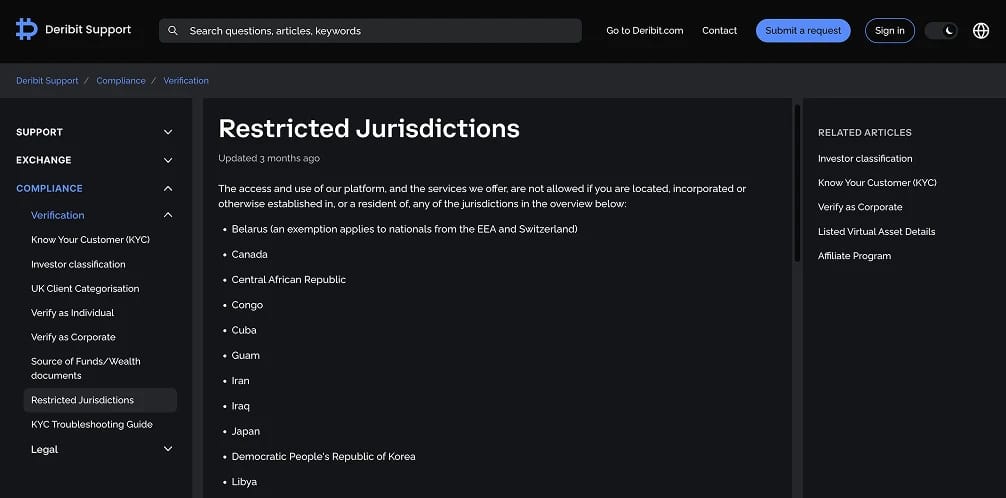
Deribit Restricted Countries List in 2026
The table below groups Deribit's restricted jurisdictions by region. Belarus and the Russian Federation exempt nationals of the European Economic Area and Switzerland.
Why Does Deribit Restrict These Countries?
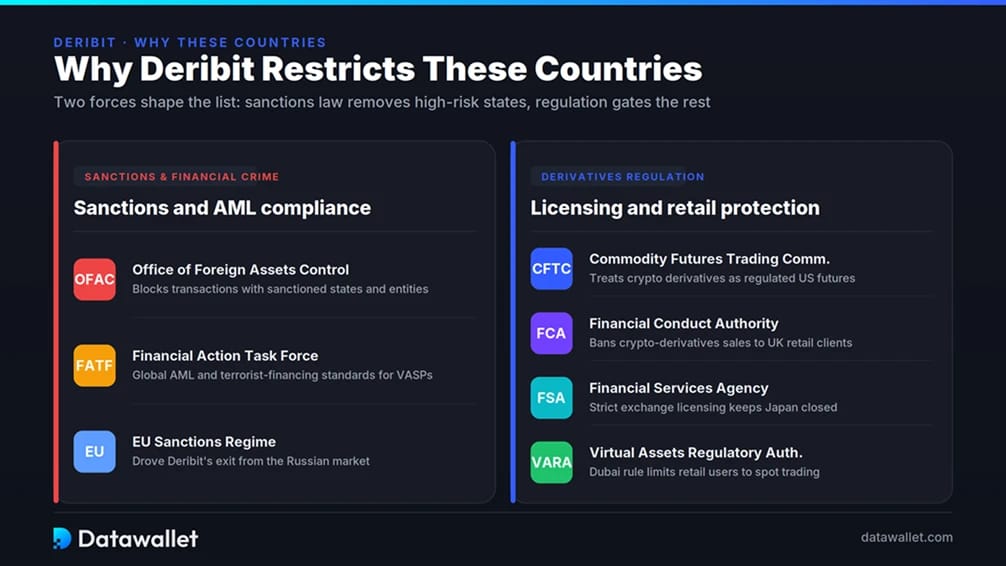
Two forces shape the list. Sanctions and financial-crime law remove high-risk territories entirely. Derivatives regulation handles the rest, where local rules on leverage and retail protection decide whether a market gets full access, spot-only access, or none.
1. Sanctions and AML Compliance
Several names, including Iran, North Korea, Syria and Cuba, are comprehensively sanctioned territories where any financial service carries heavy screening and legal exposure.
The main compliance drivers behind the full bans include:
- OFAC programmes: The US Office of Foreign Assets Control runs sanctions programmes that block transactions with designated countries, entities and individuals, reaching any platform with US touchpoints.
- AML standards: The Financial Action Task Force expects virtual asset providers to assess money-laundering and terrorist-financing risk by jurisdiction, then restrict or supervise it.
- Conflict zones: Libya, Somalia, South Sudan and Sudan combine weak oversight with sanctions exposure, raising the cost of onboarding clients there.
- Russia and Belarus: Deribit exited the Russian market to align with EU measures, retaining only a narrow carve-out for EEA and Swiss nationals.
- Ukraine regions: Access is cut for Crimea, Donetsk and Luhansk, mirroring sanctions packages that target those occupied areas rather than the whole country.
- Identity checks: Where screening cannot reliably reduce risk, a blanket ban beats case-by-case review, so entire territories are excluded.
2. Derivatives Licensing and Retail Protection
The remaining restrictions track financial regulation rather than sanctions. Options and perpetuals are leveraged products, and several major regulators limit or ban them outright for retail investors.
The product and licensing reasons behind these limits include:
- US oversight: The Commodity Futures Trading Commission treats crypto derivatives as regulated futures activity, and Deribit holds no US registration, so the country is fully excluded.
- UK retail ban: The Financial Conduct Authority prohibits selling crypto derivatives to retail consumers, so British retail clients cannot trade options or futures here.
- Canada rules: Provincial securities regulators require platforms serving Canadians to register, a step Deribit has not taken, so the country is excluded.
- Japan framework: Japan's strict licensing regime for crypto exchanges, overseen by the Financial Services Agency, closes the market to unlicensed platforms.
- UAE tiering: Under VARA rules, Emirati retail users get spot trading only, while qualified and institutional investors reach the full derivatives suite.
- Investor status: Deribit's structure pushes eligible retail derivatives clients to its Panama broker and reserves direct Dubai onboarding for qualified and institutional accounts.
Deribit Supported Countries
Outside the restricted list, Deribit stays open to eligible clients across most of Europe, Asia, Latin America and Africa, concentrated in markets that permit leveraged trading. Its appeal is liquidity rather than asset breadth, since it focuses on Bitcoin and Ethereum contracts over a long altcoin catalogue.
That focus made it the dominant venue in its niche. Deribit has handled most global Bitcoin and Ethereum options activity, with reported market share estimates from roughly 80% upward, and it cleared $1.185 trillion in volume across 2024, a 95% jump on the prior year.
Traffic reflects that European and Asian skew. According to Similarweb, the largest desktop visitor shares in May 2026 came from India at 16.67%, Hong Kong at 10.13%, France at 9.27%, Switzerland at 9.18% and Brazil at 6.56%, with the rest spread across other markets.
Is Deribit Available in the US?
Deribit's own platform still blocks US residents, and its Restricted Jurisdictions policy names the United States alongside Puerto Rico, Guam and other territories. Bypassing that with a VPN breaches the terms and risks account closure and frozen funds.
The wider picture shifted in 2026. Coinbase, which completed its $2.9 billion purchase of Deribit in August 2025, then opened a regulated path into the same liquidity for American clients. On 29 May 2026, CFTC guidance let Coinbase Financial Markets become the first US-registered futures commission merchant to connect domestic users to global crypto options and perpetuals, starting with institutional access to Deribit's order books.
So Deribit itself stays off limits to US persons, but US clients can now reach its options through a compliant intermediary, with wider retail access flagged for later. American traders who want regulated exposure today can compare domestic venues in our guide to the best crypto exchanges in the USA.
Does Deribit Require KYC?
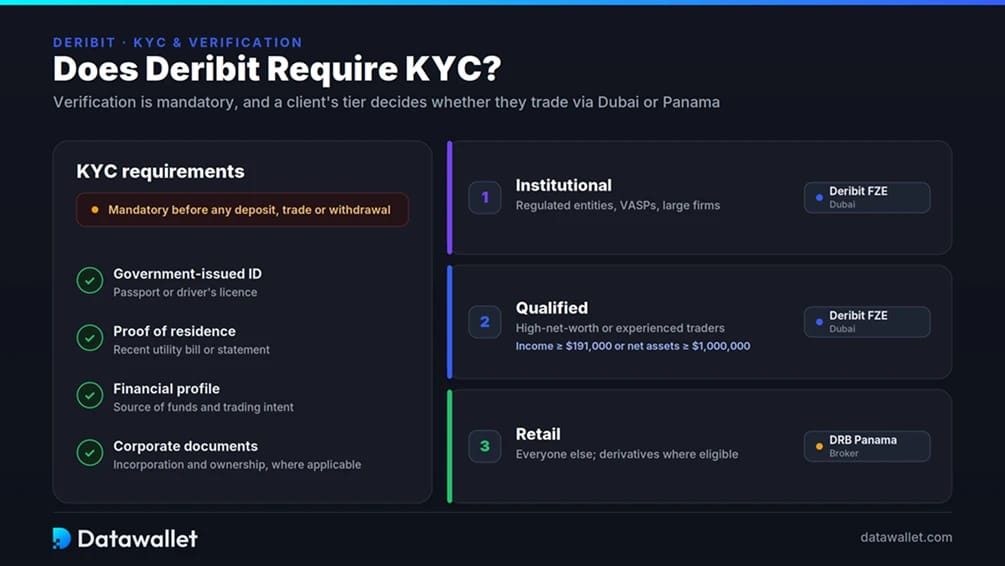
Yes. Verification is mandatory before any deposit, trade or withdrawal, and the unverified accounts that once allowed small anonymous trades are gone. Each client submits a government-issued ID and recent proof of residence, with corporate accounts adding incorporation and ownership documents, per Deribit's KYC policy.
KYC also sets where a client is onboarded. Deribit's investor classification system sorts users into institutional, qualified and retail tiers. The first two trade directly through the Dubai exchange, while eligible retail clients go to the Panama broker, which executes their orders on the same venue.
The qualified tier carries real thresholds. An individual generally needs annual income of at least USD 191,000 or net assets of USD 1 million, plus documented derivatives experience, before gaining direct access to the Dubai entity.
Deribit Licenses and Regulation
Deribit operates through Deribit FZE, the Dubai entity licensed by the emirate's Virtual Assets Regulatory Authority as a Virtual Asset Service Provider for spot and derivatives trading. It moved its headquarters to Dubai and migrated all activity to the VARA-regulated entity from the start of 2025.
The structure splits client types. Qualified and institutional investors face Deribit FZE in Dubai, while retail derivatives clients go through DRB Panama, a broker member executing on the Dubai exchange. That arrangement produces the spot-only limits for retail users in the UAE and Panama.
Ownership now sits with Coinbase. The deal places the platform under a US-listed, publicly reporting company and underpins the new CFTC-cleared pathway connecting American clients to Deribit liquidity. For context on the parent, see our Coinbase review.
About Deribit
Deribit launched in 2016, founded by Dutch brothers John and Marius Jansen, and built its name as a specialist options venue while most exchanges chased spot listings. The founders exited the business after the Coinbase deal, with Luuk Strijers continuing as chief executive.
Its product set centres on Bitcoin and Ethereum options, futures and perpetuals, backed by deep order books, an insurance fund and published proof-of-reserves attestations. It offers leverage on its futures and perpetuals, and remains the reference point for options pricing through its DVOL volatility index.
The acquisition, closed in August 2025 for $2.9 billion in cash and stock, made the combined group the global leader in crypto derivatives by open interest and options volume. Traders weighing alternatives can browse our rankings of the best crypto options exchanges and best crypto futures exchanges.
Final Thoughts
Anyone considering Deribit should check the Restricted Jurisdictions list against their residence and citizenship, since the platform screens both. Residents of the US, Canada and Japan have no direct entry, and retail users in the UK, UAE and Panama get spot products only or no derivatives at all.
Eligible clients should then complete KYC, confirm their investor classification, and learn the leverage and liquidation mechanics before opening a position.
Those outside Deribit's reach can find regulated options and perpetuals elsewhere, and the gap between spot and leveraged products is worth grasping first through our explainer on perpetual versus spot trading.