


Top 8 Crypto Wallet Statistics and Trends
1. Crypto Wallet Market Is Projected to 5x by 2033
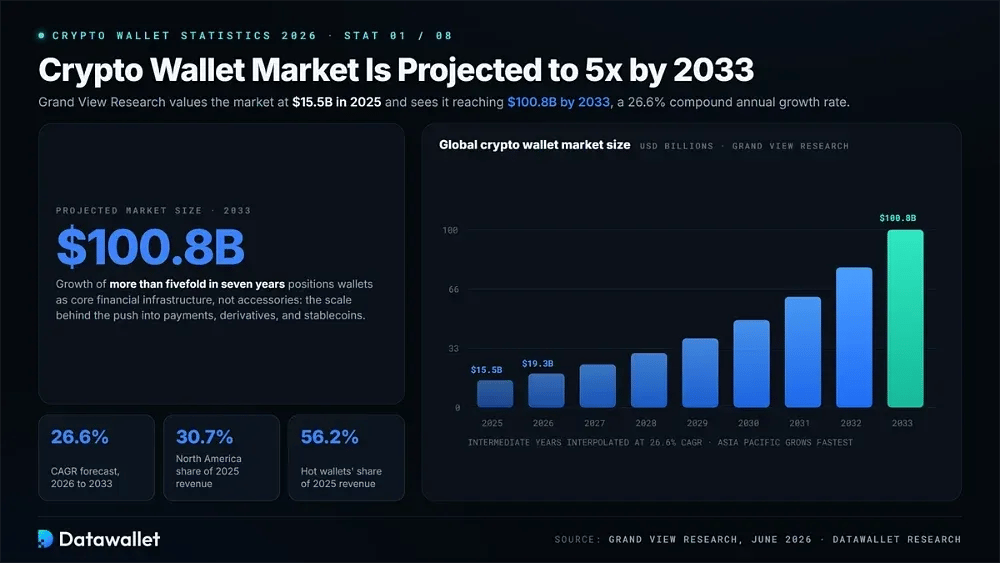
Grand View Research's June 2026 update valued the global crypto wallet market at USD 15.5 billion in 2025. It estimates the market will reach USD 19.3 billion in 2026 and then climb to USD 100.8 billion by 2033, representing a 26.6% compound annual growth rate.
North America accounted for the largest regional share in 2025 at 30.7%. Asia Pacific, by contrast, is forecast to grow fastest through 2033. Hot wallets retained a dominant 56.2% share of revenue, trading remained the leading application, and individual users continued to outweigh commercial adoption across every region tracked.
Growth of more than fivefold in seven years positions wallets as core financial infrastructure rather than accessories. That scale helps explain the push into payments, derivatives, and stablecoins. It also means a security failure can now have consequences well beyond one product line.
2. Phantom Peaked Near 17 Million Monthly Users
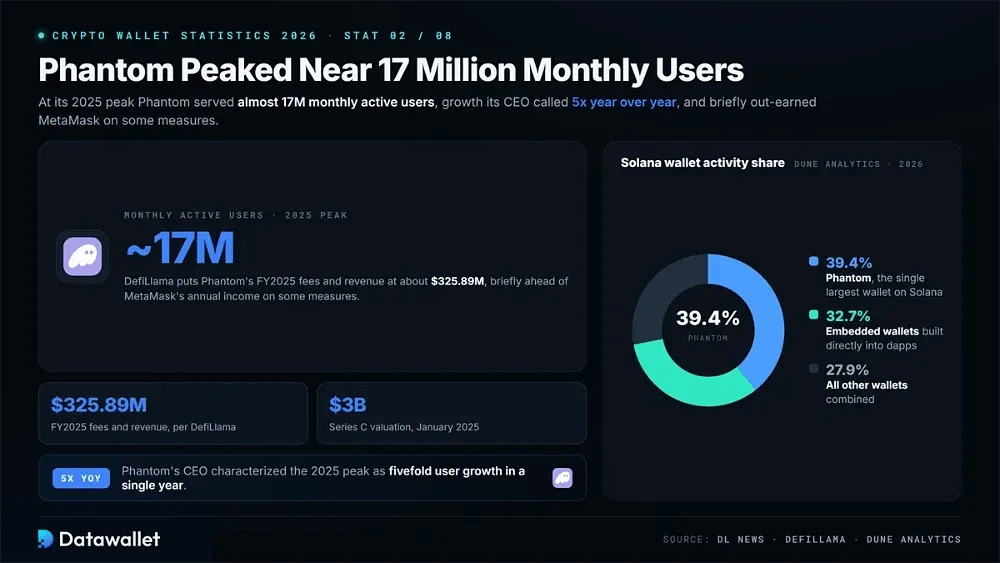
At its 2025 peak, Phantom served almost 17 million monthly active users. Its CEO characterized that as 5x year-over-year growth, according to DL News reporting. Separately, DefiLlama puts the wallet's FY2025 fees and revenue at around $325.89 million, briefly ahead of MetaMask's annual income on some measures.
Dune Analytics data cited across 2026 coverage gives Phantom 39.4% of Solana wallet activity. Embedded wallets built into dapps account for another 32.7%. The company's January 2025 Series C valued it at $3 billion, while our Phantom review explains how those figures translate into everyday features.
3. MetaMask Nears Its MASK Token With 30 Million Users
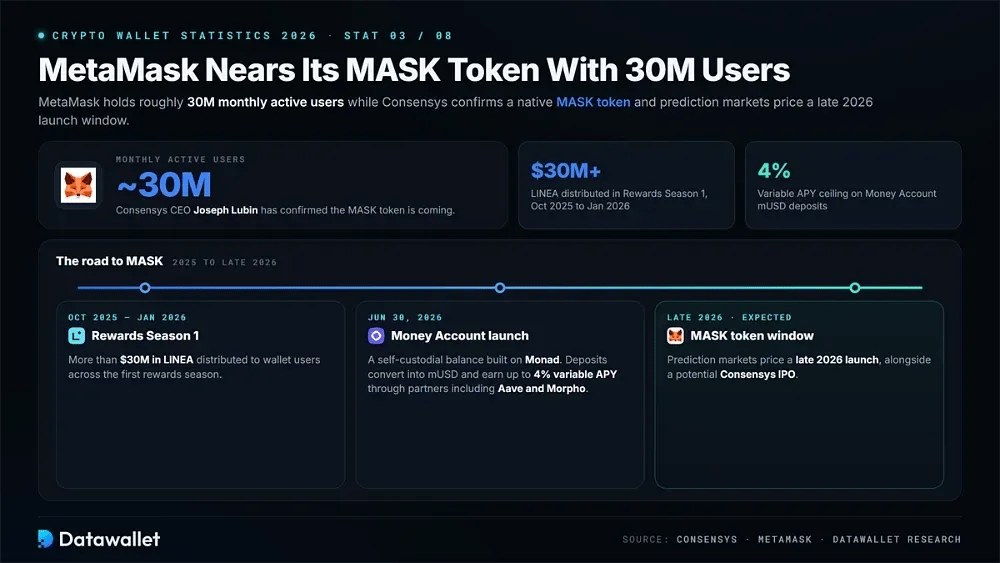
MetaMask maintains roughly 30 million monthly active users. Consensys CEO Joseph Lubin has confirmed that a native MASK token is coming, while prediction markets price a launch window into late 2026 alongside a potential Consensys IPO. Rewards Season 1 distributed more than $30 million in LINEA from October 2025 through January 2026.
The product itself is also expanding quickly. On June 30, 2026, MetaMask launched its Money Account, a self-custodial balance built on Monad. Deposits convert into mUSD and can earn up to 4% variable APY through partners including Aave and Morpho, pushing the wallet further into savings and everyday payments.
4. Wallet-Native Perps Top $42 Billion Through Phantom
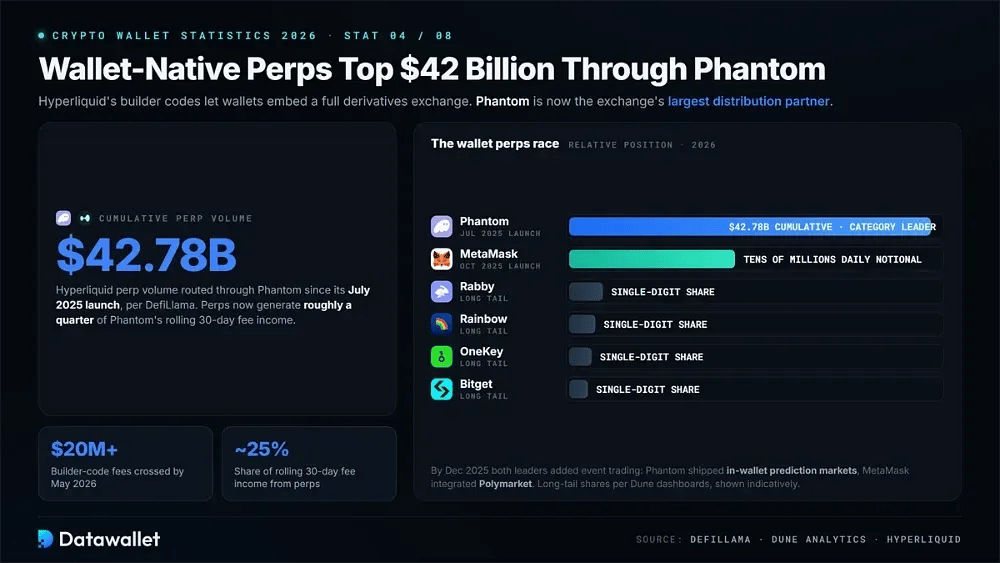
Perpetual futures have become one of the highest-stakes wallet feature races. Hyperliquid's builder-code system allows wallets to embed a full derivatives exchange and earn fees on trades executed by their users directly in-app.
Here is how the wallet perps race currently stacks up:
- Phantom volume: Since its July 2025 launch, the wallet has processed $42.78 billion in cumulative Hyperliquid perp volume, according to DefiLlama, making Phantom the exchange's largest distribution partner.
- Builder fees: By May 2026, Phantom had crossed $20 million in builder-code fees. Perps now generate roughly a quarter of its rolling 30-day fee income.
- MetaMask response: MetaMask introduced perpetual futures in October 2025 with a points-based rewards program. It has posted tens of millions in daily notional but still trails Phantom's established lead.
- Prediction markets: By December 2025, both leaders had expanded into event trading. Phantom shipped in-wallet prediction markets, while MetaMask integrated Polymarket to keep speculative flow inside the app.
- Long tail: Dune dashboards give Rabby, Rainbow, OneKey, and Bitget single-digit shares of wallet-native perp volume, showing how heavily the category remains concentrated around two brands.
- Why it matters: Swaps alone never produced the same recurring, high-margin revenue that derivatives can offer. That economics explains why leverage, funding, and margin tooling now appear on every serious wallet roadmap.
Traders comparing entry points can start with our best Hyperliquid wallets shortlist.
5. Wallets Launched Their Own Stablecoins and Debit Cards
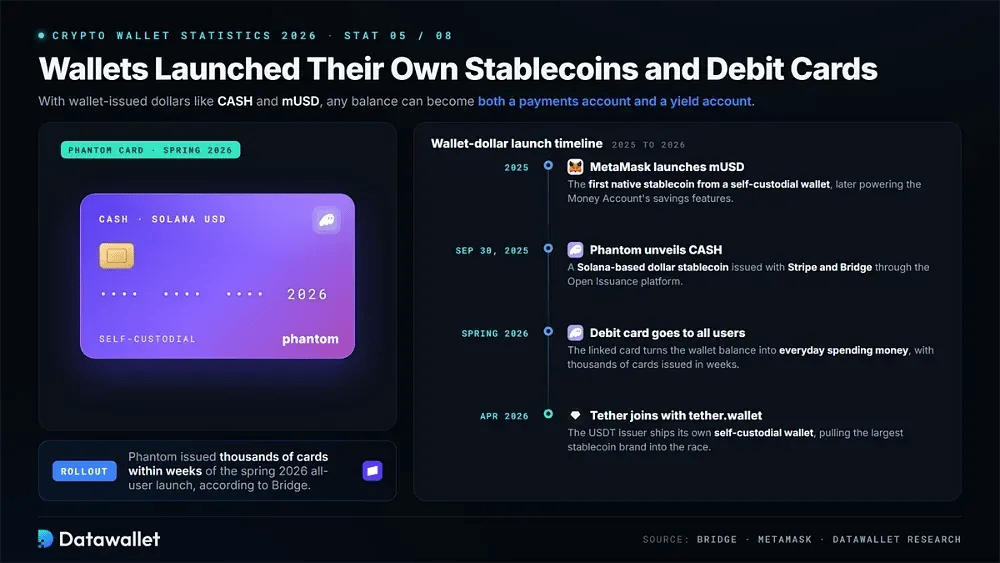
Phantom unveiled CASH on September 30, 2025. The Solana-based dollar stablecoin is issued with Stripe and Bridge through the Open Issuance platform. In spring 2026, Phantom rolled its linked debit card out to all users and issued thousands of cards within weeks, according to Bridge.
MetaMask had already moved into wallet-native stablecoins, launching mUSD in 2025 as the first native stablecoin from a self-custodial wallet. Tether joined the race in April 2026 with its self-custodial tether.wallet. With wallet-issued dollars, any balance can potentially become both a payments account and a yield account.
6. Ledger Tops 8 Million Devices and Eyes a $4B+ IPO
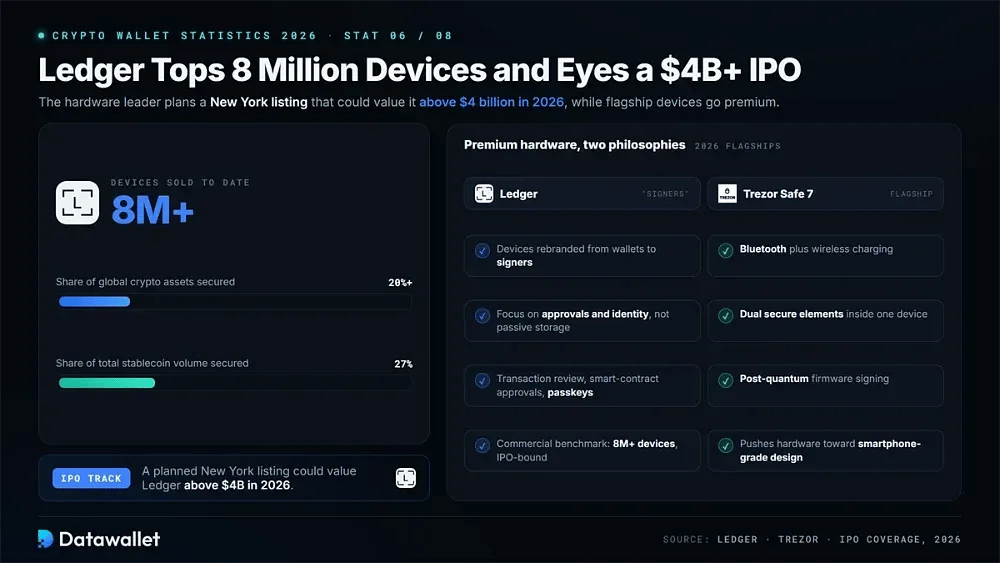
Ledger has sold more than 8 million devices. The company says it secures over 20% of global crypto assets and 27% of total stablecoin volume, according to reporting on its planned New York listing. That listing could value the hardware leader above $4 billion in 2026.
Hardware competition is also moving toward more premium products. Trezor's Safe 7 flagship combines Bluetooth and wireless charging with dual secure elements and post-quantum firmware signing. Ledger, meanwhile, now calls its devices "signers," emphasizing approvals and identity rather than passive storage. Our Ledger vs Trezor comparison examines both approaches.
7. Coldcard Exploit Became the Largest Hardware Wallet Hack
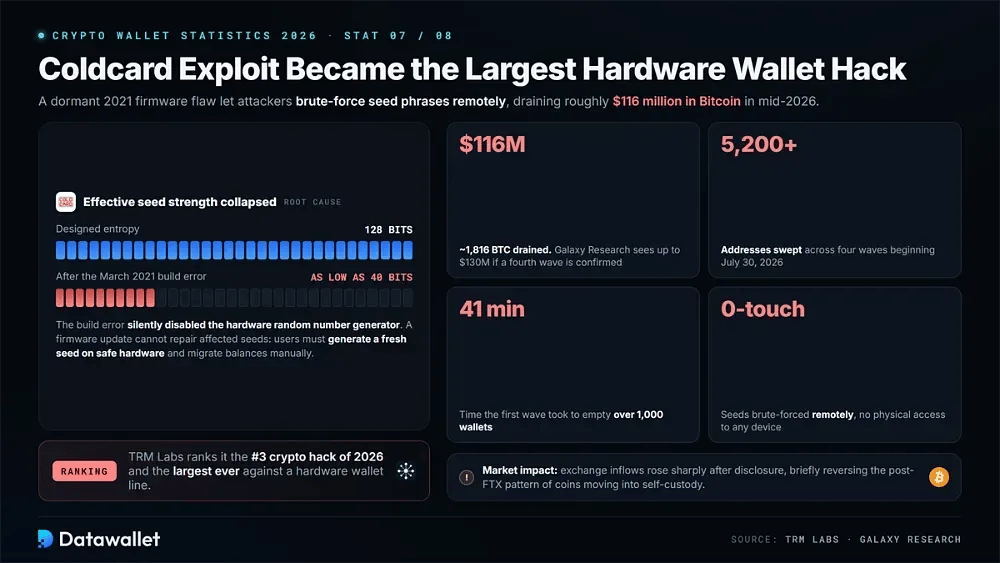
A dormant firmware flaw in Coinkite's Coldcard devices undermined one of cold storage's central assumptions in mid-2026. Attackers could brute-force seed phrases remotely without physically touching a wallet.
Key facts from the incident, based on TRM Labs' analysis:
- Root cause: A March 2021 build error silently disabled the hardware random number generator. Effective seed strength fell from 128 bits to as little as 40.
- Total losses: Attackers drained roughly 1,816 BTC worth about $116 million. Galaxy Research estimates that losses could approach $130 million if a suspected fourth wave is confirmed.
- Scale: More than 5,200 addresses were swept across four waves beginning July 30, 2026. The first run emptied over 1,000 wallets in roughly 41 minutes.
- Ranking: TRM Labs classifies the theft as the third-largest crypto hack of 2026 and the largest exploit ever recorded against a hardware wallet product line.
- Remediation: A firmware update cannot repair seeds created under the flawed code. Affected users must generate a fresh seed on safe hardware and migrate their balances manually.
- Market impact: Exchange inflows rose sharply in the days after disclosure. That briefly reversed the multi-year pattern of coins moving from trading platforms into self-custody wallets after FTX.
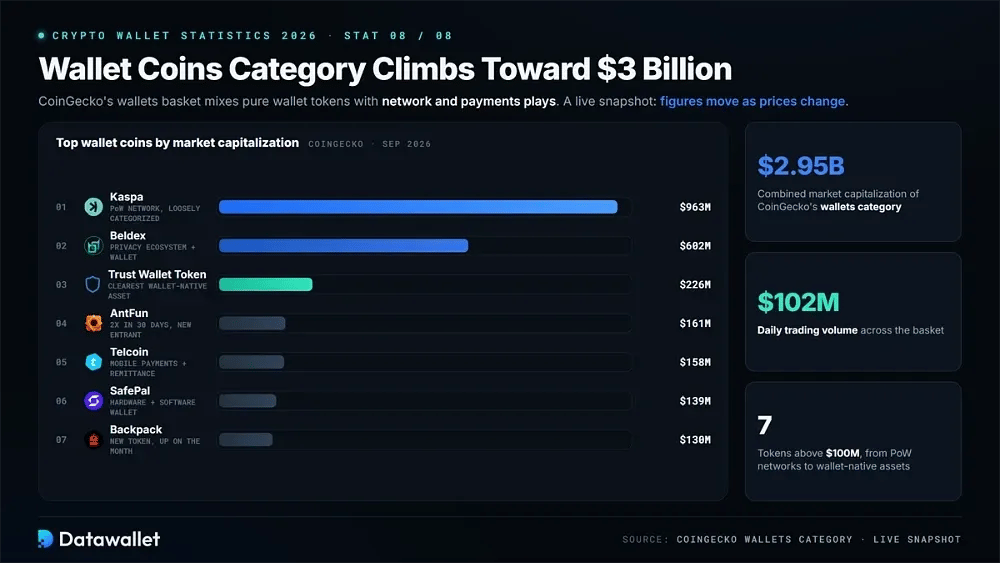
8. Wallet Coins Category Climbs Toward $3 Billion
CoinGecko's wallets category currently has a combined market capitalization near $2.95 billion and about $102 million in daily trading volume. The basket includes pure wallet tokens alongside broader network and payments plays.
Top wallet coins ranked by market capitalization right now:
- Kaspa: At roughly $963 million, Kaspa leads the category even though it operates as a proof-of-work network rather than a wallet business, demonstrating how loosely the basket is defined.
- Beldex: Second place belongs to Beldex at about $602 million. Its privacy-focused ecosystem includes the wallet as one of several products, alongside a private browser and encrypted messaging service.
- Trust Wallet Token: At around $226 million, Trust Wallet Token is the clearest wallet-native asset in the group, with direct ties to the Binance-linked mobile wallet's discounts and governance perks.
- AntFun: This newer entrant sits near $161 million after more than doubling over thirty days, illustrating how quickly speculative tokens can rotate into the wallet category and reshape it.
- Telcoin: Trading near $158 million, Telcoin is a mobile payments and remittance network whose distinctly wallet-first product design has kept it in the category for years.
- SafePal: SafePal is valued around $139 million. Its combined hardware and software wallet ecosystem recently led daily category gainers amid renewed retail trading engagement.
- Backpack: The exchange and wallet brand's new token debuts near $130 million and is up strongly on the month, signaling another monetization experiment among wallet builders.
What Are Cryptocurrency Wallets?
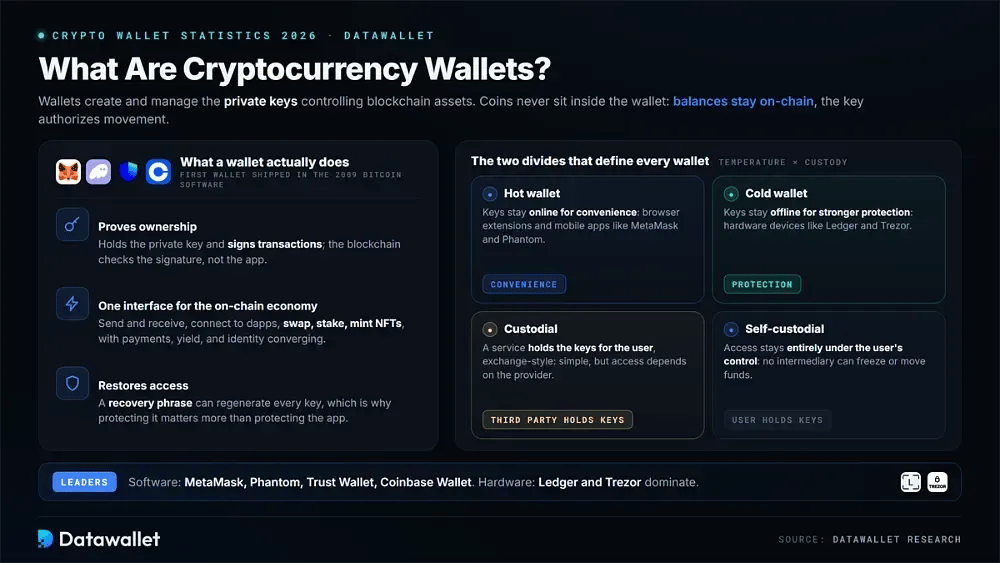
Cryptocurrency wallets are applications or devices that create and manage the private keys controlling blockchain assets. The coins themselves never sit "inside" the wallet. Balances remain onchain; the wallet proves ownership and authorizes movement when the holder signs a transaction with the corresponding key.
A wallet can be used to send or receive tokens, connect to decentralized apps, swap and stake assets, mint NFTs, or restore access with a recovery phrase. Payments, yield, and identity are increasingly part of the same interface, turning wallets into the main consumer access point for the broader onchain economy.
One basic distinction is between hot wallets and cold wallets. Hot wallets remain online for convenience, whereas cold wallets keep keys offline for stronger protection. Custody creates another divide: a custodial service holds the keys for the user, while a self-custodial setup leaves access entirely under the user's control.
Satoshi Nakamoto included the first wallet in the original 2009 Bitcoin software. On the software side, today's leaders include MetaMask from Consensys, Phantom, Trust Wallet, and Coinbase Wallet. Ledger and Trezor dominate hardware. Our best crypto wallets guide compares the leading options.
Crypto Wallets Key Terminology
Before moving funds, every holder should understand the core wallet vocabulary. The costliest mistakes tend to involve key handling, signing, and recovery rather than market timing.
Here is a quick-reference table of the most important terms:
These definitions are condensed from official MetaMask and Trezor support documentation.
Crypto Hardware Statistics and Trends
Raw offline storage is no longer the only basis of hardware wallet competition. Device quality, signing clarity, and ecosystem reach now matter as well. Ledger's installed base of more than 8 million devices, together with its planned public listing, shows how much commercial weight has accumulated behind the category's two dominant brands.
The Coldcard exploit changed the security discussion in 2026. It demonstrated that firmware quality and entropy generation can be as important as air-gapping. Separate breaches involving vendors also turned shipping records and mailing lists into useful attack surfaces for phishing crews.
Top Crypto Hardware Wallet Trends
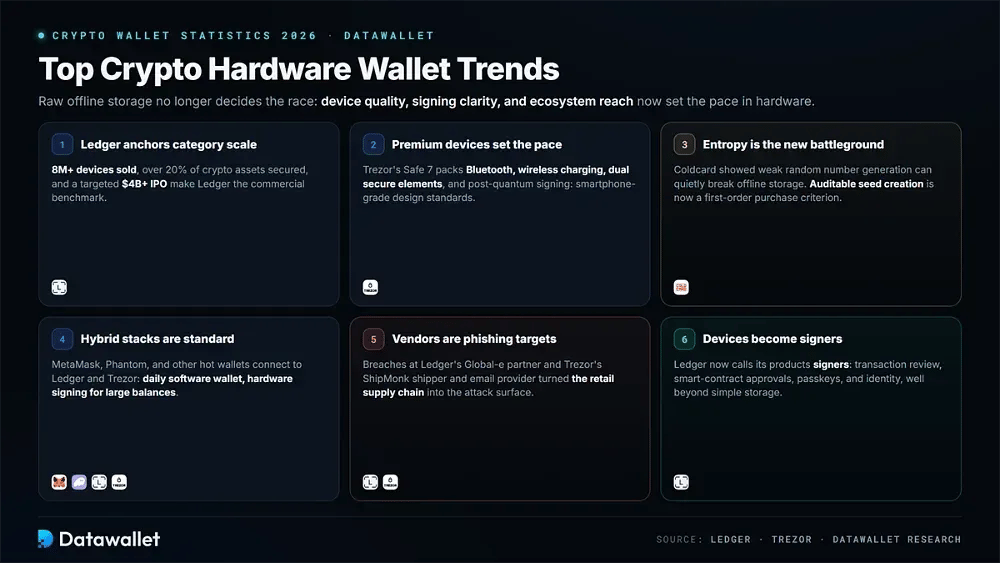
- Ledger anchors category scale: Ledger is the commercial benchmark for dedicated hardware, with more than 8 million devices sold, over 20% of crypto assets secured, and a targeted $4 billion-plus IPO.
- Premium devices set the pace: Bluetooth, wireless charging, a larger touchscreen, dual secure elements, and post-quantum firmware signing are all built into Trezor's Safe 7, pushing flagship hardware toward smartphone-grade design standards.
- Entropy is the new battleground: Coldcard showed that weak random number generation can quietly compromise offline storage. Auditable seed creation is therefore becoming a first-order purchasing criterion.
- Hybrid stacks are standard: MetaMask, Phantom, and other hot wallets officially support connections to Ledger and Trezor. Users can keep a daily software wallet while relying on hardware signing for larger balances.
- Vendors are phishing targets: The breaches involving Ledger's Global-e partner, Trezor's ShipMonk shipper, and Trezor's email provider show attackers targeting the retail supply chain around hardware devices rather than the chips themselves.
- Devices become signers: Ledger's shift from calling its products wallets to calling them signers reflects a broader move toward transaction review, smart-contract approvals, passkeys, and identity. Hardware is expanding well beyond simple storage.
Are Crypto Wallets Safe?
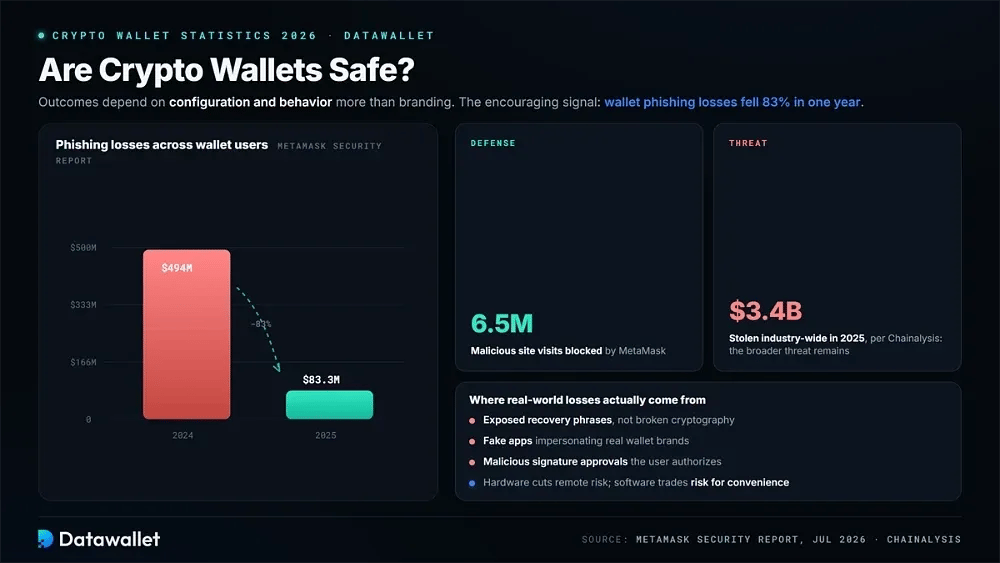
Crypto wallets can provide extremely strong security, although outcomes depend more on configuration and user behavior than on branding alone. Hardware devices reduce exposure to remote attacks, while software wallets accept more risk in exchange for convenience. In practice, exposed recovery phrases, fake apps, and malicious signature approvals account for many real-world losses rather than failures in the underlying protocol.
MetaMask's security reporting provides an encouraging data point: phishing losses across wallet users fell from $494 million in 2024 to $83.3 million in 2025, and the wallet blocked 6.5 million malicious site visits. The broader threat remains substantial, however. Chainalysis counted $3.4 billion stolen industry-wide in 2025.
Notable Crypto Wallet Breaches and Security Incidents
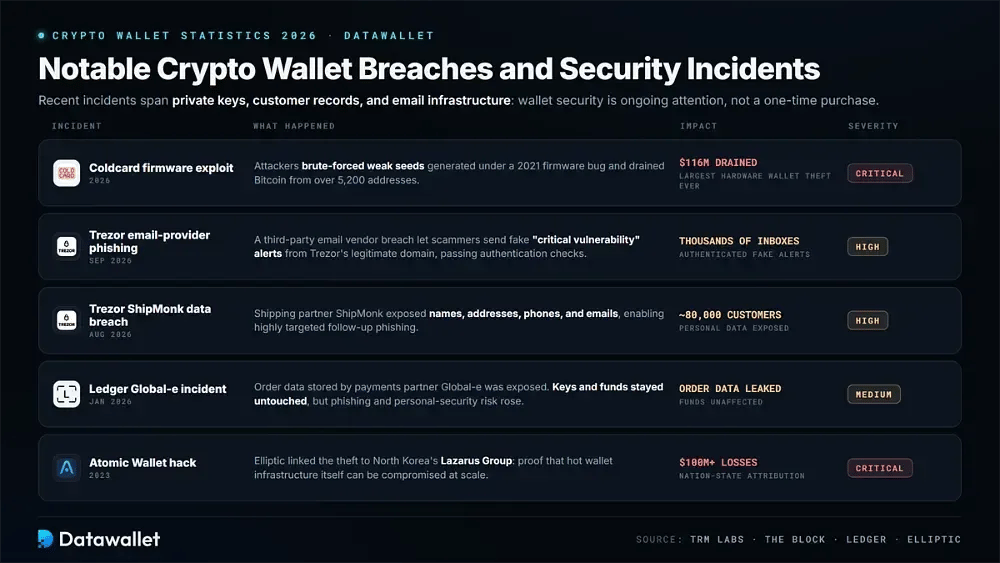
Major wallet brands have still faced exploits, vendor breaches, and impersonation campaigns. Wallet security therefore requires ongoing attention rather than a one-time purchasing decision. Recent incidents have exposed several attack surfaces, ranging from private keys to customer records and email infrastructure.
- Coldcard firmware exploit (2026): Attackers brute-forced weak seeds generated under a 2021 firmware bug and drained roughly $116 million in Bitcoin from over 5,200 addresses, making it the largest hardware wallet theft in history.
- Trezor email-provider phishing (2026): A September breach at a third-party email vendor allowed scammers to send fake "critical vulnerability" alerts from Trezor's legitimate mailing domain. The emails passed authentication checks and reached thousands of inboxes.
- Trezor ShipMonk data breach (2026): In August, Trezor disclosed that shipping partner ShipMonk had exposed the names, addresses, phone numbers, and emails of around 80,000 customers, enabling highly targeted follow-up phishing.
- Ledger Global-e incident (2026): Ledger reported in January that order data stored by payments partner Global-e had been exposed. Keys and funds remained untouched, but the leaked customer information increased phishing and personal-security risks.
- Atomic Wallet hack (2023): Elliptic linked over $100 million in losses to North Korea's Lazarus Group. The case remains a reminder that hot wallet infrastructure itself can be compromised at devastating scale.
How to Secure Your Crypto Wallet
The strongest approach is layered security. Keep the recovery phrase protected, limit online exposure, check what you are signing, and separate funds according to their purpose. Anyone with meaningful balances should manage them more like a treasury than a casual app account.
- Keep your recovery phrase offline. Do not place it in screenshots, cloud drives, synced notes, or email drafts.
- Use a hardware wallet for savings. Signing offline sharply reduces exposure to malware and remote attacks.
- Treat vendor emails as hostile by default. After the provider breaches of 2026, verify alerts through official apps instead of following links from an inbox.
- Separate spending and savings wallets. Keeping a daily hot wallet limits the amount that one compromise can drain.
- Review every approval before signing. Most drains result from malicious transactions the user authorized, not broken cryptography.
- Update software and firmware promptly. Patches become especially important in the days following disclosed exploits or active phishing waves.
- Harden the device itself. Strong PINs, biometrics, and a clean operating system remain baseline protections for a wallet.
Emerging Crypto Wallet Trends to Watch
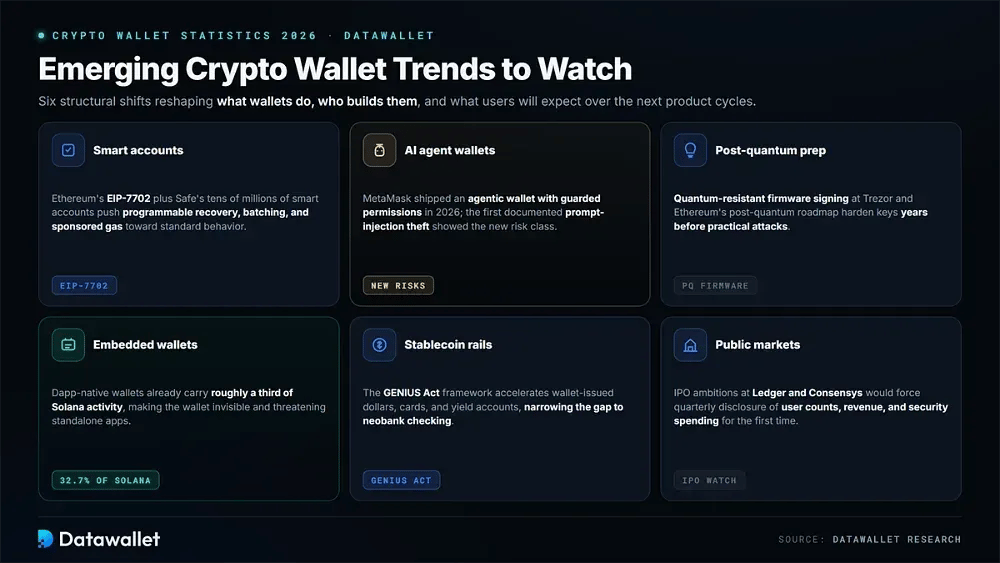
Several structural changes beyond the headline statistics are reshaping what wallets do, who builds them, and which features or pricing models users may come to expect over the next few product cycles.
Six developments most likely to define the next wallet generation:
- Smart accounts: Ethereum's EIP-7702 upgrade, together with Safe's tens of millions of deployed smart accounts, is moving programmable recovery, transaction batching, and sponsored gas toward standard wallet behavior.
- AI agent wallets: MetaMask launched an agentic wallet with guarded permissions in 2026. The first documented prompt-injection theft, however, showed that autonomous wallets introduce entirely new classes of risk.
- Post-quantum prep: Quantum-resistant firmware signing from Trezor and Ethereum's post-quantum roadmap show vendors strengthening key infrastructure years before practical quantum attacks actually materialize.
- Embedded wallets: Dapp-native wallets already account for roughly a third of Solana activity. By making the wallet effectively invisible inside consumer crypto experiences, they threaten standalone apps.
- Stablecoin rails: The GENIUS Act's federal stablecoin framework is accelerating wallet-issued dollars, cards, and yield accounts, narrowing the distinction between crypto wallets and neobank checking products.
- Public markets: IPO ambitions at Ledger and Consensys would impose quarterly disclosure obligations on wallet companies, creating unprecedented transparency into user counts, revenue, and security spending for the first time.
How Are Crypto Wallets Regulated?
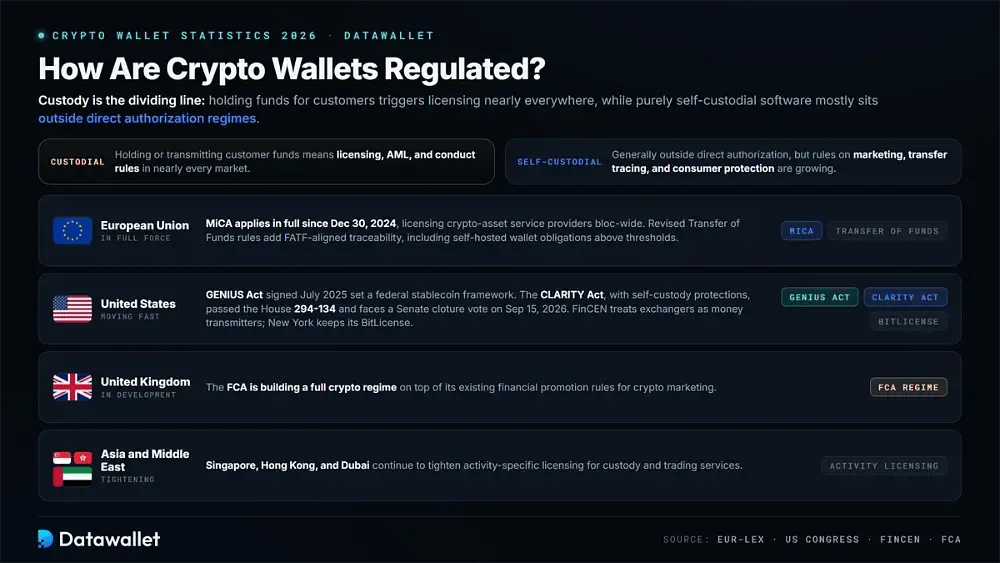
Custody remains the key dividing line in wallet regulation. Businesses that hold or transmit funds for customers face licensing, AML, and conduct requirements in nearly every market. Purely self-custodial software generally falls outside direct authorization regimes, although its providers increasingly encounter rules covering marketing, transfer tracing, and consumer protection.
In the European Union, MiCA has applied in full since December 30, 2024, requiring licensing for crypto-asset service providers across the bloc. Revised Transfer of Funds rules also impose FATF-aligned traceability requirements on crypto transfers, including obligations involving self-hosted wallets above certain thresholds.
The United States moved particularly quickly on stablecoins. Signed in July 2025, the GENIUS Act established a federal framework for payment stablecoin issuers. The broader CLARITY Act, which includes self-custody protections, passed the House 294-134 and faces a decisive Senate cloture vote on September 15, 2026.
FinCEN continues to classify exchangers and administrators of convertible virtual currency as money transmitters. New York still maintains its BitLicense, while the UK's FCA is developing a full crypto regime on top of its promotion rules. Singapore, Hong Kong, and Dubai are also continuing to tighten activity-specific licensing.
How to Choose a Crypto Wallet in 2026
Choose according to use case before brand. Active multichain traders tend toward Phantom, while EVM and DeFi power users lean toward MetaMask or Rabby. Long-term holders are more likely to use a Ledger or Trezor device. Rather than making a single choice, most experienced users pair a hot wallet with a hardware signer.
Security posture should then take priority over the length of the feature list. Audited code, hardware compatibility, scam-detection tooling, and a clean incident-response record matter more than any one integration. Our best crypto wallets and best Ethereum wallets guides rank the current field against these criteria and update as the market changes.
Final Thoughts
Crypto wallets are now the main consumer gateway to trading, payments, identity, and yield across every major chain.
The market is dividing along distinct lines. Hot wallets are becoming money apps built around perps, stablecoins, and debit cards. Hardware devices still anchor long-term self-custody, but the Coldcard exploit shows that even this layer requires close scrutiny.
The market is on a trajectory toward $100 billion, with IPOs and tokens approaching as regulation takes shape on both sides of the Atlantic. Wallets that combine usability with verifiable security will define the next cycle.
Our Methodology
This article evaluates the evolution of crypto wallets through 2026 using market research, protocol analytics, live category snapshots, company disclosures, incident reports, and regulatory sources.
How The Data Was Compiled:
- Market research: Grand View Research's June 2026 report provided the market sizing, regional shares, segment splits, and 2033 forecast.
- Protocol analytics: DefiLlama and Dune Analytics were used for Phantom revenue, perp volume, builder fees, Solana wallet share, and embedded-wallet activity.
- Category leaderboards: CoinGecko's live wallets category supplied the sector market cap, 24-hour volume, and individual token rankings.
- Platform materials: Product launches, stablecoin rollouts, card programs, and token plans were checked against official posts from MetaMask, Phantom, Ledger, and partner announcements.
- Security records: TRM Labs, Galaxy Research, vendor disclosures, and MetaMask's monthly security reports were reviewed to document breaches and loss trends.
- Regulatory research: The review covered MiCA texts, US congressional records for the GENIUS and CLARITY Acts, FinCEN guidance, and licensing updates from major markets.
- Snapshot caveat: Some figures come from live dashboards or category pages and therefore change as traders rotate, wallets release features, and prices move.