




What is USDS?
USDS, short for Sky Dollar, is the flagship US dollar-pegged stablecoin of Sky Protocol, the DeFi system formerly known as MakerDAO. It is designed as the upgraded successor to DAI, keeping the familiar $1 target while adding new Sky ecosystem integrations.
The token’s issuer ecosystem is Sky, which emerged from MakerDAO’s rebrand in August 2024. MakerDAO was best known for DAI, launched in 2017, and the MKR governance token. Under Sky, DAI became upgradeable to USDS, while MKR became upgradeable to SKY.
USDS went live on mainnet in September 2024 alongside the SKY governance token and the Sky.money app. The migration was structured as an optional upgrade: DAI holders could convert to USDS at a 1:1 rate, while MKR holders could convert to SKY at 1:24,000.
In practical terms, USDS is not a completely separate stablecoin brand with no history; it is the renamed, upgraded continuation of Maker’s stablecoin system. It supports Sky Savings Rate products, rewards, and non-custodial DeFi access through Sky.money, while legacy DAI continues to exist in the ecosystem.
How Does USDS Work?
USDS works as Sky Protocol’s upgraded dollar-pegged stablecoin, combining MakerDAO’s collateral-backed model with new conversion, savings, and rewards features. Users can hold USDS directly, upgrade from DAI, or deposit it into Sky-connected products.
1. Collateral and Dollar Peg
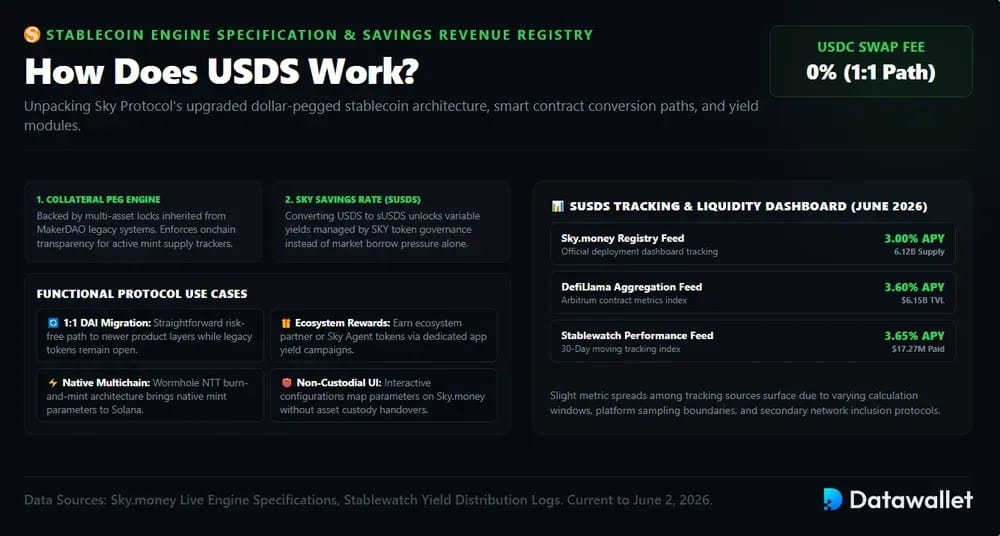
USDS is designed to track $1 by relying on Sky Protocol’s collateral system, liquidity management, and governance-controlled parameters inherited from MakerDAO’s stablecoin infrastructure.
Key mechanisms that support the USDS peg include:
- Collateral: USDS is backed by assets within the Sky/Maker collateral system, helping support redemption confidence and reduce dependence on a single issuer reserve model.
- Peg Target: The token aims to maintain a one-dollar value, making it useful for payments, trading, savings, and DeFi accounting across supported platforms.
- DAI Upgrade: DAI holders can upgrade to USDS at a 1:1 rate, connecting the new token directly to MakerDAO’s earlier stablecoin economy.
- Liquidity: USDS relies on exchange listings, DeFi pools, and protocol integrations to keep trading efficient and help market prices stay near the peg.
- Governance: SKY governance can adjust system parameters, including savings rates and incentives, to respond to changing demand, risk, and market conditions.
- Transparency: Because USDS operates through onchain infrastructure, users can track supply, integrations, and protocol activity more openly than with many custodial stablecoins.
2. Sky Savings Rate and sUSDS
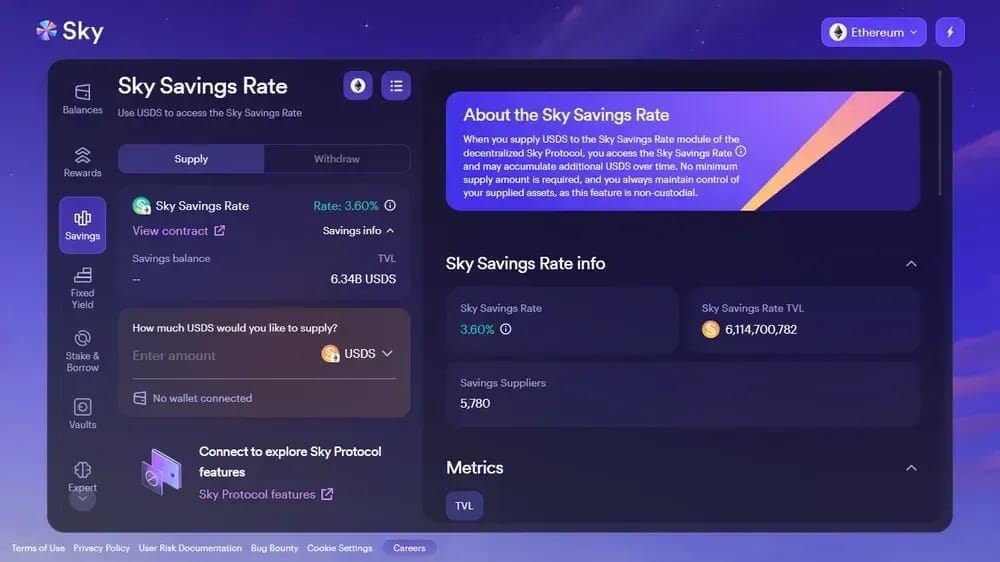
One of USDS’s main features is access to the Sky Savings Rate through sUSDS. When users supply USDS into the savings module, they receive sUSDS, a yield-bearing token that represents their deposited stablecoins plus accumulated value over time.
The Sky Savings Rate is variable and governed by SKY token holders, rather than being set by simple market utilization alone. USDS itself does not automatically earn yield just by sitting in a wallet; the yield experience comes from converting or depositing into sUSDS.
As of early June 2026, Sky.money listed the Sky Savings Rate at 3.00% APY, with total sUSDS supply around 6.12 billion. DefiLlama showed a nearby 3.60% APY and $6.15 billion TVL, while Stablewatch reported about 3.65% 30-day APY and $17.27 million paid out over 30 days.
3. Rewards, Upgrades, and Ecosystem Access
Beyond holding a dollar-pegged asset, USDS connects users to Sky.money, ecosystem rewards, upgraded governance participation, and future multichain access across supported Sky integrations.
USDS ecosystem functions are built around these core actions:
- Upgrade: Users can move from DAI to USDS at a 1:1 rate, making migration simple while keeping legacy DAI accessible.
- Save: USDS can be supplied into the Sky Savings Rate to receive sUSDS, allowing users to pursue variable stablecoin yield.
- Earn: Sky ecosystem rewards may be available through selected campaigns, though rates, availability, and value can change with market conditions.
- Govern: The wider Sky system uses SKY, the upgraded MKR token, to guide protocol decisions, parameters, and ecosystem direction.
- Access: Sky.money acts as a non-custodial interface, meaning users connect wallets and interact with protocol features without surrendering asset custody.
- Bridge: SkyLink is intended to expand USDS and related Sky assets across supported Layer-2 networks, improving access and transaction efficiency.
- Integrate: USDS can be used across exchanges, DeFi platforms, wallets, and savings products as adoption grows beyond the original MakerDAO ecosystem.
Top USDS Use Cases
USDS is used for stablecoin savings, DeFi yield, trading liquidity, DAI migration, payments, and multichain access. Its main advantage is that it connects a dollar-pegged asset to Sky Protocol’s savings, vault, rewards, and non-custodial wallet ecosystem.
The most practical USDS use cases include:
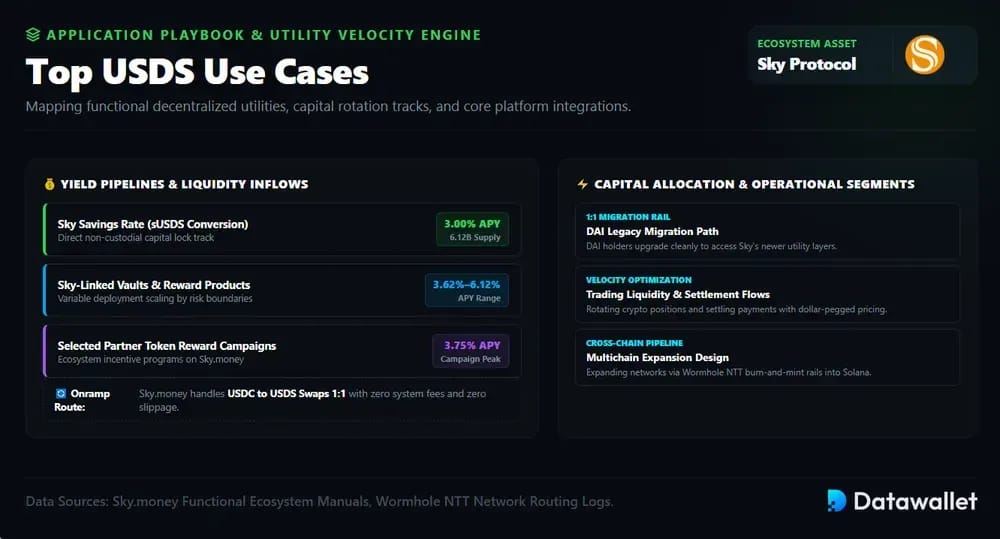
- Savings: USDS holders can convert into sUSDS to access the Sky Savings Rate, shown at 3.00% APY with 6.12B sUSDS supply on Sky.money.
- Yield: Users can deploy USDS into Sky-linked vaults, fixed-yield sUSDS, and rewards products, with listed opportunities around 3.62%-6.12% APY depending on product risk.
- Trading: USDS gives traders a dollar-pegged asset for rotating between crypto positions, settling onchain transactions, and managing volatility without leaving DeFi markets.
- Migration: DAI holders can upgrade into USDS at a 1:1 rate, gaining access to Sky’s newer savings, rewards, and ecosystem products while DAI remains available.
- Payments: USDS can support blockchain payments, remittances, treasury transfers, and settlement flows where users want dollar pricing with faster crypto-native movement.
- Rewards: Sky Ecosystem Rewards let users supply USDS to earn partner or Sky Agent tokens, with Sky.money showing 3.75% APY for selected reward campaigns.
- Multichain: USDS and sUSDS are expanding across chains through Wormhole NTT, bringing native transfer support to Solana using a burn-and-mint design.
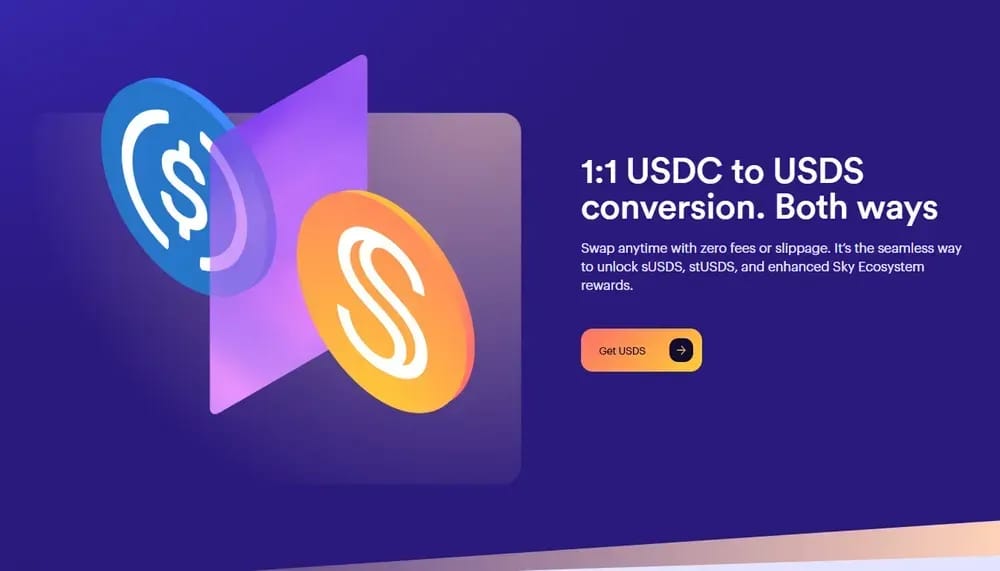
- Access: Sky.money lets users swap USDC to USDS 1:1 with zero fees or slippage, then access sUSDS, stUSDS, vaults, and rewards non-custodially.
Pros and Cons of Using USDS
USDS combines the benefits of a decentralized dollar stablecoin with Sky Protocol’s savings, rewards, and DeFi infrastructure, but users still face variable yield, smart-contract, liquidity, governance, and jurisdictional risks.
Here are the main USDS pros and cons:
Where to Buy USDS?
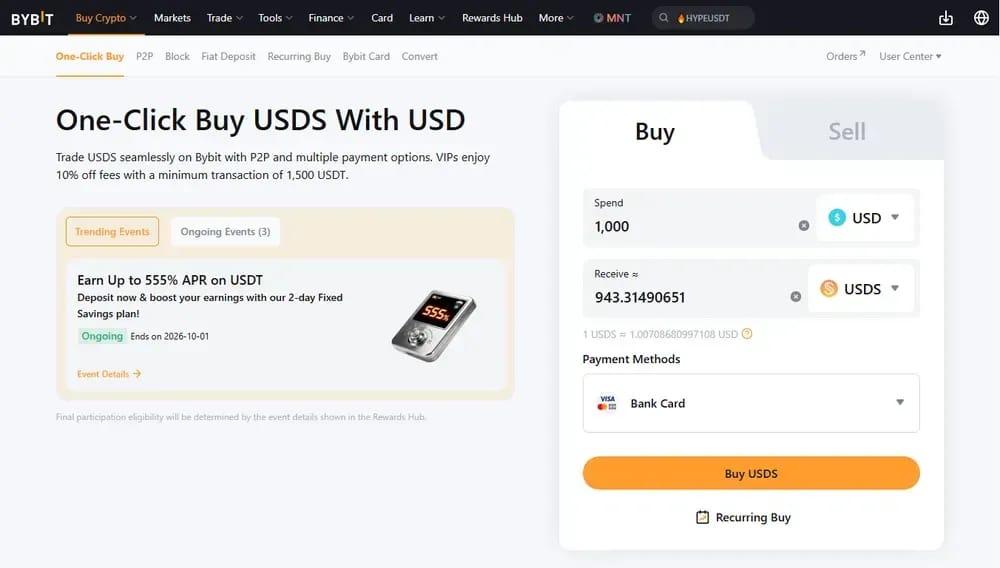
USDS can be bought with fiat on exchanges that support direct stablecoin purchases, with Bybit offering One-Click Buy routes for selected local currencies and USDS pairs.
Here is a simple fiat-to-USDS buying flow:
- Register: Create a Bybit account, confirm your email or phone number, enable two-factor authentication, and complete identity verification before using fiat payment services.
- Deposit: Go to Buy Crypto > Fiat Deposit, choose a supported currency such as USD, EUR, or GBP, then fund your Bybit balance by available payment method.
- Select: Open Bybit’s One-Click Buy page, choose USDS as the crypto asset, enter your fiat amount, and select a supported payment method.
- Confirm: Review the quoted exchange rate, fees, payment details, and final USDS amount, then confirm the order to receive USDS in your Bybit account.
- Trade: Keep USDS on Bybit for trading, stablecoin settlement, or supported USDS markets, including derivatives access where USDS pairs are available.
- Withdraw: Send USDS to a compatible cold wallet or DeFi wallet after checking the correct network, wallet address, withdrawal status, and fixed network fee.
- Use: After withdrawal, users can hold USDS, send payments, trade onchain, or connect to Sky.money to explore sUSDS yield and Sky ecosystem products.
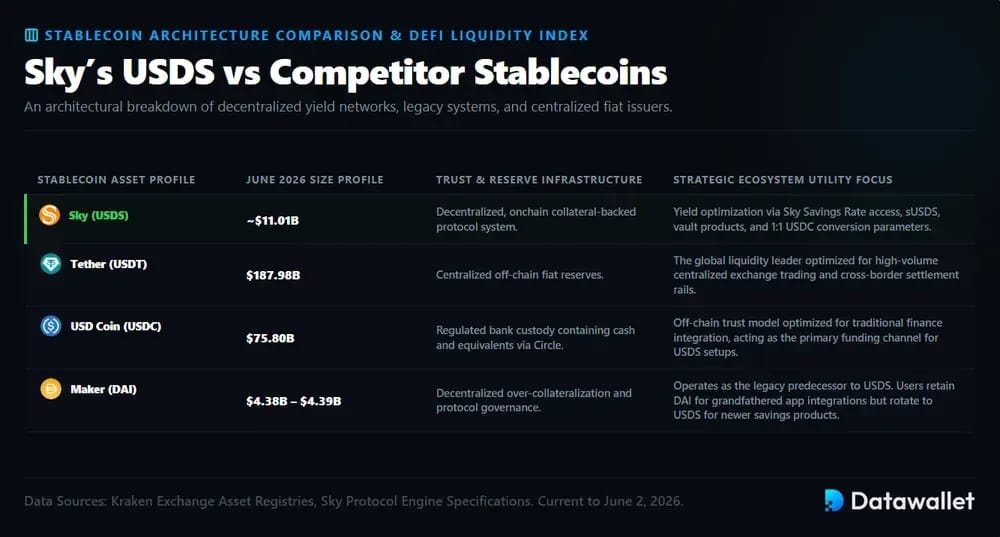
Sky’s USDS vs Competitor Stablecoins
USDS competes with fiat-backed giants like USDT and USDC, but its positioning is closer to DAI: a DeFi-native, onchain stablecoin tied to collateral, governance, and protocol revenue. By June 2026, Kraken listed USDS near $11.01B market cap, behind USDT’s $187.98B and USDC’s $75.80B.
Compared with USDT, USDS is much smaller but more integrated with DeFi yield. Tether remains the liquidity leader for exchange trading and global settlement, while USDS focuses on Sky Savings Rate access, sUSDS, vault products, and DAI migration. That makes USDS more yield-oriented, but less universally liquid.
When we look at USDS vs USDC, the biggest difference is the trust model. USDC is issued by Circle and backed by cash or cash-equivalent reserves, while USDS is connected to Sky Protocol’s decentralized stablecoin system, 1:1 USDC-to-USDS conversion, and non-custodial access to sUSDS.
Compared with DAI, USDS is best understood as its upgraded successor rather than a totally unrelated rival. DAI still exists and had about $4.38B-$4.39B market cap in June 2026, while USDS had surpassed $10B. Users choose DAI for legacy integrations and USDS for Sky’s newer savings products.
Is USDS Safe?
USDS is relatively established because it comes from Sky Protocol, formerly MakerDAO, one of DeFi’s longest-running stablecoin systems. Sky promotes sUSDS as fully liquid, zero-fee, verifiably backed, and connected to an S&P-rated DeFi savings product, but that does not remove risk.
The main safety tradeoff is that USDS is not a simple bank-issued stablecoin like USDC. It depends on collateral management, governance decisions, smart contracts, liquidity conditions, and protocol revenue. S&P assigned Sky Protocol a B- rating and highlighted depositor concentration, governance, and liquidity risks.
Risks of Using USDS
USDS can be useful, but users should understand the main risks before treating it as a risk-free digital dollar or guaranteed-yield asset.
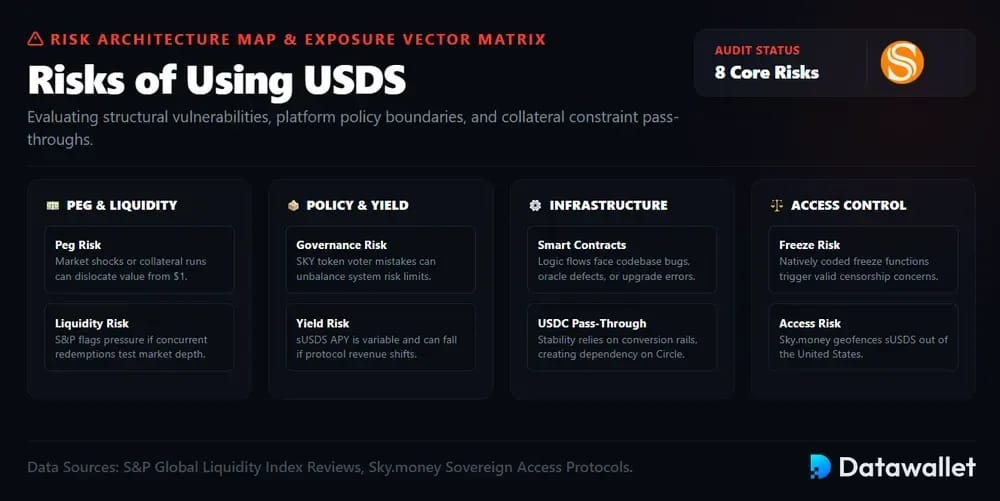
The biggest USDS risks include:
- Peg Risk: USDS targets $1, but stressed markets, collateral shocks, liquidity shortages, or redemption pressure could push the token away from its intended dollar value.
- Liquidity Risk: S&P flagged liquidity pressure if many USDS or DAI holders exit simultaneously, especially when redemption routes depend on available market depth.
- Governance Risk: SKY token holders influence rates, collateral policy, rewards, and system parameters, so poor governance decisions could affect USDS stability or user returns.
- Smart Contracts: USDS, sUSDS, vaults, and integrations rely on smart contracts, meaning audits reduce but cannot eliminate bugs, exploits, oracle failures, or upgrade mistakes.
- Yield Risk: sUSDS APY is variable, governance-set, and paid from protocol revenue, so today’s displayed rate can fall when revenue or policy changes.
- USDC Exposure: Some USDS stability mechanisms may depend on USDC conversion routes, creating pass-through risk if USDC liquidity, reserves, or market confidence weaken.
- Freeze Risk: Unlike legacy DAI, USDS reportedly includes freeze functionality, which may help with compliance or theft response but introduces censorship concerns.
- Access Risk: Sky.money notes sUSDS is currently unavailable in the US, meaning availability can depend on jurisdiction, interface restrictions, and changing compliance rules.
The Future of USDS
USDS’s future is centered on scale and reserve strength. In April 2026, Sky Frontier Foundation said USDS supply hit an all-time high of $11.82 billion on April 5, while governance redirected surplus toward a $150 million Sky Reserves target instead of near-term distributions for resilience.
Product development is also moving toward broader stablecoin yield access. Sky.money’s May 2026 interface highlights 1:1 USDC-to-USDS conversion with zero fees or slippage, sUSDS, stUSDS, fixed-yield sUSDS, Sky Vaults, and ecosystem rewards, showing a roadmap focused on turning idle stablecoins into active DeFi capital markets.
The longer-term roadmap points to institutional and real-world asset expansion. Sky’s 2026 outlook projected USDS supply reaching $20.6 billion, with $611.5 million in gross protocol revenue, while Rune Christensen described Sky Agents, tokenized credit, and AI-driven automation as major growth themes.
Final Thoughts
USDS is best understood as Sky Protocol’s upgraded stablecoin for users who want dollar exposure plus DeFi-native savings access. Its value proposition is strongest when paired with sUSDS, Sky Savings Rate products, vaults, or ecosystem rewards.
At the same time, USDS is not risk-free. S&P assigned Sky Protocol a B- rating and highlighted liquidity, governance, and depositor concentration risks, so users should evaluate peg stability, jurisdictional access, and smart-contract exposure carefully.
Overall, USDS is a serious stablecoin contender, especially for DeFi users seeking yield-bearing dollar assets. With sUSDS supply above 6 billion on Sky.money, its future depends on adoption, risk management, and continued confidence in Sky governance.