







What is STRC?
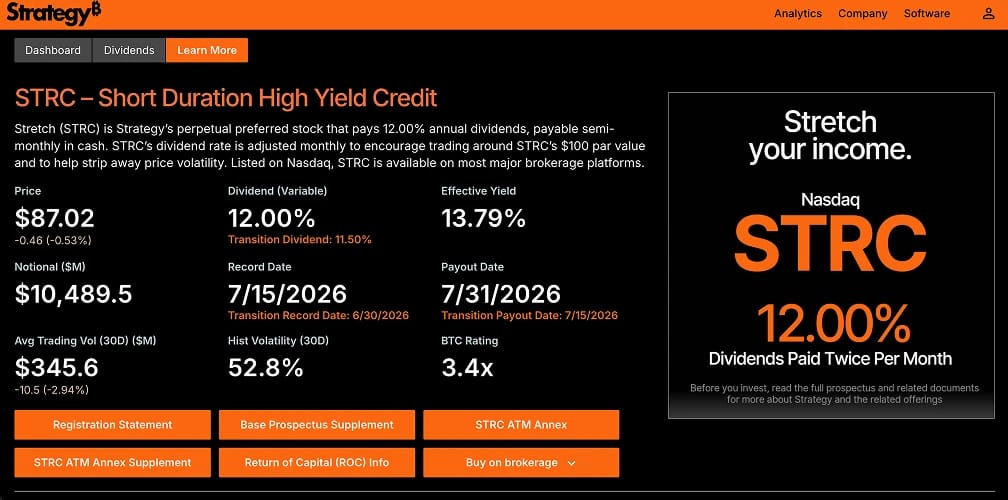
STRC is the Variable Rate Series A Perpetual Stretch Preferred Stock issued by Strategy, the enterprise software firm that transformed itself into the world's largest corporate holder of Bitcoin. A preferred stock is a class of shares that pays dividends ahead of common stock and ranks above it if the company is wound down, though it carries no voting rights.
Strategy priced the initial public offering in July 2025 at $90 per share, selling just over 28 million shares and raising roughly $2.47 billion in net proceeds. Each share carries a $100 stated amount, the reference value on which dividends accrue, and the company's stated goal is for STRC to trade in a range of approximately $99 to $100.
The security exists to fund Bitcoin accumulation. Strategy sells STRC shares to income investors, uses the cash to buy more Bitcoin for its treasury, and pays holders a high monthly cash yield in return. The company held 843,775 BTC as of early July, a position you can monitor on our Bitcoin treasury tracker.
Strategy markets STRC as part of its "Digital Credit" family alongside four sibling preferred stocks. It is the largest and most actively traded of the group. More than $10 billion in shares are outstanding, and daily volume regularly exceeds $300 million.
How Does STRC Work?
STRC combines a company-set dividend, a price target, and a share issuance program into one self-reinforcing system.
1. The Variable Dividend and $100 Par Target
STRC pays a cumulative cash dividend at a rate Strategy reviews every month. Cumulative means unpaid dividends accrue and must be settled before common shareholders receive anything, which gives holders a legal protection even though the board must still declare each payment.
The rate is the steering wheel. When STRC trades below $100, a higher dividend makes the shares more attractive and pulls the price back up. When it trades above $100, a lower rate cools demand. Strategy launched the rate at 9% and has lifted it repeatedly, reaching 12% for record dates from July onwards.
Rate cuts face contractual limits. Under the terms filed with the SEC, Strategy cannot reduce the rate by more than 25 basis points per month plus an adjustment tied to SOFR, the overnight benchmark interest rate, and it cannot cut the rate at all while any past dividends remain unpaid. Increases carry no such cap.

2. The Issuance Loop That Funds Bitcoin Buying
When STRC trades at or above par, Strategy sells new shares directly into the market through an at-the-market (ATM) program, a mechanism that lets a listed company issue stock gradually at prevailing prices. The proceeds go straight into Bitcoin purchases, so a strong STRC price accelerates treasury growth.
The loop only spins in one direction. Once STRC falls below $100, issuing new shares means raising less than each share's stated value, so Strategy pauses the ATM program and loses one of its main funding channels. That is why traders watch the STRC price as a health gauge for Strategy's Bitcoin accumulation model.

3. Seniority, Perpetuity and What Backs the Dividend
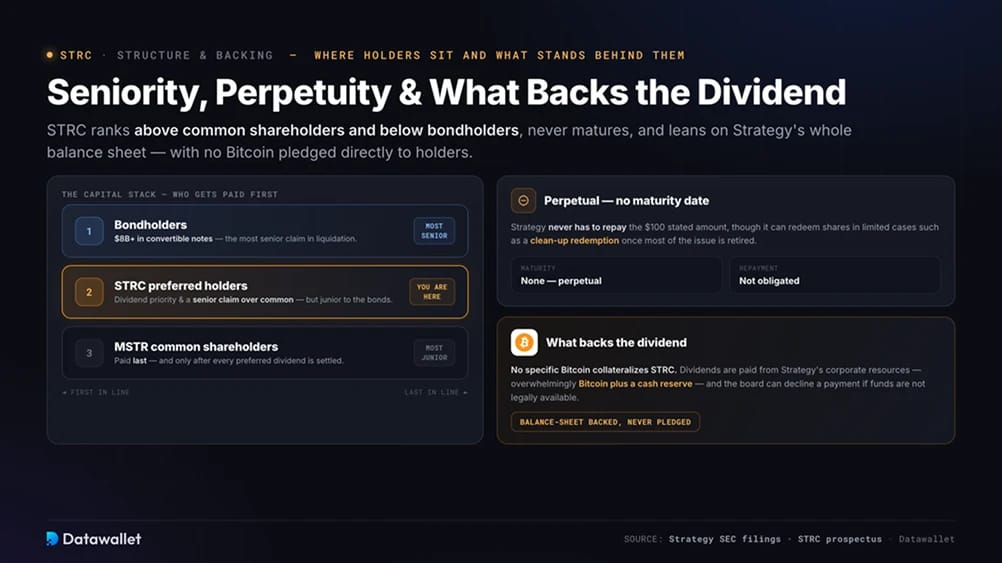
STRC has no maturity date, so Strategy never has to repay the $100 stated amount, though it can redeem the shares in limited circumstances such as a clean-up redemption once most of the issue has been retired. Holders rank above MSTR common shareholders and below the company's bondholders in any liquidation.
No specific Bitcoin collateralizes STRC. Dividends are paid from Strategy's corporate resources, overwhelmingly Bitcoin plus a cash reserve, and the board can decline to declare a payment if funds are not legally available. The Bitcoin backing is philosophical and balance-sheet based, never a pledged asset.
4. The USD Reserve and BTC Monetization Program
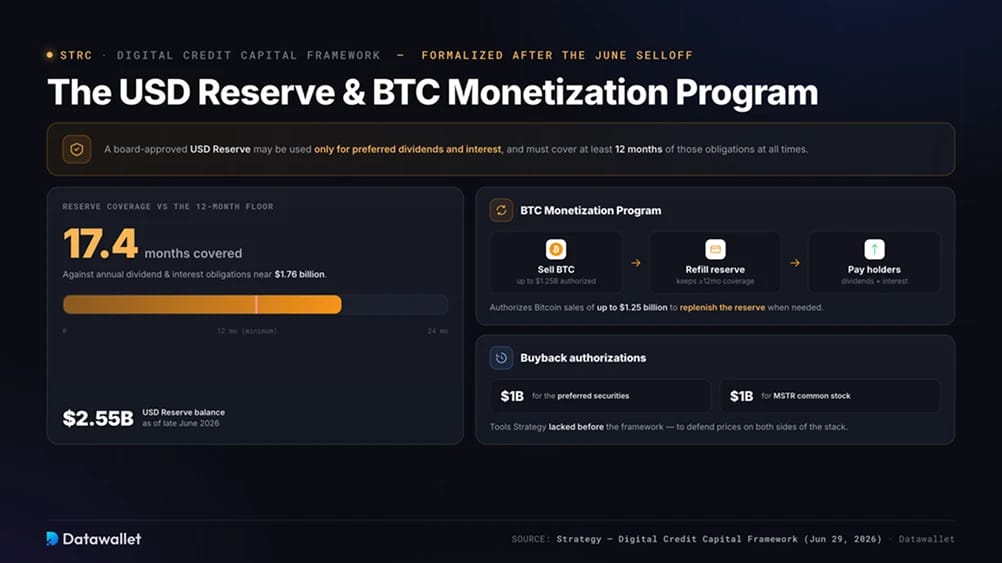
After the June selloff, Strategy formalized how it funds payouts through a Digital Credit Capital Framework. A board-approved USD Reserve, holding $2.55 billion as of late June, may be used only for preferred dividends and interest, and must cover at least 12 months of those obligations at all times.
The framework also created a BTC Monetization Program that authorizes Bitcoin sales of up to $1.25 billion to replenish the reserve, alongside $1 billion buyback authorizations for both the preferred securities and MSTR common stock. With annual dividend and interest obligations near $1.76 billion, the current reserve covers roughly 17.4 months.
STRC Dividend Yield History
STRC's dividend rate has moved in only one direction since launch. Strategy raised it every month from the 9% starting level through March, held it at 11.50% for four consecutive months, then lifted it to 12% during the June selloff when the effective yield for new buyers had climbed toward 15%.
The monthly rate progression since launch runs as follows:
- August to September 2025: The rate opened at 9.00% for the first dividend period, then jumped a full percentage point to 10.00% in the second month.
- October to December 2025: Three quarter-point raises took the rate through 10.25% and 10.50% to 10.75% by year end, as Strategy kept nudging the price toward par.
- January to March 2026: Further monthly increases of 25 basis points lifted the rate to 11.00%, 11.25%, and then 11.50%.
- April to June 2026: Strategy held the rate at 11.50% even as the share price broke down, drawing criticism that the reset lagged what the market demanded.
- July 2026: The rate rose to 12.00% for record dates on or after July 1, equal to $12 per share annually, the highest level in the instrument's history.
The stated rate and the yield you earn are two different numbers. A buyer at $100 earns the stated 12%, while a buyer at $85 earns an effective yield above 14% on the same dividend, since the payout is fixed against the $100 stated amount. Wide gaps between the two signal that investors are pricing in more risk.

STRC Ex-Dividend Date
The ex-dividend date is the cutoff for payment eligibility. Anyone holding STRC at the close before the ex-date receives the next dividend, while buyers on or after it do not, and the share price mechanically drops by roughly the payment amount that morning.
Through June, STRC paid on a monthly cycle. The record date fell on or around the 15th of each month and payment landed on the last calendar day. Shareholders approved a switch to semi-monthly dividends on June 8, so record dates now land on the 15th and the final day of each month, and cash is paid about two weeks after each one.
The first semi-monthly payment of $0.48 per share went to holders of record on June 30 and was paid on July 15. Strategy has also stated that it expects STRC dividends to be treated as non-taxable returns of capital for most US holders, meaning payments reduce a holder's cost basis instead of counting as ordinary income immediately.
STRC vs MSTR
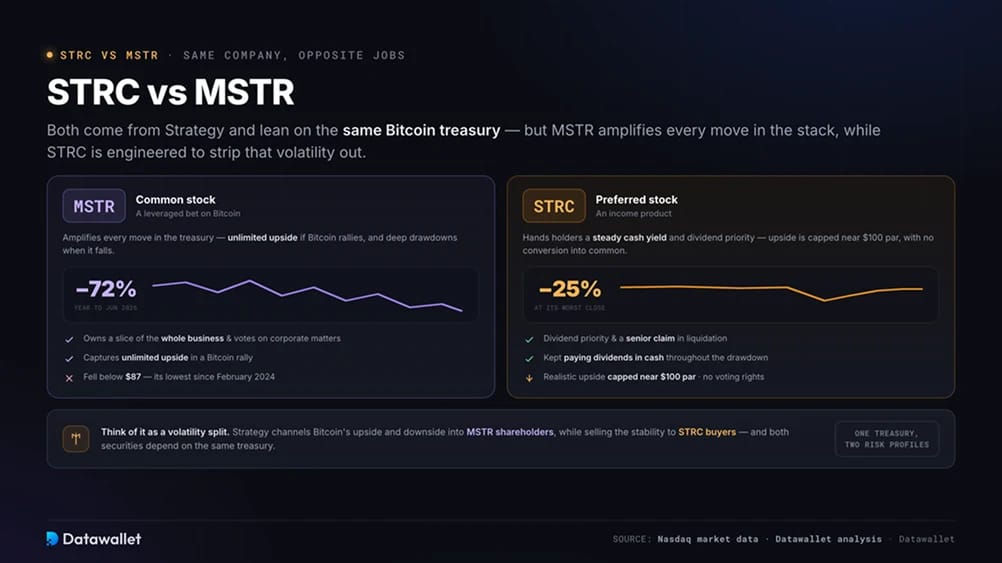
STRC and MSTR come from the same company but serve opposite purposes. MSTR is Strategy's common stock, a leveraged bet on Bitcoin's price that amplifies every move in the treasury, while STRC is an income product designed to strip that volatility out and hand holders a steady cash yield.
The trade-off shows up in performance. MSTR fell around 72% in the year to June 2026 and dropped below $87, its lowest level since February 2024, as its market premium over the value of its Bitcoin evaporated. STRC, even at its worst close near $74, lost about a quarter of its value and continued paying dividends in cash throughout.
Ownership rights differ too. MSTR holders own a slice of the whole business, vote on corporate matters, and capture unlimited upside if Bitcoin rallies. STRC holders receive dividend priority and a senior claim in liquidation, but their realistic upside is capped near the $100 par value, and they hold no conversion right into common shares.
We view the pairing as a volatility split. Strategy channels Bitcoin's upside and downside into MSTR shareholders while selling the stability to STRC buyers, and both securities depend on the same treasury. Investors wanting simple spot exposure without either wrapper can compare products on our Bitcoin ETF tracker.
STRC vs SATA
SATA is the closest direct competitor, a variable rate perpetual preferred stock issued by Strive (Nasdaq: ASST), the Bitcoin treasury firm co-founded by Vivek Ramaswamy. Both securities target a $100 par value, pay cumulative cash dividends adjusted to defend that level, and lean on a corporate Bitcoin treasury for credibility.
The differences sit in scale and payout design. Strategy holds over 60 times more Bitcoin than Strive's roughly 13,300 BTC and runs a legacy software business, while Strive carries no debt and raised SATA's rate to 12.25% in December 2025 on its way to about 13%. SATA also began paying dividends every trading day in June, the first listed US security to do so.
During the June turbulence, investors rotated toward SATA, which held near par while STRC broke down, helped by its higher yield and daily payments. Strive itself bought around $50 million of STRC for its own treasury in early 2026, a sign that even the rival issuer treats Stretch as a quality reserve asset.
STRC vs STRF, STRK, STRD and STRE
STRC is one of five preferred securities in Strategy's Digital Credit lineup, and each occupies a different rung on the risk ladder. Where Stretch sits explains both its yield and its behavior during stress.
Strategy's preferred family breaks down as follows:
- STRF (Strife): The senior-most preferred, paying a fixed 10% cumulative dividend quarterly, aimed at investors who want the strongest claim in the structure.
- STRK (Strike): An 8% convertible preferred that can be exchanged for MSTR common stock, blending income with equity upside if the shares rally hard.
- STRC (Stretch): The variable rate, par-targeting instrument covered here, built for stability and the highest liquidity of the group.
- STRD (Stride): A 10% non-cumulative preferred that ranks lowest among the four Nasdaq listings, so missed dividends never accrue, and it trades at the widest effective yield.
- STRE (Stream): A euro-denominated 10% perpetual preferred listed on the Luxembourg Stock Exchange, created to reach European income investors.
The Bitcoin sale in July 2026 funded quarterly dividends on STRF, STRE, STRK, and STRD along with the monthly STRC payment, a reminder that all five draw from the same corporate purse. STRC is unique in resetting its rate monthly, which makes it the most sensitive barometer of market confidence in Strategy.
The STRC Crash and Strategy's Bitcoin Sales
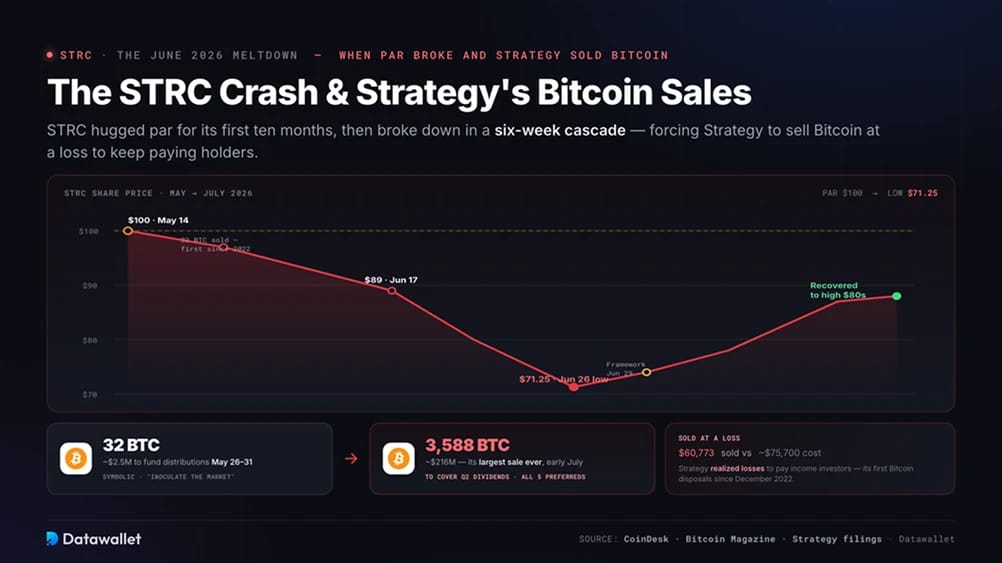
STRC spent most of its first ten months hugging par, then broke down in a six-week cascade. On May 14, the shares closed at $100 into the ex-dividend date, but Bitcoin was already sliding well below its October record, and Strive chose the same day to announce daily SATA dividends, which sharpened the competitive pressure.
The first crack in confidence came from a symbolic sale. Between May 26 and May 31, Strategy sold 32 BTC for about $2.5 million to fund STRC distributions, its first Bitcoin disposal since December 2022. Michael Saylor had telegraphed the move on the Q1 earnings call, saying the company would sell some Bitcoin "to inoculate the market," yet the disclosure still rattled holders who had priced in a never-sell doctrine.
Selling accelerated through June as Bitcoin fell below $60,000. STRC closed at a then-record $89 on June 17, slid further after a $1.5 billion convertible note buyback drained part of the cash reserve, and hit an intraday low of $71.25 on June 26. Analysts attributed much of the final leg to forced selling, as leveraged holders who had bought a "stable" security on margin were liquidated in sequence. Rosen Law Firm opened an investor investigation the same week.
Strategy answered with the Digital Credit Capital Framework on June 29, then followed through days later by selling 3,588 BTC for roughly $216 million, the largest Bitcoin disposal in its history, to cover second-quarter dividends across all five preferreds. Part of that sale executed near $60,773 per coin, below the company's roughly $75,700 average cost, meaning Strategy realized losses to pay income investors.
The response has partially worked. STRC recovered into the high $80s within a week, and Standard Chartered's research team argued the security is heavily overcollateralized and framed the episode as a communication failure that should resolve toward par. The crash still stands as a defining stress test for Bitcoin-backed credit, and we cover comparable episodes in our guide to historic crypto crashes.
STRC Risks and Safety
STRC is safer than Strategy's common stock by design, with cumulative dividends, seniority over MSTR, a dedicated cash reserve, and a treasury whose market value still exceeds the preferred obligations many times over. None of that makes it a savings product, and the June drawdown proved the $100 target is an objective the company can miss.
The risks we weigh most heavily include:
- Bitcoin dependence: Strategy's ability to pay dividends rests almost entirely on its Bitcoin holdings, so a prolonged bear market erodes the asset base standing behind every payout.
- Discretionary dividends: The board must declare each payment from legally available funds, and while unpaid amounts accrue, holders cannot force a distribution on schedule.
- No collateral: No Bitcoin is pledged to STRC holders, who own only a claim on residual corporate assets behind more than $8 billion of convertible debt.
- Price instability: The par-targeting mechanism failed for weeks in June 2026, and buyers using leverage against an assumed $95 floor were liquidated in cascades.
- Issuance dependence: Strategy's model relies on continuous access to capital markets, and a sustained discount to par shuts the ATM program that funds both Bitcoin buying and reserve top-ups.
- Rising payout burden: Every rate increase adds to a dividend bill already near $1.76 billion annually across preferreds and interest, tightening future coverage.
- Legal and regulatory scrutiny: An open law firm investigation adds headline risk that can move the price independently of Bitcoin.
- No deposit protections: STRC is not FDIC insured and carries none of the safeguards attached to bank accounts, money market funds, or Treasuries.
How to Buy STRC
STRC trades on Nasdaq like an ordinary share, so buying it needs a brokerage account rather than a crypto wallet. The one detail that trips people up is timing, since the record date decides whether your first dividend arrives in two weeks or six.
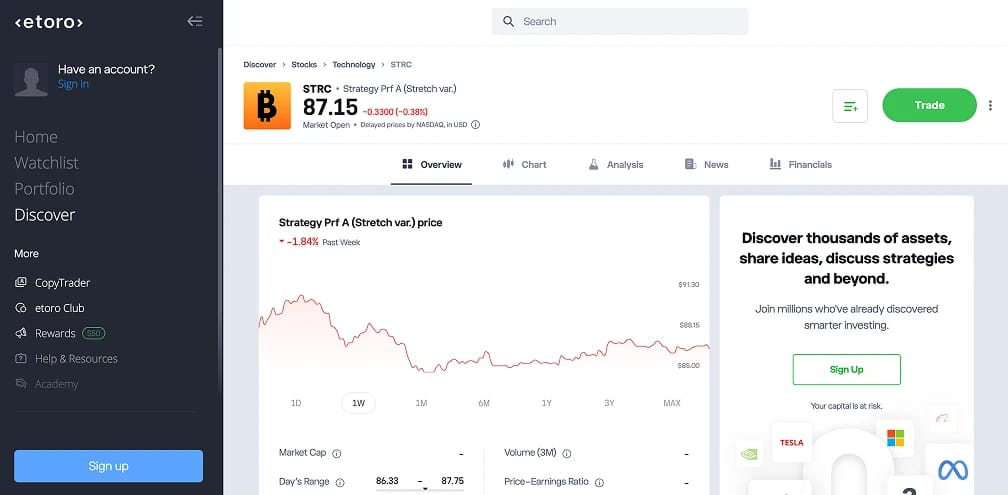
We use eToro for this trade, as it listed STRC alongside Strategy's other preferred shares in June and lets you buy fractional amounts. eToro does not offer these preferred shares to US clients, who should use a domestic broker such as Fidelity, Schwab, or Interactive Brokers.
Buying STRC takes these steps:
- Open an account: Register with eToro, complete identity verification, and confirm that preferred shares are available in your country before depositing.
- Fund the balance: Deposit by bank transfer, card, or e-wallet, keeping in mind that STRC is priced and paid in US dollars.
- Search the ticker: Look up STRC, listed as Strategy Prf A (Stretch var.), and check you have not landed on MSTR common stock by mistake.
- Check the price against par: Compare the quote to the $100 stated amount, since buying at a discount raises the yield you earn on the same fixed dividend.
- Time the record date: Buy before the 15th or the final day of the month to qualify for the next semi-monthly payment.
- Place the order: Use a limit order instead of a market order, because preferred shares trade thinner than common stock and spreads can widen quickly.
- Track the rate resets: Watch Strategy's monthly announcements, as each change to the dividend rate signals how hard the company is working to defend the $100 target.
Final Thoughts
STRC is one of the most inventive securities to emerge from the Bitcoin treasury era, converting a volatile asset pile into a high cash yield through nothing more exotic than a monthly rate dial and a disciplined issuance program.
The June 2026 crash revealed both the model's fragility and its resilience. The price target broke, Strategy sold Bitcoin at a loss to keep paying holders, and yet every dividend arrived in cash and the company emerged with a codified reserve policy and buyback tools it lacked before.
We think the honest framing is that STRC holders are underwriting Strategy's balance sheet, and being paid 12% to do it. Anyone buying should understand the discretionary nature of the dividend, size the position for a repeat of the drawdown, and treat the yield as compensation for real credit risk tied to Michael Saylor's Bitcoin conviction.
.webp)