




USDS and USDC both target dollar stability, but they serve different user needs. USDS suits DeFi users seeking Sky-native savings and onchain strategies, while USDC suits users prioritizing liquidity, payments, and broader app support.
Choosing between them depends on whether yield or usability matters more. USDS can offer stronger DeFi upside, while USDC remains the safer default for trading, transfers, institutional access, and everyday stablecoin activity.
Read on for the full USDS vs USDC breakdown. 👇
USDS vs USDC Overview
USDS and USDC are both dollar-pegged stablecoins, but they serve different users: USDS focuses on DeFi-native savings and protocol yield, while USDC prioritizes regulated issuance, broad liquidity, and transparent fiat reserves.
The table below gives a quick snapshot of how USDS and USDC compare side by side:
What is USDS?
USDS is the upgraded stablecoin of Sky Protocol, the rebranded MakerDAO ecosystem. Introduced in 2024, it was designed as the successor to DAI, giving users a dollar-pegged asset that connects more directly with Sky’s newer savings, rewards, and governance features.
USDS works within Sky’s decentralized stablecoin system, rather than relying only on a traditional issuer model. Users can upgrade DAI into USDS at a fixed 1:1 rate, while both assets continue to circulate. This makes USDS more of an ecosystem migration than a simple replacement.
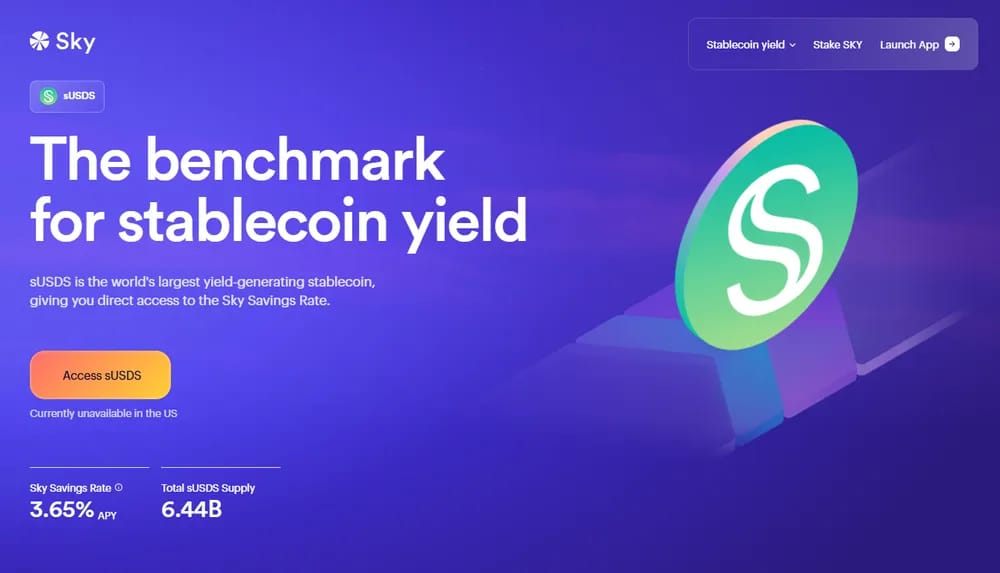
The biggest draw is yield access through sUSDS, the savings version of USDS. Sky.money lists sUSDS yield through the Sky Savings Rate, with the rate governed by Sky Protocol and not guaranteed by Sky.money. That makes USDS attractive, but more DeFi-dependent.

What is USDC?
USDC is a dollar-backed stablecoin issued by Circle. It launched in 2018 and was built to represent digital dollars on public blockchains. Each token aims to stay worth one US dollar, making USDC popular for trading, payments, transfers, and onchain liquidity.
USDC’s main selling point is reserve transparency. Circle says USDC is fully backed by highly liquid cash and cash-equivalent assets, and it publishes monthly reserve attestations from a Big Four accounting firm. This gives users clearer insight into the assets supporting the token.
Unlike USDS, USDC does not offer native yield just for holding the token. Users usually earn returns by lending, supplying, or depositing USDC through exchanges, DeFi apps, or fintech platforms. That can improve returns, but it also adds third-party, smart contract, or platform risk.

USDS vs USDC Features
USDS and USDC overlap as dollar stablecoins, but their feature sets are built for different jobs. USDS leans into DeFi savings, rewards, and governance-driven utility, while USDC emphasizes payments, integrations, and institutional-grade transfer rails.
USDS Features
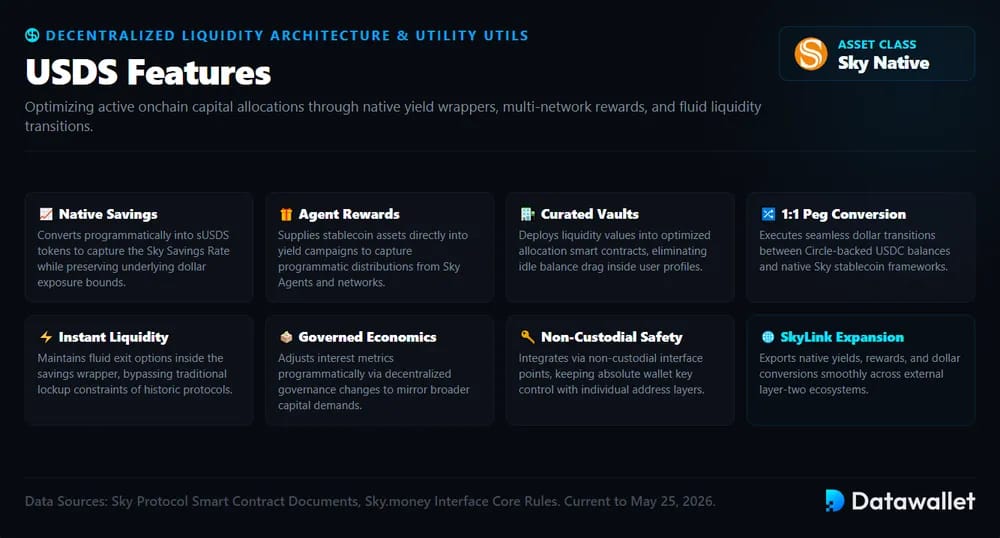
USDS is designed around active onchain capital, not just passive dollar storage. Its strongest features support yield access, ecosystem rewards, and flexible movement between Sky products, while keeping users connected to non-custodial DeFi infrastructure.
Key USDS features include the following:
- Savings: USDS can move into sUSDS, allowing holders to access the Sky Savings Rate while keeping exposure denominated in the same dollar-pegged ecosystem.
- Rewards: Sky supports ecosystem reward programs where eligible users can supply USDS and earn additional token incentives from Sky Agents and partner networks.
- Vaults: Users can deploy USDS into curated vault strategies, giving the stablecoin broader utility beyond simple transfers or idle wallet balances.
- Conversion: Sky.money supports 1:1 USDC-to-USDS conversion routes, helping users move between Circle liquidity and Sky’s DeFi-native stablecoin products.
- Liquidity: sUSDS is presented with instant liquidity, making the savings wrapper more flexible than traditional lockup-based stablecoin yield structures.
- Governance: USDS yield settings are tied to Sky Protocol governance, so rates can adjust as protocol economics, market demand, and risk preferences change.
- Access: Sky.money acts as a non-custodial interface, meaning users interact with protocol features while retaining control of assets through their own wallets.
- Expansion: SkyLink is intended to bring native USDS, savings, rewards, and conversion features across additional chains and Layer 2 networks.
USDC Features
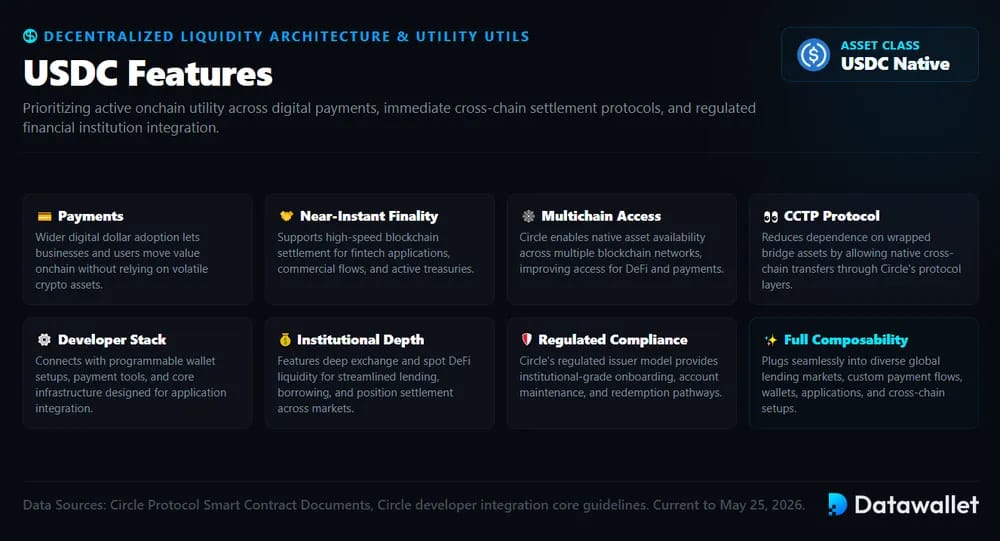
USDC focuses less on built-in yield and more on utility across payments, transfers, trading platforms, and developer workflows. Its feature set is strongest for users who need reliable settlement, broad network support, and infrastructure from a regulated issuer.
Key USDC features include the following:
- Payments: USDC is widely used for digital dollar payments, helping businesses and users move value onchain without relying on volatile crypto assets.
- Settlement: The token supports near-instant blockchain settlement, making it useful for exchanges, fintech apps, treasuries, and cross-border commercial flows.
- Multichain: Circle makes USDC available across multiple blockchain networks, improving access for wallets, exchanges, DeFi apps, and payment platforms.
- CCTP: Circle’s Cross-Chain Transfer Protocol enables native USDC transfers between supported chains, reducing dependence on wrapped bridge assets.
- Developers: USDC connects with Circle’s developer stack, including wallets, payment tools, and infrastructure designed for application-level stablecoin integration.
- Liquidity: USDC has deep exchange and DeFi liquidity, making it easier to trade, lend, borrow, or settle positions across major crypto markets.
- Compliance: Circle’s regulated issuer model gives institutions clearer onboarding, account, and redemption pathways than many decentralized stablecoin alternatives.
- Composability: Because USDC is widely integrated, developers can plug it into lending markets, payment flows, wallets, apps, and cross-chain systems.
USDS vs USDC Safety
Safety depends on what risk you care about most: smart contract and governance risk for USDS, or issuer, banking, and reserve-management risk for USDC. Both provide transparency, but they prove safety differently, through onchain collateral data, audits, reserve disclosures, and third-party assurance reports.
USDS safety comes from Sky Protocol’s collateral system, onchain visibility, and reviewed smart contracts, rather than a single corporate reserve account. ChainSecurity audited Sky token-conversion contracts, S&P cited audits and security history, and Immunefi lists Sky bug-bounty materials, though governance and DeFi risks remain.
USDC safety is more traditional and reserve-focused. Circle says USDC is fully backed by highly liquid cash and cash-equivalent assets, publishes weekly reserve and mint/burn data, and receives monthly Big Four assurance. Circle also reported $76.9 billion USDC in circulation and $77.1 billion reserves on May 21, 2026.
The takeaway: USDC looks safer for users who prioritize regulated reserves and redemption clarity, while USDS is safer only for users comfortable reading DeFi, governance, and smart contract risk. That difference becomes even clearer when comparing yields.
USDS vs USDC Yields
Yields are where USDS and USDC diverge most: USDS has native savings routes, while USDC depends more on external DeFi pools, lending markets, and exchange earn products with variable terms.
USDS Yields
USDS yield is strongest when users want direct exposure to Sky-linked savings, lending vaults, and protocol incentives rather than chasing higher, less predictable exchange promotions.
Notable USDS yield opportunities include these pools:
- fx Pool: FXUSDSTABILITYPOOLV2.0 on fx Protocol shows $51.1 million TVL and 6.88% APY, offering the highest listed USDS yield in this dataset.
- Jupiter Lend: USDS on Jupiter Lend shows $11.9 million TVL and 5.10% APY, giving Solana users a non-Ethereum route for stablecoin lending yield.
- Morpho Vault: SKYMONEYUSDSFLAGSHIP on Morpho Blue holds $53.58 million TVL and 4.38% APY, blending Sky exposure with Morpho’s vault-based lending infrastructure.
- Spark Farm: USDS in SparkLend’s SPK Farming Pool shows $836.03 million TVL and 3.77% APY, with yield tied to Spark Savings mechanics.
- Sky Ethereum: sUSDS on Sky Lending Ethereum shows $6.204 billion TVL and 3.65% APY, making it the deepest and most liquid USDS savings route.
- Sky Arbitrum: sUSDS on Sky Lending Arbitrum shows $358.79 million TVL and 3.65% APY, offering similar savings exposure with cheaper Layer 2 transactions.
USDC Yields
USDC yields are more fragmented because Circle does not pay native holder yield; returns usually come from DeFi lending vaults, structured pools, or exchange earn products.
Notable USDC yield opportunities include these pools:
- Superform: SUPERUSDC on SuperVault shows $14.24 million TVL and 8.65% APY, combining base yield and rewards for Ethereum-based USDC depositors.
- Morpho Delta: ALPHAUSDCDELTAV2 on Morpho Blue shows $30.69 million TVL and 9.02% APY, making it the strongest listed USDC DeFi pool here.
- Morpho Core: ALPHAUSDCCOREV2 on Morpho Blue shows $11.44 million TVL and 6.94% APY, offering a lower-yielding but still competitive Ethereum USDC lending route.
- Monad Pool: AUGUSTUSDCV2 on Morpho Blue shows $12.38 million TVL and 7.06% APY, adding newer-chain exposure alongside USDC lending yield.
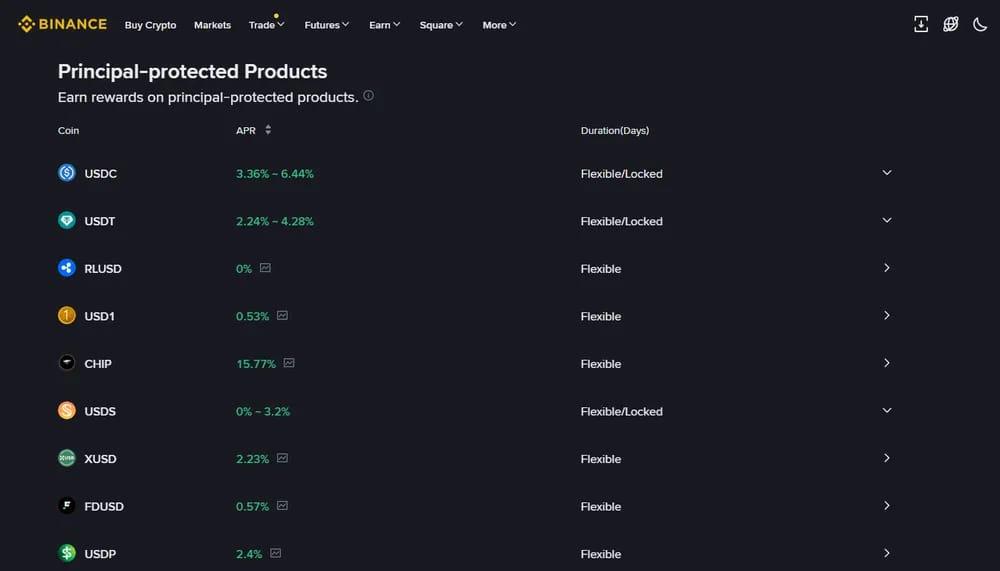
- Binance Earn: Binance Simple Earn lists USDC options around 6.44% and 3.36%, but APRs are estimates and can adjust daily by product.
- Bybit Earn: Current market trackers list Bybit USDC earn rates from about 3.55% APR, while Bybit notes Easy Earn can include flexible and fixed products with changing availability.
USDS vs USDC Regulation
USDC has a clearer regulatory profile because Circle operates through licensed entities, including US money-transmission and stored-value frameworks. Circle also says USDC is issued in the EU under MiCA through Circle Mint Europe, giving it stronger compliance positioning for institutions.
USDS is regulated more indirectly because it is issued through Sky Protocol, a decentralized, non-custodial system rather than a traditional company-led stablecoin issuer. That makes it more dependent on protocol governance, jurisdiction-specific access rules, collateral design, and DeFi risk disclosures than formal issuer licensing.
For most users, the regulation gap is simple: USDC fits better where legal clarity, fiat redemption, and institutional onboarding matter, while USDS fits users comfortable with decentralized stablecoin infrastructure. Regulation does not remove risk, but it changes which risks are easiest to understand and verify.
USDS vs USDC in Futures Trading
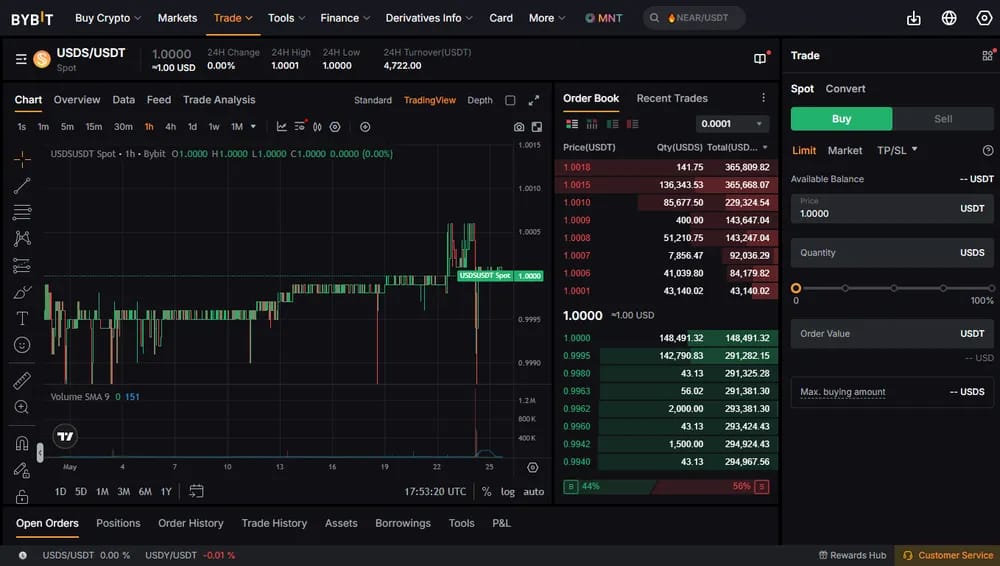
USDC is far more useful for futures trading because several major exchanges support USDC-margined or USDC-settled derivatives. USDS has some derivatives exposure, but it is usually traded as the underlying asset against USDT, not used widely as futures collateral.
Key futures trading differences include these exchanges:
- Bybit: For USDC, Bybit supports USDC perpetual contracts where margin, P&L, and settlement are calculated in USDC, with standard fees of 0.02% maker and 0.055% taker. For USDS, Bybit lists a USDSUSDT perpetual, but it is USDT-margined exposure to USDS rather than USDS used as collateral.
- Binance: For USDC, Binance offers selected USDC-margined perpetuals, including LTCUSDC up to 75x and NEARUSDC up to 50x, with promotional regular-user fees of 0% maker and 0.04% taker. For USDS, Binance “USDⓈ-M” or “USDS-M” wording refers to stablecoin-margined futures generally, not Sky’s USDS token as collateral.
- Coinbase: For USDC, Coinbase Advanced supports perpetual futures with USDC collateral rewards, up to 50x leverage on crypto perps, and advertised fees from 0% maker and 0.01% taker on eligible markets. For USDS, Coinbase does not present comparable USDS collateral or USDS-margined perpetual support.
- OKX: For USDC, OKX’s USD-margined futures let users choose USDC as a supported settlement currency alongside USDG, while liquidity stays in a unified USD order book. For USDS, OKX does not list the same settlement role, so USDS is not comparable as futures collateral there.
- Kraken: For USDC, Kraken lists USDC futures markets and says USDC, USDG, and USDT have 0% conversion fees for derivatives collateral, with leverage depending on product and region. For USDS, Kraken states USDS derivatives are not available to trade, so it offers no equivalent USDS futures.
Takeaway: USDC clearly wins for futures trading because it is accepted directly in more margin, settlement, and collateral workflows. USDS is better treated as a spot, DeFi, or yield asset unless a specific platform supports it.
USDS vs USDC Risks
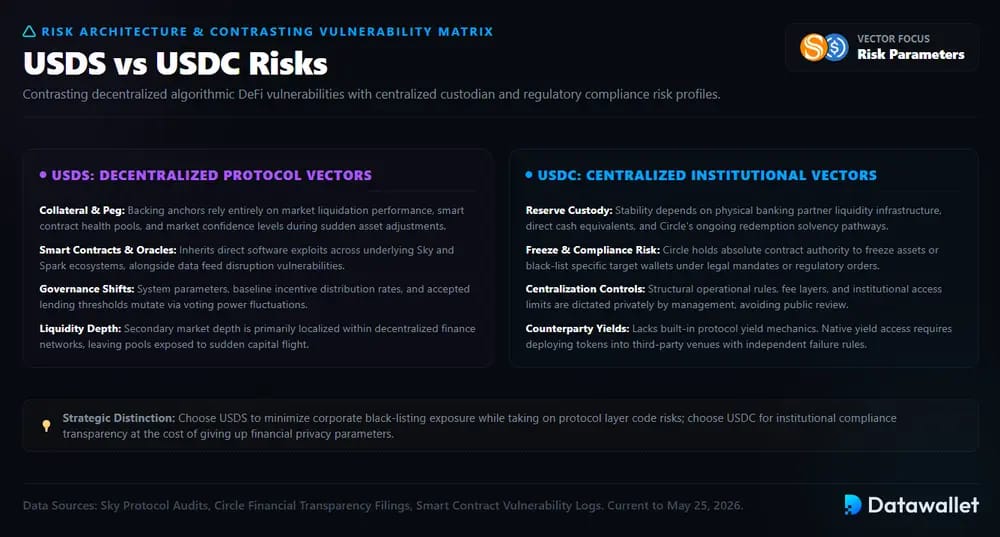
Both stablecoins carry risk, but the weak points are different. USDS risk comes from DeFi mechanics, governance, collateral quality, and smart contracts, while USDC risk comes from issuer control, reserves, banking partners, regulation, and address-freezing powers.
The main risks to compare are:
- Peg Risk: USDS depends on collateral health, liquidation design, and market confidence, while USDC depends on reserve liquidity, redemption access, and Circle’s ability to keep reserves matched to supply.
- Collateral Risk: USDS can be affected by volatility or concentration in approved collateral types, while USDC depends on cash, short-term reserve assets, custodians, and banking relationships.
- Smart Contract: USDS carries direct smart contract and oracle risk across Sky, Spark, and connected DeFi markets, while USDC mainly inherits this risk when deposited into external protocols.
- Governance Risk: USDS rates, collateral rules, and system parameters can change through governance, while USDC decisions are centralized around Circle’s policies, compliance duties, and operating controls.
- Freeze Risk: USDS is more permissionless at the protocol layer, while USDC can be frozen or blocked by Circle when required by law, court order, or compliance rules.
- Yield Risk: USDS yield depends on protocol economics, lending demand, and incentive programs, while USDC yield usually comes from third-party exchanges or DeFi pools with separate counterparty risks.
- Liquidity Risk: USDC has deeper exchange and payment liquidity, while USDS liquidity is more concentrated in DeFi, Sky-related products, and selected trading pairs.
- Regulatory Risk: USDC faces direct issuer regulation and compliance obligations, while USDS faces more uncertainty from decentralized governance, jurisdiction-specific access rules, and future stablecoin policy treatment.
Is USDS Better Than USDC?
USDS can be better for users already active in Sky, Spark, Morpho, or other DeFi protocols where stablecoin yield and protocol composability matter. It is more specialized: useful for onchain strategies, but less convenient for everyday liquidity, exchange support, and institutional workflows.
USDC (USD Coin) is still the better default for most users because it works across far more wallets, exchanges, apps, and blockchain networks. Circle says USDC is natively supported on 34 networks, making it easier to use for trading, payments, transfers, and cross-chain activity.
Final Thoughts
USDS and USDC are both useful, but they solve different problems. USDS is better for users who live inside DeFi, while USDC is stronger for broad access, payments, trading, and everyday stablecoin utility.
For yield-focused users, USDS deserves attention because Sky is built around non-custodial savings and protocol-level stablecoin activity. Still, that advantage depends on comfort with governance, smart contracts, and DeFi-specific risks.
The GENIUS Act also strengthens the case for regulated payment stablecoins. Since it creates a US framework around reserves, disclosures, and issuer oversight, it may benefit assets like USDC more directly than decentralized alternatives such as USDS.