

Kraken vs OKX: Overview
Kraken opened for trading in 2013 after Jesse Powell spent two years building it in the shadow of Mt. Gox. Today it serves around 15 million clients in 190+ countries with 500+ cryptocurrencies, and it has grown into something closer to a brokerage, spanning US equities, tokenized stocks, regulated futures, and banking rails through a Wyoming charter.
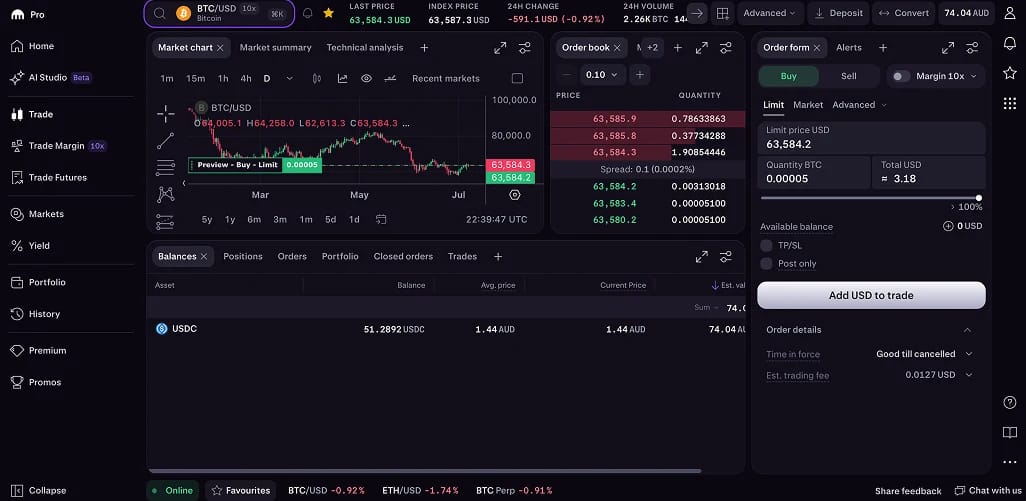
Funding our Kraken Pro account again for this piece was uneventful in the best sense. The fee ladder is printed on the order ticket, our test withdrawal cleared without a manual review, and the platform never steers you toward a pricier product than the one you opened.
OKX launched in 2017 under founder Star Xu and now counts more than 120 million users across 100+ countries, consistently ranking in the top five exchanges by volume. Its centre of gravity is derivatives, wrapped in an ecosystem that includes a 130-chain self-custody wallet, trading bots, copy trading, and the X Layer network.
Trading on OKX feels built for people who live on the perps screen. Our USDT deposit credited in minutes, BTC perpetual fills came back tight, and the unified account let us margin positions against mixed collateral without shuffling funds between wallets. The interface carries more density than Kraken's, which suits active traders and slows down everyone else.
Here is the side-by-side picture.
Kraken vs OKX: Features
The two platforms overlap on the trading core of spot, margin, perpetuals, staking, and bots, then diverge sharply beyond it. Kraken has spent its acquisition budget on regulated market infrastructure, buying its way into US futures, equities broking, and tokenized asset issuance. OKX has invested in trading machinery and on-chain tooling, from its options desk to a wallet that doubles as a DeFi gateway.
Kraken Products
Kraken splits its offering across a simple app and the professional platform, with everything meaningful priced through Kraken Pro.
- Kraken Pro: The main venue for 500+ assets, running the volume-tiered fee ladder with full charting, API access, and margin. The standard app charges a flat 1% on instant buys, so regular traders should graduate quickly.
- Futures: Perpetual and fixed-maturity contracts at up to 50x with multi-collateral margining, while US customers trade CFTC-regulated perpetuals through a separate domestic entity.
- xStocks: Tokenized US stocks and ETFs backed 1:1 by shares in regulated custody, tradable in 110+ countries and withdrawable to self-custody wallets. We cover this fully in its own section below.
- US Equities: Kraken Securities, a FINRA member broker-dealer, gives American clients commission-free trading in 11,000+ stocks and ETFs beside their crypto balances.
- Staking: Flexible and bonded terms on 20+ assets, restored for US customers in 2025 after the SEC dropped its case.
- Krak and Kraken Embed: A peer payments app for cross-border transfers, plus white-label exchange infrastructure already powering crypto trading inside the Dutch neobank bunq.
- Custody and OTC: Institutional custody, an OTC desk, and index products round out the professional side.
OKX Products
OKX arranges its stack around active trading first, with a self-custody layer bolted on for everything beyond the exchange.
- Spot and Margin: 350+ cryptocurrencies across 700+ pairs, with cross and isolated margin against a unified collateral pool.
- Perpetuals and Expiry Futures: The flagship product. USDT, USDC, and coin-margined contracts run to 125x leverage, alongside quarterly and bi-quarterly futures for traders who prefer a fixed settlement date.
- Options: BTC and ETH options with a full chain view and an RFQ marketplace for block-sized trades, a product Kraken does not offer at comparable depth.
- X-Perps: MiFID-regulated derivatives for EEA customers covering crypto, the Magnificent 7 stocks, gold, silver, oil, and the SPY and QQQ indices, all tradable around the clock at up to 10x.
- OKX Wallet: A self-custody wallet spanning 130+ blockchains with a built-in DEX aggregator, staking, and NFT support. It operates independently of the exchange account.
- Bots and Copy Trading: Grid, DCA, and arbitrage bots plus a large copy trading network with published trader statistics.
- Earn and Jumpstart: On-chain staking, savings products, and early access allocations to new token launches.
- X Layer: OKX's Ethereum Layer 2, connected natively to the wallet for cheap transactions and dApp access.
Kraken vs OKX: Security
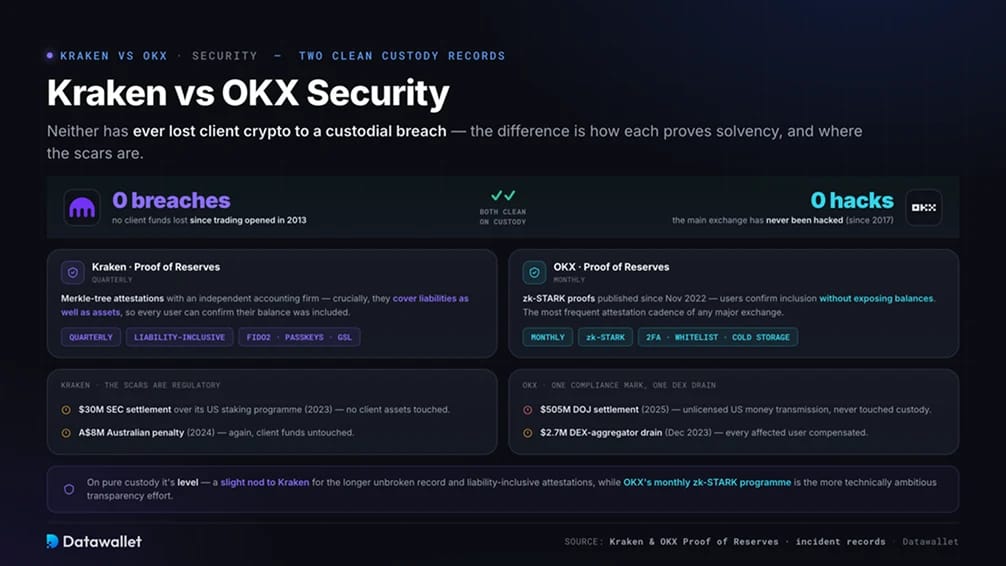
Neither exchange has ever lost client crypto to a custodial breach, which already places this matchup above most. The difference sits in how each proves solvency and where the historical scars are.
Kraken Security Measures and History
- Custody record: No client funds lost to a breach since trading opened in 2013, a claim very few venues of its size can make.
- Proof of Reserves: Quarterly Merkle-tree attestations prepared with an independent accounting firm. The reports cover liabilities as well as assets, so every user can confirm their own balance was included.
- Account controls: FIDO2 hardware keys, passkeys, PGP-signed email, and a Global Settings Lock that freezes account changes for a set period even if a password leaks.
- Incident history: Kraken's setbacks have been regulatory. A $30 million SEC settlement over its US staking programme in 2023 and an A$8 million Australian penalty in 2024 both stung, and neither touched client assets.
OKX Security Measures and History
- Custody record: The main exchange has never suffered a hack. A malicious contract upgrade drained $2.7 million from the OKX DEX aggregator in December 2023, and OKX compensated every affected user.
- Proof of Reserves: Monthly reports published since November 2022, verified with zk-STARK proofs so users can confirm inclusion without exposing balances. It is the most frequent attestation cadence of any major exchange.
- Account controls: 2FA, anti-phishing codes, withdrawal whitelisting, and device management cover the standard set, with cold storage and a risk reserve behind custody.
- Incident history: The 2025 Department of Justice settlement concerned compliance and never touched exchange custody. OKX's affiliate admitted to operating an unlicensed money transmitting business in the US between 2018 and early 2024 and paid $505 million in penalties and forfeited fees.
On pure custody, we call it level, with a slight nod to Kraken for the longer unbroken record and liability-inclusive attestations. OKX's monthly zk-STARK programme is the more technically ambitious transparency effort, and its clean exchange-level history deserves credit.
Kraken vs OKX: Regulation
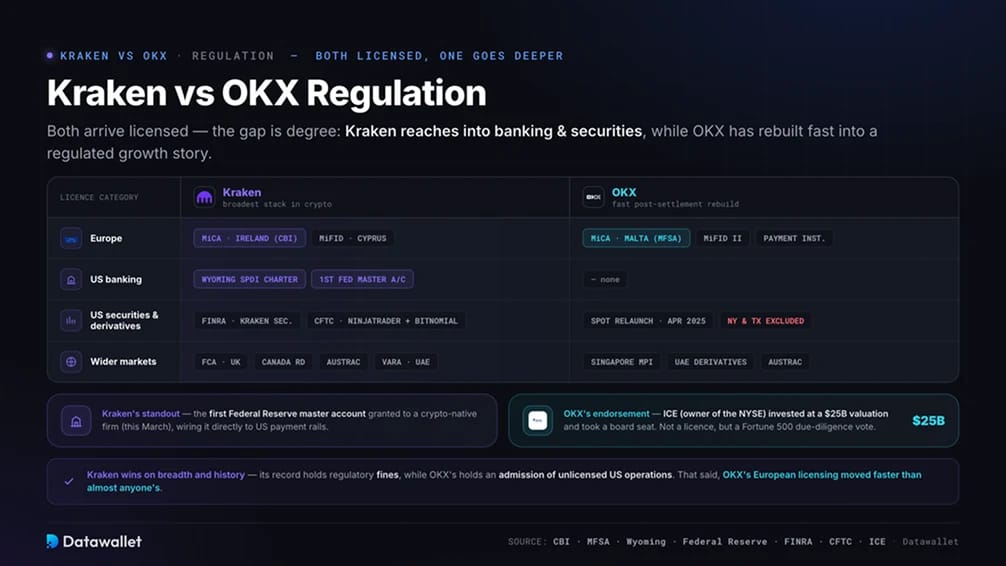
Both exchanges arrive at this section licensed, which was not true of OKX two years ago. The gap now is one of degree. Kraken has assembled permissions that reach into banking and securities, while OKX has rebuilt its standing quickly and is converting a major compliance failure into a regulated growth story.
Kraken's Licenses
- Europe: A MiCA CASP authorization from the Central Bank of Ireland granted in June 2025, paired with MiFID derivatives permissions through Cyprus. Few venues hold both.
- US banking: A Wyoming SPDI bank charter held since 2020 and, from this March, the first Federal Reserve master account granted to a crypto-native firm, connecting Kraken directly to US payment rails.
- US securities and derivatives: FINRA membership through Kraken Securities, CFTC-regulated futures through the NinjaTrader acquisition, and a full CFTC derivatives stack added through the purchase of Bitnomial this April.
- Other markets: FCA registration in the UK, Restricted Dealer status in Canada, AUSTRAC in Australia, and a VARA authorization in the UAE. Coverage sits in Kraken's supported countries.
OKX's Licenses
- Europe: A MiCA CASP license from Malta's MFSA issued in January 2025, one of the first granted to a global exchange, plus a MiFID II permission acquired through a Maltese entity and a payment institution license covering OKX Pay and the OKX Card.
- United States: OKX relaunched in April 2025 with a San Jose headquarters after the $505 million DOJ settlement, offering spot trading and the OKX Wallet, with some states including New York and Texas still excluded.
- Institutional endorsement: Intercontinental Exchange, owner of the NYSE, invested in OKX at a $25 billion valuation this March and took a board seat. An investment is no substitute for a license, and a Fortune 500 market operator completing due diligence and buying in still says plenty about where OKX now stands.
- Other markets: A Major Payment Institution license in Singapore, UAE derivatives permissions, and AUSTRAC registration in Australia. Restrictions are tracked in OKX's restricted countries.
Kraken wins this section on breadth and on history. Its record contains regulatory fines, while OKX's contains an admission of unlicensed US operations, and those are different weights. That said, OKX's post-settlement trajectory has been genuinely impressive, and its European licensing moved faster than almost anyone else's.
Kraken vs OKX: Fees
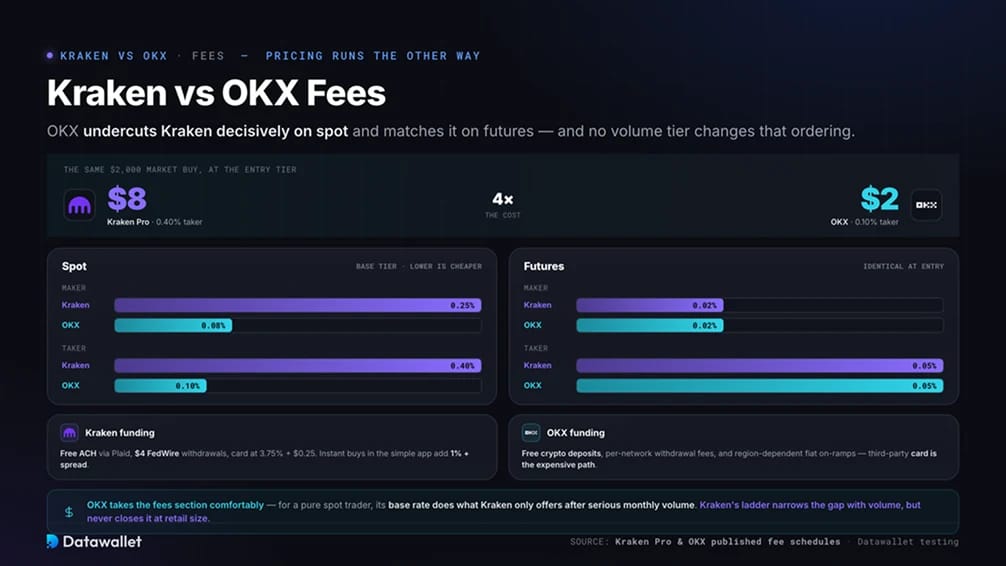
Pricing runs the other way. OKX undercuts Kraken decisively on spot and matches it on futures, and no volume tier changes that ordering. Our maker vs taker guide explains why the side of the book you trade on shapes what you pay.
Spot Trading Fees
- Kraken: Kraken Pro starts at 0.25% maker and 0.40% taker, stepping down with 30-day volume until makers reach zero at the top public tiers. Instant buys in the standard app carry a flat 1% plus spread.
- OKX: The base schedule is 0.08% maker and 0.10% taker, with OKB holdings and VIP tiers cutting further, down to maker rebates for the highest-volume accounts.
Our trading note: We placed a $2,000 market buy on each platform at the entry tier. OKX charged $2 and Kraken Pro charged $8. Fills on BTC were equally clean, so on majors the fee gap is money kept. Kraken's ladder narrows the difference with volume, and it never closes it at retail size.
Futures Fees
- Kraken: Global futures price at 0.02% maker and 0.05% taker with volume discounts, while the regulated US perpetuals venue charges a flat $0.15 per contract per side.
- OKX: The same 0.02% and 0.05% entry rates apply, with OKB discounts and VIP tiers pushing high-volume makers toward zero and beyond.
Funding Costs
- Kraken: Free ACH deposits and withdrawals through Plaid in the US, $4 FedWire withdrawals, and card funding at 3.75% plus $0.25.
- OKX: Free crypto deposits, per-network withdrawal fees, and fiat on-ramps whose cost depends on region and provider, with third-party card purchases the expensive path.
OKX takes the fees section comfortably. For a pure spot trader, its base rate does what Kraken only offers after serious monthly volume.
Kraken vs OKX: Tokenized Stocks
This is the newest battleground between the two, and the contrast is unusually clean. Kraken sells you a token backed by a real share today. OKX sells you price exposure today and is building the real thing with the New York Stock Exchange's owner. Our guide to the best tokenized stock trading platforms maps the wider field.
Kraken xStocks
Kraken launched xStocks in June 2025 and has since built it into the reference product for the category. Each token represents a US stock or ETF backed 1:1 by the underlying share held in regulated custody, issued by Backed Assets, which Kraken's parent acquired outright in late 2025.
The catalogue passed 100 listings early this year, with a stated target above 500, and the framework has processed more than $30 billion in transaction volume across 125,000+ holders. Tokens trade from $1 minimums, pay dividends through automatic reinvestment, and can be withdrawn to Solana or Ethereum wallets for 24/7 on-chain trading. Kraken has also opened tokenized IPO access, letting eligible customers take allocations at the offering price, with SpaceX the first listing offered.
The hard limit is geography, since xStocks exclude the US, UK, Canada, and Australia, and the tokens confer price exposure without voting rights.
OKX and the ICE Joint Venture
OKX's live product is synthetic. Its European X-Perps line covers the Magnificent 7 stocks plus SPY and QQQ as regulated futures rather than backed tokens, which suits traders and does nothing for holders.
The bigger story is OKXICE, the 50-50 joint venture with Intercontinental Exchange announced in June and co-chaired by former New York Governor Andrew Cuomo. Pending US broker-dealer and futures commission merchant approvals, it aims to give OKX's 120 million users access to tokenized NYSE-listed equities and ICE futures, with a rollout targeted for later this year. If approved, it would be the first tokenized equities product carrying the NYSE's own infrastructure, and unlike xStocks it is designed to include American customers.
For anyone who wants tokenized stocks now, Kraken wins without argument. OKX holds the more interesting hand for 2026 and beyond, and a roadmap is still a roadmap until the licenses land.
Kraken vs OKX: Perps
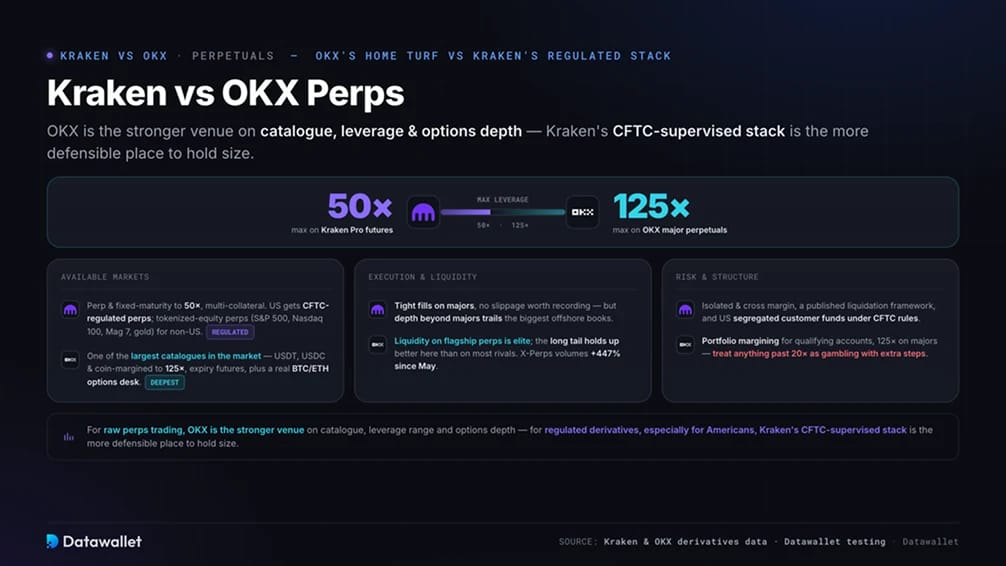
Perpetuals are OKX's home turf and the product most of its volume runs through. Kraken's derivatives business is smaller and more regulated, which is either a limitation or the entire point depending on who you are. Both rank among the leading crypto futures exchanges we track.
Available Markets
- Kraken: Perpetual and fixed-maturity contracts on majors and a solid altcoin range at up to 50x, with multi-collateral margining on Kraken Pro. US customers get CFTC-regulated crypto perpetuals through a domestic venue, and a tokenized equity perps line built on xStocks covers the S&P 500, Nasdaq 100, Magnificent 7, and gold for non-US clients.
- OKX: One of the largest perpetuals catalogues in the market, spanning USDT, USDC, and coin-margined contracts at up to 125x, plus expiry futures and a genuine BTC and ETH options desk. In Europe, the X-Perps line extends regulated derivatives to stocks, indices, gold, silver, and ICE's Brent and WTI oil benchmarks, with volumes up more than 447% since the start of May.
Execution and Liquidity
- Kraken: Our BTC and ETH perp fills came back tight with no slippage worth recording, in line with its long-standing reputation for order book quality on majors. Depth beyond majors trails the biggest offshore books.
- OKX: Liquidity on flagship perps is elite, spreads stayed tight through the size we tested, and the unified account made collateral management the smoothest part of the session. The long tail holds up better here than on most rivals.
Risk and Structure
- Kraken: Isolated and cross margin, a published liquidation framework, and the fallback that its US derivatives arm operates with segregated customer funds under CFTC rules.
- OKX: Sophisticated margin modes and portfolio margining for qualifying accounts, with 125x available on majors. Leverage that high is a tool for a very small group, and we would treat anything past 20x as gambling with extra steps.
For raw perps trading, OKX is the stronger venue on catalogue, leverage range, and options depth. For regulated derivatives, especially for Americans, Kraken's CFTC-supervised stack is the more defensible place to hold size.
Final Thoughts
Kraken is our overall pick, and the margin is the license stack plus the custody record. It is the only exchange anywhere offering crypto, US equities, regulated futures, and 1:1 backed tokenized stocks behind one login, and it has run since 2013 without losing a client coin to a breach. If you value verifiable reserves and regulated venues over the last basis point of fees, it is the safer long-term home.
OKX is the better trade for cost-sensitive and derivatives-first users. Spot fees at a third of Kraken's base rate, a deeper perps catalogue with real options, and the ICE partnership give it clear wins, and its post-settlement rebuild has been faster and more credible than we expected. The main asterisks are its shorter regulatory history and the fact that its tokenized equities remain a plan.
Running both is a reasonable answer, with Kraken holding the core portfolio and OKX handling active derivatives trading at lower cost. Whichever you choose, verify fully, switch on hardware 2FA, and test a small withdrawal before moving size.