



What is GMGN?
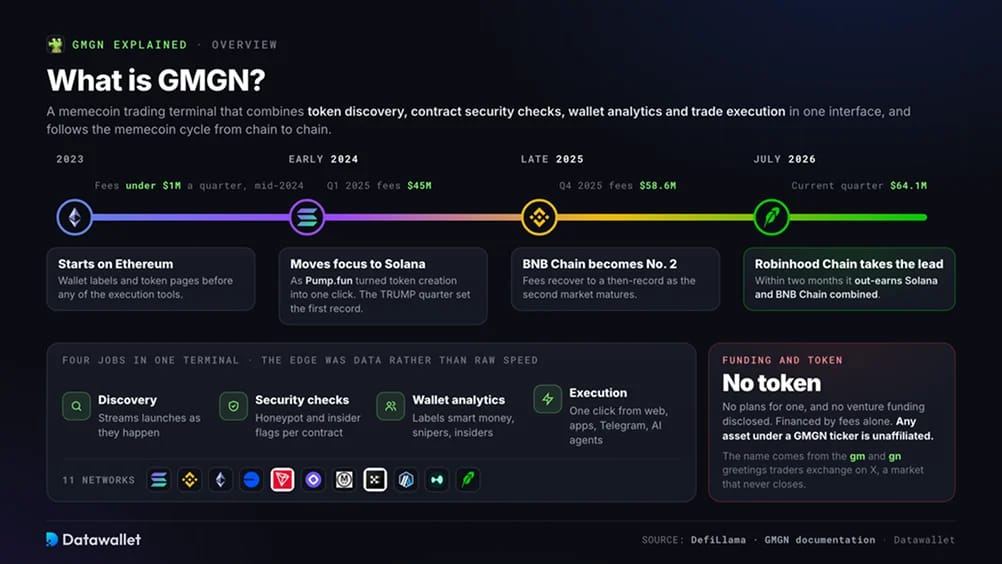
GMGN is a memecoin trading platform that brings token discovery, contract security checks, wallet analytics and trade execution into one interface. Its name combines the “gm” and “gn” greetings exchanged by crypto traders on X, reflecting markets that never close.
The platform launched on Ethereum in 2023. Its focus shifted to Solana in early 2024, when Pump.fun made token creation a one-click process. Quarterly fees rose from under $1 million in mid-2024 to $45 million in the first quarter of 2025, when the TRUMP memecoin launched on Solana, according to DefiLlama.
Data, rather than raw execution speed, gave GMGN its edge. Each token page identified insiders, snipers and bundled buyers. Traders could also copy addresses with a history of profitable trades, while competing bots focused mainly on executing swaps.
GMGN now covers Solana, BNB Chain, Ethereum, Base, Tron, Monad, MegaETH, X Layer, Arbitrum, Hyperliquid’s HyperEVM and Robinhood Chain. Less than two months after Robinhood Chain launched its mainnet, GMGN was earning more fees there than on Solana and BNB Chain combined. We track that shift in our Robinhood Chain statistics.
GMGN has no token and has not announced plans to launch one. Any asset trading under a GMGN ticker is unaffiliated with the platform.
How Does GMGN Work?
GMGN is software built on top of decentralised exchanges. It does not operate its own order book or provide liquidity. Instead, the platform reads public blockchain data, turns it into trading signals and routes approved orders to the relevant exchange on each network.
1. Token Discovery and Security Checks
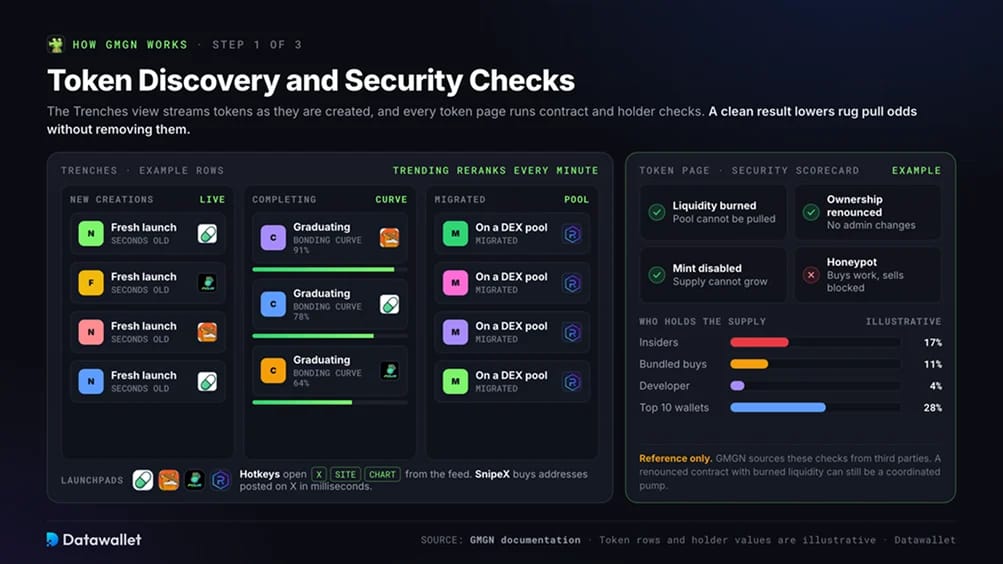
The Trenches view streams tokens as launchpads create them, including Pump.fun, letsbonk, FourMeme and Raydium. It separates fresh launches from tokens nearing completion of their bonding curve, the launchpad pricing stage before migration to a normal exchange pool, and those that have already migrated.
Trending rankings refresh every minute using buys, sells, volume, price and holder growth. Hotkeys open a token’s X account, website and chart directly from the feed, according to the official documentation. SnipeX monitors X for newly posted contract addresses and can buy them within milliseconds.
Every token page checks whether liquidity has been burned, ownership renounced and mint permissions disabled. It also tests for honeypot behaviour, where users can buy a token but cannot sell it. The page displays how much supply is held by insiders, the developer and the ten largest wallets. It also identifies tokens bought in bundles, meaning several wallets purchased within one block, as covered in our guide to Solana bundles.
GMGN obtains these checks from third parties and labels them as reference information only. A clean result may reduce the likelihood of a rug pull, but it cannot eliminate the risk.
2. Smart Money Tracking and Copy Trading
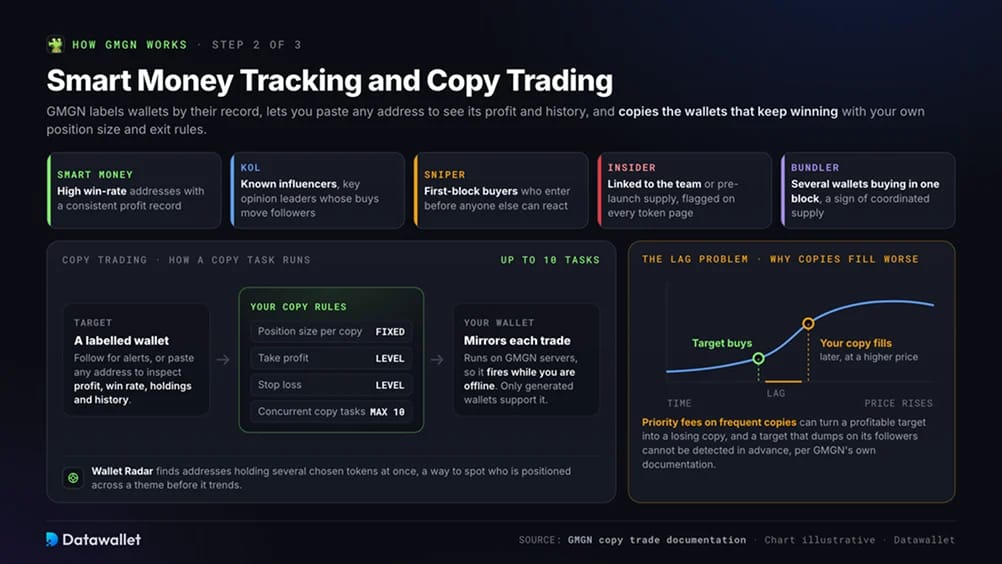
GMGN categorises wallets according to their trading record. Addresses with high win rates may receive a smart money label, known influencers are marked as KOLs, or key opinion leaders, and first-block buyers are identified as snipers.
Users can paste any address into the terminal to review its profit, win rate, holdings and transaction history, as shown in our guide on how to track Solana wallets. Wallet Radar can also find addresses that hold several selected tokens simultaneously.
A wallet can be followed for alerts or copied automatically. Traders control the position size, take-profit and stop-loss levels, with a maximum of ten active copy tasks. GMGN’s copy trade documentation warns that priority fees from frequent orders can turn a profitable target into an unprofitable copy. Our review of crypto copy trading platforms compares these tools with dedicated services.
3. Execution and Automated Orders
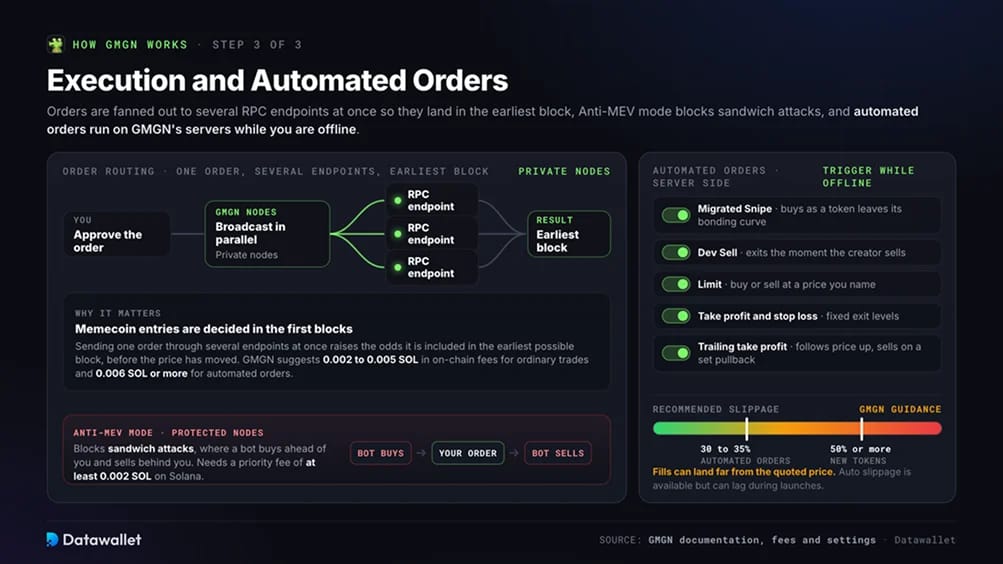
GMGN routes each order through several RPC endpoints at once using private nodes. These endpoints are the servers that accept blockchain transactions, and parallel routing helps the order reach the earliest possible block.
Anti-MEV mode sends transactions through protected nodes to prevent sandwich attacks, where a bot buys before a trader’s order and sells immediately after it. On Solana, Anti-MEV requires a priority fee of at least 0.002 SOL.
Automated orders run on GMGN’s servers and remain active while the user is offline. Migrated Snipe buys when a token leaves its bonding curve, while Dev Sell exits if the creator sells. Traders can also use limit orders, take-profit and stop-loss settings, or trailing orders to manage exits.
GMGN recommends slippage of 30% to 35% for automated orders and at least 50% for new tokens. As a result, the final execution price can differ substantially from the quoted price.
4. Wallets, Interfaces and AI Agent Skills
GMGN’s wallet model is often misunderstood. Logging in through Telegram generates three addresses: one for Solana, one shared across EVM networks such as Ethereum, Base and BNB Chain, and another for Tron. The wallet documentation states that private keys cannot be exported on any chain.
Withdrawals are available only through the website and require Google Authenticator plus a whitelisted address. Changing the whitelist triggers a three-hour withdrawal lock. Users who want direct control of their private keys can connect an external browser wallet such as Phantom instead.
The same account works through the web terminal, the iOS and Android apps, and a separate Telegram bot for each chain. In June, GMGN released GMGN Skills, a collection of more than 40 commands that allows AI agents such as Claude Code and Cursor to access its research and trading functions through the gmgn-cli tool.
Access uses an Ed25519 API key with either read-only or trading permissions, supported by an IP whitelist, according to the Agent API documentation. GMGN Skills also includes Cooking, a token launch tool for Pump.fun, FourMeme, Clanker and Flap.
How to Trade on GMGN
The fastest route into GMGN is its web terminal with a Telegram login, which enables copy trading and automated orders. Start with a small deposit because each setting affects how the trade is executed.
A typical first trade runs as follows:
- Open the official site: Enter gmgn.ai directly or use a saved bookmark. Clone websites and fake Telegram bots with slightly altered handles are the main source of user losses.
- Choose a login: Connect a browser wallet you control or sign in through Telegram to generate GMGN trading wallets. Copy trading and automated orders work only with the generated wallets.
- Set up security: Bind Google Authenticator and add a withdrawal address to the whitelist before depositing. Withdrawals remain unavailable until both steps are complete.
- Deposit gas tokens: Send SOL, ETH, BNB or TRX to the displayed address for the chain you intend to use. Stablecoins transferred by mistake must be swapped within the terminal.
- Pick a chain and a feed: Select the network from the top corner, then open Trenches, Trending or New Pair. If you already know the target, paste its contract address into the search bar.
- Read the token page: Review the security badges, insider and bundle percentages, developer holdings and top-ten concentration before examining the chart.
- Configure the trade: Choose the slippage, priority fee and Anti-MEV settings before buying. GMGN suggests 0.002 to 0.005 SOL in on-chain fees for standard trades and at least 0.006 SOL for automated orders.
- Buy and attach exits: Place a market order through quick buy, then set take-profit and stop-loss levels. A trailing take-profit can follow the price higher and sell after a specified pullback.
- Monitor holdings: The Holding page displays open positions, limit orders and realised profit across wallets. Telegram alerts notify users when a tracked wallet sells.
- Withdraw to cold storage: Transfer profits from the website’s withdrawal page to the whitelisted address instead of keeping large balances in a generated wallet.
.webp)
GMGN Fees
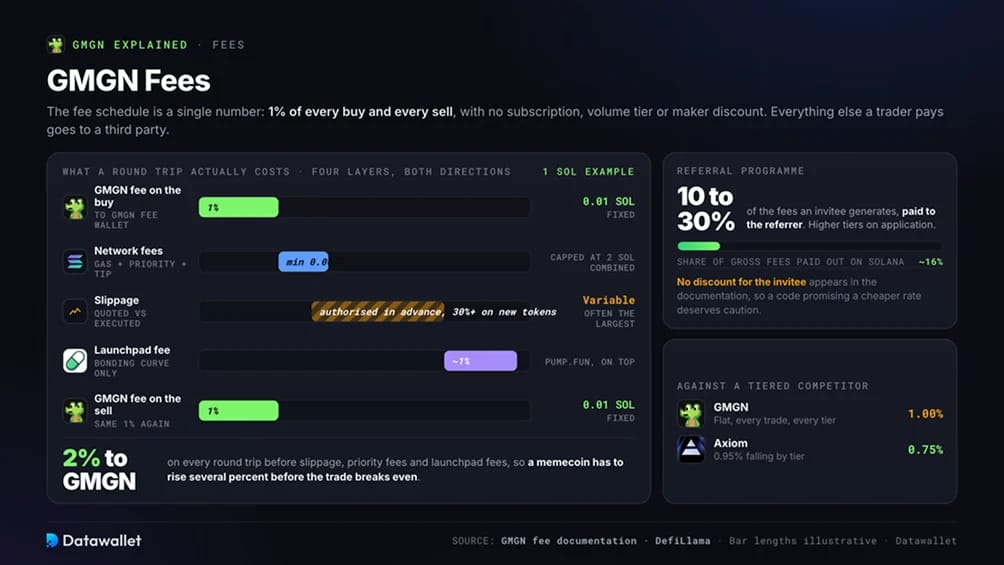
GMGN’s fee schedule is straightforward. The platform deducts 1% from every buy and sell in either the chain’s gas token or USDC. There are no subscriptions, volume tiers or maker discounts. All other costs go to third parties.
The full cost of a trade has four layers:
- GMGN fee: 1% of the trade value. Buying with 1 SOL sends 0.01 SOL to GMGN’s fee wallet.
- Network fees: Traders pay base gas and can add a priority fee for validators or a tip to private nodes for faster inclusion. Each has a minimum of 0.0001 SOL, and the combined maximum is 2 SOL.
- Slippage: The difference between the quoted and executed price, authorised by the trader before submission. Auto slippage is available but may lag during token launches.
- Launchpad fees: Tokens that remain on a bonding curve incur the launchpad’s fee in addition to GMGN’s charge. Pump.fun, for example, charges roughly 1%.
Referrers receive up to 30% of the fees generated by invited users. DefiLlama estimates these payouts at about 16% of gross Solana fees.
GMGN’s flat 1% rate is expensive for frequent traders compared with tiered competitors such as Axiom, which lowers its fee to 0.75% at the highest tier.
The round-trip cost is more important than the headline rate. Buying and selling incurs a combined GMGN fee of 2% before slippage, priority charges and launchpad fees. A memecoin therefore needs to gain several percent before the position breaks even.
GMGN Restricted Countries
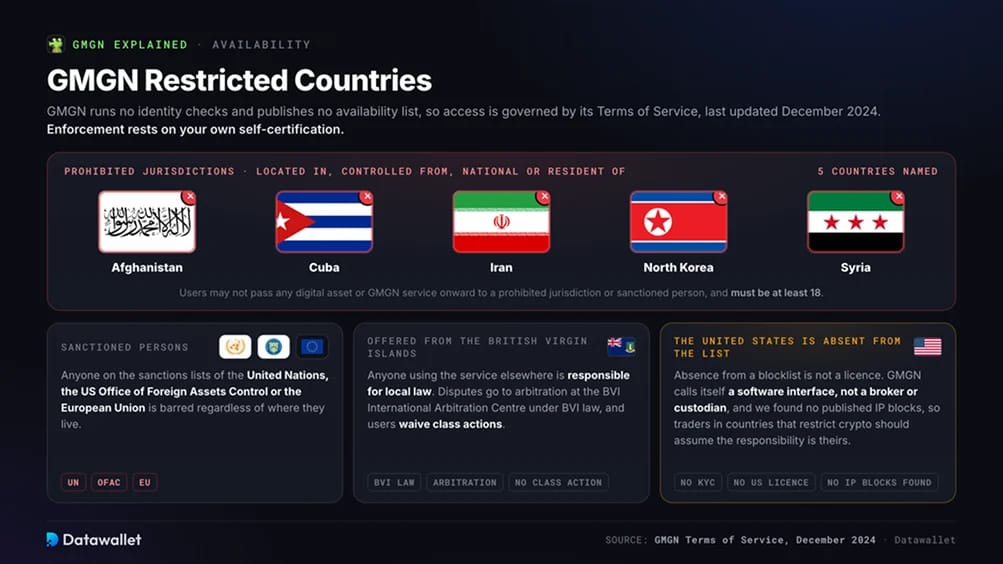
GMGN conducts no identity checks and does not publish a country availability list. Access is instead governed by its Terms of Service, last updated in December 2024.
The terms exclude the following:
- Prohibited jurisdictions: The service is unavailable to anyone located in, controlled from, or a national or resident of Afghanistan, Cuba, Iran, North Korea or Syria.
- Sanctioned persons: Anyone included on sanctions lists maintained by the United Nations, the US Office of Foreign Assets Control (OFAC) or the European Union is prohibited, regardless of residence.
- Minors: Users must be at least 18 and are responsible for preventing minors from accessing their accounts.
- Onward supply: Users cannot provide a digital asset or GMGN service to a sanctioned person or prohibited jurisdiction.
The terms say the service is offered from the British Virgin Islands. Anyone accessing it elsewhere must comply with local law. Disputes are subject to arbitration at the BVI International Arbitration Centre under BVI law, and users waive their right to participate in class actions.
The United States does not appear on the prohibited list, but omission from a blocklist does not constitute a licence. GMGN describes itself as a software interface rather than a broker or custodian. It also classifies listed assets as entertainment tokens without practical use.
We found no public list of blocked IP addresses. Enforcement therefore appears to rely on the self-certification contained in the terms. Traders in countries that restrict crypto trading should assume responsibility for compliance rests with them.
GMGN Statistics
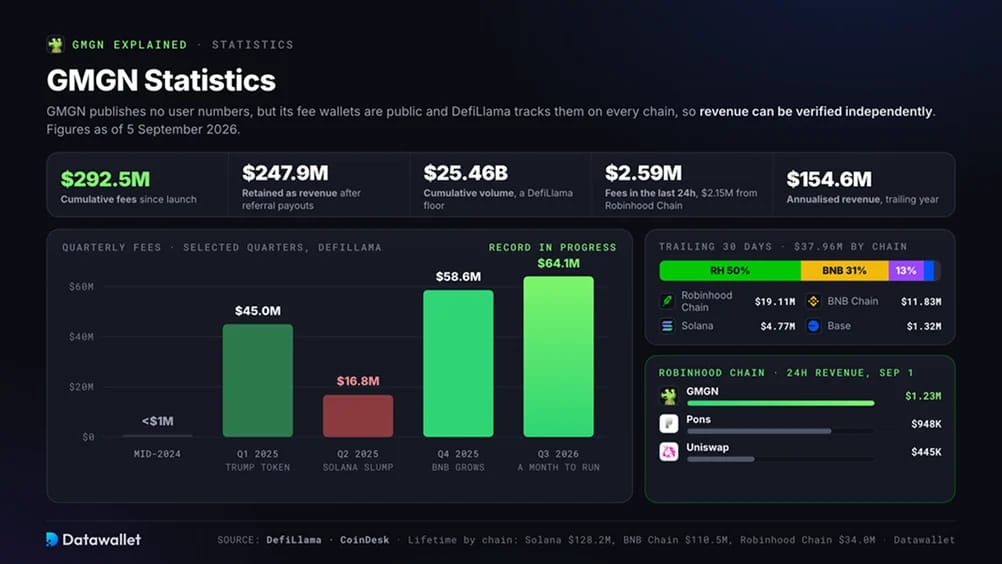
GMGN does not publish user numbers. Its fee wallets are public, however, allowing DefiLlama to track activity independently across each supported chain. Unless otherwise stated, the following figures are current as of 5 September 2026.
Key GMGN metrics:
- Cumulative fees: $292.5 million since launch, with $247.9 million retained as revenue after referral payouts, according to DefiLlama.
- Cumulative volume: $25.46 billion in swaps that incurred a GMGN fee. DefiLlama describes this as a floor because it excludes undecoded venues.
- Trailing 30 days: $37.96 million in fees from $3.31 billion of volume. Robinhood Chain generated $19.11 million, followed by BNB Chain at $11.83 million, Solana at $4.77 million and Base at $1.32 million.
- Daily run rate: $2.59 million in fees during the latest 24-hour period, including $2.15 million from Robinhood Chain.
- Record quarter: The current quarter has generated $64.1 million in fees with nearly one month remaining. The previous record was $58.6 million in the fourth quarter of 2025.
- Annualised revenue: $154.6 million on a trailing-year basis, based on DefiLlama’s annualised figure.
- Chain history: Solana has generated $128.2 million in lifetime fees, while BNB Chain has produced $110.5 million. Robinhood Chain reached $34.0 million in roughly two months.
- Robinhood Chain rank: On 1 September, GMGN earned $1.23 million in revenue from the network over 24 hours. That exceeded the Pons launchpad at $948,044 and Uniswap at $445,379, according to CoinDesk.
Changes in the platform’s chain mix explain the volatility in these results. Fees dropped from $45.0 million in the first quarter of 2025 to $16.8 million in the second as Solana memecoin volume declined. Co-founder Haze responded to bankruptcy rumours by saying the company held healthy cash reserves, as MarsBit reported.
BNB Chain later developed into GMGN’s second-largest market, helping fees recover to a then-record $58.6 million in the fourth quarter of 2025.
Robinhood Chain followed a similar pattern at a much faster pace. GMGN added support within two weeks of the July mainnet, in time for the CASHCAT rally. By early September, GMGN and the Pons launchpad accounted for about 70% of all launchpad and trading bot fees across crypto, according to crypto.news.
Robinhood’s gas subsidy, which covers transaction fees for wallet users, expires on 29 September. Every Robinhood Chain trade will cost more once the subsidy ends.
GMGN vs Axiom
Axiom is the terminal most commonly compared with GMGN. Both combine browser and Telegram access for memecoin traders, but their chain coverage, fees and derivatives support differ. The Axiom figures come from our Telegram trading bot review.
GMGN offers greater breadth, while Axiom goes deeper within one ecosystem. Axiom’s perpetuals integration and lower top-tier fee are better suited to high-volume Solana traders. GMGN benefited when trading activity shifted first to BNB Chain and later to Robinhood Chain, neither of which falls within Axiom’s Solana focus.
Axiom also faced data-privacy allegations this year, pushing its trust rating below the category leaders.
Is GMGN Safe?
There is no confirmed breach of GMGN’s own systems. Documented losses have instead involved phishing.
In late October 2025, a fraudulent third-party token website persuaded about 107 users to sign transactions that drained their GMGN accounts. Losses exceeded $700,000, according to GoPlus Security’s tally. Co-founder Haze announced full compensation for affected accounts that same day. GMGN denied reports that the platform itself had been hacked.
The company operates a vulnerability bounty programme. Its safety guide begins by warning that official administrators will never contact users first. Generated-wallet withdrawals also require two-factor authentication and an approved address, limiting what an attacker can do with a stolen session.
GMGN’s custody model still warrants scrutiny. Its terms say users retain control of their private keys, yet its documentation prohibits exporting those keys. Funds held in a Telegram-generated wallet therefore depend on GMGN’s infrastructure for withdrawals.
That arrangement resembles an exchange account more closely than a self-custody wallet. Both the platform’s security and its solvency matter to the safety of user balances.
Risks
Memecoin trading is risky regardless of the terminal, and GMGN introduces several additional concerns.
- Total loss on tokens: GMGN’s terms say listed assets have no practical use and users may lose the entire amount spent.
- Phishing and impersonation: Clone sites, fake bots and fraudulent administrators are the documented sources of user losses. The October 2025 incident showed that one fake website could drain dozens of accounts within hours.
- Key custody: Generated-wallet private keys cannot be exported, leaving balances dependent on GMGN remaining operational and solvent. Keep trading balances small and withdraw regularly.
- Fee drag: A 2% round trip, combined with slippage of 30% or more on new tokens, can leave an apparently successful trade unprofitable after costs.
- Copy trading lag: Copied orders execute after the target wallet and often receive a worse price. The system cannot identify in advance whether the target intends to sell into its followers.
- Data accuracy: GMGN obtains security checks and wallet labels from third parties for reference purposes. Even a renounced contract with burned liquidity can be part of a coordinated pump.
- Chain dependency: Robinhood Chain currently generates half of GMGN’s fees. Its single sequencer, the server responsible for ordering transactions, is operated by Robinhood, and the chain’s gas subsidy ends on 29 September.
- Regulatory exposure: GMGN is unlicensed, performs no identity checks and operates from the British Virgin Islands. Regulation of trading interfaces remains unsettled in most jurisdictions.
GMGN Founders
Jerry Ma founded GMGN alongside Haze and Arthur. RootData describes Ma as having more than 20 years of experience building tool products. Haze, who uses the handle @haze0x on X, is the company’s public face.
Haze was born in 1985 and held a conventional office job until discovering Bitcoin in 2017. He joined a quantitative trading firm the following year. His later roles included leading BitUniverse’s China operations and becoming an early member of the Pionex exchange. Before GMGN, he also created an NFT analytics tool called NFTTrack, according to an interview with ChainCatcher.
The company employs about 30 people, most of whom are Chinese-speaking. GMGN has disclosed no venture funding and finances its operations through trading fees.
During the 2025 slowdown, Haze told users the company’s cash reserves could sustain three years of extreme conditions. Public filings do not provide enough information to verify that claim.
Final Thoughts
GMGN turned wallet intelligence into a trading product, then followed memecoin activity from Ethereum to Solana, BNB Chain and Robinhood Chain without losing its discovery advantage. The terminal now earns more than $2 million per day in fees despite having no token or disclosed venture backing and a team of about 30 people.
Its weaknesses stem from the same model. The flat 1% fee is now above the market, private keys from generated wallets cannot be exported, and revenue depends heavily on whichever chain is hosting the current memecoin cycle. The AI agent skills released in June are its most interesting next step because they make GMGN’s data accessible beyond the platform’s own interface.
Use GMGN as a research tool that can also execute trades. Keep balances small, enable two-factor authentication before depositing and verify every domain and account handle. Review the holder breakdown before focusing on the chart. The terminal can reveal what smart money is buying, but it cannot show whether those wallets are about to sell.