

Can I Get Robinhood Chain Testnet Tokens?
Robinhood Chain test ETH has no price and cannot be transferred to mainnet. Faucets distribute it for free, usually after an anti-bot check. Robinhood's support page confirms that the testnet remains available after the mainnet launch and directs users to the official faucet.
First, add the testnet to your wallet. Our add Robinhood Chain to MetaMask guide explains the process. Robinhood's developer documentation also provides the network settings, including Chain ID 46630 and the testnet explorer. Robinhood Wallet users can enable the network under Developer Settings.
Robinhood Chain mainnet uses Chain ID 4663. If your wallet remains connected to mainnet, it will show a zero balance even after a successful testnet claim. Ethereum Sepolia is a separate chain, so ETH from a standard Sepolia faucet must be bridged before it can be used on Robinhood Chain testnet.
How to Get Robinhood Chain Testnet Tokens from a Faucet
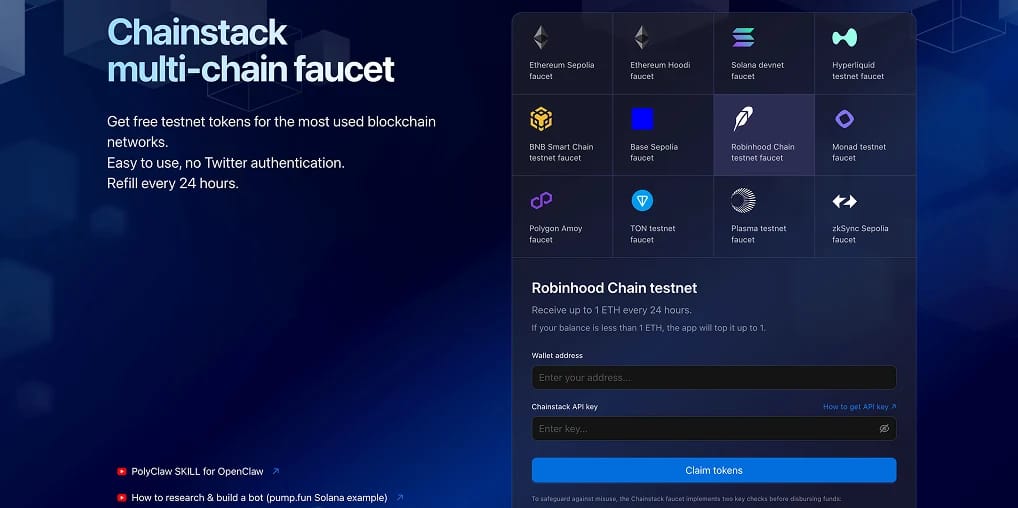
Start with Chainstack, which offers the largest Robinhood Chain testnet allocation. It tops qualifying addresses up to 1 test ETH every 24 hours, roughly ten times a typical faucet drip. Our top-up arrived in under a minute.
Chainstack does not require a social post. Its faucet also supports Ethereum Sepolia, Hoodi, Base Sepolia and Monad testnet.
Here is the Chainstack claim from start to finish:
- Create an API key: Register for a free Chainstack account and generate a platform API key. The faucet uses this to connect each claim to a verified account instead of requiring a social login.
- Open the faucet: Visit the Chainstack Robinhood Chain faucet, then enter your wallet address and API key.
- Pass the eligibility check: Your address must hold at least 0.08 ETH on Ethereum mainnet and have a history of holding it. Use an established wallet rather than a newly created one.
- Claim and confirm: Submit the request, switch your wallet to Chain ID 46630 and confirm that its balance rises to 1 ETH. The next claim becomes available 24 hours later.
The 0.08 ETH threshold is the highest requirement on this list, excluding empty and recently created wallets. QuickNode requires only 0.001 mainnet ETH, while Robinhood's official faucet has no balance requirement. Use the comparison below if your address does not qualify for Chainstack.
Claiming Test ETH and Stock Tokens from the Official Faucet
Robinhood's faucet is the only option that distributes assets beyond gas tokens. When the testnet opened in February, Arbitrum's factsheet explained that developers could request test ETH and simulated Stock Tokens. Available tokens included Tesla, Amazon, Palantir, Netflix and AMD, allowing builders to test against the tokenised equities planned for the chain before they existed on mainnet.
Visit faucet.testnet.chain.robinhood.com, paste your address, select an asset and submit the request. Robinhood does not publish a fixed allocation or cooldown. We use its faucet for test Stock Tokens and rely on third-party providers when larger amounts of ETH are needed.
Robinhood Chain Faucet Limits Compared
Public faucets limit their distributions because an unrestricted pool can empty within hours. Each provider differs in the amount offered and the evidence required to confirm that a claimant is a genuine developer. The table below is how the main Robinhood Chain testnet faucets compare.
Bridging Sepolia ETH to Robinhood Chain Testnet
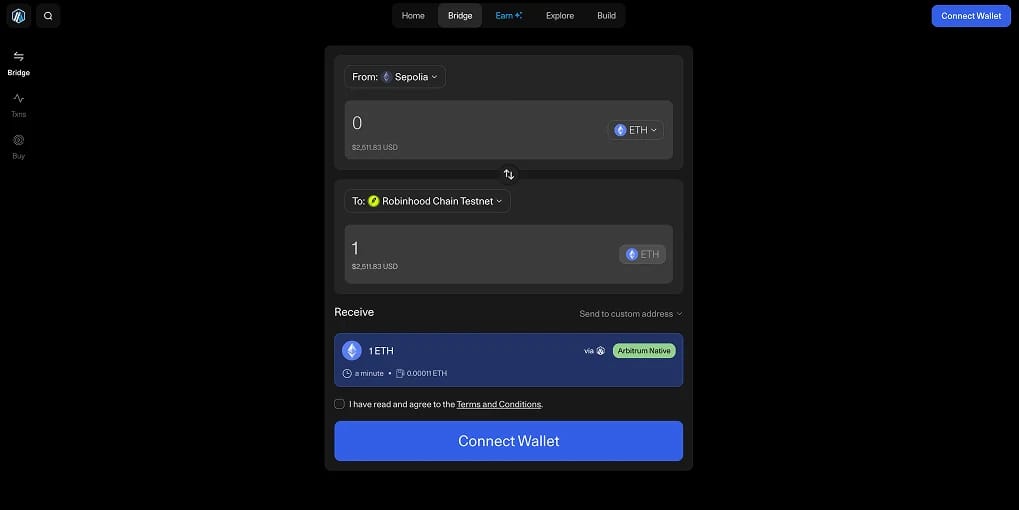
Existing Sepolia ETH can be moved to Robinhood Chain testnet through the Arbitrum bridge, since the testnet settles to Ethereum Sepolia. The interface also moves real ETH onto Robinhood Chain mainnet, making a testnet deposit a free rehearsal. Our bridge to Robinhood Chain guide covers the mainnet options.
Connect your wallet to Ethereum Sepolia, select Robinhood Chain Testnet as the destination and enter an amount before approving the transaction. Robinhood's bridging documentation estimates that deposits take about ten minutes. If a deposit fails on the Robinhood side, it can be redeemed manually from the bridge within seven days.
Withdrawals to Sepolia are subject to a seven-day challenge period. During this time, anyone can dispute a fraudulent state update, so it is generally easier to keep test funds on the Layer 2.
Sepolia is scheduled to retire around the end of September under the Ethereum Foundation's testnet lifecycle, with a successor network expected to overlap with it. Robinhood had not published a migration plan for the testnet's settlement layer when we checked. Review the Notices & Upgrades page before building anything long-lived on Chain ID 46630.
Why Are My Robinhood Chain Testnet Tokens Not Arriving?
A missing faucet payment is usually queued or visible on the wrong network. Robinhood Chain produces a block every 100 milliseconds. Once the faucet transaction reaches the sequencer, which is the operator responsible for ordering transactions, confirmation is nearly instant. This generally leaves the faucet or wallet configuration as the source of the problem.
Work through these causes before submitting another request:
- Mainnet instead of testnet: Chain IDs 4663 and 46630 are easy to confuse. A wallet connected to mainnet will not display the testnet funds until you switch networks.
- Sepolia balance, not Robinhood balance: Ethereum Sepolia ETH remains on a separate chain and must be bridged before it can pay gas on Robinhood Chain.
- Cooldown still running: Chainstack and Alchemy reset every 24 hours, while QuickNode resets every 12 hours. Repeat claims submitted within these periods may fail without a clear message.
- Eligibility not met: Some faucets require mainnet ETH, transaction history or a completed identity check. Choose a provider whose conditions your wallet satisfies.
- Faucet queue: Providers sometimes batch transactions during busy periods, leaving a drip pending before it is broadcast.
If the funds have not appeared after an hour, enter your address in the testnet explorer. An incoming transfer confirms that the faucet paid, meaning your wallet needs to be refreshed or switched to the correct network. If the explorer shows no transaction, the request never left the faucet and you should use another source.
About Robinhood Chain
Robinhood Chain is an Ethereum Layer 2 built with Arbitrum's technology. Robinhood operates the network to support tokenised stocks, ETFs and DeFi. Contract deployment is open to anyone, while EVM compatibility allows Solidity, Hardhat, Foundry and standard Ethereum wallets to work unchanged. Our Robinhood Chain explainer examines the architecture in more detail.
The public testnet opened on 10 February and processed more than 200 million transactions before mainnet, according to the Arbitrum DAO. Blocks arrive every 100 milliseconds. Transactions are ordered strictly by arrival time, preventing users from paying to move ahead in the queue.
Under the Arbitrum Expansion Program licence, 10% of protocol net revenue goes to the Arbitrum DAO. Uniswap, Morpho, Chainlink and the Paxos-issued USDG stablecoin were live at launch.
Stock Tokens are the network's core product. They are structured as tokenised debt securities issued by a Jersey entity and can be traded around the clock in more than 120 countries, though they are unavailable to US persons. Developers can rehearse mainnet applications against simulated versions of these tokens first.
Our Robinhood Chain statistics page tracks network activity. The tokenised stock exchanges ranking covers the platforms where the live tokens trade.
Final Thoughts
Funding a Robinhood Chain testnet wallet takes only a few minutes when you choose a faucet that matches your wallet. Chainstack offers the largest allocation to addresses holding 0.08 mainnet ETH. QuickNode is the fastest option for wallets with a smaller balance, while Alchemy provides a predictable 0.1 ETH per day. Use Robinhood's official faucet for simulated Stock Tokens or bridge any Sepolia ETH you already hold through Arbitrum.
Check that your wallet is connected to Chain ID 46630 before each claim and split requests between two providers. Once funded, the wallet can deploy at no cost within the same Arbitrum-based EVM environment used by Robinhood's live Stock Tokens.