




Can I Get Sepolia Testnet ETH?
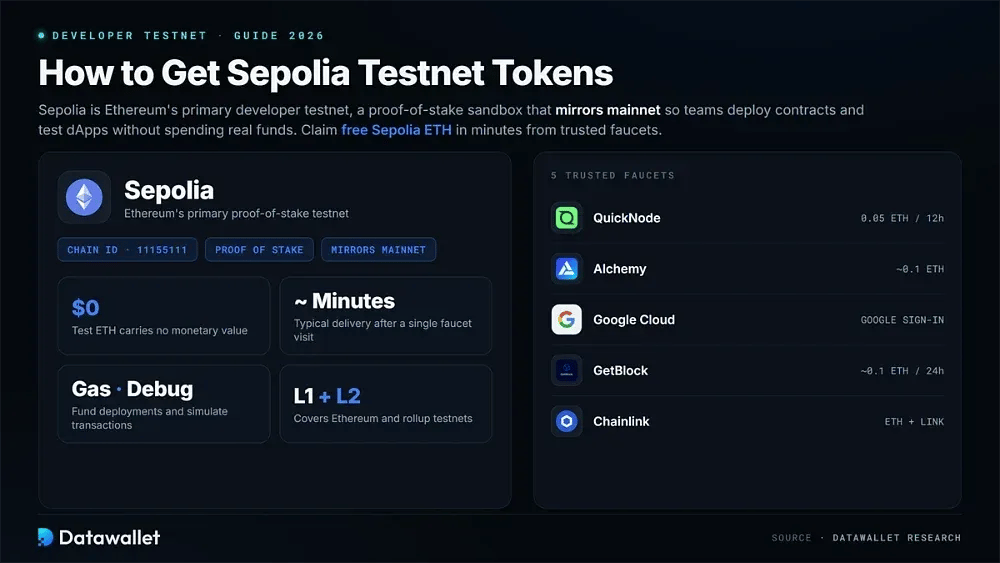
Yes, and the process is free. Sepolia ETH carries no monetary value, so faucets hand it out specifically to fund testing. Before claiming, connect your wallet to the Sepolia network using Chain ID 11155111, since a faucet cannot deliver tokens to an address it cannot resolve on the correct chain.
Once your wallet is pointed at Sepolia, a single visit to a trusted faucet drops test ETH into your balance, usually within a few minutes. Developers rely on these tokens to pay gas while deploying smart contracts, simulating transactions, and debugging failures in an environment that behaves almost identically to Ethereum mainnet.
One detail trips up newcomers: Sepolia also underpins many Layer 2 testnets, so Base, Arbitrum, and Blast each run their own Sepolia variant. Claiming Ethereum Sepolia ETH does not automatically fund those rollups, so always pick the faucet network that matches the exact chain you intend to test against.
How to Get Sepolia Testnet Tokens
The most reliable faucet for most developers is QuickNode's multi-chain drip, which covers Ethereum Sepolia alongside Base Sepolia, Arbitrum Sepolia, and more than 25 other networks from a single interface. It ranks first because it pairs broad coverage with a fast, predictable claim flow that rarely leaves you empty-handed.
Claim Sepolia ETH from QuickNode in four short steps:
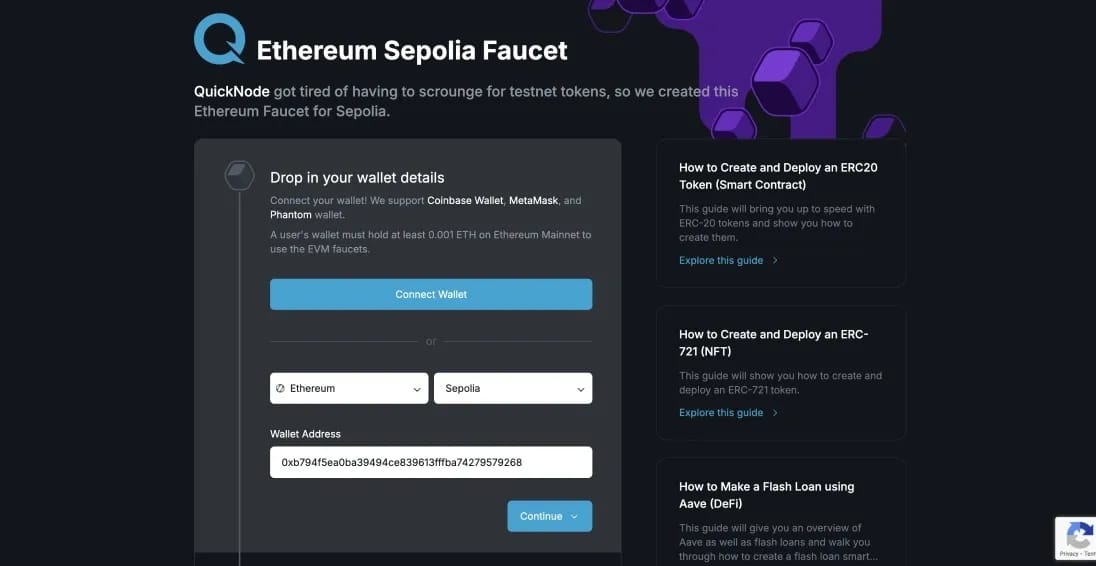
- Open the faucet: Visit the QuickNode Sepolia Faucet and connect a supported wallet such as MetaMask, Coinbase Wallet, Phantom, or Uniswap Wallet directly.
- Select the network: Choose Ethereum as the chain and Sepolia as the network, confirming your wallet is switched to Sepolia so the balance appears after delivery.
- Boost the drip: Post the prompted tweet about QuickNode and paste the link to double your allocation, or simply skip this optional step entirely.
- Confirm receipt: Watch your wallet for the incoming transaction, which usually lands within minutes but can take up to a few hours during peak congestion.
QuickNode requires a small mainnet balance of at least 0.001 ETH on the connected address, a common anti-bot measure across faucets. If you hold no mainnet ETH at all, skip ahead to the alternatives section, where several faucets waive that requirement entirely for first-time developers.
What Is the Faucet Limit of Sepolia Ethereum?
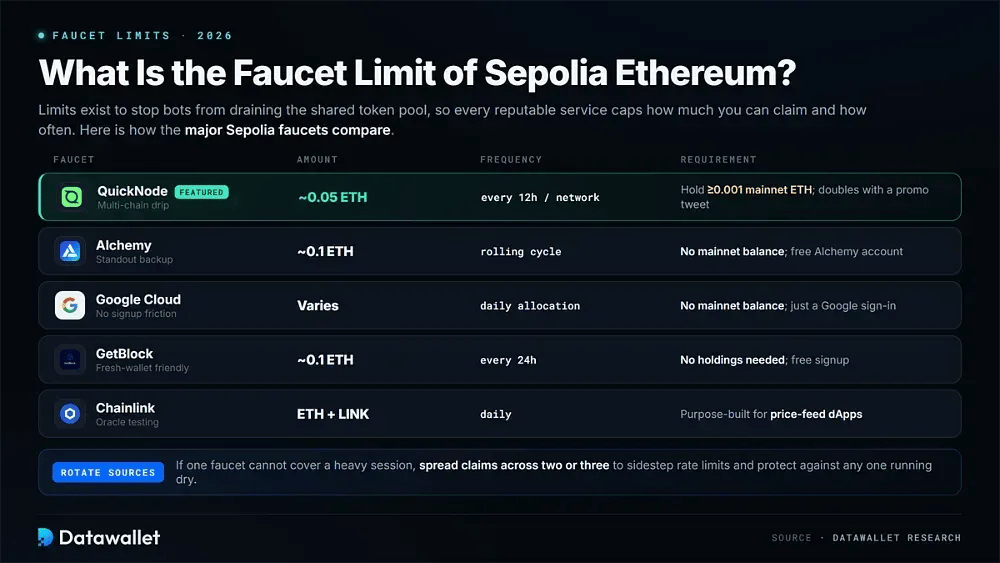
Faucet limits exist to stop bots from draining the shared token pool, so every reputable service caps how much you can claim and how often.Different faucets strike different balances between generosity and friction.
Here is how the major Sepolia faucet limits compare in 2026:
- QuickNode: Roughly 0.05 ETH every 12 hours per network, doubling with a promotional tweet, but requires holding at least 0.001 mainnet ETH to qualify.
- Alchemy: About 0.1 Sepolia ETH on a rolling cycle with no mainnet balance requirement, gated only behind a free Alchemy account for verification.
- Google Cloud: A convenient no-mainnet-balance option requiring just a Google sign-in, though daily allocations fluctuate based on the faucet's available reserves.
- GetBlock: Around 0.1 ETH every 24 hours after a free signup, with no mainnet holdings needed, making it useful for brand-new wallets.
- Chainlink: Distributes Sepolia ETH alongside test LINK tokens daily, purpose-built for developers testing oracle-powered dApps and price feed integrations.
If a single faucet cannot cover a heavy testing session, spreading claims across two or three sources is standard practice. Rotating between them sidesteps individual rate limits and protects you against any one faucet running dry during a busy development sprint.
Sepolia Faucet Alternatives
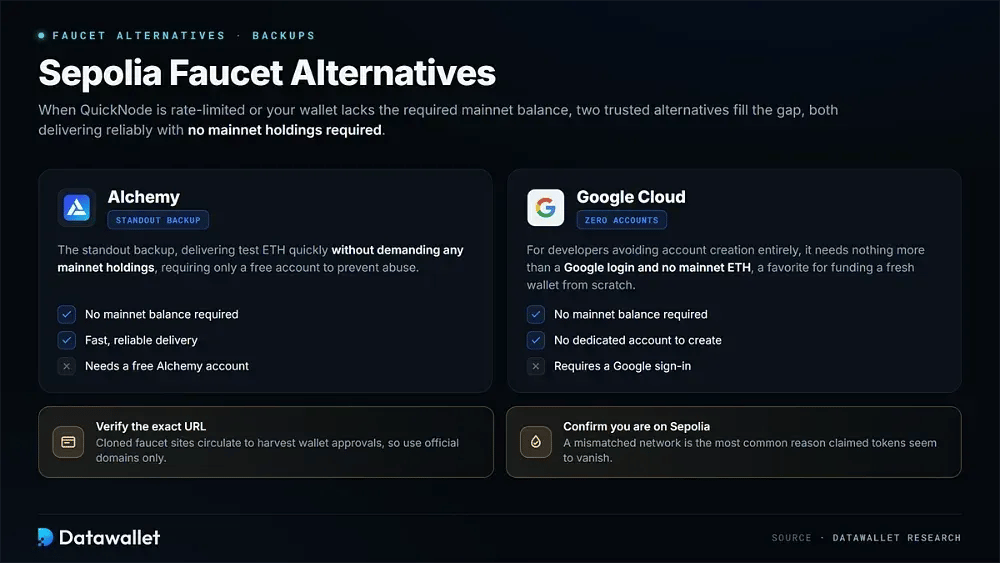
When QuickNode is rate-limited or your wallet lacks the required mainnet balance, several trusted alternatives fill the gap. Alchemy's Sepolia faucet is the standout backup, delivering test ETH quickly without demanding any mainnet holdings, requiring only a free account to prevent abuse.
For developers who want to avoid account creation entirely, Google Cloud's Sepolia faucet needs nothing more than a Google login and no mainnet ETH, making it a favorite for those funding a fresh wallet from scratch. Both deliver reliably and pose no security concerns, provided you use the official domains.
Two habits keep alternative faucets working smoothly. Always verify the exact URL before connecting, since cloned faucet sites occasionally circulate to harvest wallet approvals, and confirm your wallet sits on Sepolia rather than mainnet before claiming, because a mismatched network is the single most common reason tokens seem to vanish.
Which Faucet Should You Use for Layer 2 Testing
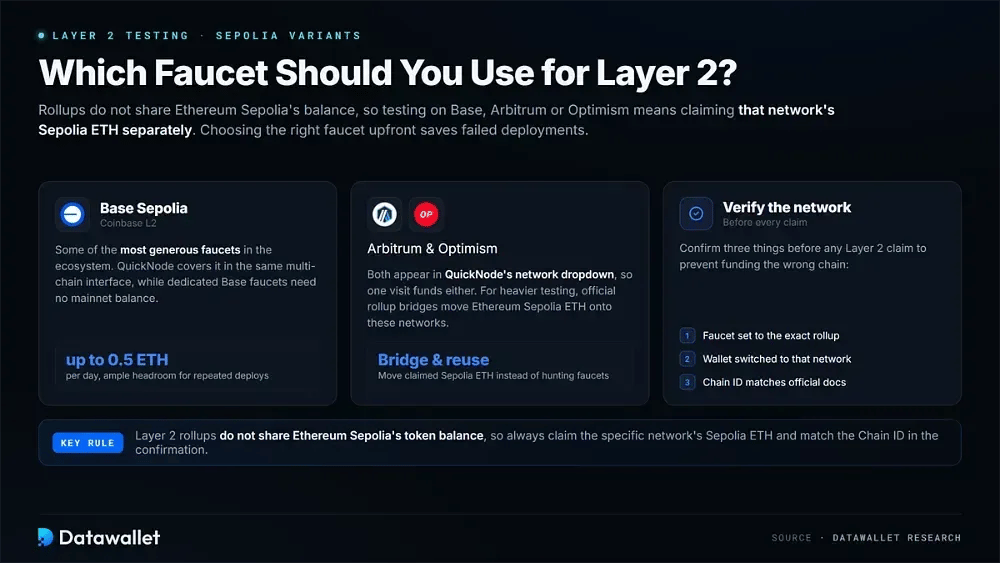
Layer 2 rollups do not share Ethereum Sepolia's token balance, so testing on Base, Arbitrum, or Optimism means claiming that specific network's Sepolia ETH separately. Choosing the right faucet upfront saves you from deploying against an unfunded chain and watching every transaction fail.
1. Base Sepolia
Base Sepolia has some of the most generous faucets in the ecosystem, which suits developers iterating rapidly on Coinbase's Layer 2. QuickNode covers it in the same multi-chain interface, while several dedicated Base faucets drip up to 0.5 ETH per day without a mainnet balance requirement, giving you ample headroom for repeated contract deployments.
2. Arbitrum and Optimism Sepolia
Arbitrum Sepolia and Optimism Sepolia both appear in QuickNode's network dropdown, so a single faucet visit can fund either one. For heavier testing, the official rollup bridges let you move Ethereum Sepolia ETH onto these networks, an efficient way to reuse tokens you already claimed rather than hunting for separate faucet allocations.
3. Verifying the Right Network
Before every Layer 2 claim, confirm three things: the faucet is set to the exact rollup you need, your wallet is switched to that network, and the Chain ID in the confirmation matches official documentation. This quick check prevents the frequent mistake of funding Ethereum Sepolia when your contract actually lives on a Layer 2 network.
Why Are My Sepolia Tokens Not Arriving?
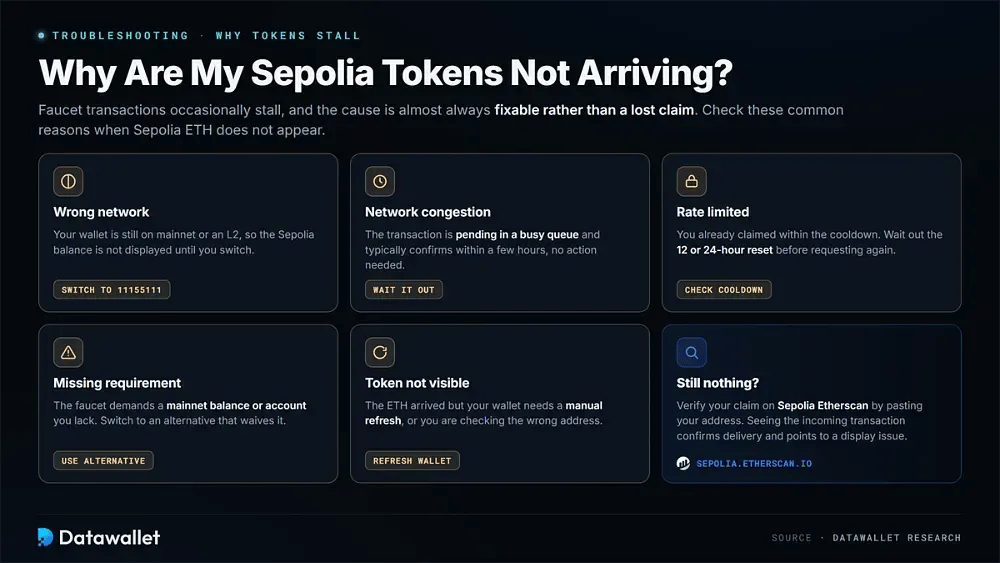
Faucet transactions occasionally stall, and the cause is almost always fixable rather than a lost claim. Test networks experience congestion just like mainnet, and faucets sometimes set gas low to conserve reserves, which pushes your transaction behind higher-priority ones in the queue.
Check these common causes when Sepolia ETH does not appear:
- Wrong network: Your wallet is still on mainnet or a Layer 2, so the Sepolia balance simply is not displayed until you switch to Chain ID 11155111.
- Network congestion: The faucet transaction is pending in a busy queue, and it typically confirms within a few hours without any action needed from you.
- Rate limited: You already claimed within the faucet's cooldown window, so wait out the 12 or 24-hour reset before attempting another request from that source.
- Missing requirement: The faucet demands a mainnet balance or account you have not provided, so switch to an alternative that waives that particular condition.
- Custom token missing: The ETH arrived but is not visible because your wallet needs a manual refresh, or you are checking a block explorer for the wrong address.
If tokens still fail to appear after a few hours across multiple faucets, verify your claim on Sepolia Etherscan by pasting your address. Seeing the incoming transaction there confirms delivery succeeded and points the problem back to a wallet display issue rather than the faucet.
About Sepolia
Sepolia launched in 2021 and transitioned to proof-of-stake, giving developers a lightweight, permissioned-validator testnet that closely replicates Ethereum mainnet behavior. It became the ecosystem's recommended environment for contract and dApp work after Goerli was deprecated in 2024, thanks to faster syncing, a controlled validator set, and dependable faucet access.
The network also anchors a wide family of Layer 2 test environments, including Arbitrum Sepolia, Base Sepolia, and Optimism Sepolia, which makes it central to nearly every EVM development workflow. That breadth is exactly why keeping a small Sepolia ETH reserve on hand has become routine for active builders.
One critical planning note: Sepolia is approaching end-of-life. The Ethereum Foundation has scheduled its retirement for around September 2026, with a successor testnet launching earlier in 2026 and running in parallel during a grace period. Sepolia remains the correct choice for contract testing today, but teams planning long-running deployments should track the Ethereum Foundation's roadmap and prepare to migrate before support ends.
Final Thoughts
Sepolia remains the backbone of Ethereum testing in 2026, offering a free, mainnet-like environment where developers validate contracts and dApps before risking real capital. Trusted faucets such as QuickNode, Alchemy, and Google Cloud make funding a test wallet quick, whether you need Ethereum Sepolia ETH or tokens for a Layer 2 rollup.
Keep the practical details in mind: verify official faucet URLs, confirm your wallet sits on Chain ID 11155111, spread claims across sources to beat rate limits, and watch the network's approaching sunset. With those habits, you will always have test ETH ready and a clear path to whichever testnet replaces Sepolia next year.