
What is Stonk Fun?
Stonk Fun is a Solana launchpad built around an unusual design choice: creators decide what their coin trades against. A launch does not have to use the standard SOL or stablecoin pairing. Instead, it can be quoted in tokenized stocks, pre-IPO exposure tokens, commodities, currencies, or other crypto assets, with the market priced entirely in the selected asset.
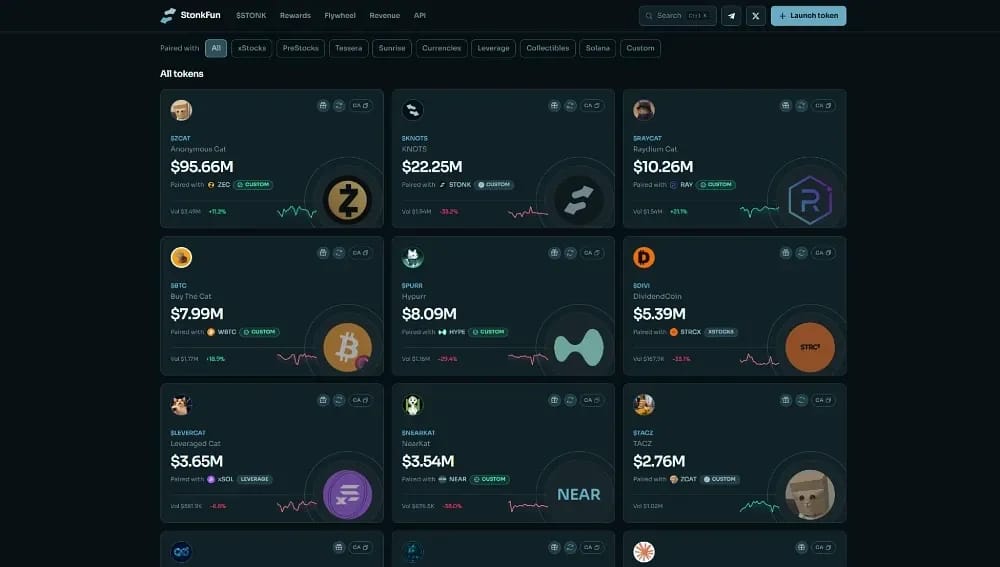
Its supported asset menu is broad. Available options include xStocks from Backed Finance such as SPYx, NVDAx, and QQQx; PreStocks pre-IPO tokens including OPENAI and ANTHROPIC; and crypto assets such as ZEC, WBTC, HYPE, and TAO. Our guide to the best tokenized stock exchanges compares the major stock-token issuers.
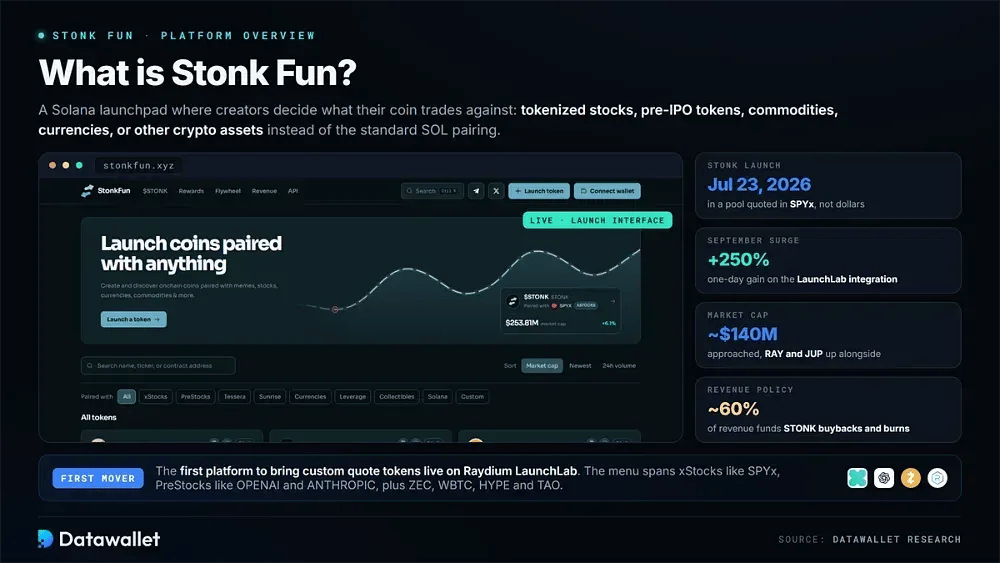
STONK, the platform's native token, launched on July 23, 2026 in a pool quoted in SPYx, the tokenized S&P 500 tracker. Rather than being priced directly in dollars, STONK trades in index units. Its chart therefore reflects both demand for STONK and movements in the underlying equity benchmark.
Momentum accelerated in September. Stonk Fun became the first platform to bring custom quote tokens live on Raydium LaunchLab, after which The Block reported that STONK gained more than 250% in one day. Its market capitalisation approached $140 million, while RAY and JUP rallied alongside it.
Platform economics add another layer to that activity. According to the official revenue page, approximately 60% of revenue goes toward open-market STONK purchases followed by burns. Another program uses pool fees to buy and burn the ten largest coins on Stonk Fun. Holders of launched tokens can also receive rewards denominated in the relevant quote asset.
How Does Stonk Fun Work?
Stonk Fun provides the market-creation infrastructure rather than issuing the launch tokens itself. Each deployment mints a fixed supply, opens trading immediately, and routes fees through the platform. All new deployments have used Raydium LaunchLab infrastructure since September 6.
Earlier launches opened one-sided concentrated liquidity pools directly, and those markets remain tradable onchain. The current LaunchLab route handles quote selection and bonding curve pricing before managing graduation and fee distribution.
1. Pick-Anything Quote Assets
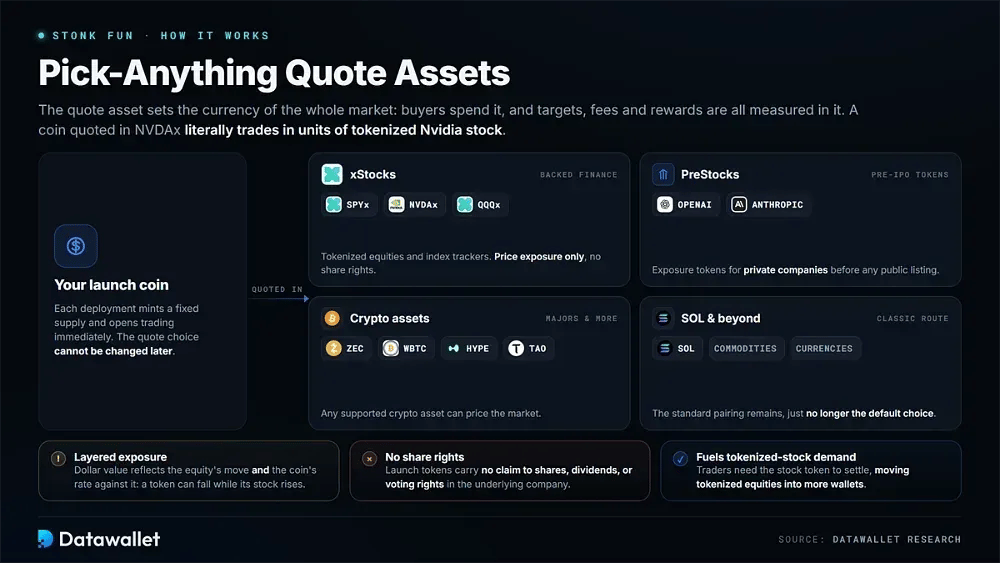
A launch's quote asset determines the currency in which its market operates. Buyers spend that asset, graduation targets are measured in it, creator fees accrue in the same denomination, and holder rewards are paid with it. If a coin is quoted in NVDAx, for example, it literally trades in units of tokenized Nvidia stock.
That structure creates layered exposure. The dollar value of a stock-paired coin reflects both the underlying equity's price movement and the coin's exchange rate against that equity. A token can therefore lose value even while its paired stock rises. Ownership of the launch token also provides no claim to shares, dividends, or voting rights.
The effect on tokenized-stock demand is measurable. Memecoin traders need the relevant stock token to settle trades, moving tokenized equities into more wallets and liquidity pools. Our tokenization statistics guide tracks the wider growth of the onchain equity market.
2. Bonding Curve Launches on Raydium LaunchLab
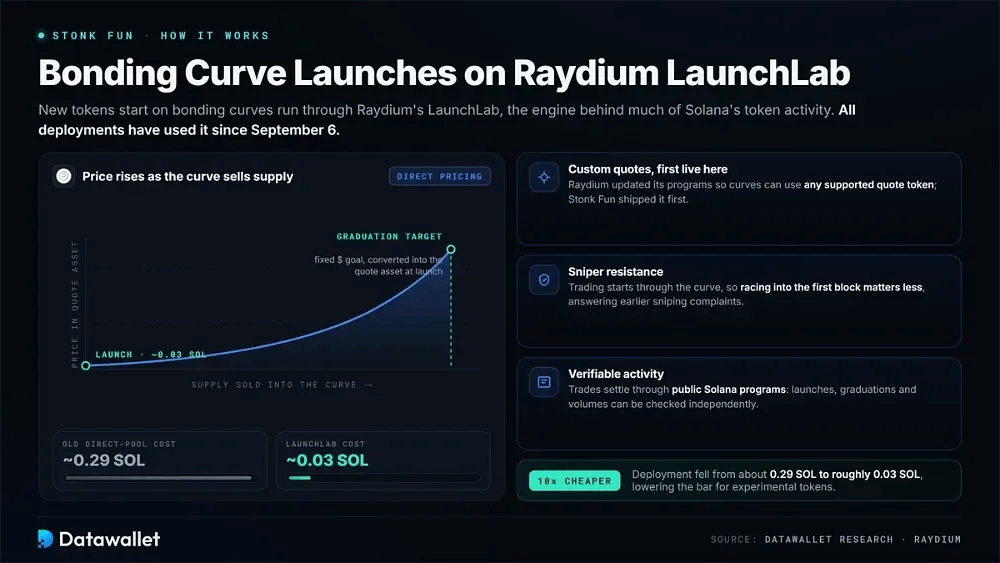
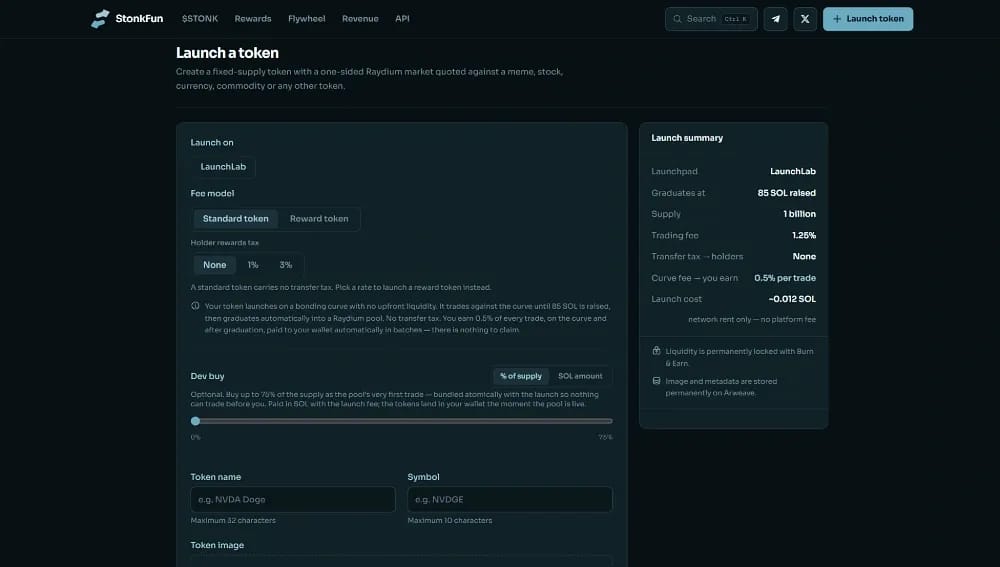
New Stonk Fun tokens begin trading on bonding curves operated through Raydium's LaunchLab program, the same launch engine behind much of Solana's token activity. Stonk Fun adopted the infrastructure to lower deployment costs and reduce the advantage held by snipers.
What the curve mechanics mean for creators and traders:
- Direct pricing: Buyers and sellers interact with the curve rather than another counterparty. Prices increase as more supply is sold and fall when tokens are redeemed.
- Custom quotes: Raydium updated its programs to let curves use any supported quote token. Stonk Fun was confirmed as the first integration partner to bring the feature live.
- Cheaper deployment: A launch now costs roughly 0.03 SOL, down from about 0.29 SOL under the previous direct-pool system. That materially lowers the entry cost for experimental and community-driven tokens.
- Sniper resistance: Because trading starts through the curve, racing to enter the first block provides less of an advantage. The change addresses earlier complaints about sniping and single-wallet launches.
- Dollar-based targets: A fixed dollar graduation goal is converted into the chosen quote asset when a token launches. As a result, raise thresholds can differ even between launches using the same quote token.
- Verifiable activity: Curve trades settle through public Solana programs. Launch counts, graduations, and trading volumes can therefore be checked independently instead of relying on platform dashboards.
3. Graduation into Locked Raydium Pools
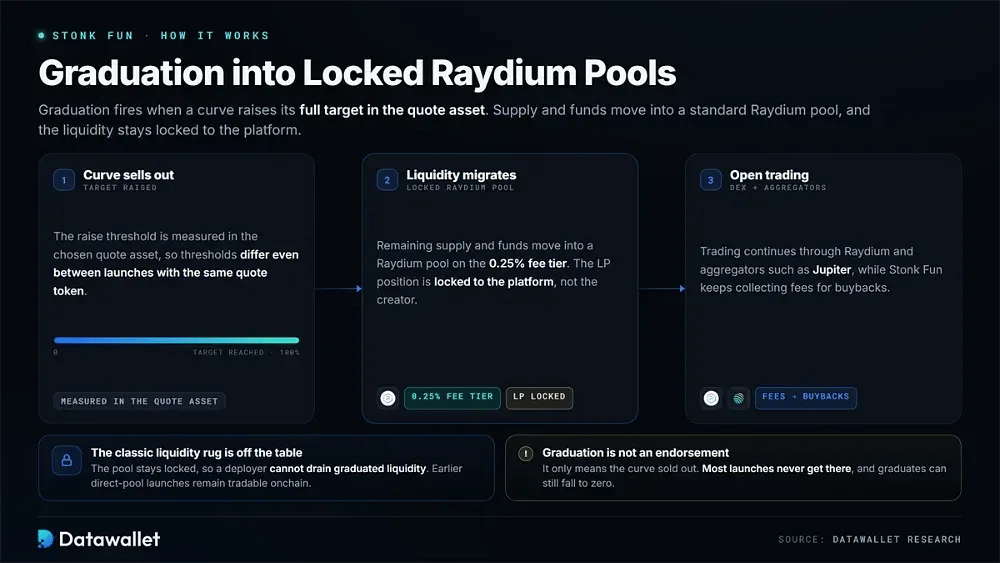
Graduation occurs when a bonding curve raises its full target in the quote asset. The remaining token supply and the accumulated funds then move together into a standard Raydium pool on the 0.25% fee tier. From there, trading continues through Raydium and aggregators such as Jupiter.
The resulting liquidity position stays locked to the platform instead of being transferred to the creator. A deployer cannot simply drain the pool in a conventional liquidity rug. Stonk Fun, meanwhile, continues collecting fees from graduated markets and can recycle them into buybacks rather than permanently burning the liquidity position.
Graduation should not be treated as an endorsement. It means the curve sold out and a real liquidity pool now exists. Most launches never reach that point, and those that do can still fall to zero as soon as trader attention moves elsewhere, just as they can on any other launchpad.
4. Fees, Creator Payouts and Holder Rewards
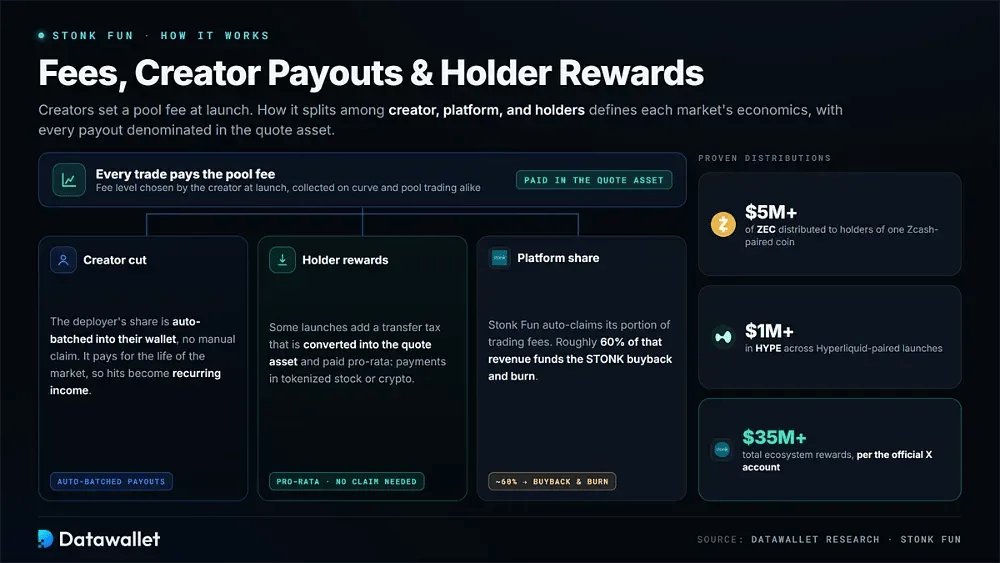
Creators set a pool fee when launching a token on Stonk Fun. How that fee is divided among the creator, platform, and token holders determines the economics of each market.
How the money moves once a token is live:
- Pool fees: The creator chooses the trading fee level. After graduation, the creator's share is automatically batched into their wallet, with no manual claim required.
- Creator cut: A deployer's percentage continues to be paid in the quote asset throughout the market's life. Successful launches can therefore produce recurring income instead of a single upfront payment.
- Reward tokens: Some launches apply a transfer tax that is converted into the paired quote asset and distributed pro-rata to holders, effectively producing payments in tokenized stock or crypto.
- Proven distributions: The team reports distributing more than $5 million of ZEC to holders of one Zcash-paired coin and over $1 million in HYPE across Hyperliquid-paired launches.
- Ecosystem total: The official X account says holders across the wider Stonk Fun ecosystem have received more than $35 million in rewards.
- Platform share: Stonk Fun automatically claims its portion of trading fees. Roughly 60% of that revenue funds the STONK buyback described in the tokenomics section below.
How to Launch or Trade a Token on Stonk Fun
Using Stonk Fun requires a Solana wallet with enough SOL to cover deployment and network fees. Traders buying a stock-paired launch also need the relevant quote asset. Both launching and trading take place through the same interface.
A typical path from empty wallet to live token looks like this:
- Set up a wallet: Install a self-custodial wallet such as Phantom or Solflare. Our guide to the best Solana wallets covers security trade-offs and hardware support in detail.
- Fund with SOL: Purchase SOL on an exchange and withdraw it to your wallet. Keep enough available for the roughly 0.03 SOL deployment cost and additional network fees.
- Connect to the site: Go to stonkfun.xyz and check the domain carefully to avoid phishing clones. Approve the wallet connection from the launch page before entering token details.
- Choose a quote asset: Decide what the coin will trade against. Options include an xStock, a PreStocks pre-IPO token, another crypto asset, or SOL. The choice cannot be changed later.
- Configure the token: Enter the name and ticker, upload an image, add social links, and select the pool fee level that determines your creator share from each trade.
- Deploy and trade: Launch the token onto its bonding curve. Trading then takes place against the curve with an appropriate slippage tolerance while the market progresses toward graduation.
- Trade after graduation: When the curve reaches its target, liquidity moves into a locked Raydium pool and becomes accessible through aggregators across Solana.
- Collect earnings: Creator fees are automatically batched into the creator's wallet in the quote asset. Holders of reward-enabled tokens receive distributions without needing to claim them manually.
STONK Tokenomics & Supply
STONK is a standard SPL token that launched with a supply of one billion. Its economics centre on one mechanism: using platform revenue for open-market purchases that steadily reduce supply through burns.
Supply and Distribution
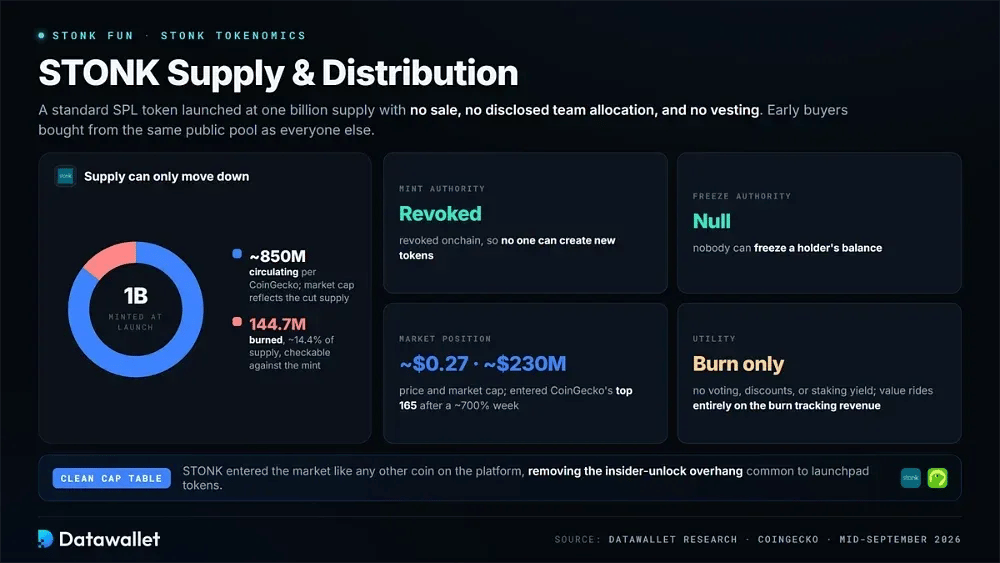
There was no structured sale, disclosed team allocation, or vesting schedule when STONK launched. It entered the market like any other coin created on the platform, with early buyers purchasing from the same public pool. That removes the insider-unlock overhang attached to many other launchpad tokens.
Key supply facts as of mid-September:
- Maximum supply: One billion STONK were minted at launch. The mint authority has since been revoked onchain, preventing any party from creating additional tokens.
- Frozen controls: The freeze authority is also null, so nobody can freeze a holder's balance. Supply can only move downward.
- Burned supply: Roughly 144.7 million STONK has been destroyed, equivalent to about 14.4% of the original supply. The figure can be checked directly against the mint.
- Circulating supply: CoinGecko reports approximately 850 million tokens remaining, meaning market capitalisation already reflects the reduced supply rather than the original one billion.
- Market position: STONK trades at around $0.27 with a market capitalisation near $230 million. It entered CoinGecko's top 165 after gaining roughly 700% in one week.
- No governance: STONK offers no voting rights, fee discounts, or staking yield. Its value therefore depends entirely on the burn mechanism tracking platform revenue.
The Burn & Earn Flywheel
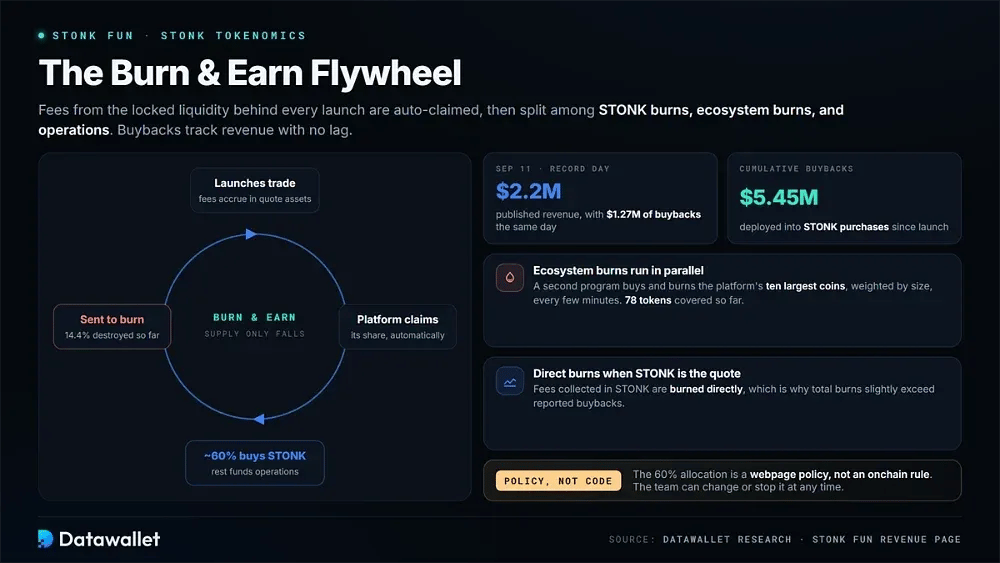
Trading fees generated by the locked liquidity behind Stonk Fun launches are automatically claimed by the platform. Revenue is then divided among STONK burns, ecosystem burns, and operations. On September 11 alone, Stonk Fun published revenue of $2.2 million and buybacks worth $1.27 million.
How the flywheel converts trading into supply reduction:
- STONK buybacks: About 60% of platform revenue is used to purchase STONK on the open market before the acquired tokens are sent to the burn address. The balance is retained for operations.
- Direct burns: When STONK itself is the quote asset for a launch, collected fees can be burned directly instead of first going through an open-market purchase. This is why total burns slightly exceed reported buyback totals.
- Ecosystem burns: Another program continually buys and burns the platform's ten largest coins by market capitalisation. Purchases are weighted by size, occur every few minutes, and have covered 78 tokens so far.
- Cumulative scale: Approximately $5.45 million has been deployed into STONK purchases since launch, alongside the quote-asset rewards distributed to holders across the ecosystem.
- Two-way pressure: Buybacks follow revenue without a lag. Burn pressure falls immediately when activity slows and increases just as quickly during high-volume periods.
- Policy caveat: The 60% allocation is a policy published on a webpage, not an immutable onchain rule. The team can change or discontinue it at any time.
Stonk Fun Statistics and Trends
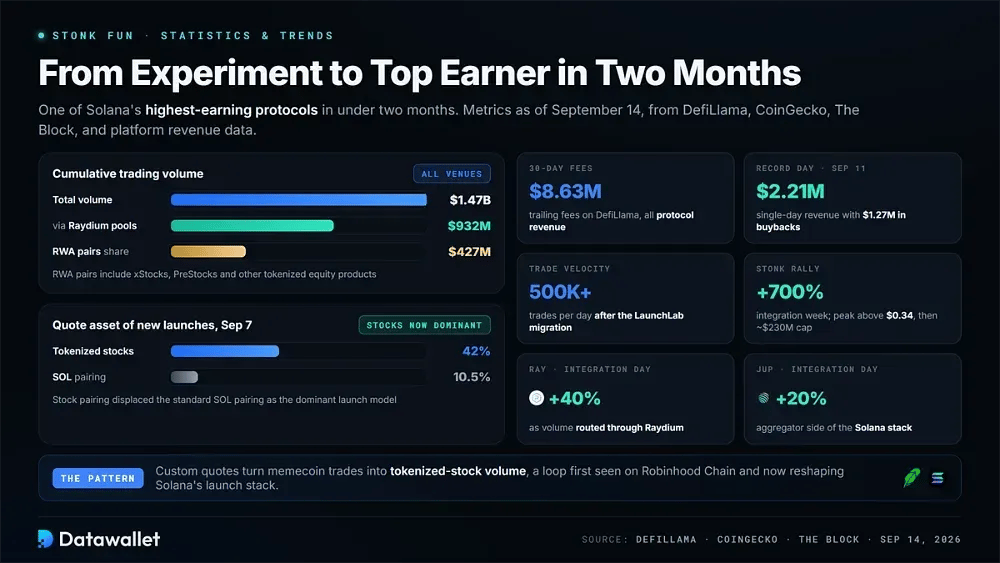
Stonk Fun moved from a little-known experiment to one of Solana's highest-earning protocols in less than two months. The figures below draw on DefiLlama, CoinGecko, The Block, and revenue data published by the platform.
Key metrics as of September 14:
- Monthly fees: DefiLlama recorded $8.63 million in fees over the trailing 30 days, all classified as protocol revenue from the platform's liquidity positions.
- Record revenue: September 11 produced $2.21 million in revenue and $1.27 million in buybacks, the strongest single day reported by the platform since launch.
- Cumulative volume: Trading volume has exceeded $1.47 billion across all venues. About $932 million of that total passed through Raydium pools created by Stonk Fun.
- RWA share: Roughly $427 million came from real-world asset pairs, including xStocks, PreStocks, and other tokenized equity products.
- Launch mix: By September 7, tokenized stocks were the quote asset for around 42% of new launches. SOL accounted for only about 10.5%, indicating that stock pairing had become the dominant model.
- Trade velocity: After the LaunchLab migration, active bonding curves were processing more than half a million trades per day.
- Token rally: STONK rose close to 700% in the week following the integration, reached a peak above $0.34, and then consolidated around a $230 million market capitalisation.
- Ecosystem effect: RAY gained more than 40% on integration day, while JUP rose over 20% as Stonk Fun volume was routed through both parts of the Solana trading stack.
The pattern reaches beyond Stonk Fun itself. Custom quote assets turn memecoin transactions into tokenized-stock volume. That loop first appeared on Robinhood Chain launchpads and is now influencing Solana's launch infrastructure in the same direction.
Stonk Fun vs Pump.fun vs Pons
Pump.fun remains the reference point for Solana launchpads because it established the bonding curve template in January 2024. Stonk Fun uses a similar basic structure but changes the pricing currency, how rewards flow through markets, and the proportion of revenue directed toward token burns.
Pons adds a more direct comparison for Stonk Fun's newer model. It operates on Robinhood Chain and supports fixed-supply launches, including markets priced in tokenized equities. Live Pons markets have used assets such as GME and NVDA as their pricing currency, giving both platforms exposure to the stock-paired memecoin category on different chains.
All three platforms now compete for speculative launch capital. Their daily revenue rankings have changed repeatedly through September: Pons and Stonk Fun have each surpassed Pump.fun on individual days, while Stonk Fun has also briefly moved ahead of Pons before the lead reversed again. Longer-period revenue still gives the more established platforms a substantial advantage.
Is Stonk Fun Safe?
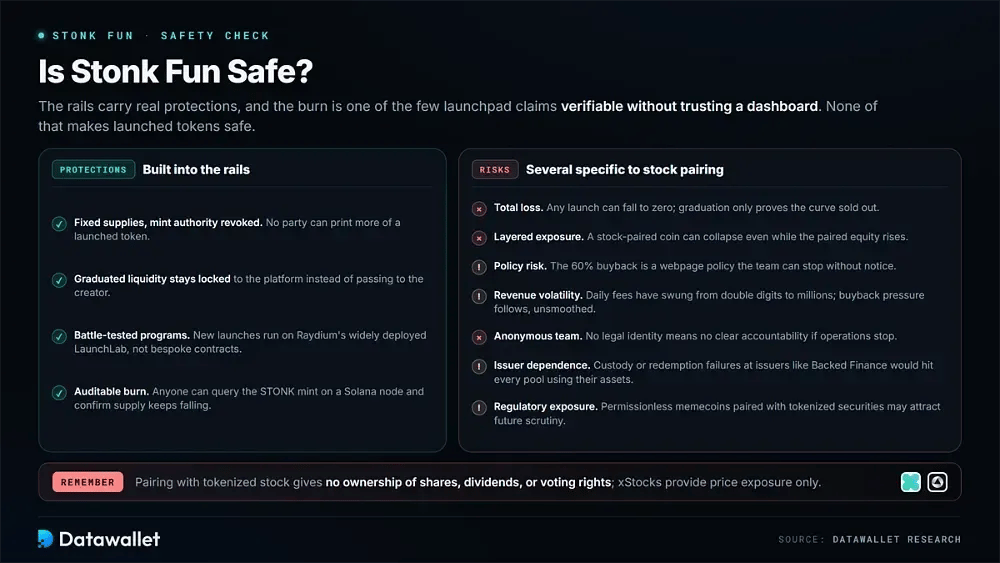
Several protections come from Stonk Fun's underlying infrastructure. Token supplies are fixed and mint authority is revoked. Graduated liquidity stays locked to the platform instead of passing to the creator, while new launches use Raydium's widely deployed LaunchLab programs rather than bespoke, unproven contracts.
The burn mechanism is independently auditable as well. Anyone can query the STONK mint through a Solana node and check whether supply continues to fall. That makes the platform's main economic commitment one of the few launchpad claims that can be verified without trusting its dashboard.
Risks
Those protections do not make tokens launched on Stonk Fun safe. Some of the platform's most important risks are specific to its stock-pairing model.
- Total loss: Any launch token can fall to zero. Graduation proves only that its bonding curve sold out, and most tokens never develop sustained demand.
- Layered exposure: A stock-paired token responds both to meme demand and movement in its underlying equity. The coin can collapse even when the paired stock is rising.
- No share rights: Pairing a coin with tokenized stock does not give its holders ownership of shares, dividends, or voting rights. xStocks themselves provide price exposure only.
- Policy risk: The 60% buyback allocation exists as a stated webpage policy rather than an onchain rule. The pseudonymous team can alter or stop it without notice.
- Revenue volatility: Daily fees have ranged from double digits to millions of dollars. Buyback pressure follows those changes immediately, with no smoothing mechanism.
- Anonymous team: The platform's operator has not disclosed a legal identity. Users therefore have no clear accountability route if operations stop or policies change abruptly.
- Issuer dependence: Stock quote assets depend on third-party issuers such as Backed Finance. Custody failures or redemption problems upstream would affect every pool using those assets.
- Regulatory exposure: Permissionless memecoins paired with tokenized securities combine speculative assets with regulated instruments, a structure that senior industry figures have warned could attract future scrutiny.
Stonk Fun Founders
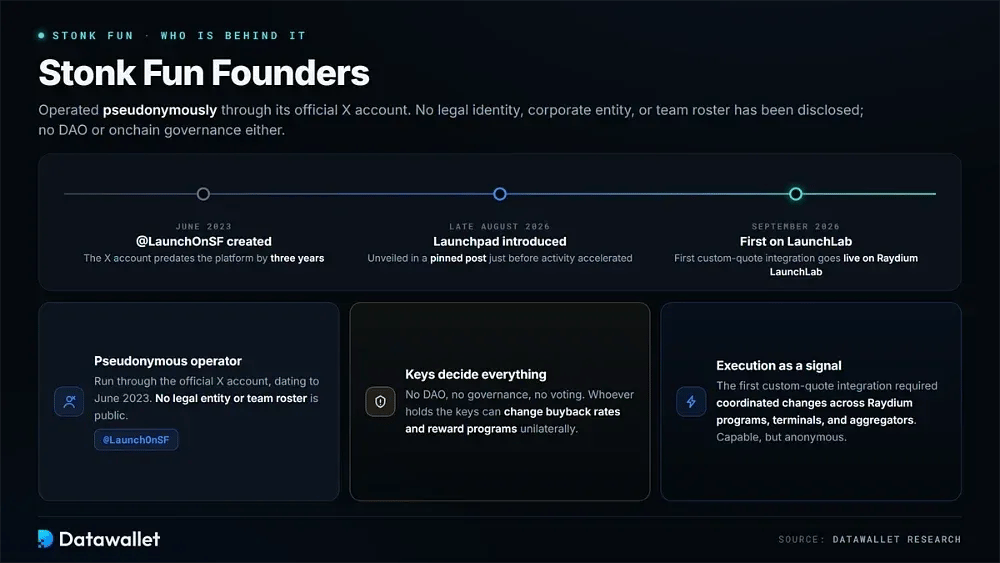
Stonk Fun is operated pseudonymously through its official X account, @LaunchOnSF. The account dates to June 2023 and publicly introduced the launchpad in a pinned post in late August 2026, shortly before activity began to accelerate.
No legal identity, corporate entity, or team roster has been disclosed. Nor is there a DAO, governance function for STONK, or onchain voting process. Whoever controls the platform's keys and accounts therefore makes every operational decision, including changes to the buyback rate and reward programs.
Execution has partly compensated for that lack of transparency. Becoming the first custom-quote integration on Raydium LaunchLab required coordinated changes across Raydium programs, trading terminals, and aggregators. That work points to a technically capable operation, but it does not remove the risks created by anonymity.
Final Thoughts
Stonk Fun compressed the usual launchpad development cycle into a matter of weeks. It found a distinct angle with stock-paired launches, moved onto Raydium infrastructure to address its weakest mechanics, and created a verifiable burn system that has already destroyed more than 14% of STONK's supply. Holder rewards have also reached tens of millions of dollars.
The same features create its main vulnerabilities. Revenue relies on a speculative trend that can rotate quickly. Its buyback policy is controlled through a webpage by an anonymous team, while stock-paired pools add memecoin risk on top of tokenized-equity exposure in a category already attracting regulatory attention.
Treat STONK as a leveraged bet on the stock-paired launch narrative rather than a durable business. Verify the mint address before trading and check burns directly onchain instead of relying on dashboards. Any position should be sized on the assumption that a launch token can fall to zero.