



Trying to decide between Zcash and Monero for private transactions or portfolio exposure? This comparison examines both privacy coins across cryptography, supply design, market performance, security, regulation, and the institutional wave reshaping the sector in 2026.
Privacy coins staged a historic comeback through late 2025 and 2026. Zcash rose from roughly $42 to above $1,000, secured the first US privacy coin ETF, and overtook Monero as the largest privacy asset. Monero also doubled and reached a fresh all-time high near $757.
Compare both privacy coins side by side below. 👇
Zcash vs Monero: Overview
Zcash is a privacy-focused cryptocurrency launched in 2016 by cryptographer Zooko Wilcox-O'Hearn and the Electric Coin Company. It pioneered zk-SNARK encryption on a public blockchain and allows users to choose between transparent and shielded transactions. Its main strengths are auditable scarcity, selective disclosure, and regulated market access.
Monero emerged in 2014 as a community-driven privacy cryptocurrency through a grassroots fork of Bytecoin. No company, foundation treasury, or pre-mine sits behind it. Mandatory transaction privacy and full fungibility define the network, alongside CPU-friendly RandomX mining and an independent development culture built to resist outside capture.
Here is a quick side-by-side comparison of both privacy coins:
Privacy Technology Compared
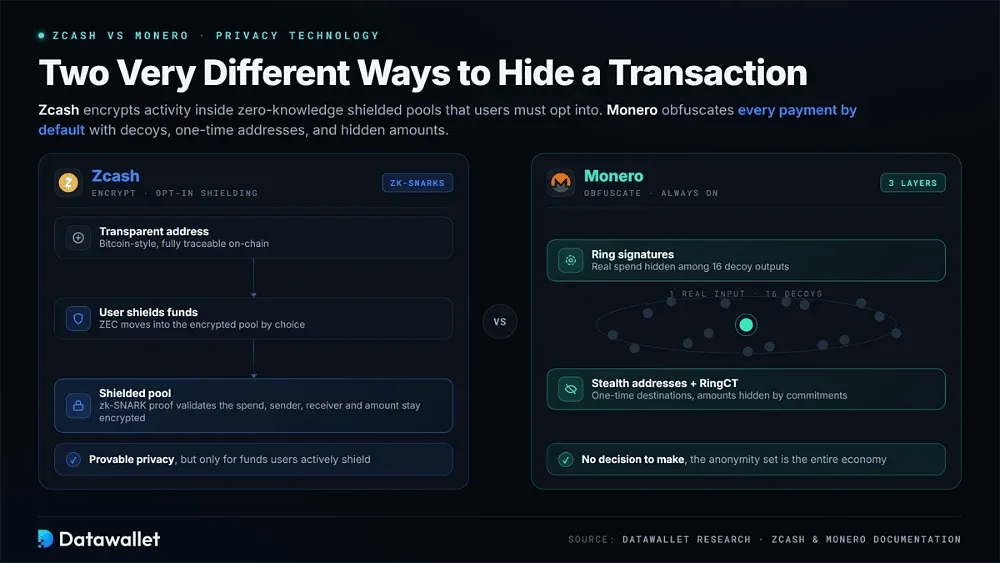
Although Zcash and Monero both conceal transaction data on public ledgers, their cryptographic architectures have little in common. Zcash encrypts activity within zero-knowledge shielded pools. Monero instead obfuscates every payment through decoys, one-time addresses, and hidden amounts.
The practical distinction is more important than the underlying mathematics. Zcash users must actively shield funds to gain privacy. Monero removes that decision altogether, making the effective anonymity set the entire economy rather than a smaller opt-in group.
Zcash Privacy Features
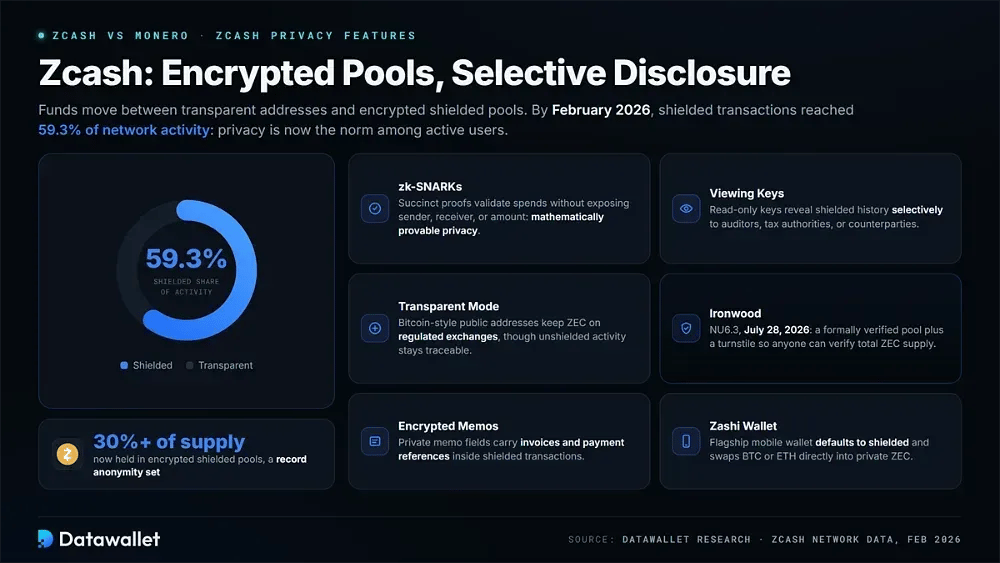
Zcash bases its privacy system on zero-knowledge proofs, the same cryptographic approach used by zk-rollups on Ethereum. Funds can move between transparent addresses and encrypted shielded pools according to a user's disclosure requirements.
The key privacy features that Zcash offers users today include:
- zk-SNARKs: Zero-knowledge succinct proofs confirm the validity of shielded transactions without exposing the sender, receiver, or amount. This gives Zcash mathematically provable privacy rather than probabilistic privacy guarantees.
- Shielded Pools: Private ZEC balances are held in encrypted pools. More than 30% of circulating supply is now shielded, a record level that substantially strengthens the practical anonymity set.
- Transparent Mode: Bitcoin-style public addresses remain available for exchanges and auditing. That helps keep ZEC listed on regulated venues, although any unshielded activity remains fully traceable on-chain.
- Viewing Keys: Holders can provide read-only keys to auditors, tax authorities, or counterparties, revealing shielded transaction history selectively without exposing funds publicly.
- Ironwood: Activated through the NU6.3 upgrade on July 28, 2026, Ironwood introduced a formally verified shielded pool and a turnstile mechanism that allows anyone to independently verify total ZEC supply.
- Encrypted Memos: Private memo fields within shielded transactions can carry invoices, messages, or payment references. Transparent blockchains cannot provide the same functionality without publicly exposing sensitive commercial information.
- Zashi Wallet: Zcash's flagship mobile wallet defaults to shielded transactions and supports cross-chain swaps from Bitcoin or Ethereum directly into private ZEC, making onboarding simpler for non-technical users.
- Shielded Adoption: By February 2026, shielded transactions accounted for 59.3% of network activity. Privacy is therefore the norm among active Zcash users rather than a niche feature.
Monero Privacy Features
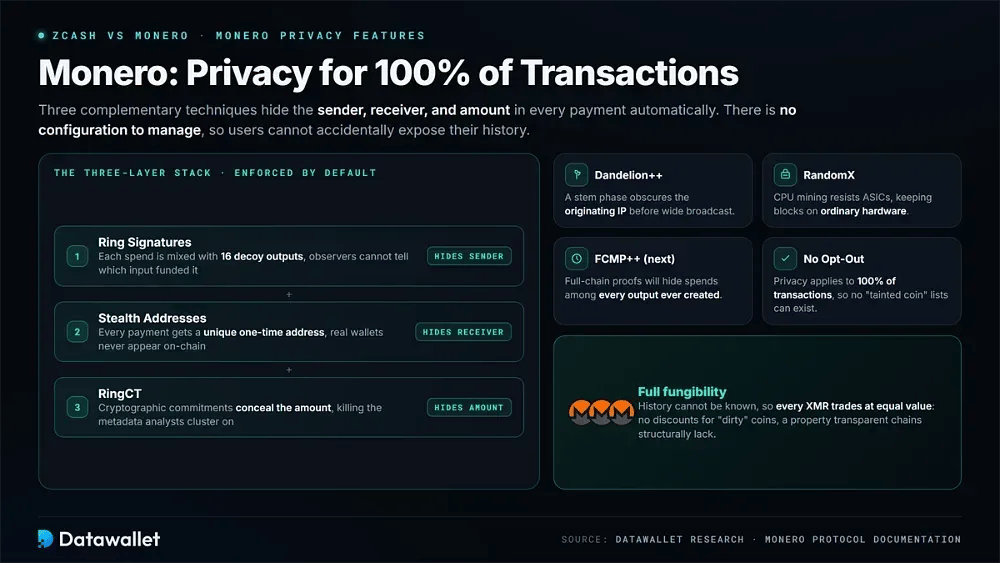
Monero combines three complementary techniques to conceal the sender, receiver, and amount in every transaction automatically. There is no privacy configuration to manage, so users cannot accidentally expose their own financial history on-chain.
The key privacy features that Monero enforces by default include:
- Ring Signatures: Each spend is cryptographically mixed with 16 decoy outputs from the blockchain, making it impossible for observers to determine which input actually funded the transaction being verified.
- Stealth Addresses: Each payment creates a unique one-time destination address. A recipient's real wallet address never appears on-chain, preventing incoming payments from being linked together.
- RingCT: Cryptographic commitments conceal the amount transferred, eliminating the metadata leak that enables analysts to cluster and trace payments on transparent networks such as Bitcoin.
- Default Privacy: Privacy applies to 100% of transactions with no opt-out. Every XMR is therefore indistinguishable from every other, preventing "tainted coin" blacklists from existing.
- Dandelion++: Before transactions are broadcast widely, propagation passes through a stem phase that obscures the originating IP address and adds network-level protection to Monero's on-chain cryptography.
- FCMP++: An upcoming hard fork will replace 16-decoy rings with full-chain membership proofs, concealing each spend among every unspent output ever created across the network.
- RandomX: Monero's CPU-optimized mining algorithm is designed to resist ASICs and keep block production accessible to ordinary hardware, supporting decentralization and indirectly reducing miner-level censorship or surveillance risk.
- Fungibility: Because transaction history cannot be known, all XMR trades at equal value without discounts for "dirty" coins. This gives Monero a monetary property that transparent cryptocurrencies structurally lack.
Zcash vs Monero: Tokenomics
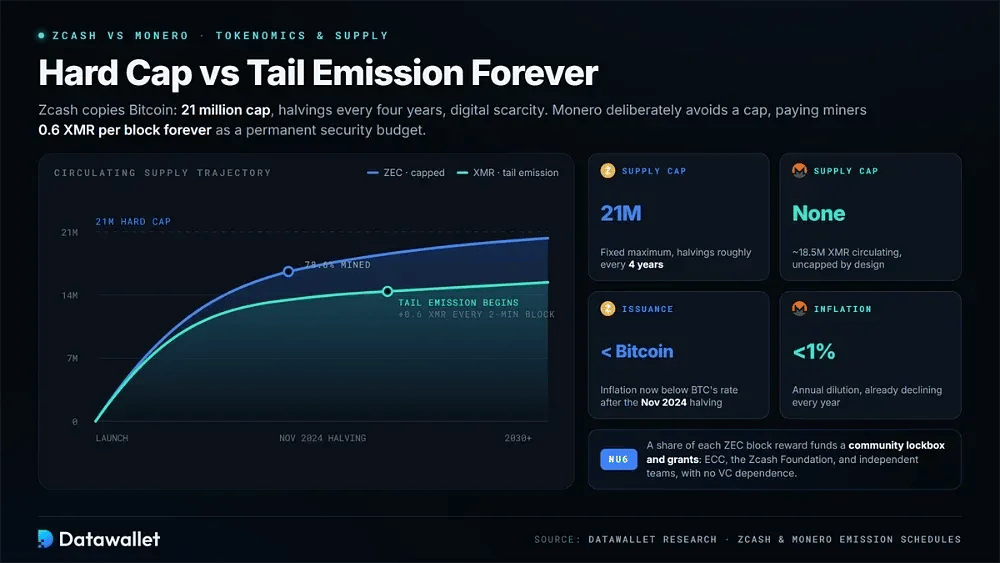
Zcash follows Bitcoin's monetary model with a hard cap of 21 million coins and halvings roughly every four years. The most recent halving occurred in November 2024. About 78.6% of the supply has already been mined, while current issuance is below Bitcoin's inflation rate, supporting ZEC's digital-scarcity narrative.
Part of Zcash issuance also pays for development. Under the NU6 framework, a share of each block reward flows into a community-governed lockbox and ecosystem grants. This funds the Electric Coin Company, the Zcash Foundation, and independent developer teams for years ahead without dependence on venture capital or token sales.
Monero deliberately avoids a hard cap. Instead, tail emission pays miners a constant 0.6 XMR every two-minute block forever. With roughly 18.5 million XMR in circulation, annual inflation is already below 1% and continues to decline. Supporters consider that dilution negligible for long-term holders.
This structure is an intentional security decision. Monero's community argues that blockchains relying entirely on transaction fees may eventually underpay miners and weaken network security, so tail emission creates a permanent security budget. Critics respond that unlimited supply weakens the store-of-value case enjoyed by fixed-cap assets.
Zcash vs Monero: Adoption
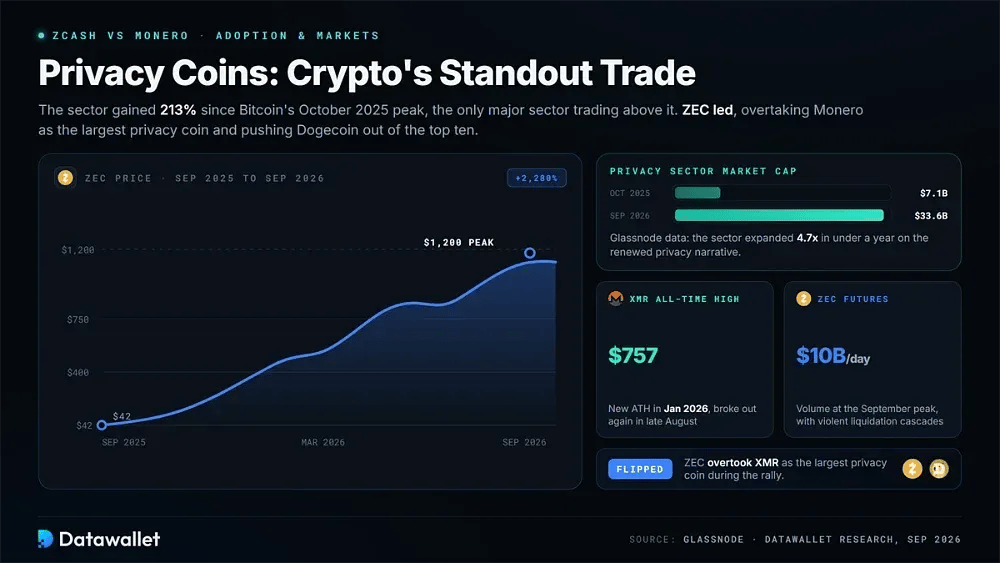
Privacy coins were crypto's standout trade over the past year. Glassnode data cited in market coverage shows the sector gaining 213% since Bitcoin's October 2025 peak. It was the only major sector trading above that level, while combined market capitalization expanded from $7.1 billion to $33.6 billion.
Zcash led the rally by a wide margin. ZEC climbed from roughly $42 in September 2025 to above $1,000 one year later and briefly touched $1,200. The move pushed Dogecoin out of the top ten and allowed Zcash to overtake Monero as the largest privacy coin. Full performance data is available in our Zcash statistics report.
Monero's advance drew less attention but was still historic. XMR reached a new all-time high near $757 in January 2026 and consolidated through the middle of the year. It broke out again in late August alongside Zcash and Dash as traders rotated back toward the renewed privacy narrative across the asset category.
Spot demand was closely followed by derivatives activity. At the September peak, ZEC futures volume approached $10 billion per day, while leveraged positions produced violent liquidation cascades in both directions. Traders can check where leverage is concentrated in real time with our Zcash liquidation heatmap before entering positions.
Is Zcash or Monero Safer?
Security differs materially between the two networks. Cryptographic soundness, mining decentralization, protocol maturity, and custody access do not carry the same risks on each chain. Both networks faced severe stress tests during 2025 and 2026, changing how researchers and traders evaluate them.
Zcash Security
Zcash relies on audited zero-knowledge cryptography and Equihash mining. Events in 2026 showed, however, that even formally sophisticated systems remain exposed to protocol risk. The network's handling of its largest security scare became a notable test of crisis management.
The most important security points for Zcash today include:
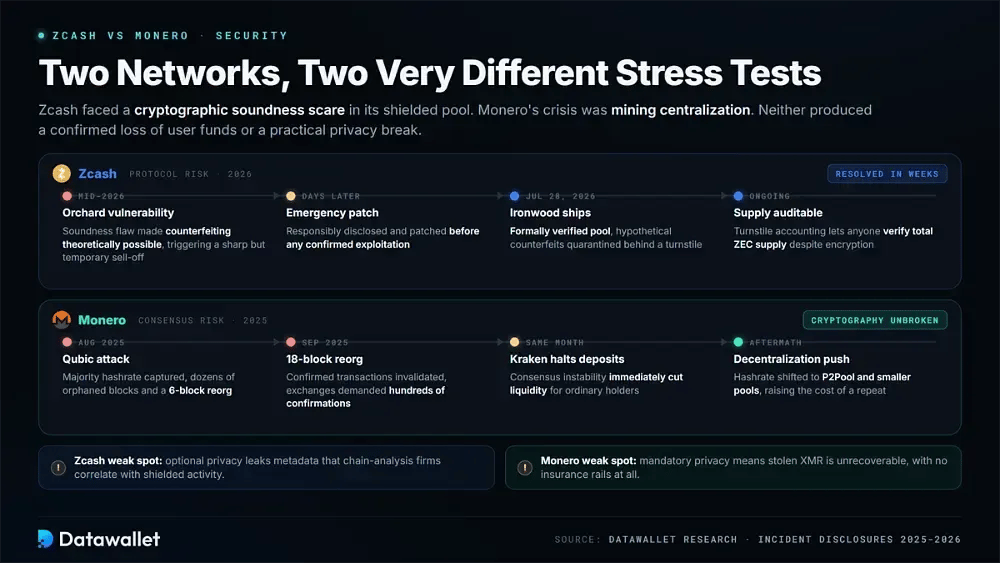
- Orchard Vulnerability: A serious soundness flaw found in the Orchard shielded pool in mid-2026 theoretically made counterfeiting possible. The discovery prompted an emergency patch and a sharp but temporary market sell-off.
- Ironwood Response: Within weeks, developers released a formally verified replacement pool. Any hypothetical counterfeit ZEC was quarantined behind a turnstile that requires migrating funds to pass supply-integrity checks.
- Supply Auditability: Turnstile accounting between pools allows total ZEC supply to be verified independently despite transaction encryption, addressing the longstanding criticism that privacy chains cannot prove honest issuance.
- Transparent Leakage: Optional privacy remains a structural weakness for Zcash. Unshielded transactions, exchange deposits, and pool migrations produce metadata that chain-analysis firms can correlate with shielded activity.
- Quantum Roadmap: ZIP 2005 introduces recoverability protections for Orchard funds, while the Tachyon redesign removes on-chain ciphertext that future quantum adversaries could collect for retrospective decryption attacks.
- Mining Concentration: Equihash mining is dominated by ASICs, concentrating hashrate among industrial operators. Even so, the network has never experienced a successful 51% attack or deep hostile reorganization in production.
- Audit Culture: Shielded circuits are repeatedly reviewed by third parties. During the 2026 incident, vulnerabilities were responsibly disclosed and patched before any confirmed exploitation or loss of user funds.
Monero Security
Monero's privacy cryptography has never been broken in practice. Its major 2025 security challenge came instead from mining centralization, when the Qubic episode forced the community to confront the economic assumptions behind proof-of-work security.
The most important security points for Monero today include:
- Qubic Attack: In August 2025, the Qubic project redirected enough hashrate to claim majority control of Monero mining. It orphaned dozens of blocks and carried out a six-block chain reorganization.
- Reorg Fallout: September 2025 brought a deeper 18-block reorganization that invalidated confirmed transactions. Exchanges responded by raising XMR deposit confirmation requirements to hundreds of blocks.
- Kraken Response: Kraken temporarily halted Monero deposits during the hashrate crisis, showing how consensus instability can immediately reduce liquidity and restrict custody for ordinary holders.
- Decentralization Push: Afterward, the community shifted support toward P2Pool and smaller mining pools. The redistribution of hashrate made it harder for one coordinator to repeat the takeover at a comparable cost.
- Cryptographic Record: The mining turmoil did not produce a confirmed practical break of Monero's privacy layer, and no double-spend against end users was demonstrated during the attacks.
- FCMP++ Audits: Trail of Bits audited the full-chain membership proof integration in May 2026 as part of a deliberately slow de-risking process ahead of the most consequential hard fork in Monero's history.
- No Insurance Rails: With mandatory privacy, stolen or mis-sent XMR is genuinely unrecoverable. At the same time, shrinking regulated custody options are pushing more users toward self-custody and its accompanying operational responsibility.
Zcash vs Monero: Regulations
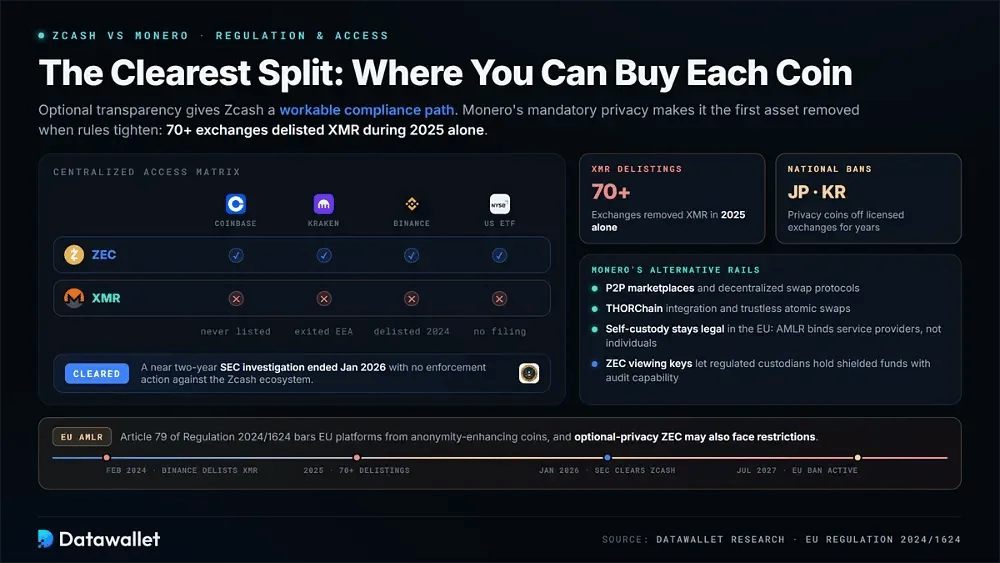
The clearest practical split between Zcash and Monero appears in regulation. Optional transparency gives Zcash a workable compliance path in many markets. Monero's mandatory privacy, by contrast, often makes it the first asset removed when regulators tighten their rules.
Zcash Regulatory Position
During 2026, Zcash turned years of regulatory uncertainty into greater institutional legitimacy. Its selective disclosure tools provide exchanges and institutions with a compliance framework that mandatory-privacy assets cannot reproduce under current global anti-money-laundering expectations.
The key regulatory points shaping Zcash access right now include:
- SEC Clearance: A nearly two-year SEC investigation involving the Zcash ecosystem ended in January 2026 without enforcement action, removing the largest legal overhang before ETF conversion.
- ETF Approval: In August 2026, the Grayscale-built ZCSH fund uplisted to NYSE Arca. That made ZEC the only privacy coin currently available through ordinary US brokerage accounts.
- Exchange Coverage: ZEC remains available on Coinbase, Kraken, Binance, and most other major exchanges. Transparent addresses allow those platforms to satisfy travel-rule and transaction-monitoring requirements for deposits.
- Viewing Keys: Regulated entities can hold fully shielded ZEC while retaining audit capability through selective disclosure. This argument is central to the legal positioning of Grayscale and custodians.
- AMLR Exposure: The EU's Anti-Money Laundering Regulation still categorizes optional-privacy coins as anonymity-enhancing assets. As a result, regulated European platforms may have to restrict ZEC by July 2027.
- Policy Tailwinds: US legislative frameworks that distinguish compliant privacy technology from illicit mixing services strengthened the case for treating shielded transactions with disclosure options as normal legal activity overall.
- Jurisdiction Splits: Some Asian markets continue to restrict all privacy assets regardless of their technical design. ZEC access therefore still depends on local regulation rather than protocol architecture alone.
Monero Regulatory Position
Monero responds to regulatory pressure through its design rather than through negotiation. Its community views delistings as an expected cost of uncompromised privacy and increasingly redirects liquidity toward decentralized channels that regulators cannot easily reach or close.
The key regulatory points shaping Monero access right now include:
- Mass Delistings: More than 70 exchanges removed XMR during 2025 alone, following Binance's landmark February 2024 delisting and Kraken's earlier exit from European Economic Area markets.
- EU Ban: Article 79 of Regulation 2024/1624 bars EU-regulated platforms from servicing anonymity-enhancing coins starting in July 2027, effectively ending compliant centralized XMR trading throughout the bloc.
- Self-Custody Legal: AMLR requirements apply to regulated service providers rather than individuals. EU residents can therefore continue to lawfully own, hold, and transact Monero peer-to-peer after the deadline.
- National Bans: Japan and South Korea removed privacy coins from licensed exchanges years earlier. Coinbase has never listed XMR in any market it currently serves.
- No ETF Path: Mandatory privacy makes surveillance-sharing agreements structurally impossible. No credible US spot ETF filing for Monero currently exists anywhere in the regulatory pipeline.
- Alternative Rails: P2P marketplaces, decentralized swap protocols, THORChain integration, and trustless atomic swaps have increasingly taken the place of traditional centralized exchanges as Monero's main day-to-day trading and liquidity infrastructure.
- Darknet Stigma: Monero remains the preferred settlement asset in illicit online markets. That reality reinforces regulatory hostility even as advocates point out that most usage is lawful.
Institutional Adoption: ETFs & Treasuries
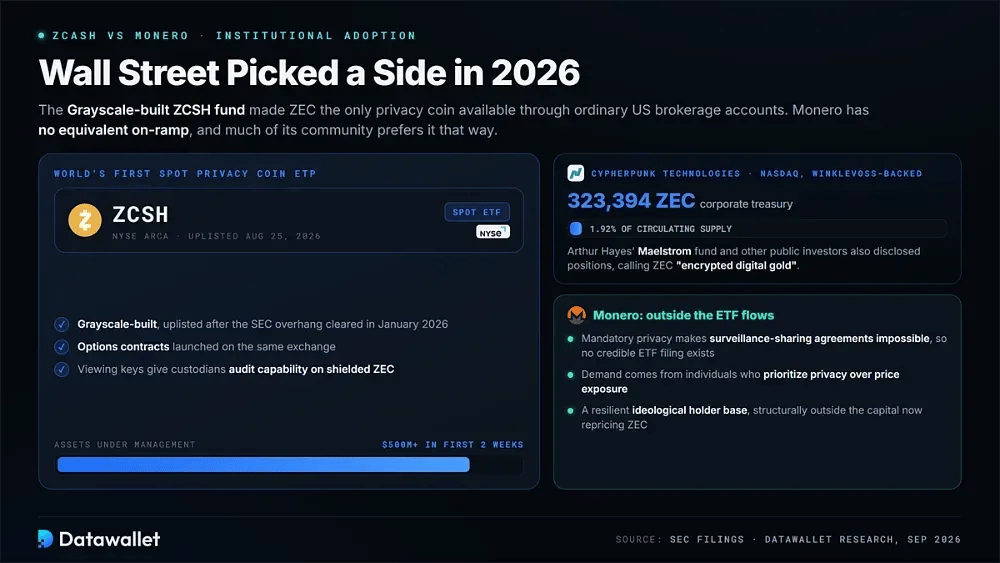
Wall Street's arrival was a defining development for Zcash in 2026. The Zcash ETF (ZCSH) began trading on NYSE Arca on August 25, 2026, becoming the world's first spot privacy coin ETP. It surpassed $500 million in assets within its first two weeks of trading, alongside newly launched options contracts on the same exchange.
Corporate treasuries adopted the same thesis. Cypherpunk Technologies, a Nasdaq-listed vehicle backed by Winklevoss Capital, reported holdings of 323,394 ZEC, equal to roughly 1.92% of circulating supply. Arthur Hayes' Maelstrom fund and other public investors also disclosed positions, publicly describing ZEC as a form of encrypted digital gold.
Monero has no equivalent institutional on-ramp, and much of its community prefers that outcome. Demand for XMR comes primarily from individuals who prioritize transactional privacy over price exposure. That creates a resilient ideological holder base while leaving Monero structurally outside the ETF-driven capital flows now repricing Zcash and the broader sector.
2026 Roadmaps: Tachyon, Crosslink & FCMP++
Both networks are undertaking the most ambitious engineering programs in their histories. Upgrades arriving between now and 2027 will help determine whether each chain can extend its privacy guarantees to mainstream transaction volumes without compromising them.
Zcash Roadmap
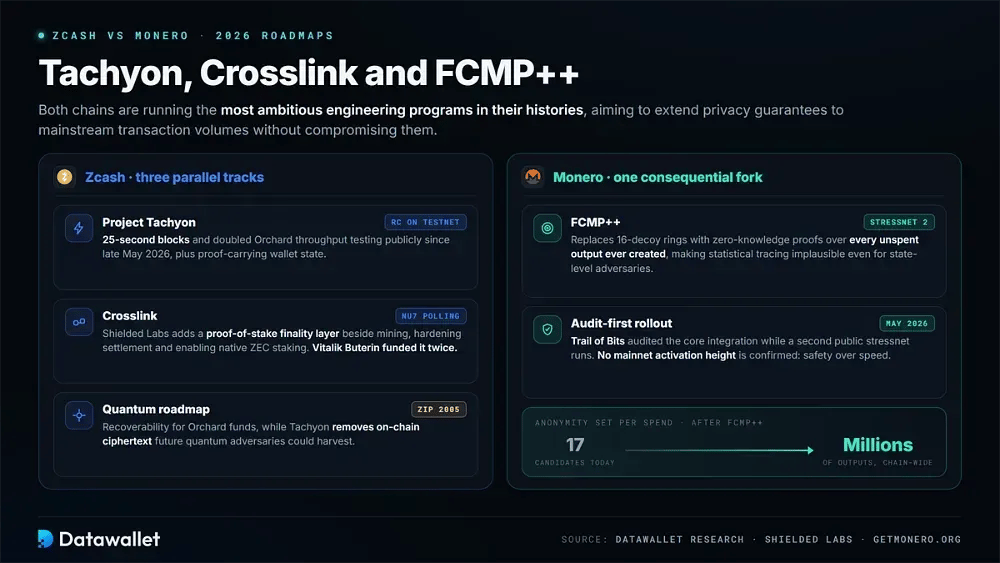
Zcash development is proceeding along three ambitious tracks in parallel. Project Tachyon redesigns shielded scaling around proof-carrying wallet state and oblivious synchronization. Its first release candidate has been testing 25-second block times and doubled Orchard throughput on public testnet infrastructure since late May 2026.
Crosslink is led by Swiss nonprofit Shielded Labs and adds a proof-of-stake finality layer alongside existing mining. The goal is to harden settlement against reorganizations and eventually enable native ZEC staking. Vitalik Buterin has personally funded the effort twice, while the NU7 upgrade progressed through community sentiment polling in September 2026.
Monero Roadmap
Monero's roadmap centers on FCMP++, a hard fork that will replace 16-decoy ring signatures with zero-knowledge proofs covering every unspent output on the blockchain. The change increases each transaction's anonymity set from seventeen candidates to millions of outputs, making statistical tracing computationally implausible even for state-level adversaries.
Deployment remains intentionally cautious. A second public stressnet launched in May 2026 while Trail of Bits audited the core integration, and the accompanying CARROT addressing scheme updates wallet key management. No mainnet activation height has been confirmed, as the community continues to prioritize safety over speed.
Is Zcash Better than Monero?
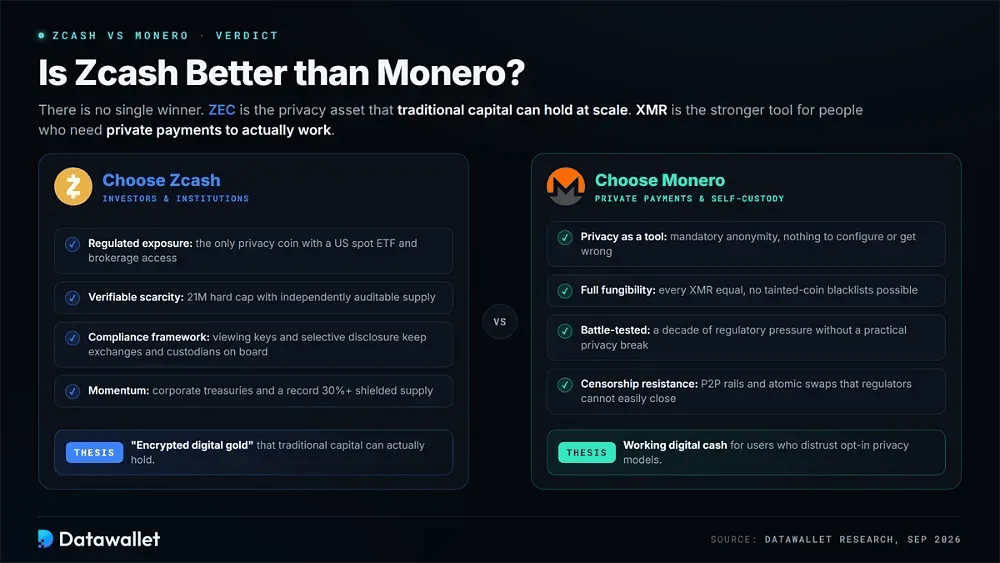
Zcash is better suited to investors and institutions seeking privacy exposure through regulated markets, verifiable scarcity, and an active compliance framework. The combination of its ETF, corporate treasury adoption, expanding shielded pool, and selective disclosure architecture makes ZEC the privacy asset that traditional capital can hold at scale.
Monero better serves users who need privacy as a functional tool rather than as an investment narrative. Its mandatory anonymity and full fungibility have endured a decade of regulatory pressure. That makes XMR the stronger option for private payments, self-custody maximalists, and users who distrust opt-in privacy models.
Final Thoughts
Zcash and Monero show that blockchain privacy does not have a single model. Zcash created a route into Wall Street portfolios through optional encryption and disclosure keys. Monero built an economy in which surveillance is cryptographically impossible and institutional approval is irrelevant to the network's mission.
Both benefited from the 2026 privacy rally, though not equally. Zcash captured the institutional repricing and ETF flows while reaching a top-ten market cap. Monero retained its users, fungibility, and ideological high ground even as more regulated access points closed ahead of Europe's July 2027 deadline.
The choice depends on what privacy means to you. If you want an investable, exchange-listed hedge against increasing financial surveillance, Zcash fits that role. If your priority is everyday transactions that nobody can ever reconstruct, Monero remains unmatched. Our best privacy coins guide covers the broader competitive field.