



Can You Add Unichain to MetaMask?
Unichain is an EVM-equivalent optimistic rollup built on the OP Stack. MetaMask therefore handles it like any other custom network, without requiring an extension or Snap. Uniswap Labs launched the mainnet in February 2025 with permissionless fault proofs already active, giving it a Stage 1 rating on L2BEAT from its first day.
As on Ethereum, transaction fees are paid in ETH. There is no separate gas token to acquire, and typical costs are fractions of a cent. If this is your first custom chain, our general MetaMask network guide explains the setup process.
How to Add Unichain to MetaMask
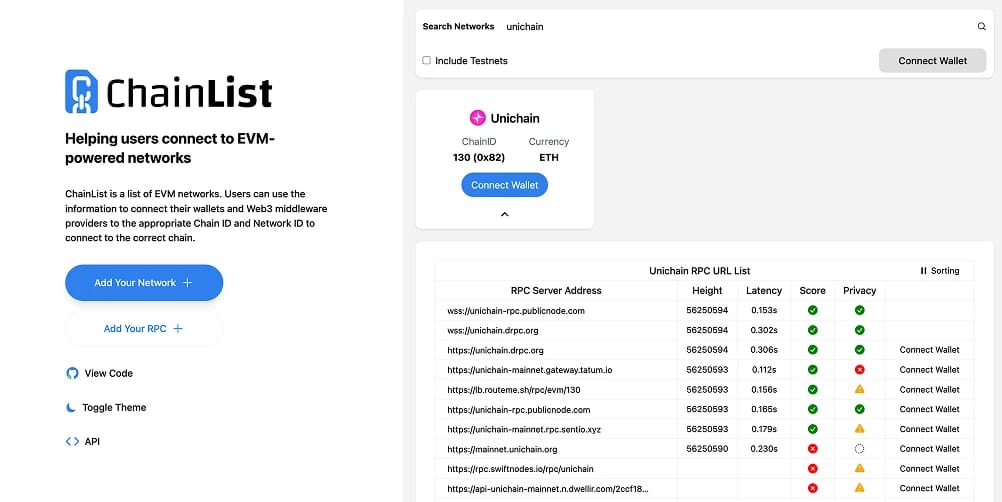
We recommend ChainList because it sources network parameters from the community-maintained ethereum-lists registry rather than relying on arbitrary search results. Before approving the connection, compare the populated values with the official documentation:
- Open ChainList: Visit the Unichain page on ChainList, confirm the address bar shows chainlist.org, then click 'Connect Wallet'.
- Verify the listing: Look for Chain ID 130 and ETH as the gas currency. Unichain Sepolia, which uses Chain ID 1301, appears in the same results, so make sure you select mainnet.
- Add the network: Click 'Add to MetaMask'. Check the fields in the pop-up against the Unichain docs before approving.
- Switch and fund: Select Unichain from MetaMask's network menu, then transfer ETH using one of the methods outlined below.
Do not copy network parameters from group chats, replies on X, or unverified websites. A poisoned RPC endpoint can manipulate everything shown in your wallet, including displaying false balances or disguising a transaction's actual purpose.
Unichain RPC and Chain ID
Manual setup takes less than a minute through the "Add a custom network" option in MetaMask's settings. Enter the following values from the official network documentation:
- Network Name: Unichain Mainnet
- RPC URL: https://mainnet.unichain.org
- Chain ID: 130
- Currency Symbol: ETH
- Block Explorer URL: https://uniscan.xyz
Uniswap Labs rate limits the official endpoint and does not recommend depending on it in production. ChainList tracks community alternatives, while dedicated providers such as Alchemy offer production-grade Unichain access with Flashblocks support.
Unichain Sepolia Testnet RPC and Chain ID
Unichain Sepolia lets developers test contracts without putting real funds at risk. Add the testnet using these settings:
- Network Name: Unichain Sepolia
- RPC URL: https://sepolia.unichain.org
- Chain ID: 1301
- Currency Symbol: ETH
- Block Explorer URL: https://sepolia.uniscan.xyz
ETH appears as the gas symbol on both networks, so use the Chain ID to verify where you are signing. Testnet gas can be obtained by bridging Sepolia ETH or using faucets operated by providers such as Alchemy and QuickNode.
How to Get ETH on Unichain
You will need ETH before the wallet can make a transaction. There are three main ways to move funds onto Unichain:
- The Uniswap interface: The Uniswap web app transfers assets to Unichain through the canonical Superchain bridge, which inherits Ethereum's security. Withdrawals back to Ethereum take longer.
- Exchange withdrawals: Several major exchanges support direct ETH and USDC withdrawals to Unichain. Always confirm that Unichain is listed as the destination network, as transfers sent through the wrong chain can be difficult to recover.
- Third-party bridges: Aggregators source assets from dozens of chains and generally complete smaller transfers within minutes. Our best crypto bridges guide compares leading options by fees and security.
About Unichain
Unichain is a DeFi-focused Layer 2 released by Uniswap Labs in February 2025 as part of Optimism's Superchain. The network publishes transaction data to Ethereum as blobs and produces blocks every second. Permissionless fault proofs allow anyone to challenge invalid state, meeting a security standard that most competing Layer 2 networks have not reached.
Block production is its main technical distinction. Uniswap Labs and Flashbots developed a block builder that operates inside a trusted execution environment. This secure hardware proves that transactions were ordered according to priority fees instead of private arrangements with the sequencer. Flashblocks went live in August 2025, adding revert-protected confirmations streamed every 200 milliseconds.
Unichain's economics shifted in December 2025 after the UNIfication proposal passed governance with 125.3 million UNI supporting it and only 742 opposed. The proposal burned 100 million UNI from the treasury and activated protocol fees. It also directed Unichain's net sequencer revenue to the same burn mechanism after deducting Ethereum data costs and Optimism's 15% share. At the time, the chain was processing roughly $100 billion in annualized DEX volume. Uniswap v4 fee activation followed in July 2026.
Growth has not followed a straight path. Total value locked reached nearly $1.45 billion in July 2025, then fell sharply as early incentive programs ended. Stablecoin supply on Unichain has started rising again this year.
Infrastructure development has continued alongside these changes. In March, the network adopted the Chainlink data standard, adding price feeds and oracle value recapture to its lending markets. Node operators moved to op-reth after OP Labs retired op-geth in May. The largest unfinished roadmap item remains the Unichain Validation Network, which is intended to let UNI stakers verify blocks and receive a share of chain revenue.
Final Thoughts
Adding Unichain to MetaMask takes a minute or two through ChainList or manual entry using Chain ID 130 and the official RPC. Verify every field against Unichain's documentation before approving the network, since an incorrect endpoint creates more serious risks than a failed connection.
After funding the wallet with a small amount of ETH, you can transact on one of the few Stage 1 rollups in production. Confirmations arrive in under a second, while network fees contribute to UNI burns. The next major development to watch is the Unichain Validation Network, which would introduce staking rewards for verifying the chain.