


Which Countries Does CoinW Restrict?
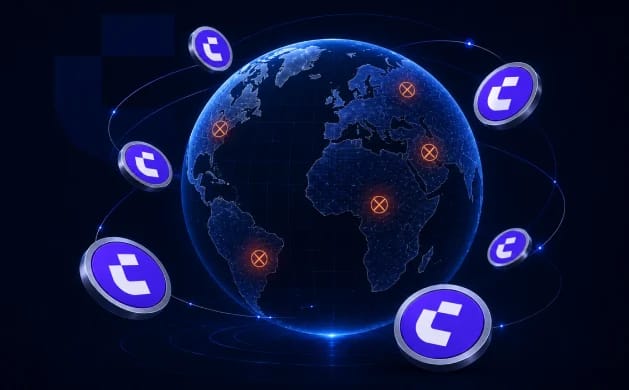
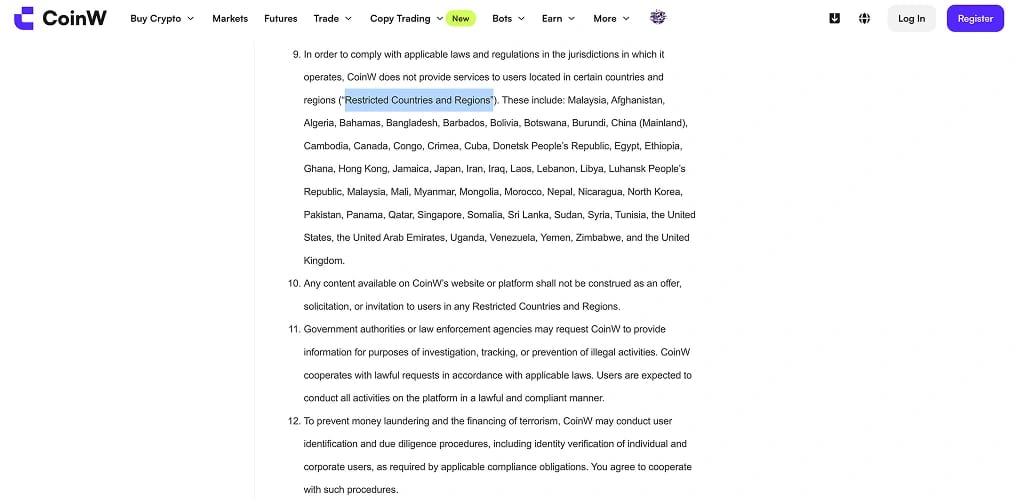
CoinW publishes its exclusion list inside the official Legal Statement, which names every jurisdiction the platform has decided not to serve. The document counts more than 45 entries, each driven by a specific legal pressure rather than one blanket policy.
The table below sorts the full list by the driver of each restriction, since a trader in Ohio and a trader in Havana are shut out for different reasons.
Notably absent are the United Kingdom, the European Union, India, Australia and most of Latin America, all of which remain open at the time of writing. Restricted lists shift with regulation, so anyone near a grey area should confirm against the Legal Statement before funding an account.
Why CoinW Blocks These Jurisdictions
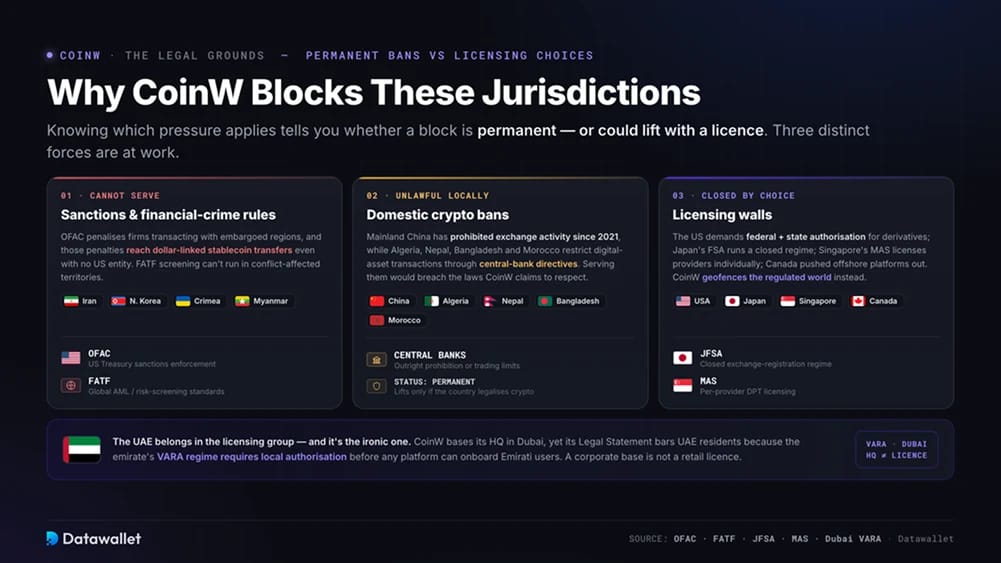
Knowing which pressure applies to your country tells you whether a block is permanent or could lift with a licence. CoinW's exclusions rest on the following legal grounds:
- Sanctions and financial-crime rules: The US Treasury's Office of Foreign Assets Control penalizes firms that transact with embargoed regions, and those penalties reach dollar-linked stablecoin transfers even on platforms with no American entity. Financial Action Task Force standards add risk screening that cannot be run in conflict-affected territories, which places Crimea and Myanmar alongside Iran and North Korea.
- Domestic crypto bans: Mainland China has prohibited crypto exchange activity outright since 2021, while Algeria, Nepal, Bangladesh and Morocco restrict digital asset transactions through central bank directives. Serving these users would put CoinW in breach of the laws it claims to respect, so the platform excludes them at the account level.
- Licensing walls in regulated markets: The United States demands federal and state-level authorization for derivatives, Japan's FSA runs a closed registration regime, Singapore's MAS licenses digital payment token providers individually, and Canada's securities regulators have pushed most offshore platforms out. Like many crypto futures exchanges, CoinW stays offshore and geofences the regulated world instead of building local entities.
The UAE entry belongs in the licensing group. CoinW bases its headquarters in Dubai, yet its Legal Statement bars UAE residents from retail service because the emirate's VARA regime requires local authorization before any platform can onboard Emirati users.
CoinW Supported Countries
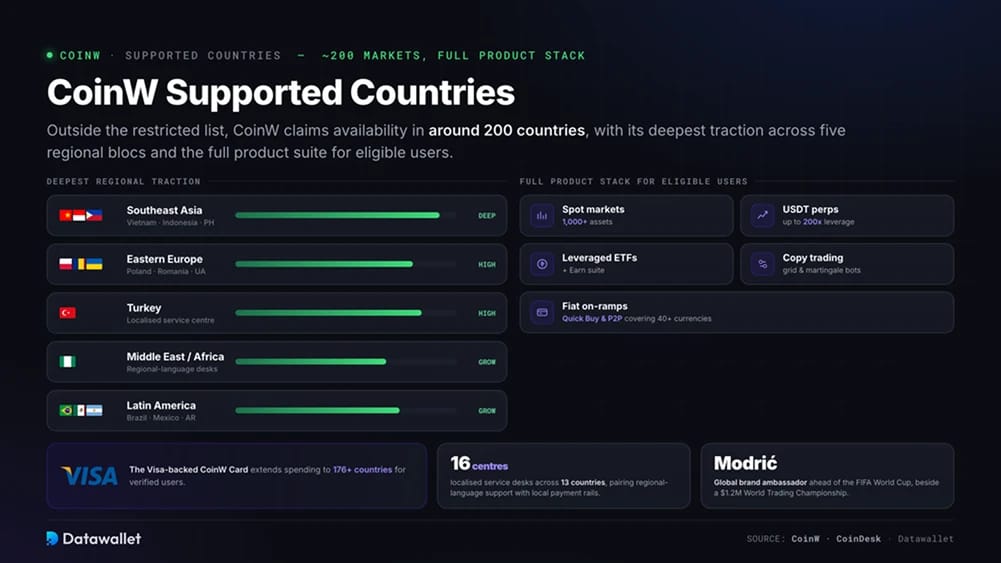
Outside the restricted list, CoinW claims availability in around 200 countries and finds its deepest traction across Southeast Asia, Eastern Europe, Turkey, the Middle East and Latin America. The company operates 16 localized service centers across 13 countries, pairing regional-language support with market-specific payment rails.
Eligible users get the full product stack, covering spot markets on 1,000+ assets, USDT-margined perpetual futures with leverage up to 200x, leveraged ETFs, copy trading, grid and martingale bots, and an Earn suite. Fiat on-ramps run through Quick Buy and P2P channels covering more than 40 currencies, and the Visa-backed CoinW Card extends spending to 176+ countries for verified users.
The platform has been pushing hard into Europe and Latin America this year, sponsoring events from Warsaw to São Paulo and signing footballer Luka Modrić as its global brand ambassador ahead of the FIFA World Cup, alongside a $1.2 million World Trading Championship timed to the tournament.
Can I Use CoinW in the US?
No. The United States is named on CoinW's restricted list, and American residents cannot legally register, trade or hold funds on the platform. CoinW carries a FinCEN Money Services Business registration, but an MSB registration covers anti-money-laundering obligations only and does not authorize the exchange to offer spot or derivatives products to US customers.
Some US traders reach the platform through VPNs, since basic accounts skip identity checks. Doing so breaches the user agreement, leaves the account without regulatory protection, and gives CoinW grounds to freeze balances the moment a US connection surfaces. Americans wanting comparable depth are better served by our guide to the best crypto exchanges in the USA, with Kraken covering spot, margin and regulated futures domestically.
Is CoinW Available in Europe and the UK?
Yes, for now. No EU member state or the United Kingdom appears on CoinW's restricted list, so residents across both regions can register and trade, though the position could change.
The EU's MiCA framework now requires crypto asset service providers to hold authorization before actively soliciting European customers, and enforcement against unlicensed offshore platforms has tightened since 2025. CoinW holds a legacy virtual currency registration in Lithuania but no MiCA license, so its European access depends on customers approaching the exchange on their own initiative, the same grey zone several offshore rivals occupy.
UK users face no FCA-driven block today, though anyone who prefers a locally registered venue can compare the best crypto exchanges in the UK.
Does CoinW Require KYC?
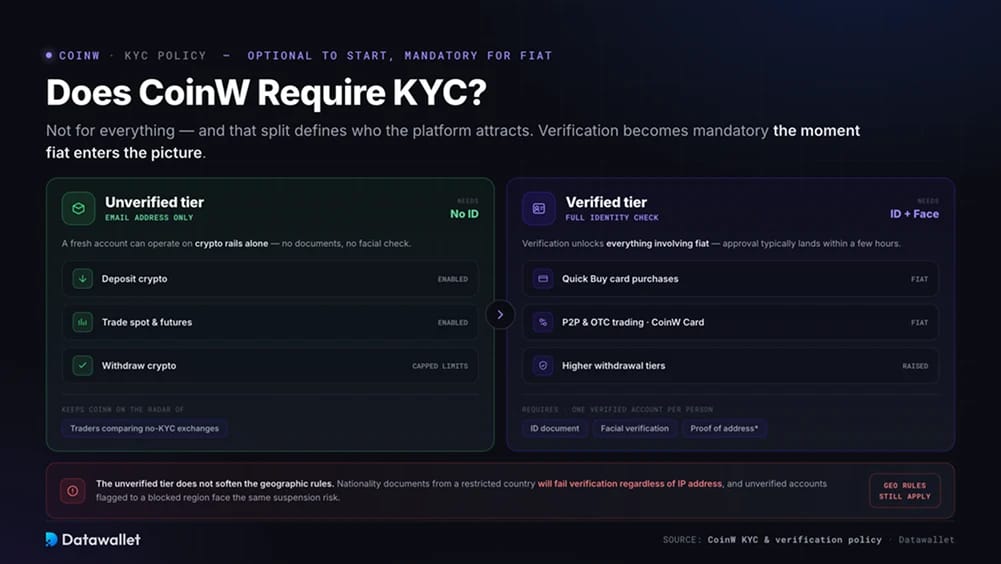
Not for everything, and that split defines who the platform attracts. A fresh account can deposit crypto, trade spot and futures, and withdraw within capped limits using only an email address, which keeps CoinW on the radar of traders comparing no-KYC crypto exchanges.
Verification becomes mandatory the moment fiat enters the picture. Quick Buy card purchases, P2P and OTC trading, the CoinW Card and higher withdrawal tiers all require identity documents, facial verification and in some cases proof of address. Each person is limited to one verified account, and approval typically lands within a few hours.
The unverified tier does not soften the geographic rules. Nationality documents from a restricted country will fail verification regardless of IP address, and unverified accounts flagged to a blocked region face the same suspension risk.
CoinW Licensing and Regulation
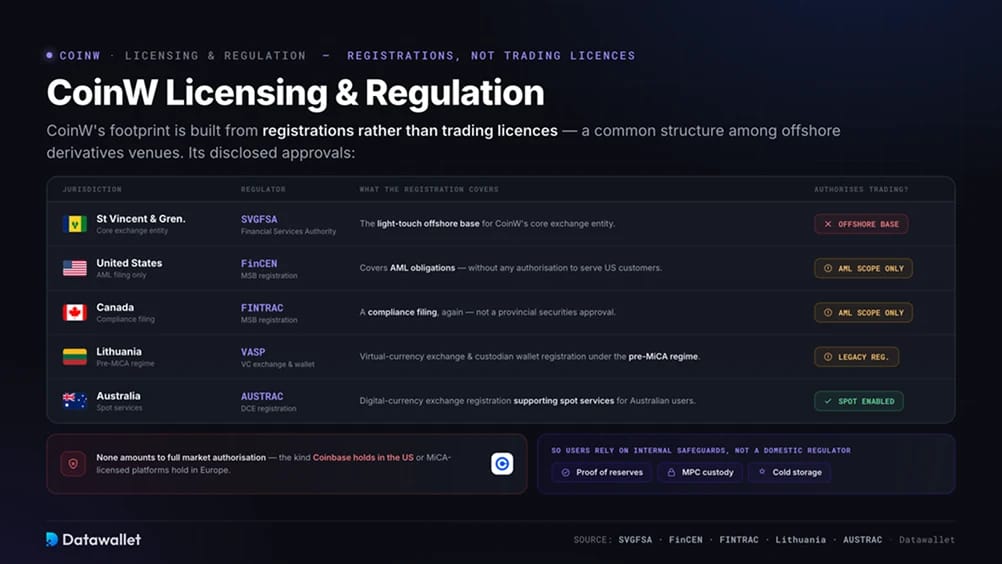
CoinW's regulatory footprint is built from registrations rather than trading licenses, a common structure among offshore derivatives venues. Its disclosed approvals include:
- St. Vincent and the Grenadines: Registered with the Financial Services Authority (SVGFSA), the light-touch offshore base used for its core exchange entity.
- United States: FinCEN MSB registration covering AML obligations, without any authorization to serve US customers.
- Canada: MSB registration with FINTRAC, again a compliance filing rather than a provincial securities approval.
- Lithuania: Virtual currency exchange and custodian wallet operator registration under the country's pre-MiCA regime.
- Australia: Digital currency exchange registration with AUSTRAC, supporting spot services for Australian users.
None of these amounts to the kind of full market authorization that Coinbase holds in the US or that MiCA-licensed platforms hold in Europe. CoinW users therefore rely on the platform's internal safeguards, including its published proof of reserves, multi-party computation custody and cold storage, rather than on a domestic regulator standing behind their account.
About CoinW
CoinW launched in 2017 and has grown into one of the larger offshore derivatives venues, reporting more than 20 million registered users, daily volume above $5 billion and a top-five position in CoinGecko's derivatives rankings. Day-to-day operations run from Dubai, while the exchange entity is registered offshore.
The product line has expanded well beyond the core exchange. PropW offers funded prop-trading accounts, DeriW runs decentralized perpetuals on a zero-gas Layer 3, and the platform layers on copy trading, an Alpha memecoin terminal and AI-assisted trading tools. Its native CWT token cuts spot fees from the base 0.2% down to as low as 0.01% at the top holding tier, while futures pricing starts at 0.01% maker and 0.06% taker.
Sports marketing does much of the brand's heavy lifting through a La Liga partnership, the official Web3 sponsorship of the EAFF E-1 Championship, and the 2026 Modrić ambassadorship aimed squarely at World Cup audiences.
Final Thoughts
CoinW's map is simple to read once the drivers are clear. Sanctioned and banned territories are closed permanently, licensing-heavy markets like the US, Japan, Canada and Singapore are closed by choice, and the remaining 200 or so countries get an aggressive, derivatives-first platform with optional KYC at the entry level.
That trade-off is the whole decision. Traders inside supported regions gain high leverage, deep altcoin coverage and light onboarding, but without the backstop of a domestic license. Anyone in or near a restricted jurisdiction should treat the Legal Statement as the final word, because a VPN workaround puts the account at risk while the exchange loses nothing.