



Compare Top Solana Staking Platforms
1. Bybit
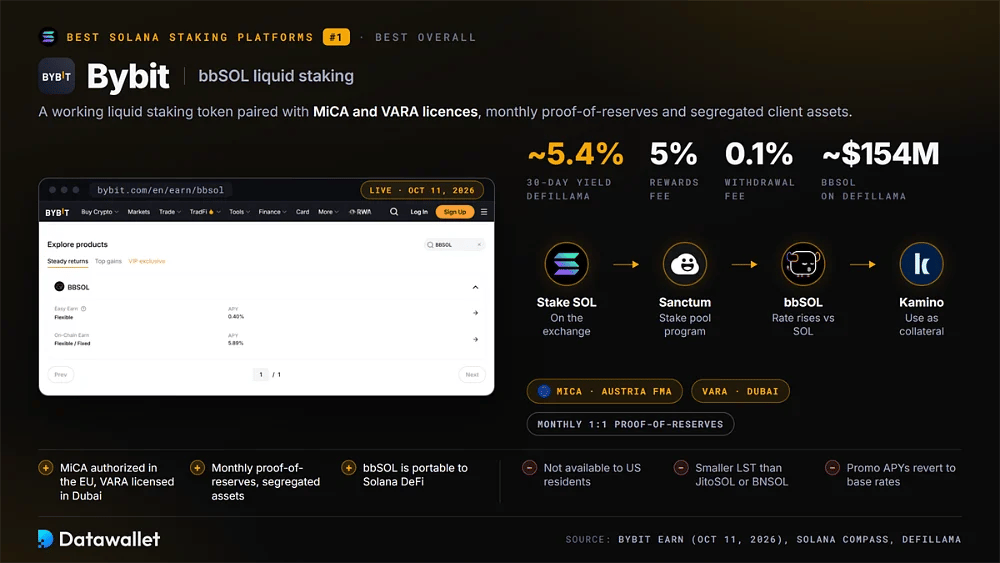
Bybit keeps first place by pairing a functioning liquid staking product with strong regulatory credentials. Bybit EU has MiCA authorization from Austria's FMA, while VARA licenses its Dubai entity. The exchange also publishes monthly proof-of-reserves and segregates client assets, an increasingly important distinction now that MiCA's transitional window has closed.
Built on Sanctum's stake pool program, bbSOL charges a 5% rewards fee with a 0.1% withdrawal fee. DefiLlama's 30-day measure puts its yield near 5.4%. Rewards appear through a rising SOL exchange rate rather than a growing token balance, and holders can move bbSOL off the exchange for use as collateral on Kamino and other Solana money markets.
Access and scale are the main compromises. Bybit is still unavailable to US residents, and bbSOL's roughly $154 million on DefiLlama remains far below Jito or BNSOL. Promotional Earn rates are temporary as well. Choosing Locked Earn terms of 7 to 60 days removes much of the liquidity advantage that bbSOL otherwise offers. Our full Bybit review covers fees in detail.
Pros
- MiCA authorized in the EU and VARA licensed in Dubai.
- Monthly 1:1 proof-of-reserves with segregated client assets.
- bbSOL is portable to Solana DeFi as lending collateral.
Cons
- Not available to US residents.
- Smaller LST than JitoSOL or BNSOL, with thinner on-chain liquidity.
- Promotional APYs revert to base rates after campaigns.
2. Jito
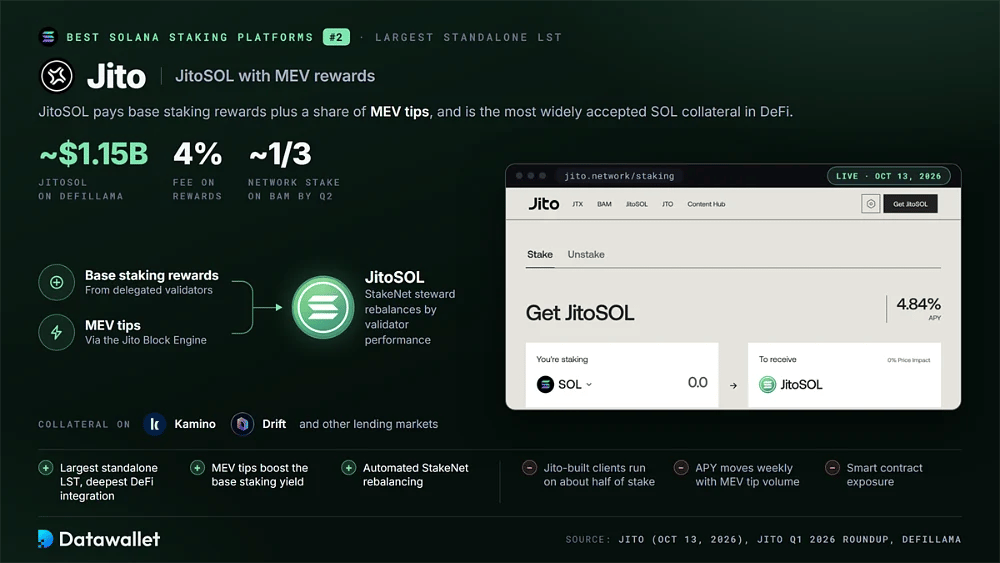
Jito takes second place largely because JitoSOL remains Solana's biggest standalone liquid staking token. It holds about $1.15 billion on DefiLlama. The stake pool directs SOL toward validators using Jito's block-building software, allowing holders to receive base staking rewards alongside a share of MEV tips routed through the Jito Block Engine.
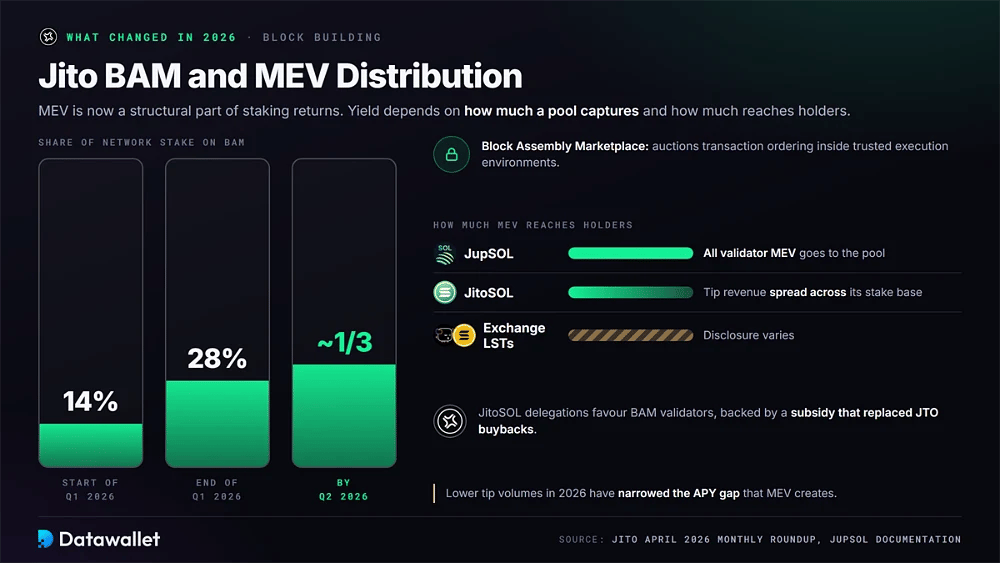
BAM, Jito's Block Assembly Marketplace, defined much of its 2026 development. Jito's Q1 data recorded BAM stake rising from 14% to 28% of the network, then reaching roughly one-third by Q2. JitoSOL delegations favor BAM validators. The token also remains one of the most broadly accepted forms of SOL collateral across Kamino, Drift, and other lending markets.
That reach comes with concentration concerns and a variable return profile. Jito-built client software runs on roughly half of active stake, reviving the Lido-style centralization debate. Jito's own reports also show tip revenue declining as on-chain activity weakened during 2026. Holders take smart contract risk, and the pool deducts 4% from rewards.
Pros
- Largest standalone Solana LST with the deepest DeFi integration.
- MEV tips from the Jito Block Engine boost base staking yield.
- Automated StakeNet steward rebalances stake by validator performance.
Cons
- Client and block-building concentration across a large share of stake.
- APY moves week to week with MEV tip volume.
- Smart contract exposure beyond native staking.
3. Binance
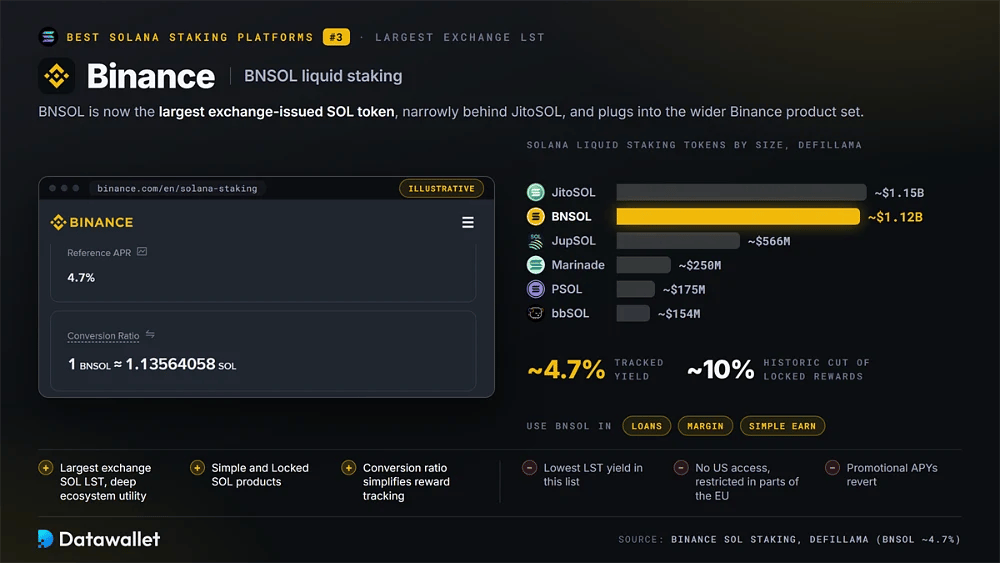
Binance rises to third because BNSOL has become Solana's largest exchange-issued LST. It holds roughly $1.12 billion according to DefiLlama, narrowly trailing JitoSOL. Rewards accumulate through a rising BNSOL-to-SOL conversion ratio, leaving token balances unchanged and eliminating manual reward claims.
Its strongest advantage is integration within the Binance ecosystem. BNSOL can be used with Binance Loans, margin, and Simple Earn. Users who prefer fixed commitments can also choose Locked SOL products. DefiLlama tracks BNSOL at about 4.7%, below competing on-chain products, partly reflecting Binance's commission on staking rewards.
Jurisdiction and fees are the main constraints. Binance.com remains unavailable to US users, Binance.US has a narrower product lineup, and onboarding is restricted in several EU states under MiCA rules. Binance has historically taken around 10% of locked staking rewards. Promotional APYs also tend to fall back once their campaigns finish.
Pros
- Largest exchange-issued SOL LST with deep Binance ecosystem utility.
- Simple and Locked SOL products suit beginners and active users.
- BNSOL's conversion ratio simplifies reward tracking.
Cons
- Lowest LST yield in this list at roughly 4.7%.
- Not available to US users and restricted in parts of the EU.
- Promotional APYs revert after campaigns.
4. Phantom
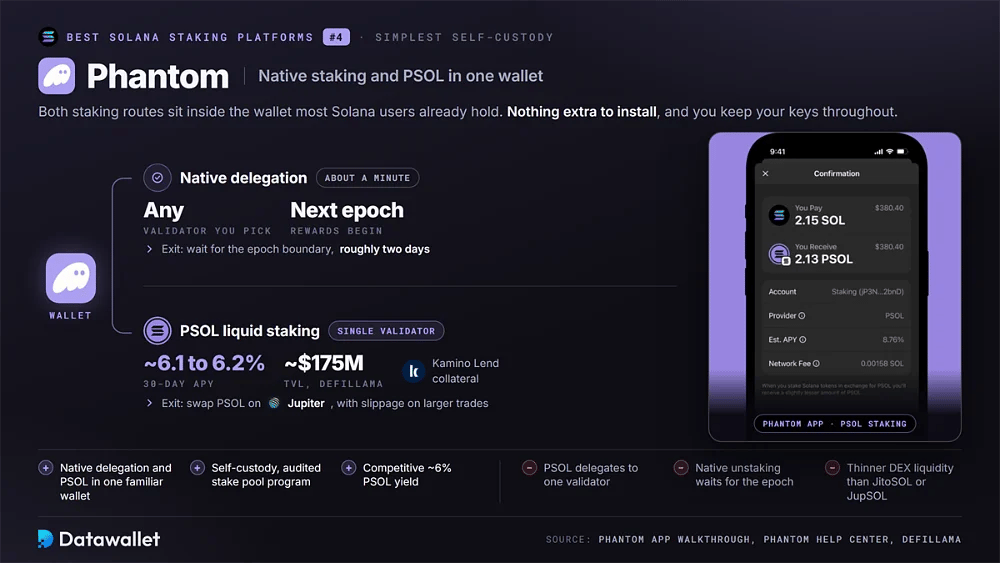
Phantom is still the simplest self-custody option because native delegation and PSOL liquid staking are built into the wallet most Solana users already hold. Nothing additional needs to be installed. The native staking flow, from selecting a validator to earning rewards at the following epoch, takes about a minute.
PSOL has reached about $175 million in TVL on DefiLlama. Its 30-day APY is around 6.1-6.2%, placing it among the stronger wallet-issued LSTs. Rather than minting extra units, PSOL increases in value against SOL as rewards accumulate. That structure keeps cost-basis tracking straightforward, and PSOL can now be used as collateral on Kamino Lend.
Concentration and exit mechanics remain the weak points. PSOL delegates to one validator, tying pool performance to a single operator. Native unstaking still requires waiting for the epoch boundary, or roughly two days. Holders can exit faster by swapping PSOL on Jupiter, although larger trades face more slippage because DEX liquidity is modest.
Pros
- Native delegation and PSOL in one familiar wallet.
- Self-custody throughout with an audited stake pool program.
- Competitive ~6% PSOL yield with Kamino collateral support.
Cons
- PSOL delegates to a single validator.
- Native unstaking waits for epoch deactivation.
- Thinner DEX liquidity than JitoSOL or JupSOL.
5. Jupiter
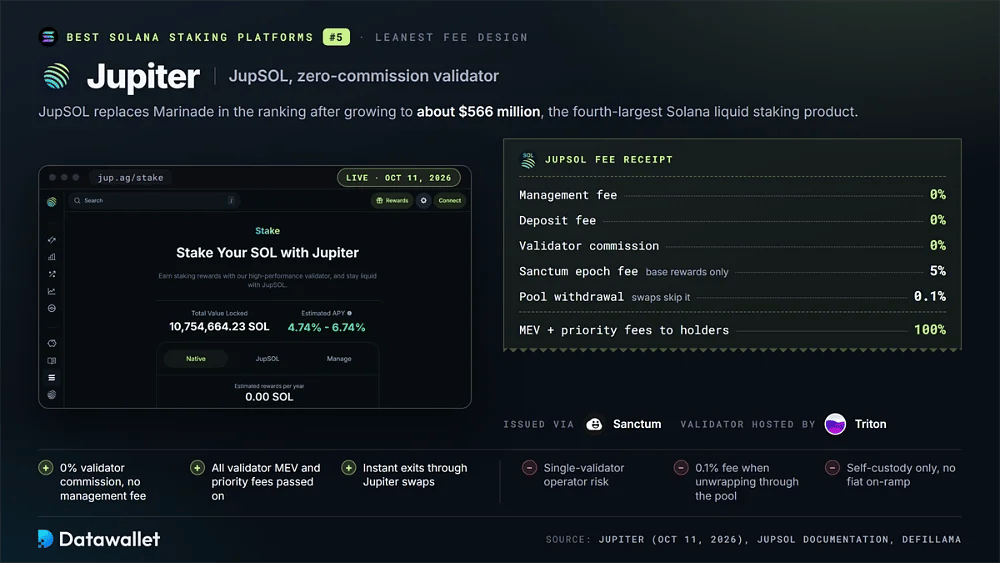
Jupiter replaces Marinade in this ranking after JupSOL expanded to roughly $566 million in TVL. It is now the fourth-largest Solana liquid staking product on DefiLlama, while Marinade's liquid TVL has slipped to about $250 million. JupSOL is issued through Sanctum's infrastructure and delegates to Jupiter's validator, which Triton hosts.
Its fee design is unusually lean. JupSOL documentation lists no management or deposit fee and 0% validator commission. A 5% Sanctum epoch fee applies only to base rewards, excluding MEV and priority fees. The pool receives all MEV kickbacks and priority fees generated by the Jupiter validator.
The structure creates the same operator concentration issue seen with PSOL. Because JupSOL relies on one validator, an outage or performance decline affects the entire pool. Unwrapping through the pool also carries a 0.1% withdrawal fee. Instant Jupiter swaps generally bypass that charge, and JupSOL is accepted as collateral on Jupiter Lend.
Pros
- 0% validator commission and no management fee.
- 100% of validator MEV and priority fees passed to holders.
- Instant exits through Jupiter's swap aggregator.
Cons
- Single-validator delegation concentrates operator risk.
- 0.1% fee on withdrawals that unwrap through the pool.
- Self-custody only, with no fiat on-ramp or account support.
6. Kraken
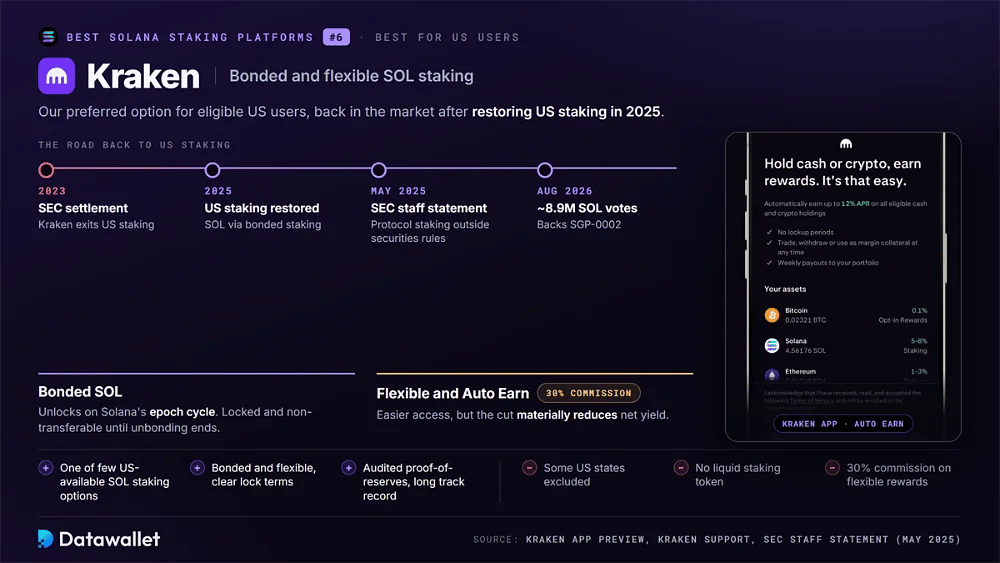
Kraken remains our preferred option for eligible US users. The exchange restored US staking in 2025 after its earlier SEC settlement and offers SOL through bonded staking. Regulatory uncertainty eased further after the May 2025 SEC staff statement, which found that certain protocol staking activities fall outside the securities framework that had driven Kraken from US staking in 2023.
Kraken's staking overview now includes both bonded and flexible products. Flexible staking and Auto Earn carry a 30% commission. Bonded SOL unlocks according to Solana's epoch cycle. Kraken's validators were also visible during the August 2026 inflation vote, when the exchange moved most of its roughly 8.9 million SOL behind SGP-0002.
US users still face important limitations. Some states remain excluded from staking, and Kraken offers no liquid staking token comparable with bbSOL or BNSOL. Flexible staking commissions materially reduce net yield. Bonded SOL also stays locked and non-transferable until unbonding finishes, which limits flexibility for active traders.
Pros
- One of few US-available SOL staking options.
- Bonded and flexible products with clear lock terms.
- Audited proof-of-reserves and a long regulatory track record.
Cons
- Some US states excluded from staking.
- No liquid staking token equivalent to bbSOL, BNSOL, or JitoSOL.
- 30% commission on flexible staking rewards.
7. Coinbase
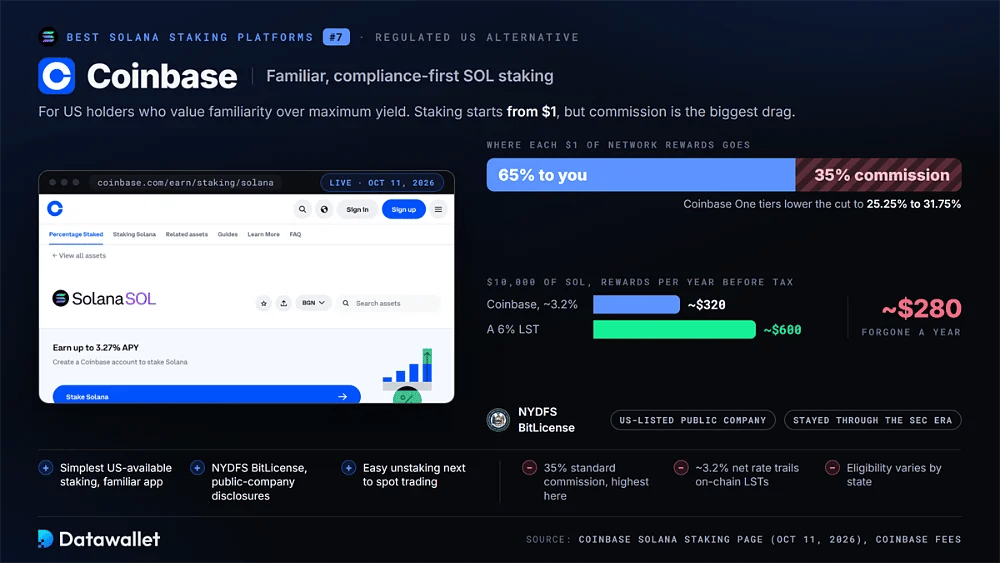
Coinbase remains the recommended regulated US alternative for holders who prioritize familiarity rather than maximum yield. Its Solana staking page lists an estimated reward rate of about 3.2%. Users can earn rewards on balances starting from $1, subject to regional staking eligibility.
The biggest drag is commission. Coinbase charges 35% of network rewards under its standard staking fee, while Coinbase One tiers reduce that rate to between 25.25% and 31.75%. For a $10,000 SOL position, the difference between that structure and a 6% LST works out to roughly $280 in forgone SOL per year before tax.
Regulatory positioning is where Coinbase stands out. The company is publicly listed in the US, holds a NYDFS BitLicense, and continued offering staking through the SEC enforcement era. The agency's 2025 staff statements covering protocol and liquid staking have since reduced much of that uncertainty. For compliance-first US investors, the trade-off remains defensible.
Pros
- Simplest US-available SOL staking in a familiar app.
- NYDFS BitLicense and public-company disclosures.
- Easy unstaking inside the same interface as spot trading.
Cons
- 35% standard commission, the highest in this list.
- Net reward rate near 3.2% trails on-chain LSTs.
- Eligibility varies by state and verification level.
How to Choose a Solana Staking Platform
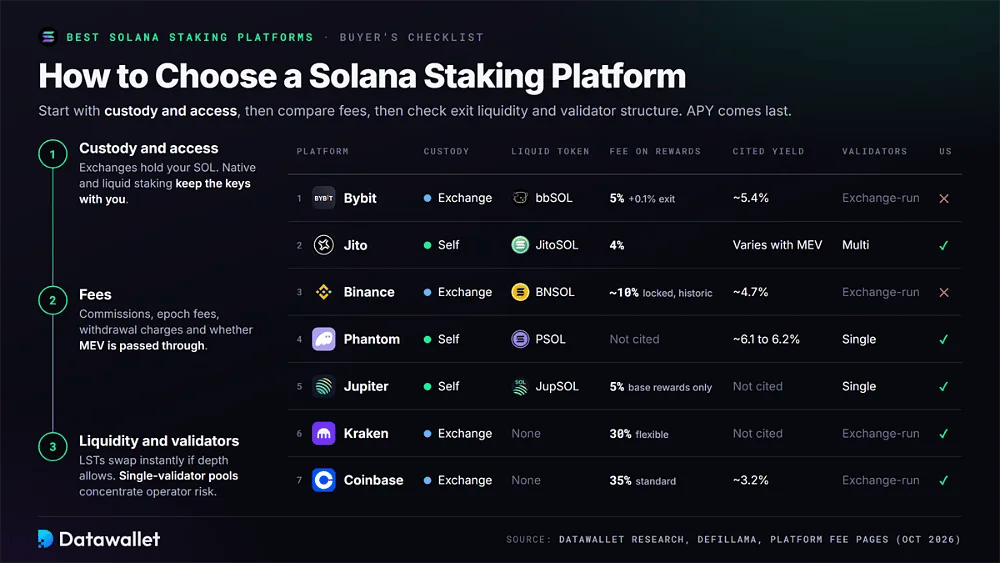
Start with custody and access rather than headline APY. Exchange staking puts the platform in control of your SOL, while native delegation keeps your keys with you. Liquid staking also preserves self-custody, but introduces smart contract and token-design risk in exchange for transferability and DeFi use.
Fees become increasingly important as Solana's nominal staking yield declines. Compare validator commissions, exchange reward deductions, epoch fees, withdrawal charges, and whether MEV or priority fees are passed through. A higher quoted yield can produce less SOL after fees when a platform takes a large share of network rewards.
Liquidity and validator structure should complete the comparison. Native stake typically waits for epoch deactivation, while LSTs can be swapped immediately if market depth is sufficient. Multi-validator pools spread operator exposure more broadly; single-validator products such as PSOL and JupSOL concentrate performance and hosting risk with one operator.
What is Solana Staking?
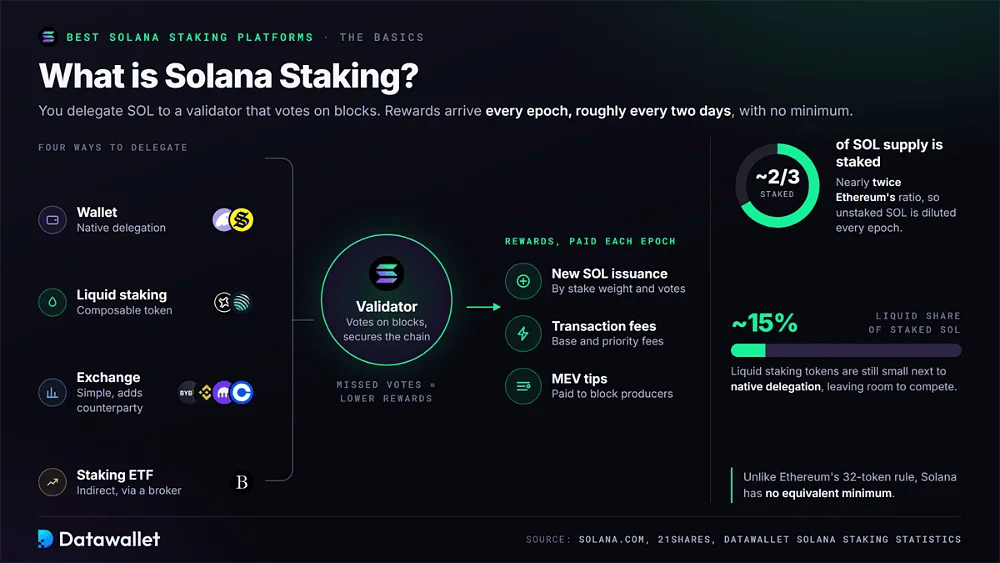
Solana staking is the process of delegating SOL to a validator that votes on blocks and helps secure the proof-of-stake network. Unlike Ethereum's 32-token requirement, Solana has no equivalent minimum. Holders may delegate almost any amount through a wallet, liquid staking protocol, exchange account, or indirectly through a staking ETF.
Staking rewards come from newly issued SOL, transaction and priority fees, plus MEV tips paid to block producers. Issuance is distributed every epoch, roughly once every two days, according to stake weight and validator vote performance. Validators that miss votes therefore deliver lower rewards to their delegators.
About two-thirds of the SOL supply is staked, nearly twice Ethereum's staking ratio. Unstaked SOL is diluted each epoch as a result. Liquid staking tokens account for only around 15% of staked SOL, leaving exchanges, ETFs, and LST providers room to compete with native delegation. Our Solana staking statistics track these changes.
This guide treats the main staking routes as different products rather than interchangeable versions of the same service. Exchanges offer simplicity but add counterparty risk. Liquid staking sacrifices some protocol simplicity for composability, while native delegation through Phantom or Solflare comes closest to participating directly without purchasing validator hardware.
Is SOL Staking Worth It?
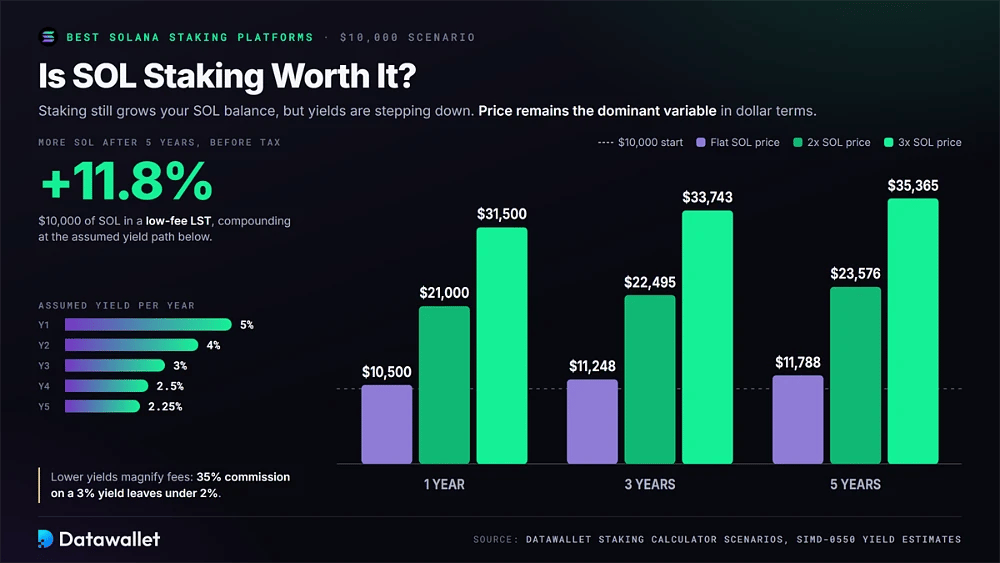
For long-term holders seeking to accumulate more SOL, staking can still make sense, although the economics changed materially in 2026. Inflation was 3.82% in June, and the approved SGP-0002 vote is expected to push nominal staking yield from roughly 5.8% toward 4.3%, then 3% and 2.25% over three years.
Consider $10,000 of SOL placed in a low-fee LST. If it earns 5% in year one, followed by 4%, 3%, 2.5%, and 2.25%, broadly matching the new schedule plus modest MEV, the balance ends five years with about 11.8% more SOL before tax. Its dollar value still depends primarily on SOL's market price.
Example scenarios:
- 1 Year: Flat SOL price: $10,500; 2x SOL price: $21,000; 3x SOL price: $31,500.
- 3 Years: Flat SOL price: $11,248; 2x SOL price: $22,495; 3x SOL price: $33,743.
- 5 Years: Flat SOL price: $11,788; 2x SOL price: $23,576; 3x SOL price: $35,365.
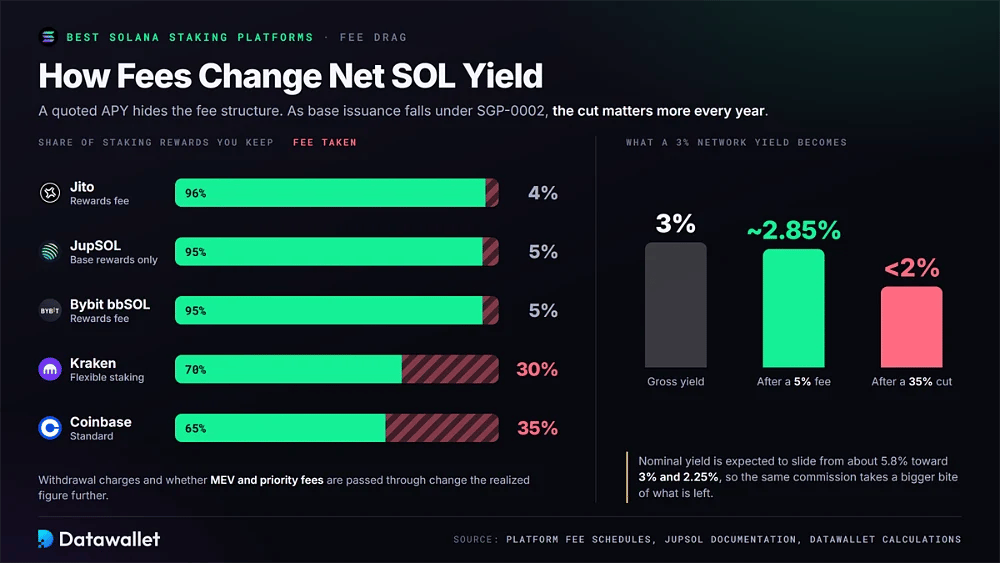
You can test different assumptions with the Datawallet Crypto Staking Calculator. Price is still the dominant variable. Lower base yields, however, magnify fee differences: a 35% commission applied to a 3% yield leaves less than 2%, whereas an LST charging 0-5% preserves most rewards every epoch.
Risks of Staking Solana
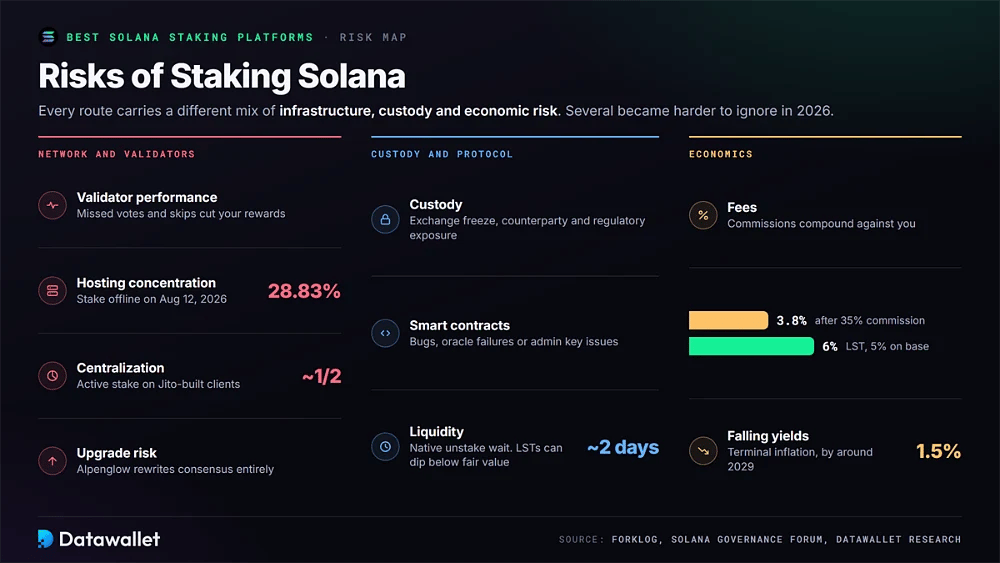
Every SOL staking route exposes holders to a different mix of custody, infrastructure, protocol, and liquidity risks. Several became harder to ignore during 2026, particularly validator hosting concentration and the decline in future issuance.
Key risks to review before you stake SOL anywhere:
- Validator Performance: Missed votes, poor uptime, or high skip rates reduce rewards, and those losses pass directly to delegators in proportion to the stake they hold.
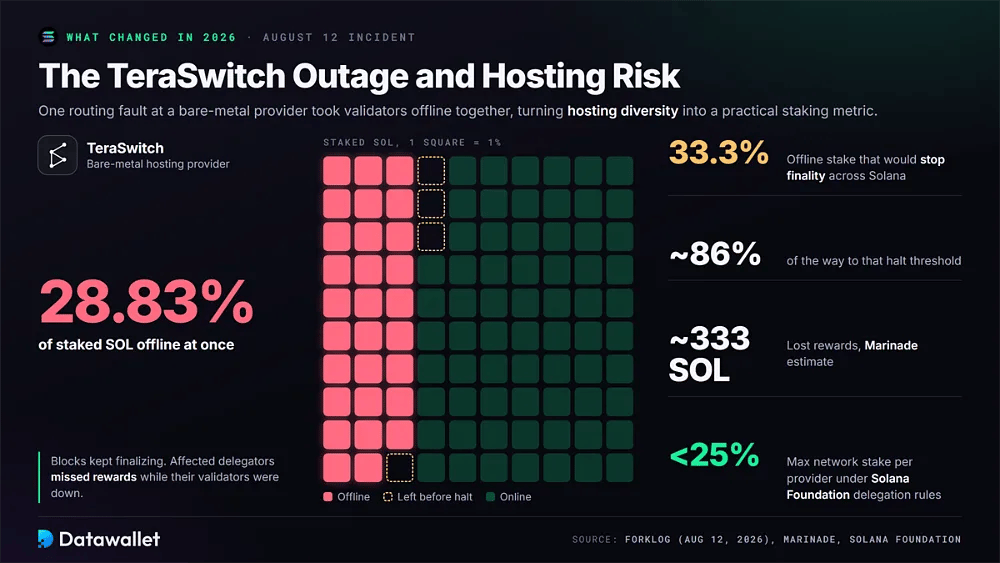
- Hosting Concentration: On August 12, 2026, a TeraSwitch routing fault knocked 28.83% of stake offline, close to the 33.3% threshold that would halt finality across Solana.
- Custody: Exchange staking concentrates SOL with one custodian, adding counterparty, account freeze, and regulatory exposure that self-custody native delegation and on-chain liquid staking tokens largely avoid.
- Liquidity: Native unstaking waits for the epoch boundary, roughly two days, and LSTs like JitoSOL or PSOL can trade below fair value when markets are stressed.
- Smart Contracts: Liquid staking, lending loops, and restaking depend on protocol code, so bugs, oracle failures, or admin key issues can impair funds while Solana runs normally.
- Fees: Commissions compound against you, so a 3.8% exchange staking rate after 35% commission trails a 6% LST charging 5% on base rewards over multiple years.
- Falling Yields: SGP-0002 accelerates disinflation toward Solana's 1.5% terminal rate by around 2029, so today's staking yield is not a stable long-term income stream for planning purposes.
- Upgrade Risk: Alpenglow replaces Solana's consensus engine entirely, and any first-release bugs during rollout could interrupt block production and pause reward accrual temporarily for all stakers.
- Centralization: Jito-built clients run on roughly half of active stake, and one LST or client dominating network weight remains an open governance concern across Solana.
Safest Ways to Stake SOL
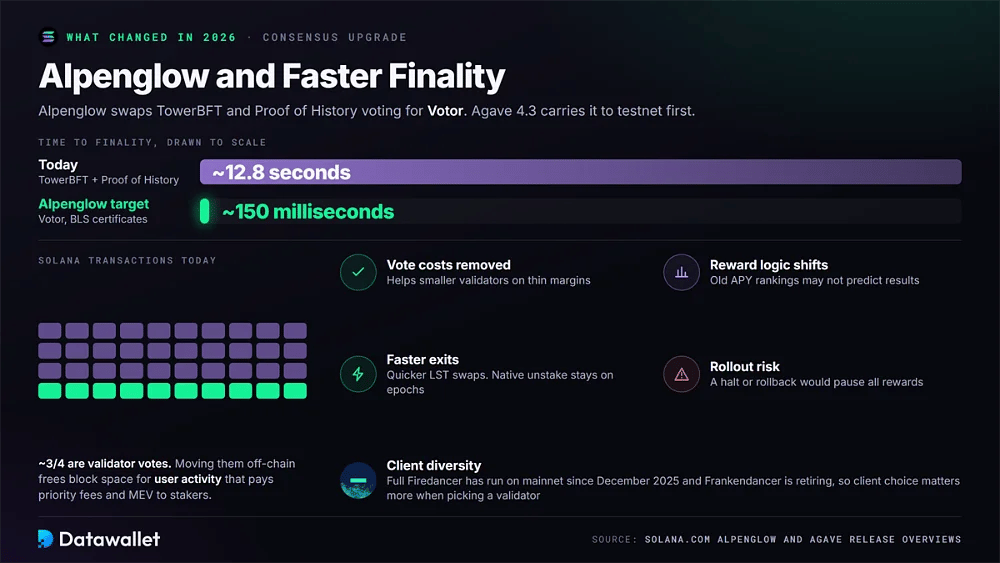
There is no single safest staking route for every holder. The answer depends on technical ability, balance size, liquidity needs, and custody preference. Native delegation offers the greatest direct control. Liquid staking and exchange products give up some of that control for composability, convenience, or regulated custody.
1. Native Delegation via Wallet
Direct staking through Phantom, Solflare, or Jupiter Stake is the self-custody baseline. You select the validator and delegate any amount while retaining your private keys. The stake stays within Solana's native stake program, with rewards automatically compounding into the stake account at the end of each epoch.
Commission alone is no longer enough to judge a validator. Following the TeraSwitch incident, operators with strong vote success, low skip rates, and hosting outside dominant data centers deserve more attention. Tools such as Stakewiz help compare those factors. The Solana Foundation's delegation criteria also cap hosting concentration, providing a useful reference point.
2. Decentralized Liquid Staking
Jito, Jupiter, Phantom, and Sanctum-powered pools form the next-safest category. Their liquid staking products let you retain self-custody while receiving a token that can be used throughout Solana DeFi. In return, you accept additional smart contract exposure and risks tied to the token's design.
What to check before choosing a Solana liquid staking token:
- Audits: Confirm the stake pool program has multiple independent audits, ideally the shared SPL or Sanctum programs rather than custom code with limited production history.
- Validator Spread: Multi-validator pools like JitoSOL dilute operator risk, while single-validator LSTs such as JupSOL and PSOL tie performance to one operator's infrastructure choices and uptime record.
- Fee Design: Compare where fees apply, since some pools charge only on base rewards and pass MEV and priority fees through to holders in full each epoch.
- Exit Liquidity: Check DEX depth and reserve liquidity, because thin pools force larger holders into delayed unstakes or meaningful slippage during volatile sessions or forced liquidations.
- Collateral Use: Wider acceptance on Kamino, Jupiter Lend, and similar markets adds utility, but looping strategies amplify liquidation risk if the LST briefly depegs from SOL during stress.
- Track Record: Prefer LSTs that processed withdrawals smoothly through stress events such as the October 2025 crash, when Sanctum infrastructure kept redemptions running normally for holders.
3. Centralized Exchange Staking
Using Bybit, Binance, Kraken, or Coinbase removes much of the operational work. These exchanges manage validator selection, reward accounting, and unstaking on the user's behalf. That model can suit beginners, smaller holders, or anyone who values customer support and fiat funding more than handling wallets and seed phrases directly.
Custody is the central drawback. The exchange controls access, eligibility, and withdrawals, meaning a freeze or insolvency can affect staked SOL just like any other platform balance. Stronger candidates publish audited proof-of-reserves and operate under clear licensing frameworks, including MiCA authorization in the EU or a NYDFS BitLicense.
4. Restaking and Leveraged Strategies
Jito (Re)staking, Solayer, and leveraged lending loops are advanced strategies rather than substitutes for ordinary staking. They add extra operators, potential slashing conditions, or liquidation thresholds on top of an existing LST. Each incremental source of yield therefore introduces another way the position can fail.
These approaches are better suited to experienced users who understand both the underlying services and collateral markets. Falling base issuance under SGP-0002 is likely to make such products more aggressively marketed. For safety-first users, they remain below native delegation, decentralized liquid staking, and exchange staking in our ranking, and we recommend keeping allocations small.
Does Solana Have Slashing?
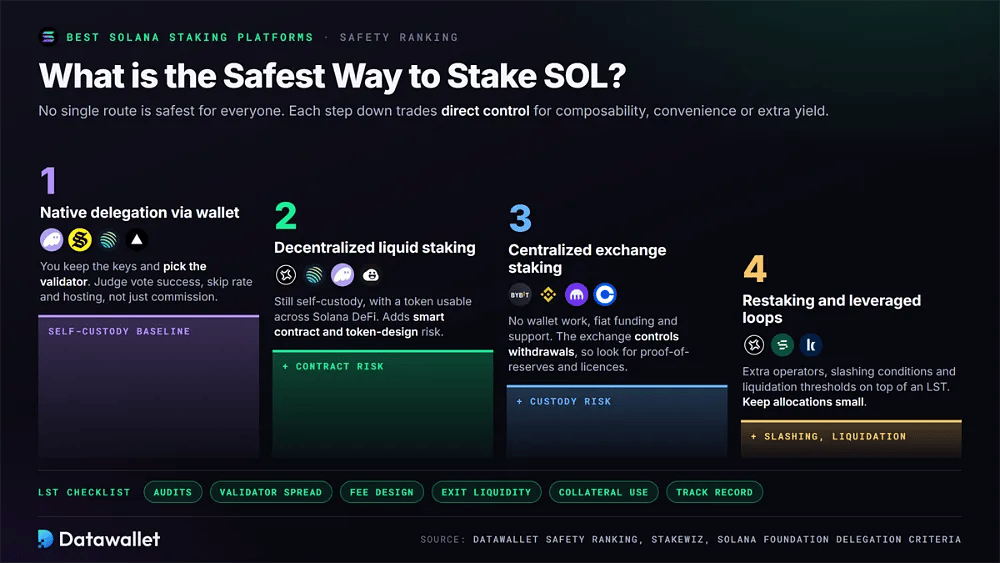
As of October 2026, Solana still has no economic slashing for validators or delegators on mainnet. This distinction is often misunderstood. For ordinary delegators, choosing a poor validator currently risks missed rewards rather than a direct loss of staked principal.
The Slashing Program from SIMD-0204 can record evidence of duplicate block production on-chain, but it does not burn stake. SIMD-0212 proposes a penalty curve ranging from minor penalties for isolated faults to full slashing for coordinated attacks above 33% of stake. It is not yet active on mainnet.
Alpenglow changes the surrounding architecture. Votor uses BLS-signed certificates together with explicit skip and notarization reward certificates, making validator behavior easier to attribute. Future slashing should therefore be treated as a live possibility over the next few years, giving validators with strong operational records an advantage today.
That remains a major structural difference from Ethereum, where slashing has existed since the Beacon Chain launched, as explained in our Ethereum staking guide. For Solana delegators in 2026, the practical worst case is still lost rewards during downtime or network incidents. The August TeraSwitch event demonstrated this when affected stake temporarily stopped earning.
What Changed for Solana Staking in 2026
Four developments materially changed Solana staking during 2026. Governance accelerated disinflation, Alpenglow began its consensus transition, Jito expanded its role in block building, and a major hosting outage exposed infrastructure concentration. Each one affects staking platform selection in a different way.
SGP-0002 and Faster Disinflation
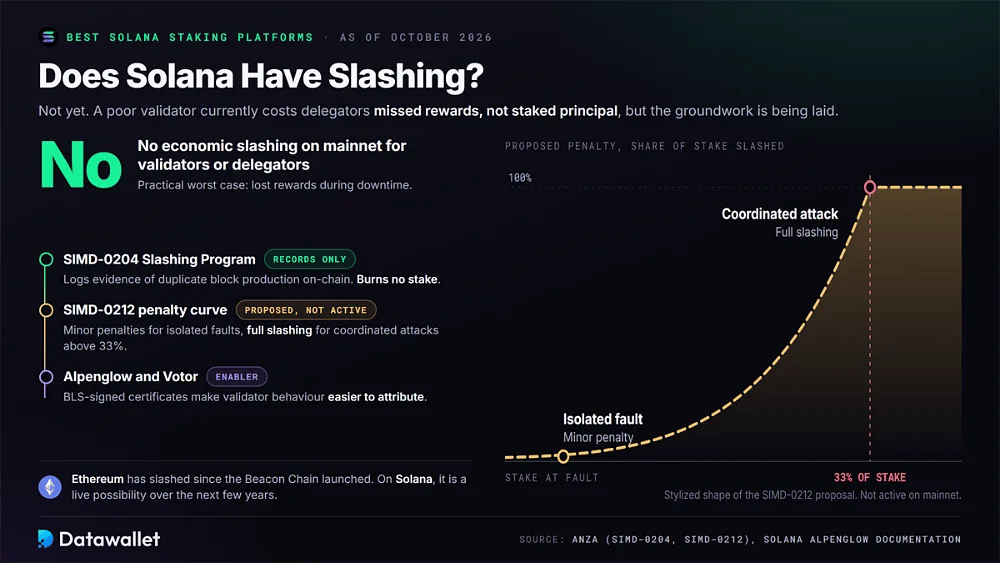
Solana's new on-chain governance framework approved SGP-0002 on August 28, 2026. The measure implements SIMD-0550, doubling annual disinflation from 15% to 30%. About 176 million SOL voted in favor and 66 million against following a late lobbying effort by Helius. A client release is still required for implementation.
The 1.5% terminal inflation target remains intact, but Solana is now expected to reach it around 2029 rather than 2032. Proposal authors estimate nominal staking yield will decline from approximately 5.84% to 4.34% in year one, followed by 3% and 2.25%. MEV and fee income are unaffected.
SGP-0003, a related fee-burn proposal, did not win approval, so base fees are not yet burned at higher rates. That increases the relative importance of low platform fees and effective MEV capture. As issuance falls, priority fees and MEV should account for a larger portion of total staking returns.
Alpenglow and Faster Finality
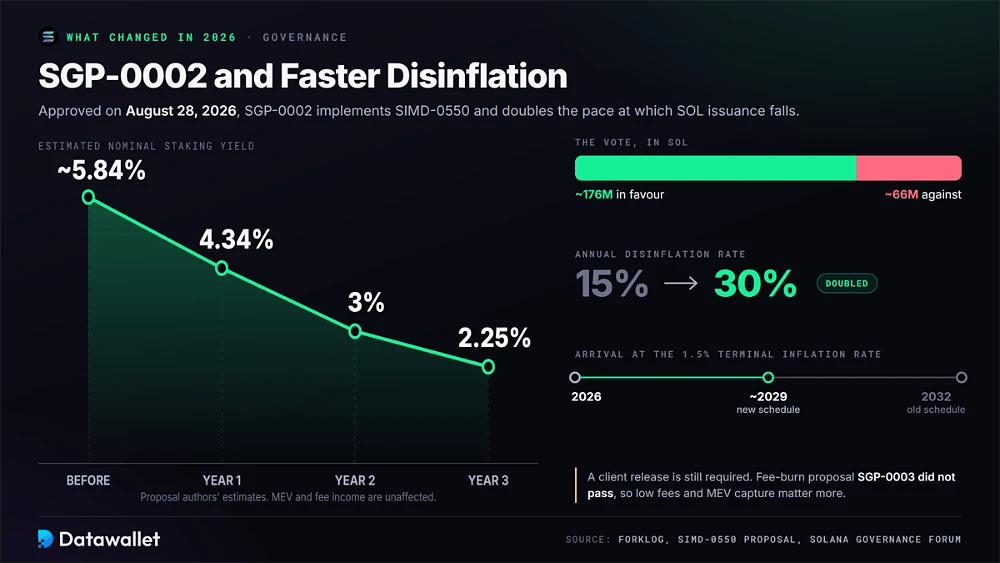
Alpenglow replaces TowerBFT and Proof of History voting with Votor. Its target is roughly 150 millisecond finality, compared with about 12.8 seconds today. Agave 4.3 carries the activation, beginning with a testnet rollout. No mainnet activation epoch had been confirmed at the time of writing.
What Alpenglow means for SOL stakers and delegators:
- Vote Costs: Votes move off-chain as BLS-signed messages, removing vote transaction fees that currently burden validators and improving economics for smaller operators running on thin margins.
- Blockspace: Vote transactions consume roughly three-quarters of Solana transactions today, so their removal frees block space for user activity that generates priority fees and MEV for stakers.
- Reward Logic: Rewards partly shift to notarization and skip certificates, so validator performance metrics will change, and historic APY rankings may not reliably predict post-activation results for delegators.
- Faster Exits: Sub-second finality speeds exchange confirmations and LST swaps, though native unstaking still follows the epoch schedule rather than becoming instant after activation for stakers.
- Rollout Risk: A consensus rewrite of this size carries first-release risk, so a brief halt or rollback during activation would pause reward accrual network-wide for every staker.
- Client Diversity: Full Firedancer has run on mainnet since December 2025, and Jump is retiring Frankendancer, so client choice becomes a bigger validator-selection factor for careful delegators.
Jito BAM and MEV Distribution
MEV is now a structural component of Solana staking returns. Jito's BAM auctions transaction ordering inside trusted execution environments and had secured roughly one-third of network stake by Q2 2026. JitoSOL delegations preferentially move toward BAM validators, supported in part by a subsidy that replaced JTO buybacks.
As a result, staking yields depend more heavily on how much MEV a pool captures and how much reaches holders. JupSOL sends all validator MEV to the pool, while JitoSOL distributes tip revenue across its stake base. Exchange LST disclosure varies. Lower tip volumes during 2026 have also narrowed the APY gap created by MEV.
The TeraSwitch Outage and Hosting Risk
A routing failure at bare-metal provider TeraSwitch on August 12, 2026 simultaneously took validators representing 28.83% of staked SOL offline. That was about 86% of the 33.3% threshold needed to stop finality. Blocks continued finalizing, although affected delegators missed rewards. Marinade estimated roughly 333 SOL in lost rewards.
The outage made hosting diversity a practical staking metric rather than a theoretical concern. Solana Foundation delegation rules already restrict participants to providers with less than 25% of network stake, and Marinade said it would revisit its distribution limits. Platform comparisons should now include how stake is distributed across data centers and autonomous systems.
How Fees Change Net SOL Yield
A platform's quoted APY does not show the full return unless its fee structure is included. Exchange commissions can consume a substantial share of network rewards, while some liquid staking pools charge only on base issuance and leave MEV or priority-fee income untouched. Withdrawal costs can further change realized yield.
This difference matters more under SGP-0002 because base issuance is declining. Coinbase's 35% standard commission, Kraken's 30% flexible staking commission, Jito's 4% rewards fee, and JupSOL's 5% epoch fee on base rewards produce increasingly different net outcomes as nominal staking yields move lower.
Solana Staking ETFs vs Staking SOL Directly
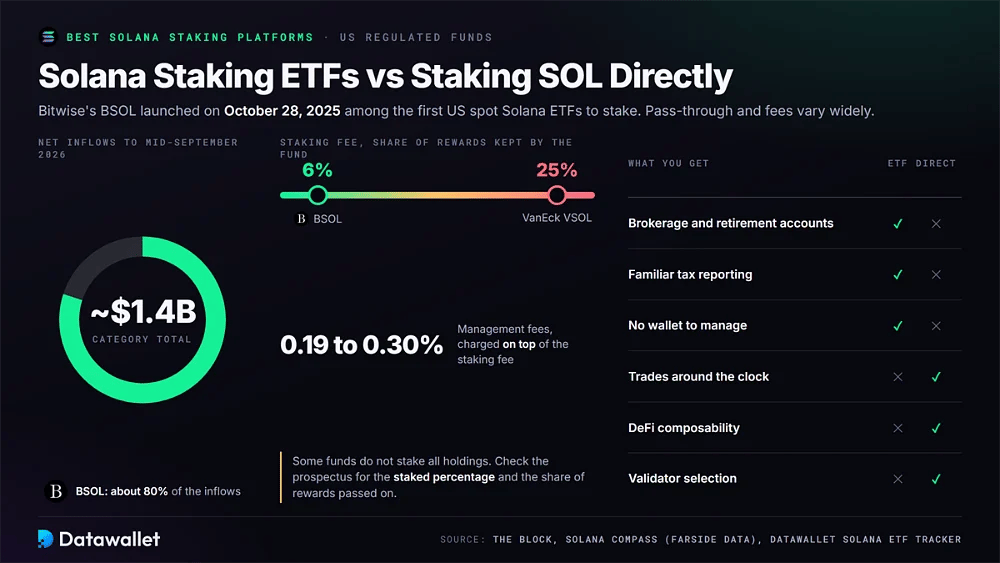
US investors can now receive Solana staking exposure through regulated funds. Bitwise's BSOL launched on October 28, 2025 as one of the first US spot Solana ETFs to stake its holdings. By mid-September 2026, the category had attracted roughly $1.4 billion in net inflows, with BSOL accounting for about 80%.
Pass-through rates and fees differ significantly between products. Farside data cited by Solana Compass puts staking fees between 6% for BSOL and 25% for VanEck's VSOL, in addition to management fees of 0.19-0.30%. Some Solana ETFs do not stake all holdings, so the prospectus should be checked for both the staked percentage and the share of rewards passed to investors.
ETFs can make sense for investors seeking staking exposure through brokerage or retirement accounts. They provide familiar tax reporting and remove wallet management. In exchange, investors accept fee drag, market-hours trading, no DeFi composability, and no control over validator selection. Our Solana ETF tracker follows daily flows.
Where Can You Stake SOL? Country-by-Country Access
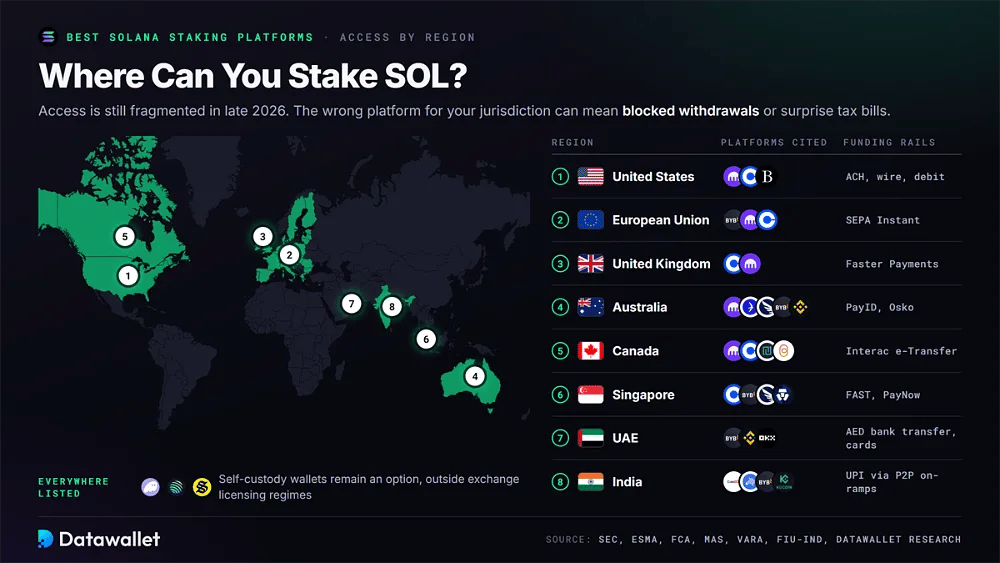
Solana staking access is still fragmented in late 2026. Choosing a platform that does not fit your jurisdiction can lead to blocked withdrawals, account restrictions, or unexpected tax consequences. The following summaries cover eight of the largest regions among Datawallet readers.
United States
Most US users can stake SOL through Kraken or Coinbase, use self-custody wallets with native delegation or LST support, or buy spot Solana staking ETFs through a brokerage account. Bybit and Binance.com remain unavailable. Binance.US offers fewer options than the international Binance platform.
The SEC's May 2025 statement concluded that protocol staking generally sits outside the Howey test. An August 2025 staff statement applied similar reasoning to liquid staking receipts. ACH, wire, and debit cards are common funding methods. Under IRS guidance, staking rewards are taxed as income when received. Our best US crypto exchanges guide compares available platforms.
European Union (MiCA Zone)
Regulated exchange access is broadest for EU users. Bybit EU received MiCA authorization from Austria's FMA in May 2025 and passports services across the EEA. Kraken and Coinbase also operate MiCA-authorized entities in Ireland and Luxembourg. SEPA and SEPA Instant remain the primary funding rails, with inbound transfers usually free.
The MiCA transitional period finished on July 1, 2026. Providers without authorization can therefore no longer offer custody services to EU clients. Self-custody through Phantom, Jupiter, or Solflare remains outside MiCA's scope, while Binance restricted onboarding in several member states during the transition.
United Kingdom
The UK remains in a transition period. Coinbase, Kraken, and other FCA-registered providers currently offer SOL staking, while self-custody services sit outside the regulatory perimeter. The FCA's new cryptoasset regime opened for authorization applications from 30 September 2026 and will take full effect on 25 October 2027, introducing explicit disclosure and consent rules for retail staking.
Most platforms support GBP deposits through Faster Payments with same-day settlement. HMRC generally treats staking rewards as miscellaneous income when received, followed by capital gains treatment when those tokens are later disposed of. Wallet users should therefore retain epoch-level records rather than relying on an exchange to generate reports.
Australia
Australian holders can stake SOL with Kraken, whose local operation is run by AUSTRAC-registered Bit Trade Pty Ltd. Swyftx, Independent Reserve, Bybit, Binance, and self-custody wallets are also available. AUD deposits commonly arrive within minutes through PayID or Osko, while inbound bank transfers are generally free.
The ATO classifies rewards as ordinary income at market value when received. Those reward tokens then become separate CGT assets when sold later. Proposed licensing rules for digital asset platforms could further tighten custodial staking requirements. Users should retain each reward's AUD value.
Canada
Canadian users can use Kraken, Coinbase, Newton, Bitbuy, and self-custody wallets. Centralized staking is overseen through the CSA and provincial regulators under the pre-registration undertaking framework. Those rules affect which assets and yields platforms may market to retail users and require registration as restricted or investment dealers.
Interac e-Transfer, wires, and pre-authorized debit are common CAD funding options, with many deposits settling within minutes. The CRA treats staking rewards as income when credited to the platform wallet, even if they have not yet been sold or withdrawn. Exchange statements should be reconciled with personal records annually.
Singapore
Coinbase, Bybit, Independent Reserve, and Crypto.com are accessible to Singapore users and hold or are pursuing MAS licences under the Payment Services Act. Phantom and Jupiter also support widely used self-custody staking routes outside MAS licensing, although MAS has tightened requirements for firms serving overseas customers.
FAST, PayNow, and wire transfers support SGD funding, usually without fees. IRAS determines staking tax treatment according to whether the activity is capital or revenue in nature. Frequent or commercial-scale staking is therefore more likely to attract income tax than occasional passive delegation by individual long-term holders.
United Arab Emirates
UAE users can stake through Bybit, which is regulated by VARA in Dubai, as well as Binance, OKX, or self-custody wallets. Platforms commonly accept AED through local bank transfers or cards, followed by AED-to-USDT conversion before users buy and stake SOL within the same account.
Individuals generally pay no personal income tax on crypto activity. The position can differ depending on residency, free-zone classification, or business-scale activity under the corporate tax framework. Anyone with connections to another jurisdiction should also determine whether staking income must be reported in their home country.
India
Compliant access is narrower in India. FIU-IND-registered domestic platforms including CoinDCX and ZebPay have limited staking menus. Bybit and KuCoin returned after obtaining FIU-IND registration during 2024-2025. Bank channels remain restrictive for crypto, leading many users to route UPI funding through P2P or compliant on-ramps.
India's VDA framework applies a 30% tax on gains plus 1% TDS on transfers and sharply limits deductions. Staking rewards are commonly treated as income at receipt. Frequent LST swaps may therefore create additional TDS events, making record-keeping more complicated than straightforward native delegation.
Is Solana Staking Yield Taxed?
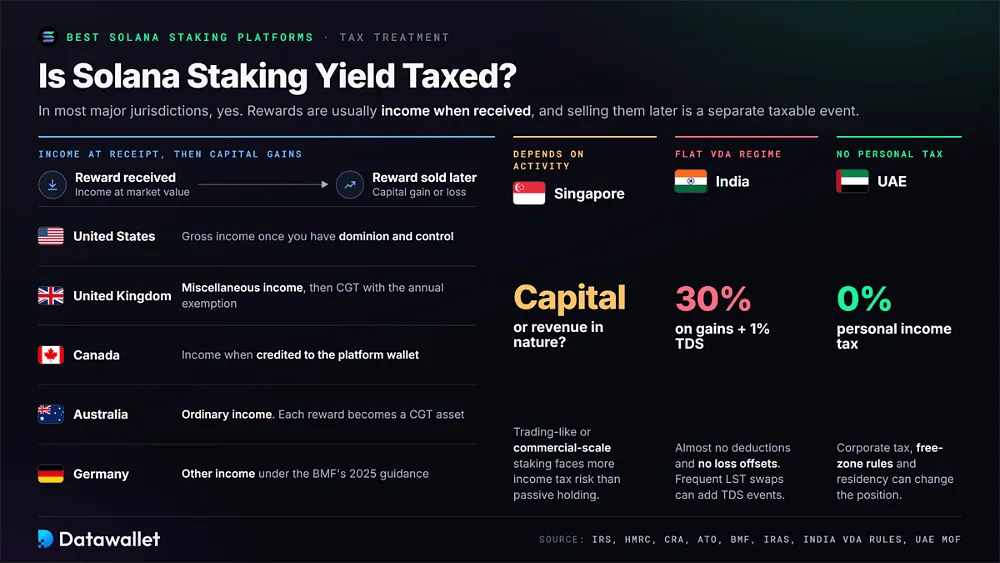
In most major jurisdictions, Solana staking yield is taxable, although the timing and classification vary by country and account structure. Rewards are frequently taxed as income when received. Selling those reward tokens later can then create a separate capital gain or loss.
Common regional treatments to check before filing locally:
- United States: Rewards are gross income when you gain dominion and control, valued at fair market value on receipt, and later sales trigger separate capital gains.
- United Kingdom: HMRC generally treats rewards as miscellaneous income at receipt, and disposing of those tokens later falls under capital gains tax with the annual exemption.
- Canada: Rewards from centralized platforms are income when credited to the platform wallet, even before you sell or withdraw them to self-custody or another exchange account.
- Australia: The ATO assesses rewards as ordinary income at market value when received, and reward tokens become CGT assets with their own cost base for later disposal.
- Germany: Rewards can be treated as other income, generally valued at market price on receipt, under the BMF's 2025 guidance on crypto assets and staking.
- Singapore: IRAS taxation depends on whether activity is capital or revenue in nature, so trading-like or commercial-scale staking faces higher income tax risk than passive holding.
- India: The VDA regime applies a 30% tax on gains plus 1% TDS on transfers, with almost no deductions and no loss offsets against other income.
- UAE: Individuals generally face no personal income tax, but corporate tax, free-zone rules, and residency status can change the effective position for larger holders or businesses.
Final Thoughts
Solana staking in late 2026 is better viewed as a long-term way to accumulate SOL than as dependable income. Faster disinflation should reduce base yields over the next three years. That makes low fees, dependable exit liquidity, effective MEV pass-through, and well-distributed validator infrastructure increasingly important.
Bybit, Jito, and Binance cover the widest range of needs, spanning regulated custody and the largest LSTs. Phantom and Jupiter are stronger fits for self-custody users focused on low fees. Kraken and Coinbase remain the practical US choices. Before committing SOL, compare custody, jurisdiction, net APY, and unstaking conditions, then reassess allocations once Alpenglow goes live.
Our Methodology
We reviewed more than 20 Solana staking routes, including native delegation tools, liquid staking protocols, centralized exchanges, stake pools, staking ETFs, and restaking products. TVL and yield figures were cross-checked against DefiLlama data during October 2026.
Here is how we evaluated and ranked each platform:
- Yield: We compared live 30-day APY figures from DefiLlama, Solana Compass, and platform dashboards, discounting temporary promotional rates that typically revert once marketing campaigns end.
- Fees: We reviewed validator commissions, epoch fees, exchange commissions, and withdrawal charges, and checked whether fees apply to base rewards, MEV, or both income streams.
- Market Share: We used DefiLlama TVL rankings to confirm scale and liquidity, which led us to add Jupiter and drop Marinade from this October 2026 update.
- Staking Model: We classified each provider as native, liquid, stake pool, exchange, ETF, or restaking, because each structure changes custody and risk exposure for the end user.
- Liquidity: We checked LST DEX depth, delayed-unstake options, withdrawal fees, and whether exits depend on Solana's roughly two-day epoch deactivation cycle or instant swaps through aggregators.
- Validator Quality: We weighed validator spread, vote performance, client diversity, and data center concentration, a factor the August 2026 TeraSwitch incident made urgent for every delegator.
- Regional Access: We considered US state eligibility, MiCA authorization, FCA status, AUSTRAC registration, and other frameworks that determine who can legally use each platform in practice today.
- Transparency: We favored platforms publishing yield data, fee schedules, proof-of-reserves, validator sets, and verifiable redemption mechanics over those relying on marketing claims and opaque dashboards.
- Use Case Fit: We ranked platforms by practical user profile, including best regulated, largest LST, easiest self-custody, lowest fees, US-eligible, and compliance-first alternatives for cautious US investors.