
Compare Top DePIN Projects in 2026
1. Bittensor (TAO)
Bittensor tops our 2026 ranking because it has the deepest onchain market structure in DePIN, coordinating machine intelligence rather than raw hardware. Its subnets are independent AI marketplaces where miners produce outputs and validators score them, with roughly $43 million in Q1 2026 revenue from real AI service usage.
The dTAO upgrade transformed its economics. Each subnet now issues an alpha token backed by its own liquidity pool, so markets rather than validators decide emissions. Studying the subnet leaderboards ourselves, we found this the clearest attempt yet to price AI work honestly, though the complexity is a genuine research burden.
Supply is Bitcoin-like: a 21 million hard cap, and the December 2025 halving cut daily emissions from 7,200 to 3,600 TAO. The May 2026 "Robin τ" expansion doubled Bittensor's subnet capacity from 128 to 256, while Grayscale's NYSE-listed GTAO trust opened an institutional access channel.
Pros
- Real revenue: Roughly $43 million in Q1 2026 from AI services puts it far ahead of most DePIN peers on paid usage.
- Scarce supply: A 21 million hard cap plus the December 2025 halving structurally tightens issuance as subnet demand grows.
- Market-priced emissions: dTAO lets capital flows, not committees, decide which AI subnets earn rewards each day.
Cons
- Governance stress: Covenant AI's April 2026 exit and $10 million liquidation knocked TAO 28% and exposed centralization concerns.
- High complexity: Subnets, alpha tokens, and Yuma Consensus make the network genuinely hard for ordinary investors to evaluate.
- Emissions concentration: A handful of teams control a large share of daily emissions, concentrating influence over the ecosystem.
2. Grass (GRASS)
Grass is the standout data DePIN, paying people to share unused residential bandwidth so AI labs can collect public web data at scale. The network has grown into a sovereign data rollup on Solana, reporting roughly 2.5 million nodes across 190 countries and 8.5 million users.
Running a node ourselves took under two minutes via the browser extension, and the appeal is obvious: idle bandwidth becomes income with no hardware cost. Behind the scenes, a ZK Processor generates proofs that scraped data was untampered, giving AI buyers verifiable provenance that centralized scrapers cannot match.
Commercially it is one of the sector's better performers, with roughly $33 million in annualized revenue and over 7,000 terabytes of web data delivered. The October 2025 points overhaul now rewards actual bandwidth usage rather than passive idling, and a 170 million token Airdrop 2 is scheduled for 2026.
Pros
- Zero-cost participation: Contributing needs only a browser extension and spare bandwidth, making it the most accessible DePIN to join.
- Verifiable provenance: ZK proofs certify that collected data is authentic, a genuine differentiator for AI labs buying training sets.
- Strong commercial traction: Around $33 million annualized revenue and 7,000-plus terabytes delivered show real buyers, not just token farming.
Cons
- Airdrop overhang: A 170 million token Airdrop 2 introduces meaningful sell pressure once recipients claim and rotate out.
- Scraping regulation: Web scraping faces rising legal scrutiny, and adverse rulings could directly threaten the network's core business model.
- Reward dilution: As node count climbs past 2.5 million, per-user earnings compress toward negligible amounts for casual participants.

3. Render (RENDER)
Render remains the benchmark for decentralized GPU work, connecting creators and AI developers to distributed graphics power. The network has now processed 69.4 million cumulative frames, with 2025 alone accounting for 24.3 million, representing 156% year-over-year growth in actual rendering throughput.
Its economics are the cleanest in DePIN. Under Burn-Mint Equilibrium, tokens spent on jobs are burned while operators earn fresh emissions, tying supply directly to usage. Reviewing the burn data, we were struck that burns grew 158% year-over-year, evidence that consumption is genuinely accelerating rather than being subsidized.
Render's 2026 expansion centers on Dispersed, its AI compute subnet serving inference at roughly $0.69 per GPU hour, plus the Salad integration adding around 60,000 consumer GPUs. That said, its token still trades at a steep multiple of disclosed revenue, which remains the central bear argument.
Pros
- Usage-linked burns: Burn-Mint Equilibrium destroys tokens with every paid job, creating deflationary pressure that scales with real demand.
- Proven throughput: Nearly 70 million frames rendered demonstrates a functioning marketplace rather than an aspirational whitepaper.
- Creative-AI bridge: OctaneRender heritage and the Dispersed subnet give it credibility across both media production and AI inference.
Cons
- Rich valuation: Analysts estimate a revenue multiple near 400x, meaning the price already assumes years of flawless execution.
- Opaque reporting: Burns are visible onchain, but USD revenue is not published in a standardized, audited format.
- Hyperscaler competition: AWS and Azure still win on reliability and enterprise support, capping Render's addressable market for now.

4. BitTorrent (BTT)
BitTorrent earns its place on sheer scale, serving over 100 million monthly active users across the world's largest peer-to-peer network. Where other DePINs must bootstrap supply from zero, BitTorrent tokenized a protocol that already had two decades of entrenched adoption behind it.
The BTTC 2.0 upgrade moved the chain to Proof-of-Stake with deflationary burns and roughly 7% staking APY. In June 2026, BitTorrent Speed rolled out optional BTT payments so users can pay peers for faster downloads, finally creating a demand sink tied directly to the network's native activity.
Regulatory clarity arrived when the SEC dismissed all claims against the BitTorrent Foundation in March 2026, removing a long-standing overhang. The honest caveat is that token utility still lags user count enormously, and monetizing free file-sharing habits remains an unsolved problem.
Pros
- Unmatched distribution: A 100 million monthly user base gives it a bootstrapping advantage no other DePIN can replicate.
- Regulatory clarity: The SEC's March 2026 dismissal removes the litigation overhang that suppressed institutional interest for years.
- New demand sink: BitTorrent Speed's June 2026 payments let users spend BTT for bandwidth, tying tokens to native usage.
Cons
- Weak monetization: Enormous usage has never translated into proportional token demand, the project's defining structural problem.
- Centralization concerns: TRON's ownership and large foundation allocations leave meaningful control outside the community.
- Diluted supply: With 990 trillion tokens outstanding, per-token appreciation requires extraordinary demand growth to register.
5. io.net (IO)
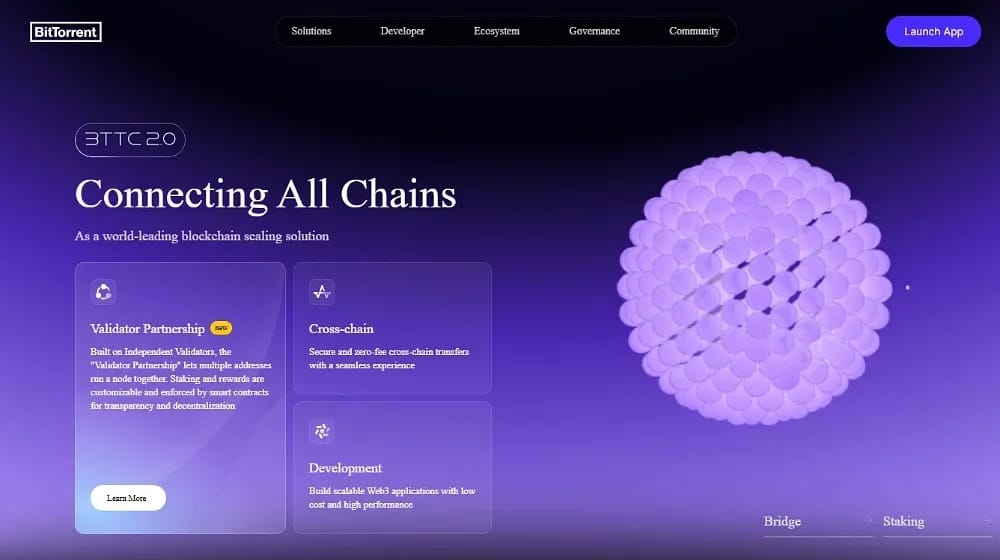
io.net aggregates idle GPUs from data centers, former mining farms, and consumer hardware into on-demand AI clusters across 130-plus countries, undercutting AWS and GCP by up to 70%. Its Ray framework integration is the practical differentiator: existing Ray jobs deploy without rewriting application code.
Enterprise traction is the story of 2026, with $8 million in enterprise deals closed in Q1 alone. The Incentive Dynamic Engine went live in June 2026, tying token burns to verified compute usage per epoch, and confidential compute using Intel TDX puts it ahead of most DePIN rivals on enterprise security.
We do have reservations after digging into the data. Independent analysis shows the IDE burn is currently emission-funded rather than the marketed revenue buyback, annualized revenue sits nearer $12.5 million than earlier projections implied, and the core orchestration stack remains closed-source despite the open-source branding.
Pros
- Enterprise revenue: Closing $8 million in Q1 2026 enterprise deals proves paying customers, not just speculative node operators.
- Developer-friendly: Native Ray integration means machine learning teams deploy existing cluster jobs without rewriting their pipelines.
- Deep cost advantage: Savings of 50-70% versus hyperscalers give it a durable edge for cost-sensitive AI training workloads.
Cons
- Inflated GPU metrics: Roughly 327,000 registered GPUs versus about 6,720 daily verified active reveals a persistent utilization gap.
- Closed-source core: The orchestration engine and worker binary remain proprietary, undermining its open-source positioning and auditability.
- Emission-funded burns: The IDE burn is not yet the revenue-backed buyback promised, leaving the token net inflationary today.
6. Arweave (AR)
Arweave closes the list as the sector's permanence layer, storing data forever for a single upfront payment. Its Storage Endowment model funds 200 years of replication by assuming storage costs decline roughly 0.5% annually, letting the endowment subsidize miners indefinitely.
Uploading to the permaweb ourselves, the pay-once model felt genuinely different from renting cloud storage, and the AO Computer, live since February 2025, extends Arweave beyond archiving into decentralized compute for AI agents and autonomous processes anchored to permanent data.
Supply mechanics are unusually tight, with roughly 65.65 million of a 66 million hard cap already circulating and no venture unlock schedule ahead. The 2026 question is demand: AI data provenance is a compelling narrative, but developer adoption of AO must materialize for the endowment flywheel to turn.
Pros
- True permanence: Pay-once storage backed by a 200-year endowment solves link rot in a way rented storage cannot.
- No dilution ahead: With about 99.4% of the 66 million cap circulating, there are no venture unlocks left to absorb.
- AI provenance fit: Immutable, auditable datasets are increasingly valuable as AI training data faces provenance and authenticity scrutiny.
Cons
- Adoption uncertainty: AO's compute traction remains unproven, and the bull case depends heavily on developers actually building there.
- Immutability risk: Data cannot be deleted, creating unresolved tension with privacy regimes like the right to erasure.
- Retrieval speed: Gateway performance under heavy parallel load still trails Web2 infrastructure, limiting latency-sensitive applications.
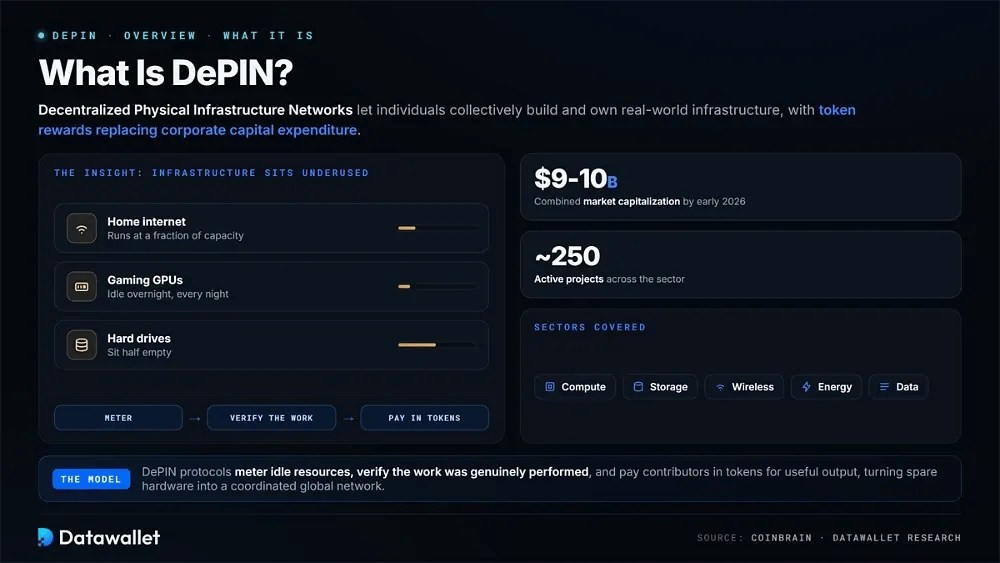
What is DePIN?
DePIN, short for Decentralized Physical Infrastructure Network, describes crypto projects that let individuals collectively build and own real-world infrastructure such as GPU compute, wireless coverage, bandwidth, or storage. Token rewards replace corporate capital expenditure, turning idle hardware into a coordinated global network.
The model works because so much infrastructure sits underused. Home internet connections run at a fraction of capacity, gaming GPUs idle overnight, and hard drives sit half empty. DePIN protocols meter those resources, verify the work was genuinely performed, and pay contributors in tokens for useful output.
By early 2026 the sector reached roughly $9 to $10 billion in combined market capitalization across nearly 250 active projects, spanning compute, storage, wireless, energy, and data. That figure is modest beside the end markets these networks target, which is precisely why the category still attracts serious capital.
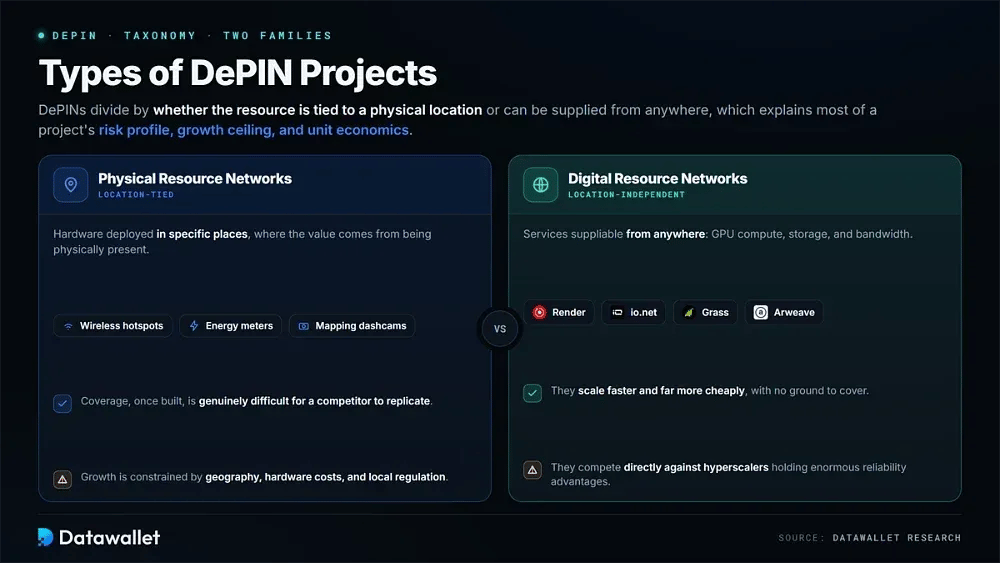
Types of DePIN Projects
DePINs divide broadly into two families, defined by whether the underlying resource is tied to a physical location or can be supplied from anywhere. Understanding which family a project belongs to explains most of its risk profile, its growth ceiling, and its unit economics.
Physical Resource Networks depend on hardware deployed in specific places, such as wireless hotspots, energy meters, or dashcams for mapping. Their growth is constrained by geography, hardware costs, and local regulation, but the resulting coverage is genuinely difficult for a competitor to replicate.
Digital Resource Networks supply location-independent services such as GPU compute, storage, and bandwidth. Render, io.net, Grass, and Arweave all sit in this camp, which is why they scale faster and far more cheaply, though they also compete directly against hyperscalers holding enormous reliability advantages.
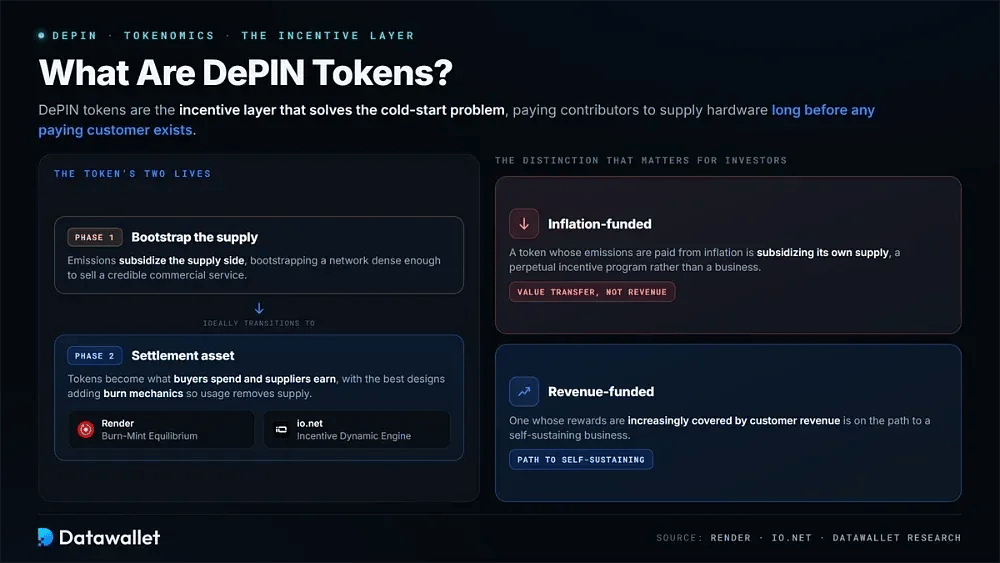
What are DePIN Tokens?
DePIN tokens are the incentive layer that solves the cold-start problem, paying contributors to supply hardware long before any paying customer exists. In these early phases, emissions effectively subsidize the supply side, bootstrapping a network dense enough to sell a credible commercial service.
The mature version looks different. Tokens become the settlement asset that buyers spend and suppliers earn, with the best designs adding burn mechanics so that usage removes supply. Render's Burn-Mint Equilibrium and io.net's Incentive Dynamic Engine both aim at that transition.
The distinction matters enormously for investors. A token whose emissions are funded by inflation is subsidizing its own supply, while one whose rewards are increasingly covered by customer revenue is on the path to a self-sustaining business rather than a perpetual incentive program.
How Does DePIN Work?
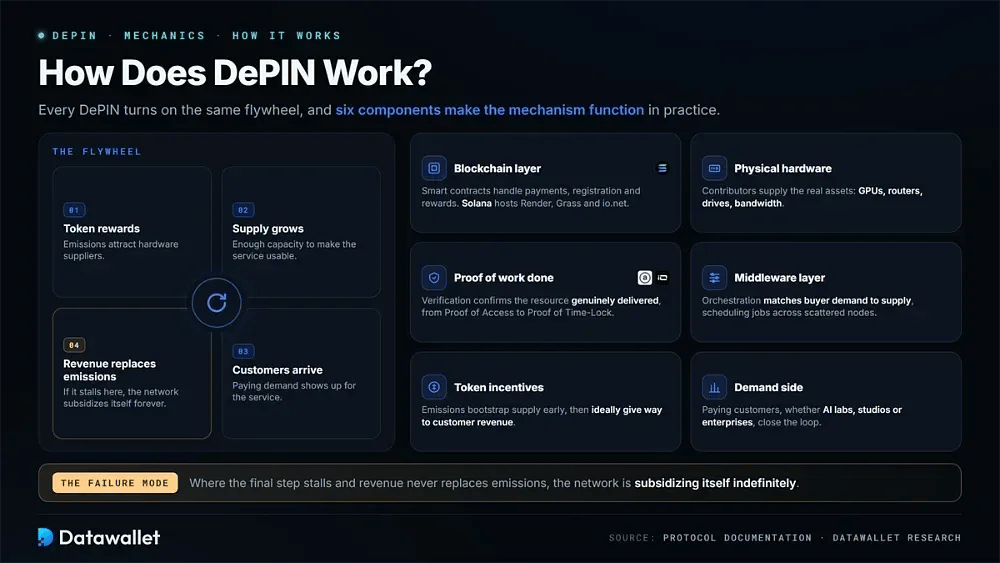
Every DePIN turns on the same flywheel: token rewards attract hardware suppliers, growing supply makes the service usable, paying customers arrive, and their revenue ideally replaces emissions as the reward source. Where that final step stalls, the network is subsidizing itself indefinitely.
Six components make the mechanism function in practice:
- Blockchain layer: Smart contracts handle payments, registration, and reward distribution transparently, with Solana hosting Render, Grass, and io.net for cheap settlement.
- Physical hardware: Contributors supply the real assets, whether GPUs, routers, storage drives, or bandwidth, forming the network's actual productive capacity.
- Proof of work done: Verification systems confirm the resource genuinely delivered, from Arweave's Proof of Access to io.net's Proof of Time-Lock checks.
- Middleware layer: Orchestration software matches buyer demand to available supply, scheduling jobs and routing traffic across geographically scattered nodes.
- Token incentives: Emissions bootstrap supply early, then ideally give way to customer revenue as the network finds genuine product-market fit.
- Demand side: Paying customers, whether AI labs, studios, or enterprises, close the loop by converting infrastructure into recurring revenue.
How to Choose a DePIN Project
Picking DePIN exposure in 2026 means separating networks with genuine paying customers from those with impressive-sounding hardware counts. The market has stopped rewarding narrative alone, so the analytical bar now sits much closer to how you would assess any infrastructure business.
Metrics That Actually Matter
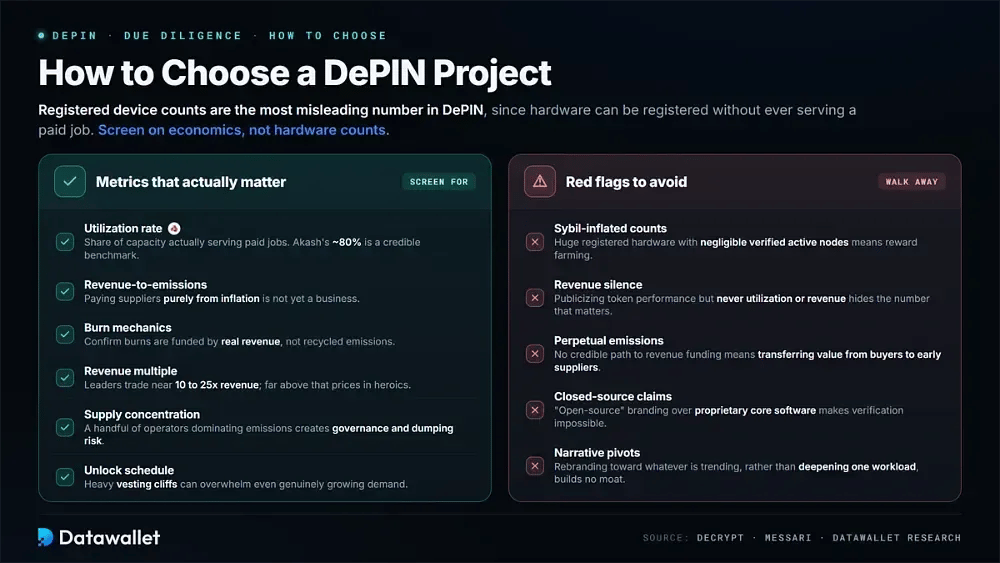
Registered device counts are the most misleading number in DePIN, since hardware can be registered without ever serving a paid job. The metrics below reveal whether a network is genuinely working or merely subsidizing idle capacity.
Screen every project against these indicators before allocating capital:
- Utilization rate: The share of registered capacity actually serving paid jobs, where Akash's roughly 80% sets a credible benchmark.
- Revenue-to-emissions: Compare customer revenue against token emissions, since a network paying suppliers purely from inflation is not yet a business.
- Burn mechanics: Confirm whether burns are funded by real revenue or simply recycled emissions dressed up as deflation.
- Revenue multiple: Leading DePINs trade near 10 to 25 times revenue, so anything far above that prices in heroic assumptions.
- Supply concentration: Check whether a handful of operators dominate emissions, since concentrated control creates governance and dumping risk.
- Unlock schedule: Map upcoming token unlocks, because heavy vesting cliffs can overwhelm even genuinely growing demand.
Red Flags to Avoid
Certain patterns reliably precede disappointment, and most are visible in public data before the token price reflects them. Recognizing them early is the cheapest risk management available in this sector.
Walk away when you encounter any of the following signals:
- Sybil-inflated counts: Huge registered hardware numbers with negligible verified active nodes usually indicate reward farming, not genuine capacity.
- Revenue silence: Projects that publicize token performance while never disclosing utilization or revenue are hiding the number that matters.
- Perpetual emissions: Reward programs with no credible path to revenue funding are transferring value from buyers to early suppliers.
- Closed-source claims: "Open-source" branding over proprietary core software makes independent verification of network claims impossible.
- Narrative pivots: Networks that rebrand toward whatever is trending, rather than deepening one workload, rarely build durable moats.
The 2026 DePIN Field: Forced Into Fundamentals
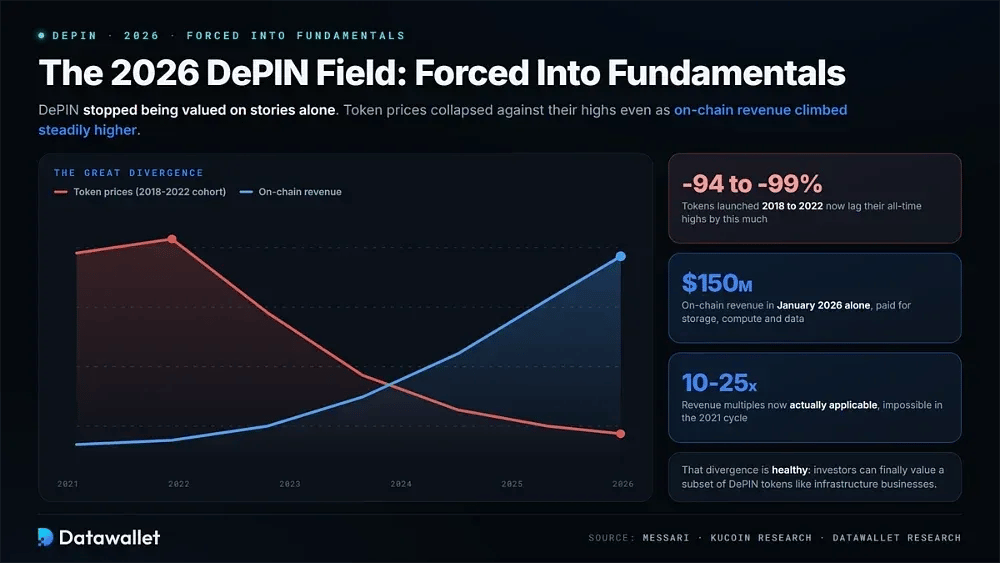
The defining shift this year is that DePIN stopped being valued on stories alone. Messari's analysis found that tokens launched between 2018 and 2022 are now lagging their all-time highs by 94-99%, even as onchain revenue across the sector climbed steadily higher.
That divergence is healthy. Leading networks generated roughly $150 million in onchain revenue in January 2026 alone, paid by real customers for storage deals, compute jobs, and data credits. Investors can now apply revenue multiples to a subset of DePIN tokens, something impossible during the 2021 cycle.
The AI Compute Bottleneck
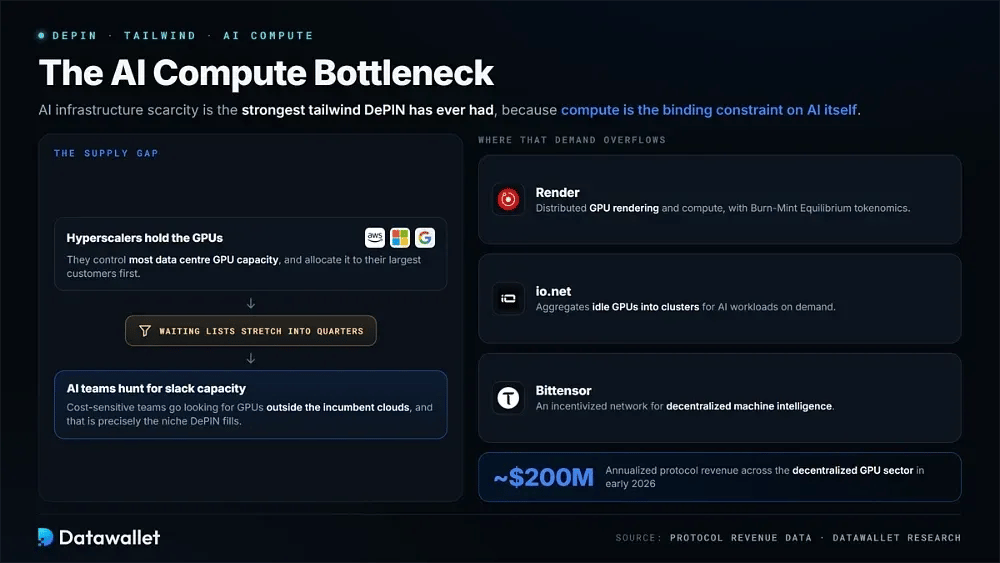
AI infrastructure scarcity is the strongest tailwind DePIN has ever had. Hyperscalers control most data centre GPU capacity, waiting lists stretch into quarters, and the resulting supply gap sends cost-sensitive AI teams hunting for slack capacity outside the incumbent clouds.
That is precisely the niche Render, io.net, and Bittensor occupy. The decentralized GPU sector collectively managed an estimated $200 million in annualized protocol revenue in early 2026, and the best AI crypto projects increasingly overlap with DePIN because compute is the binding constraint on AI itself.
Where the Sector Heads Next
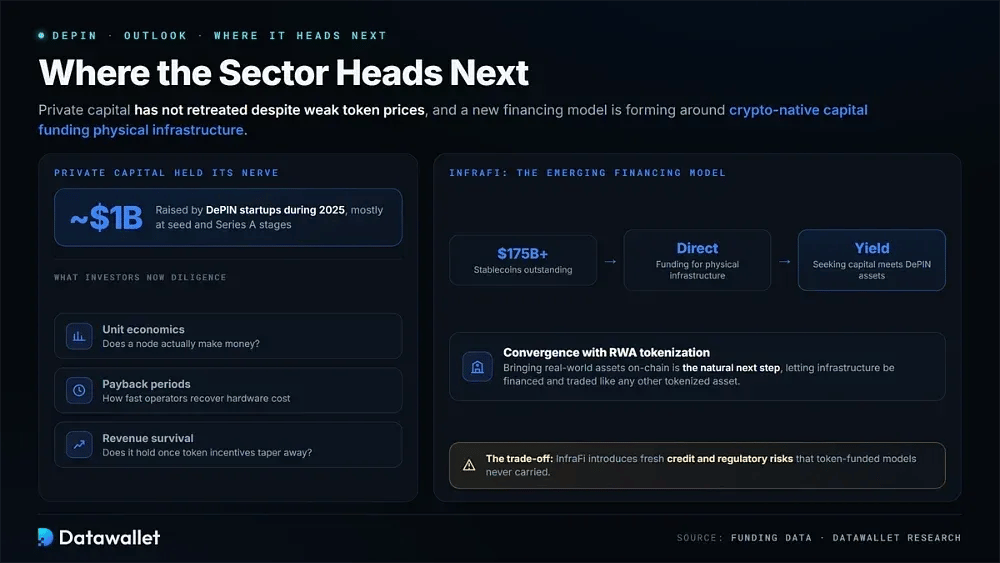
Private capital has not retreated despite weak token prices, with DePIN startups raising roughly $1 billion during 2025, mostly at seed and Series A stages. Investors now diligence unit economics, payback periods, and crucially whether revenue survives once token incentives eventually taper away.
The emerging financing model is InfraFi, using crypto-native capital such as stablecoins to fund physical infrastructure directly. With over $175 billion in stablecoins outstanding, DePIN assets could attract yield-seeking capital, though it introduces fresh credit and regulatory risks. Convergence with real-world asset tokenization is the natural next step.
Risks of Investing in DePIN Projects
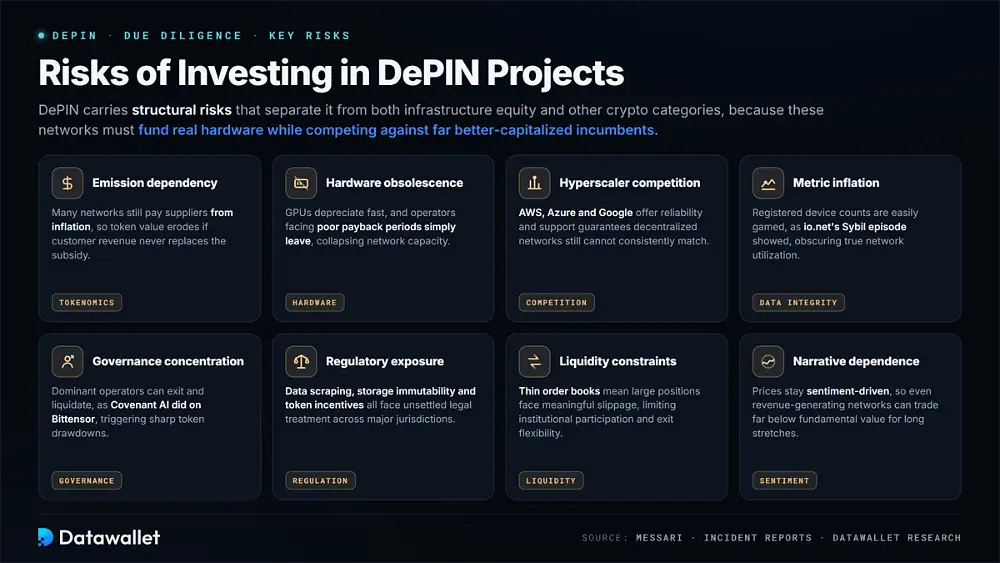
DePIN carries structural risks that clearly separate it from both traditional infrastructure equity and other crypto categories, largely because these networks must fund real physical hardware while competing directly against enormously better-capitalized incumbents.
Weigh each of these risks before committing capital to any DePIN token:
- Emission dependency: Many networks still pay suppliers from inflation, so token value erodes if customer revenue never replaces subsidies.
- Hardware obsolescence: GPUs and devices depreciate fast, and operators facing poor payback periods simply leave, collapsing network capacity.
- Hyperscaler competition: AWS, Azure, and Google offer reliability and support guarantees that decentralized networks still cannot consistently match.
- Metric inflation: Registered device counts are easily gamed, as io.net's Sybil episode showed, obscuring true network utilization.
- Governance concentration: Dominant operators can exit and liquidate, as Covenant AI did on Bittensor, triggering sharp token drawdowns.
- Regulatory exposure: Data scraping, storage immutability, and token incentives all face unsettled legal treatment across major jurisdictions.
- Liquidity constraints: Thin order books mean large positions face meaningful slippage, limiting institutional participation and exit flexibility.
- Narrative dependence: Token prices remain sentiment-driven, so even revenue-generating networks can trade far below fundamental value for extended periods.
Final Thoughts
DePIN in 2026 is a genuinely different sector from the one that ran hot in 2024. Token prices remain deeply depressed while onchain revenue keeps climbing, and that divergence is the whole story: the market is finally learning to price infrastructure like infrastructure.
Bittensor leads our ranking on the strength of real subnet revenue and the tightest supply mechanics in the category, with Grass and Render close behind on verifiable usage. io.net and Arweave offer sharper risk-reward for investors comfortable with unproven adoption curves.
Treat this as an infrastructure allocation rather than a narrative trade. Verify utilization before you buy, size positions so that any single network's failure is survivable, and remember that a token with real customers is a fundamentally different asset from one with only impressive hardware counts.
Our Methodology
We evaluated each network by examining what it actually does rather than what it claims, running nodes ourselves where participation was open, reviewing onchain revenue and burn data, reading foundation reports, and cross-checking headline device counts against independently verified active-node figures.
Six criteria shaped the final ranking, weighted toward evidence of genuine economic activity:
- Revenue quality: We measured onchain revenue paid by real customers, discounting projects whose income was recycled token emissions.
- Network utilization: We compared registered hardware against verified active nodes to expose Sybil inflation and idle capacity.
- Token economics: We assessed whether burns, caps, and emissions tie supply to usage or simply dilute existing holders.
- Technical moat: We reviewed verification mechanisms, proof systems, and whether the architecture is genuinely hard for rivals to copy.
- Governance health: We examined operator concentration, foundation control, and how each network handled stress events during 2026.
- Adoption trajectory: We tracked user growth, enterprise deals, and developer activity to distinguish acceleration from stagnation.
DePIN metrics shift quickly as networks launch upgrades and revise tokenomics, so our research cycle ran from February through July 2026, with figures verified against project documentation, foundation reports, and independent onchain trackers.