



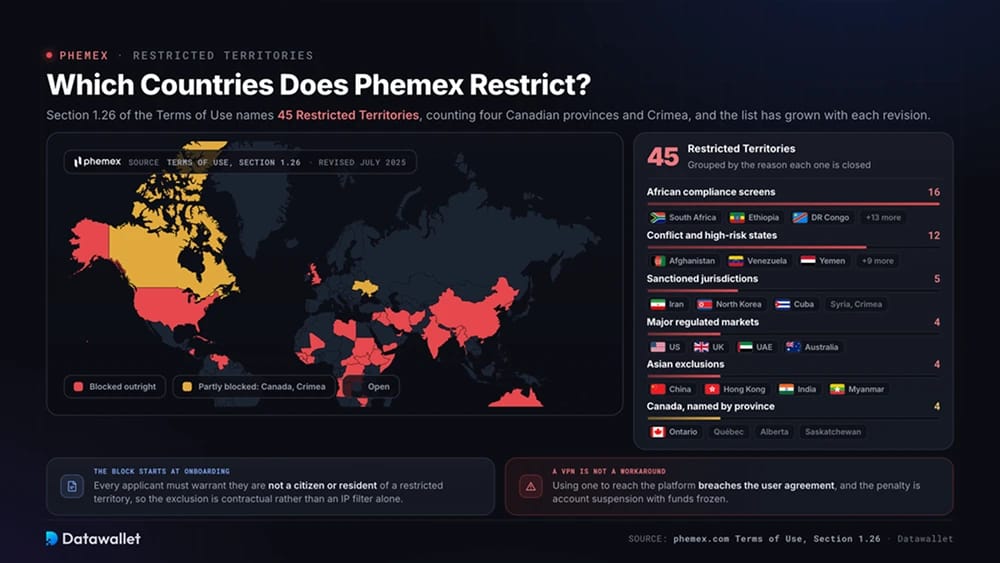
Which Countries Does Phemex Restrict?
Phemex defines its blocked markets as Restricted Territories under Section 1.26 of its Terms of Use, last revised in July 2025. The current version carries 45 entries, counting four Canadian provinces and the territory of Crimea, and it has expanded beyond earlier revisions that left Australia, Hong Kong, and South Africa untouched.
The restrictions sort into a few distinct groups:
- Sanctioned jurisdictions: Iran, North Korea, Syria, Cuba, and Crimea sit under comprehensive UN, US, or EU sanctions programmes that make serving them unlawful for exchanges with international banking exposure.
- Major regulated markets: The United States, the United Kingdom, the UAE, and Australia are excluded because each requires a domestic licence that Phemex does not hold, and the Australian market is one of the newest additions to the list.
- Canada by province: Ontario, Québec, Alberta, and Saskatchewan are named individually, a legacy of the 2023 Ontario Securities Commission settlement that ended Phemex's unregistered activity in the province.
- Asian exclusions: China, Hong Kong, India, and Myanmar are blocked, reflecting the mainland trading ban, Hong Kong's licensing regime for virtual asset platforms, and India's registration requirements for offshore exchanges.
- Conflict and high-risk states: Afghanistan, Haiti, Iraq, Lebanon, Libya, Nicaragua, Palestine, Somalia, South Sudan, Sudan, Venezuela, and Yemen fall under instability and money-laundering risk screens.
- African compliance exclusions: Angola, Burundi, Central African Republic, DR Congo, Eritrea, Ethiopia, Guinea, Guinea-Bissau, Ivory Coast, Liberia, Mali, Rwanda, Sierra Leone, South Africa, Zimbabwe, and the Seychelles round out the list.
Anyone opening an account must also warrant they are not a citizen or resident of a restricted territory, so the block operates at onboarding rather than through IP detection alone. Using a VPN breaches the agreement and risks account suspension with funds frozen.
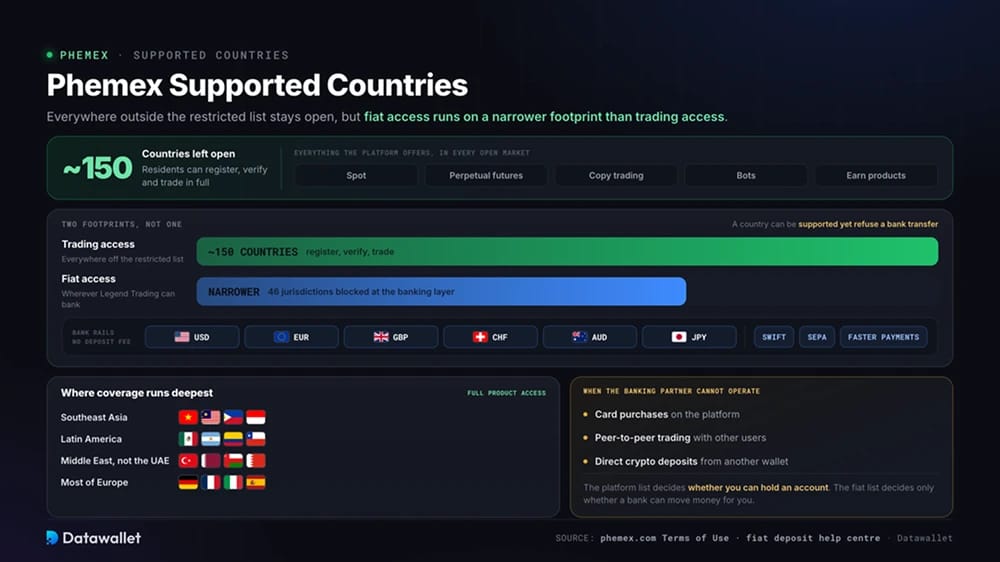
Phemex Supported Countries
Everywhere outside the restricted list remains open, which leaves roughly 150 countries where residents can register, verify, and trade spot, perpetual futures, copy trading, bots, and earn products. Coverage is deepest across Southeast Asia, Latin America, the Middle East outside the UAE, Turkey, and most of Europe.
Fiat access runs on a narrower footprint than trading access. Through its partner Legend Trading, Phemex supports bank deposits and withdrawals in major currencies including USD, EUR, GBP, CHF, AUD, and JPY, moving over SWIFT, SEPA, and the UK's Faster Payments with no deposit fee.
Where the banking partner cannot operate, users fall back on card purchases, peer-to-peer trading, or direct crypto deposits. That split explains why a country can appear supported yet still refuse a bank transfer.
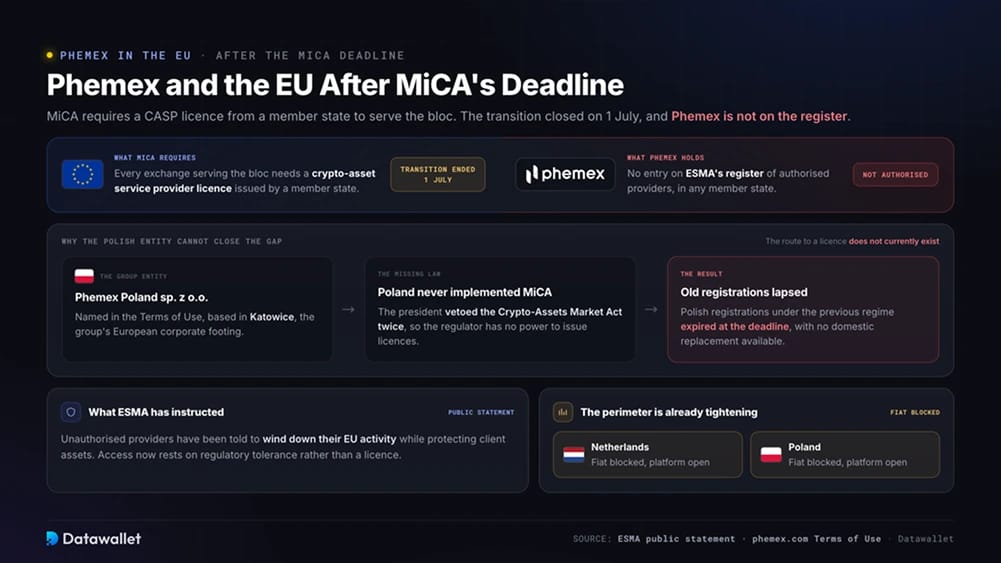
Phemex and the EU After MiCA's Deadline
The Markets in Crypto-Assets Regulation, the EU rulebook known as MiCA, requires every exchange serving the bloc to hold a crypto-asset service provider licence from a member state. The transition period for firms operating under old national registrations ended on 1 July, and ESMA has told unauthorised providers to wind down their EU activity while protecting client assets.
Phemex does not appear on ESMA's register of authorised providers, and its European corporate footing leaves little room to catch up. The Terms of Use name Phemex Poland sp. z o.o. in Katowice as a group entity, yet Poland never passed the implementing law its regulator needs to issue licences, after the president vetoed the Crypto-Assets Market Act twice. Polish registrations under the old regime lapsed at the deadline with no domestic replacement available.
The Netherlands and Poland sit on the fiat restriction list even though neither appears in the platform-level blocked territories, and EU residents weighing their options can compare the MiCA-licensed crypto exchanges that cleared the authorisation bar before enforcement began.
Phemex Licences and Regulation
Phemex's registrations cover anti-money-laundering supervision rather than full market authorisation, and several regulators have taken enforcement action against the exchange.
These are the confirmed registrations and enforcement records:
- US FinCEN MSB registration: Phemex Ltd holds money services business registration number 31000171217304. This is an AML reporting obligation and does not authorise the exchange to serve American retail customers.
- Lithuanian entity: Phemex Lithuania UAB, company code 306047839, was registered as a virtual asset service provider under Lithuania's pre-MiCA regime, a status that carries no EU passport now the transition has closed.
- UK FCA warning: The Financial Conduct Authority lists Phemex as an unauthorised firm that may be promoting services to UK consumers without permission, and the UK sits on both the platform and fiat restriction lists.
- Ontario enforcement: The OSC found Phemex Limited and Phemex Technology Pte. Ltd. traded crypto assets without registration, producing the settlement behind today's four-province Canadian block.
- Governing law: The user agreement is governed by Singapore law with disputes referred to Singapore arbitration, though the company holds no licence from the Monetary Authority of Singapore and its press releases are issued from Apia, Samoa.
Does Phemex Require KYC?
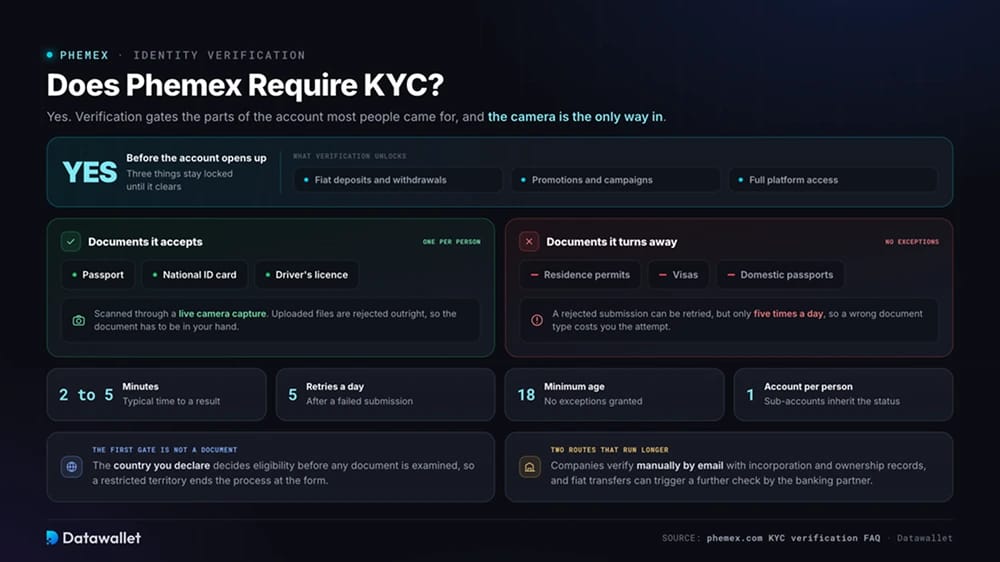
Yes, Phemex requires identity verification before fiat services, promotions, and full platform access, as set out in its verification FAQ. Applicants scan a passport, national ID card, or driver's licence using a live camera capture, since uploaded files are rejected.
Results typically arrive within two to five minutes, and a failed submission can be retried up to five times per day. Residence permits, visas, and domestic passports are not accepted, the minimum age is 18, and the declared country decides eligibility before any document is examined.
Each person can verify only one account, and sub-accounts inherit the status of the main account. Corporate applicants complete a manual business verification by email, submitting incorporation records, ownership details, proof of address, and banking information. Fiat transactions may trigger an additional check by the banking partner even after platform verification.
Countries Where Phemex Blocks Fiat Deposits
Phemex maintains a separate fiat restriction list covering 46 jurisdictions where bank deposits and withdrawals through Legend Trading are unavailable. Crypto deposits and trading can still work in many of these countries because the platform-level list decides account eligibility.
The fiat exclusions group as follows:
- Sanctions-driven blocks: Belarus, Cuba, Iran, North Korea, Russia, and Syria cannot clear compliant banking channels while international sanctions remain in force.
- European exceptions: The Netherlands, Poland, Ukraine, and the United Kingdom are refused at the banking layer, mirroring the licensing gaps discussed above.
- Latin American entries: Bolivia, Brazil, Nicaragua, Trinidad and Tobago, and Venezuela face banking friction, currency controls, or unresolved regulatory positions.
- African and Middle Eastern screens: Botswana, Burkina Faso, Cameroon, Ghana, Kenya, Mozambique, Nigeria, Tunisia, and others fail the partner's financial-crime risk thresholds.
- Asian restrictions: Cambodia, Laos, Pakistan, Sri Lanka, and Thailand are excluded where capital controls or unsettled crypto rules prevent reliable settlement.
- Canada as a whole: The entire country is fiat-blocked, a wider net than the four provinces barred from the platform itself.
Can I Use Phemex in the USA?
No, the United States is a restricted territory, and the exclusion runs deeper than an IP block. Every user must declare under the Terms of Use that they are not a US citizen, green card holder, or US tax resident as defined by FATCA, the American law that forces foreign financial firms to report US account holders.
The FinCEN registration sometimes cited as evidence of US approval does not change this. Money services business registration obliges Phemex to file AML reports, and it grants no permission to onboard American retail traders, so US residents need a domestically licensed platform instead.
The Lazarus Group Hack and Phemex Security
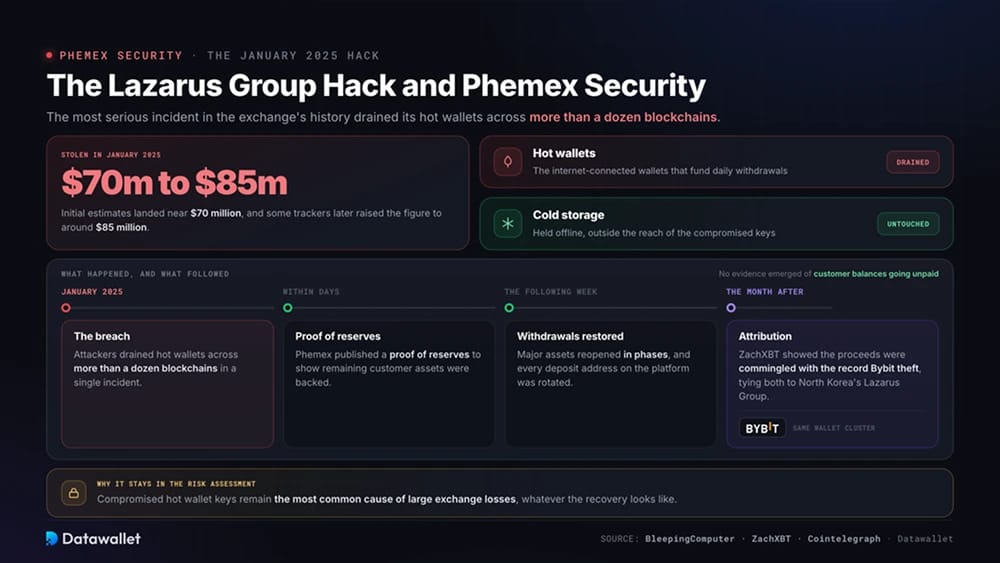
Phemex suffered the most serious incident in its history in January 2025, when attackers drained hot wallets, the internet-connected wallets used for daily withdrawals, across more than a dozen blockchains. Initial estimates put the theft near $70 million, with some trackers later raising the figure to around $85 million, while cold storage was untouched.
Attribution firmed up the following month. Onchain investigator ZachXBT showed the attackers commingled the Phemex proceeds with funds from the record Bybit theft, tying both incidents to North Korea's Lazarus Group.
Phemex published a proof of reserves within days, restored withdrawals for major assets in phases over the following week, and rotated every deposit address. The episode still belongs in any risk assessment, since compromised hot wallet keys remain the most common cause of large exchange losses.
About Phemex
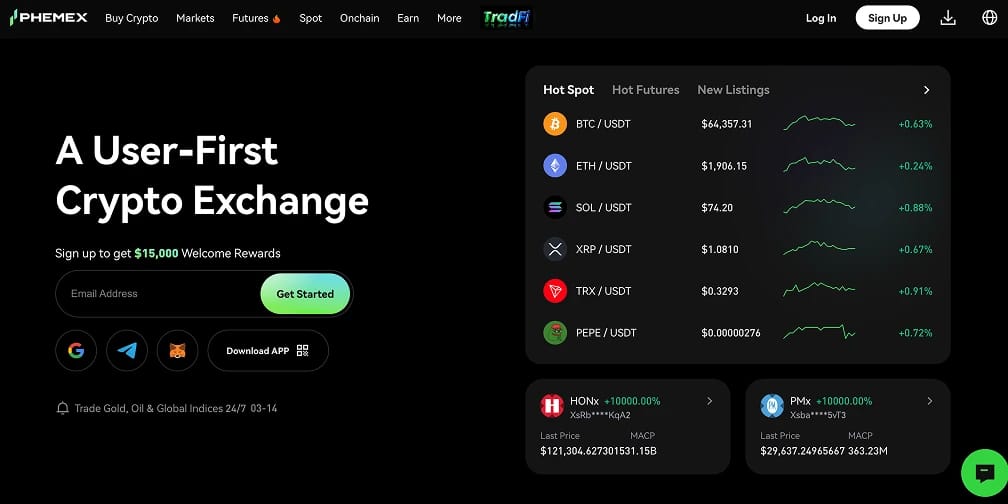
Phemex launched in 2019, founded by former Morgan Stanley executives, and runs under CEO Federico Variola with a product line spanning spot, perpetual futures with up to 100x leverage, copy trading, bots, an onchain trading zone, and yield products. The company reports serving more than 10 million users worldwide.
Its biggest recent bet is TradFi, a suite of USDT-settled perpetual futures on stocks, gold, oil, indices, and pre-IPO names such as SpaceX that trade around the clock. The product passed $10 billion in monthly volume in its first full month and had grown to 73 listed contracts by June, making Phemex one of the earlier movers among the crypto futures exchanges pushing into traditional assets.
Final Thoughts
The Phemex access map has tightened in one direction. Australia, Hong Kong, and South Africa joined a restricted list that already covered the US, the UK, the UAE, and much of Canada, and the fiat network excludes a further band of countries the platform itself still serves.
Europe is the open question. With no MiCA authorisation and the transition period behind us, Phemex's ability to keep serving EU residents rests on regulatory tolerance rather than a licence, and the fiat blocks on the Netherlands and Poland suggest the perimeter is already contracting.
Anyone checking access from a specific country should treat Section 1.26 of the Terms of Use and the fiat restriction page as the definitive records, because both have changed within the past year and can change again without notice.