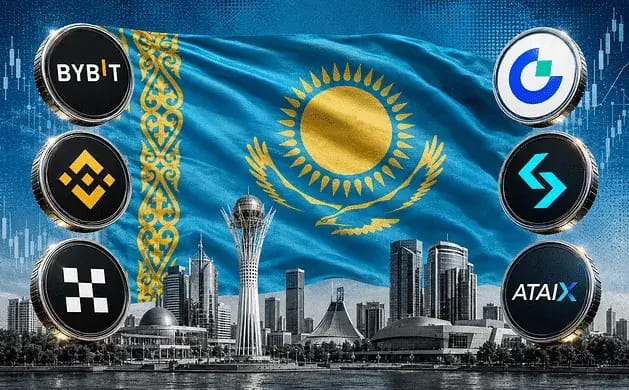

Compare Top Crypto Exchanges in Kazakhstan
1. Bybit
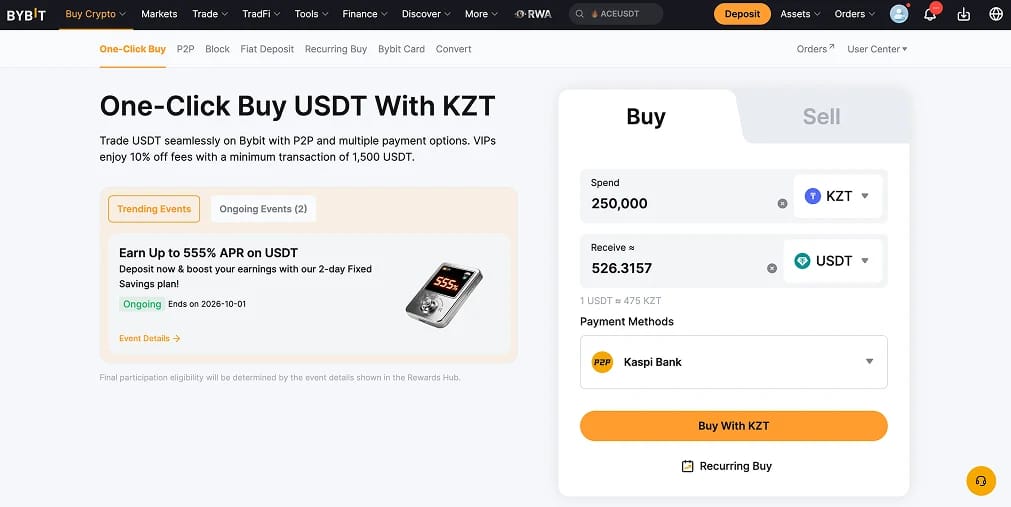
Bybit is the best crypto exchange in Kazakhstan because it has built a fully licensed local operation around the tenge, something no other global platform has matched. Under license number AFSA-A-LA-2024-0027, Bybit Kazakhstan is authorized to operate a digital asset trading facility, hold client assets in custody, and deal and manage investments. Its bybit.kz platform is available in Kazakh, Russian, and English, with local customer support.
The license is most valuable when funding an account. A KZT/USDT spot pair launched in April together with a Bank CenterCredit deposit channel. Tenge can move directly from a BCC account to the order book without requiring an initial stablecoin purchase. In November, Bybit added the country's first regulated P2P marketplace, connecting users with AFSA-licensed financial institutions at zero commission. Customers of other banks can use cards, Apple Pay, or Google Pay.
The trading experience is comparable to global Bybit. Spot fees are fixed at 0.1% across more than 2,500 listed assets. After verification, the same balance can be used for futures, copy trading, and Earn products. Our test card deposit arrived within minutes, while P2P took longer because licensed counterparties verify every cash payment. The broader platform is covered in our Bybit review.
Pros
- The only global exchange with a full AFSA license covering trading, custody, and investment services in Kazakhstan.
- Direct KZT/USDT trading and a Bank CenterCredit deposit channel eliminate the usual stablecoin conversion step.
- Its regulated P2P marketplace charges no commission and settles through AFSA-licensed financial institutions instead of anonymous merchants.
- A complete Kazakh-language interface and local customer support, which remain uncommon among major exchanges.
Cons
- Individual P2P trades are limited to 2.5 million KZT, with a daily cap of 5 million KZT, which is restrictive for larger buyers.
- The app becomes crowded as trading, Earn, and campaign pages accumulate.
- Quick-buy screens include a spread. The advertised 0.1% fee applies only to the spot order book.
2. Binance
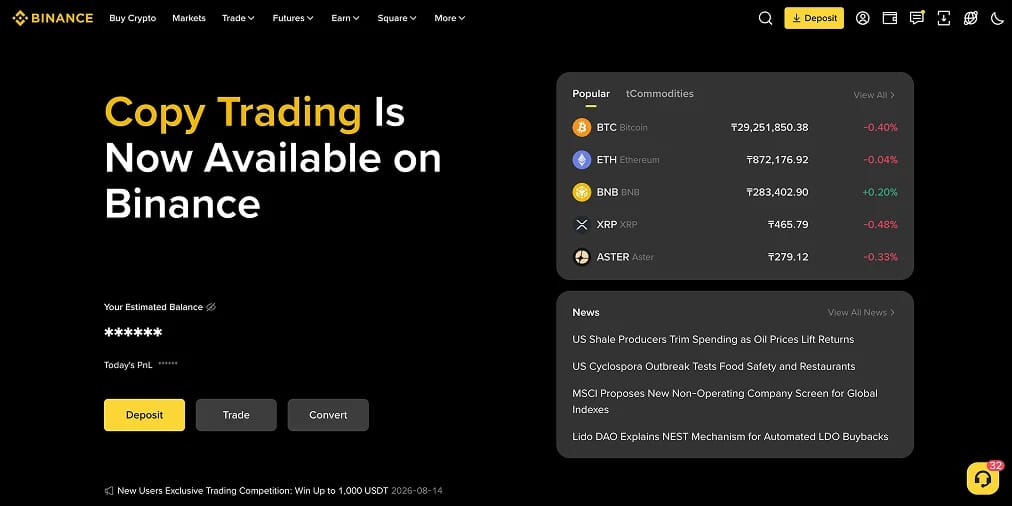
Binance serves Kazakhstan through a dedicated local company rather than its global website. BN KZ Technologies Limited holds AFSA licenses for managing a digital asset platform, custody, and investment operations under the AIFC's FinTech Lab framework. Kazakh is also supported within the localized app's 40 languages.
Users can send tenge directly to their fiat wallet through Freedom Bank online banking deposits. Before enabling the channel, Binance matches the user's IIN, the individual identification number assigned to every resident, with their banking record. This can delay customers who completed verification using a foreign passport, but it also reduces fraud. Cards and a liquid P2P market provide alternatives. A USDT/KZT spot pair has been available since May last year.
Liquidity is Binance's main advantage. Its order books handle large tenge orders with less price impact than any competing platform in this list. Users also receive access to Earn, copy trading, and trading bots. It places second because deposit and withdrawal limits rise through tiered KYC levels, with identity checks determining how much an account can transfer. The global brand also remains affected by the 2023 US Department of Justice settlement, despite the Kazakh entity being supervised separately. Our Binance review follows its compliance rebuild.
Pros
- A local AFSA-licensed entity with custody permissions that has operated under AIFC supervision since 2022.
- Freedom Bank online banking sends KZT directly to the fiat wallet after an IIN match check.
- Kazakh users receive the deepest available order books alongside Earn, bots, and copy trading.
Cons
- Deposit and withdrawal caps are tied to KYC tier, leaving modest limits until additional verification is completed.
- The local platform lists more than 400 assets but offers fewer coins than Gate.
- Despite the separate local entity, the global group's 2023 US settlement remains a reputational concern.
3. OKX
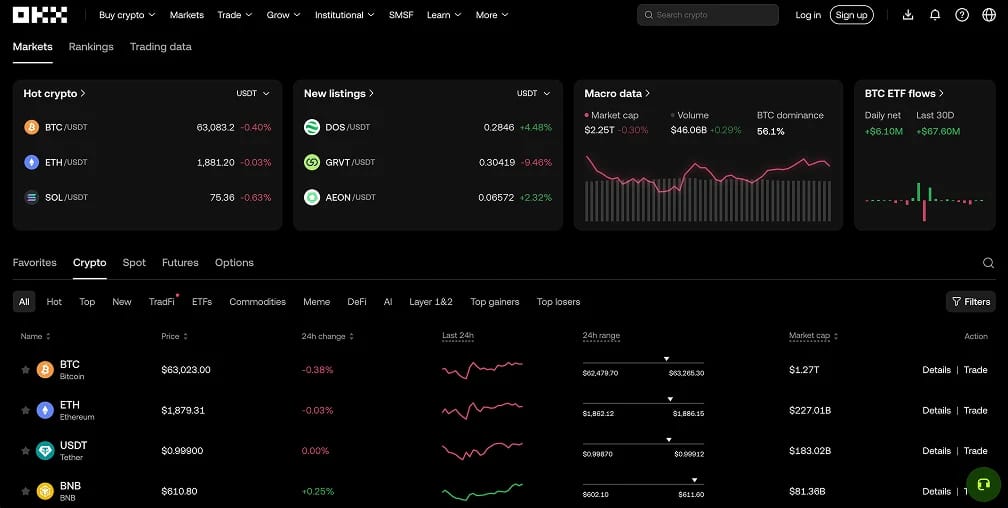
OKX ranks third because of its pricing. Spot fees begin at 0.08% for makers and 0.10% for takers, lower than any other major exchange available to Kazakh users. Monthly Proof of Reserves reports using zk-STARK cryptography have been published since late 2022, allowing customers to verify mathematically that their balances are backed. OKX does not hold a Kazakh license, so it sits below the two AFSA-regulated platforms. For active traders, however, few alternatives match its fee structure.
Tenge funding is reasonably broad despite the lack of local authorization. KZT can be exchanged for USDT through the P2P marketplace, where merchants commonly accept Kaspi Gold and Halyk transfers. Card purchases, Apple Pay, and Google Pay are also available through third-party processors, although their markup should be checked before confirming a transaction. Once the account is funded, the integrated Web3 wallet supports more than 100 chains. Its DEX aggregator searches on-chain markets for the best swap price, placing centralized and decentralized trading in one app.
Perpetual futures provide another reason to use OKX, with only Binance offering comparable depth in these contracts without expiry dates. The platform's history includes a significant compliance issue. In February 2025, OKX's global affiliate paid approximately $505 million to settle historical failures with US authorities. Our OKX review examines the full platform, while the best crypto futures exchanges guide compares its derivatives offering with competitors.
Pros
- Spot fees of 0.08% and 0.10% are lower than those of every other platform serving Kazakhstan.
- KZT P2P supports Kaspi and Halyk payments, with cards and mobile wallets also available.
- Monthly zk-STARK Proof of Reserves represents one of the industry's stronger transparency practices.
Cons
- Without an AFSA or National Bank license, activity takes place outside Kazakhstan's supervised market.
- Third-party processors add their own markup to card and mobile wallet purchases.
- The global record includes a US settlement of approximately $505 million from February 2025.
4. Gate
Gate earns its position through asset coverage. The platform lists more than 4,400 cryptocurrencies, several times the selection available through any licensed domestic exchange. Projects that would not pass an AFSA listing review can therefore become tradable shortly after launch. Fees start at 0.1% before GT token discounts. Copy trading, Simple Earn yields, and a launchpad for early-stage projects are included within the same account.
Kazakh users can deposit by card or through Gate's P2P marketplace. KZT offers are available, although the market is thinner than those operated by Bybit and Binance. Gate reports a total reserve ratio of 125%. Its Malta entity also obtained MiCA authorization in 2025, but that approval covers the European business rather than Kazakh accounts.
Gate works better as a secondary account for accessing smaller tokens than as the main place to hold tenge. Liquid markets sit next to thin pairs without much distinction, and the spread on a minor asset may cost more than the commission saved. Its crowded interface also requires some patience. Our Gate review explains its most suitable uses.
Pros
- More than 4,400 listed assets give Kazakh users the widest available coin selection.
- A published total reserve ratio of 125% provides a visible buffer behind client balances.
- Copy trading and Simple Earn are available alongside a launchpad, creating a broad all-in-one toolkit.
Cons
- Gate has no Kazakh license, while its MiCA authorization applies only to European clients.
- Spreads on many long-tail assets can exceed any saving from the low trading fee.
- New buyers may find the dense interface and frequent promotions overwhelming.
5. Bitget
Bitget is the strongest choice for users who prefer guided execution to trading alone. Its copy trading system covers spot, futures, and bots. Each lead trader has a visible performance history that can be reviewed before allocating tenge. The wider product lineup includes margin, Earn, Launchpool, and a Web3 wallet.
Its local funding coverage extends across more banks than most unlicensed competitors. Bitget's P2P marketplace has KZT merchants accepting transfers from Halyk, Jusan, Forte, Freedom, and Eurasian Bank accounts, while cards suit smaller purchases. The exchange also provides tangible trust indicators. It reported a 163% reserve ratio in January, keeps most client assets in cold storage, and publishes monthly updates on its Protection Fund.
The standard risks of copy trading still apply. A lead trader's leverage is passed on to the follower, which can expose beginners to futures risk before they understand it. Bitget supports English and Russian, but not Kazakh. Further details on its products and account structure are available in our Bitget review.
Pros
- The most extensive copy trading suite in this ranking, covering spot, futures, and automated bots.
- KZT P2P supports five major domestic banks, exceeding the bank coverage of most unlicensed competitors.
- Client balances are supported by a 163% reserve ratio and a Protection Fund reported monthly.
Cons
- Bitget has neither a Kazakh license nor a Kazakh-language interface or support service.
- Followers may inherit leveraged futures exposure through copy trading without choosing it deliberately.
- Promotional products receive more prominence in the busy interface than the basic purchase screen.
6. ATAIX Eurasia
ATAIX Eurasia is the domestic option in this ranking. Based in Astana, it received an AIFC license before any global exchange entered the market. The company advanced from the regulatory sandbox to full AFSA authorization in October 2025. License AFSA-A-LA-2025-0022 covers trading, custody, and dealing as both principal and agent. Its status can be checked through the AFSA public register. ATAIX was also among the first participants in the pilot linking crypto exchanges with Kazakhstan's second-tier banks.
Direct bank access is its practical advantage. Users can deposit through partners including Halyk, Bank CenterCredit, Bereke, and Nurbank, with support for tenge, dollars, euros, and rubles. KZT deposits are free, and withdrawals in tenge by personal customers cost 0.15%. The platform sacrifices scale for this local integration. It carries only about 40 assets, while fiat-market fees begin at 0.28% maker and 0.38% taker. Before volume discounts, those rates are roughly three times the fees charged by global exchanges.
A full license is not enough to move ATAIX higher. Public reviews repeatedly mention slow withdrawal processing and delayed support responses. Larger orders can move the price due to shallow order books. The exchange also paused operations for Russian clients, providing only a short period to close accounts as sanctions compliance became stricter. We view ATAIX as a compliant venue for deposits and cash withdrawals, best paired with a larger exchange for trading.
Pros
- Full AFSA authorization covers trading, custody, and dealing as principal and agent, with the license visible on the public register.
- Customers can deposit KZT, USD, EUR, and RUB through major Kazakh banks. Tenge deposits are free, and personal KZT withdrawals cost 0.15%.
- Local support is available, along with a complaint process that escalates directly to AFSA.
Cons
- Maker and taker fees of 0.28% and 0.38% on fiat markets are roughly three times the base rates of global exchanges.
- Serious altcoin trading is limited by shallow order books and a selection of around 40 assets.
- Reviews repeatedly report withdrawal and support delays, while Russian customers were removed abruptly under sanctions pressure.
How to Choose a Crypto Exchange in Kazakhstan
Before choosing a crypto exchange in Kazakhstan, check its license, confirm that its funding options support your bank, and calculate the total cost of the transaction rather than relying on the advertised fee.
- Verify the license before the logo: Every platform authorized within the Astana hub appears on AFSA's records at afsa.kz. The National Bank supervises exchanges operating nationwide under the framework introduced on 1 May. Only trades conducted through a licensed provider qualify for the three-year tax exemption.
- Match the deposit method to your bank: Bybit's fiat service connects through Bank CenterCredit, while Binance uses Freedom Bank. Cards work across most exchanges, although issuers can decline crypto-related transactions unpredictably. Our guides to buying crypto with a credit card, Apple Pay, and Google Pay explain the costs and process.
- Keep P2P inside the platform: Kaspi Gold and Halyk transfers appear most often in merchant listings. A secure transaction remains within the exchange's escrow, which holds the crypto until payment is confirmed, while preserving messages and receipts. Bybit adds another layer of oversight by using licensed financial institutions as counterparties in its regulated P2P market.
- Price the full transaction: Advertised fees exclude the spreads built into quick-buy tools and card processors. Make a small purchase through the spot order book, then compare its final KZT cost with a quick-buy quote for the same amount. That difference will usually reveal the cheaper funding route.
- Plan for the paperwork now: The exemption covers trades made through licensed Kazakh providers. From 2027, the OECD's Crypto-Asset Reporting Framework will begin exchanging account information between tax authorities. Export transaction records regularly, as rebuilding a P2P history several years later is extremely difficult.
Crypto and Bitcoin Regulation in Kazakhstan
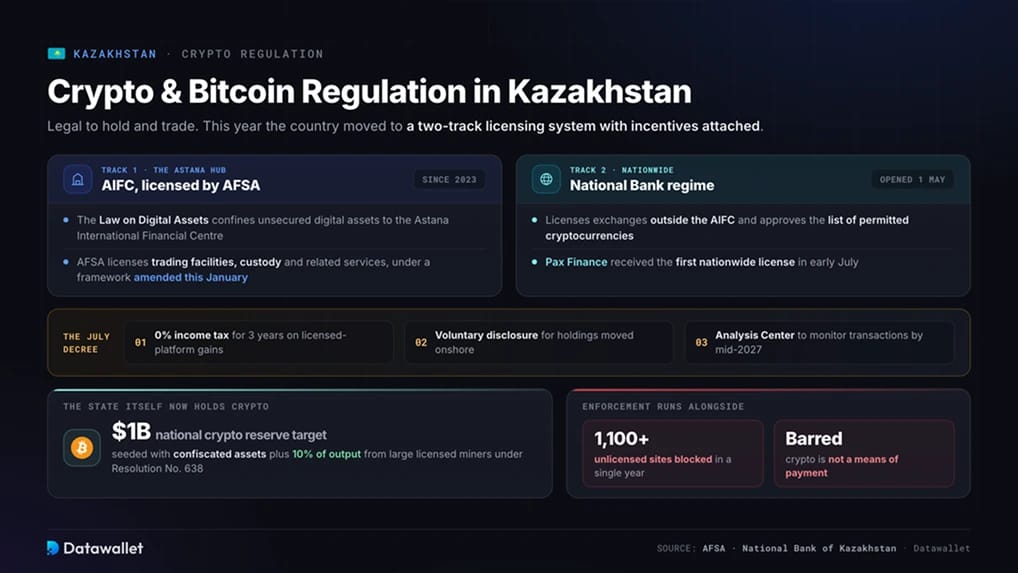
Holding and trading crypto is legal in Kazakhstan. This year, the country replaced its single-hub structure with a two-track licensing system supported by financial incentives.
- The Digital Assets Law set the baseline: The 2023 Law on Digital Assets restricted the issuance and circulation of unsecured digital assets to the Astana International Financial Centre. Within the AIFC, AFSA licenses trading facilities, custody providers, and related services under rules amended effective this January.
- A nationwide license opened on 1 May: Amendments incorporated digital assets into banking law. The National Bank now licenses exchanges outside the AIFC, supervises their conduct, and approves a list of permitted cryptocurrencies. In early July, Astana-based Pax Finance received the first license issued under this regime.
- The July decree added the pull factors: Its measures include a three-year personal income tax exemption for gains made through licensed local providers and a voluntary disclosure program for assets moved onshore. A National Cryptocurrency Analysis Center is also planned by mid-2027 to monitor transactions.
- The state itself now holds crypto: Kazakhstan is creating a national crypto reserve with a target of up to $1 billion. It will be funded through confiscated assets and the 10% share of production that large licensed miners must provide under Government Resolution No. 638. The digital tenge has also received formal recognition as national currency issued by the National Bank.
- Enforcement runs alongside the incentives: In one year, the Financial Monitoring Agency blocked more than 1,100 unlicensed crypto trading websites. Cryptocurrency remains prohibited as a means of payment.
How Does Kazakhstan Tax Crypto?
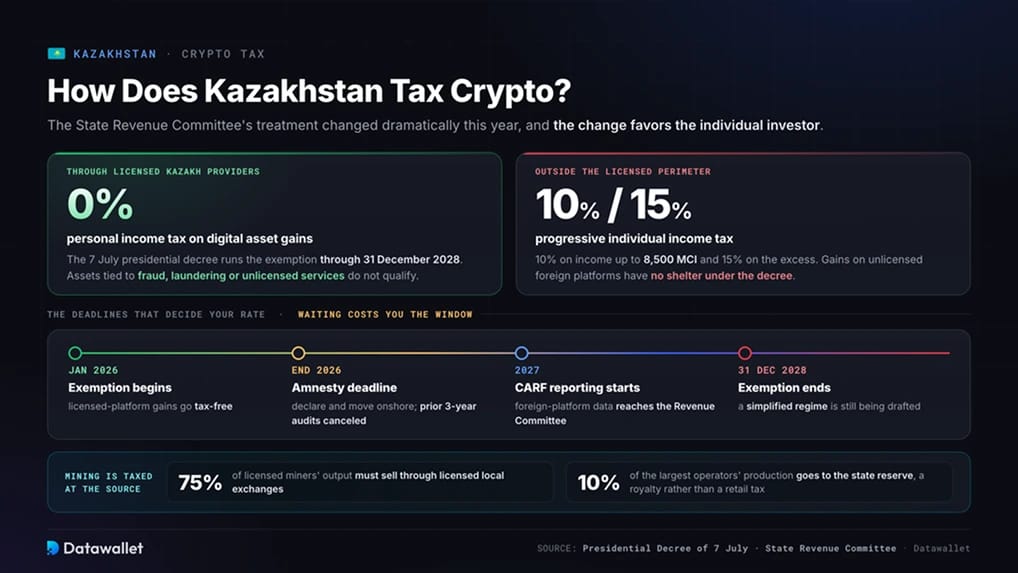
Kazakhstan's State Revenue Committee substantially changed its treatment of crypto this year, with the new rules favoring individual investors.
- A three-year exemption on licensed trading: Under the presidential decree signed on 7 July, personal gains from digital asset transactions made through licensed Kazakh providers are tax-free from this January until 31 December 2028. Crypto linked to fraud, money laundering, or unlicensed services is excluded.
- The amnesty has a deadline: Crypto holders who declare their assets and transfer them to licensed platforms before the end of 2026 qualify for the exemption. Officials have also indicated that participants will have tax audits covering the preceding three years canceled. The opportunity closes after the deadline.
- Outside the exemption, normal income tax applies: Individual income tax became progressive this January. Income up to 8,500 MCI, the monthly calculation index used throughout Kazakh tax law, is taxed at 10%, while the excess is taxed at 15%. Gains realized through unlicensed foreign exchanges are not protected by the decree.
- Mining is taxed at the source: Licensed miners are required to sell at least 75% of their output through licensed domestic exchanges. The largest operators must also contribute 10% of production to the national reserve, which operates as a royalty rather than a tax on retail users.
- Reporting is going international: Kazakhstan is preparing for the OECD's Crypto-Asset Reporting Framework. Its first automatic exchanges of crypto account data with foreign tax authorities are scheduled for 2027, making activity on overseas platforms visible to the Revenue Committee.
This information is not tax advice. Kazakhstan is still drafting the simplified regime intended to apply after 2028, so anyone trading substantial amounts should maintain records on the assumption that full taxation could resume.
Cryptocurrency Adoption in Kazakhstan
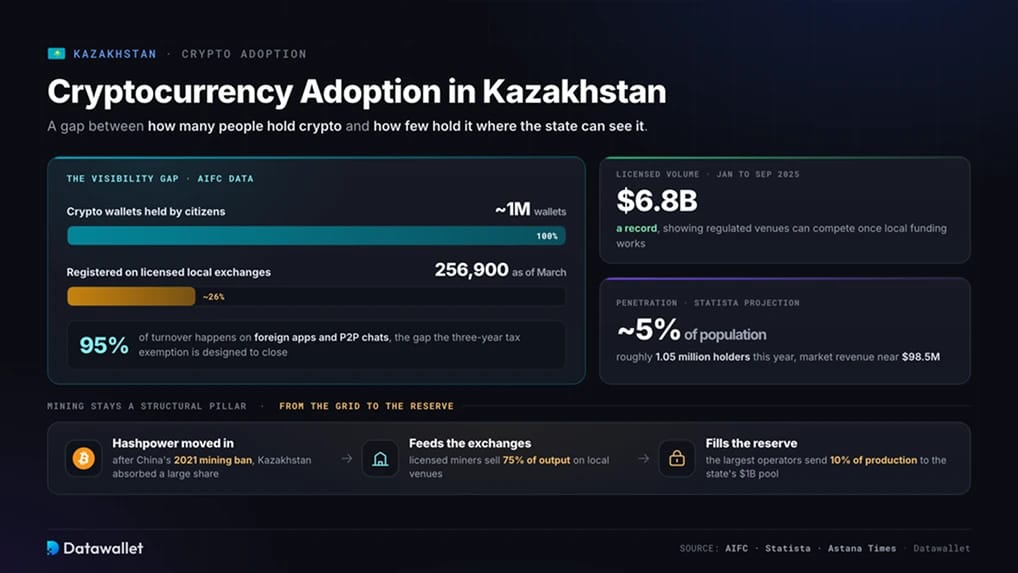
Crypto adoption in Kazakhstan is defined by the difference between the number of people who hold digital assets and the smaller group using platforms visible to domestic regulators.
- A million wallets, a quarter registered at home: AIFC data estimates that Kazakh citizens control roughly one million crypto wallets. Only 256,900 people were registered with licensed domestic exchanges as of March, and the tax exemption is intended to narrow that gap.
- The licensed market is growing fast anyway: AIFC-regulated exchanges processed $6.8 billion between January and September 2025. The record volume suggests that regulated venues can compete when practical local funding is available.
- Penetration keeps climbing: Statista projects that about 5% of the population will hold cryptocurrency this year, equal to roughly 1.05 million people. Expected market revenue is close to $98.5 million.
- Mining remains a structural pillar: After China's 2021 mining ban, Kazakhstan absorbed a significant share of global Bitcoin mining power. Licensed miners now supply domestic exchanges through mandatory sales while also contributing to the state reserve.
Our crypto adoption statistics page provides comparisons with other markets.
How to Buy Bitcoin in Kazakhstan
With the necessary documents prepared, buying Bitcoin in Kazakhstan takes less than 30 minutes. The cheapest route usually combines a direct tenge deposit with a limit order placed on the spot market.
- Pick a licensed platform first: Choose Bybit for its full AFSA license and direct KZT market, or Binance for Freedom Bank funding and stronger liquidity. Using a licensed provider also protects the tax exemption on your gains, which is likely to outweigh any fee saving offered by an offshore platform.
- Complete verification with your ID and IIN: Most exchanges approve a passport or national ID and liveness check within minutes. Where required, use documents containing your IIN. Bank-linked deposit services compare it with the number registered to your account, and any mismatch can halt the transfer.
- Deposit tenge through the direct channel: Bybit accepts Bank CenterCredit transfers, while Binance supports Freedom Bank online banking. Both avoid card-processor markups. Cards provide a fallback, and customers of other banks can use P2P with Kaspi or Halyk transfers, provided the entire transaction remains inside platform escrow.
- Buy on the spot order book: Use a limit order on KZT/USDT followed by USDT/BTC, or select a direct market where available, to avoid the quick-buy spread. Many Kazakh users hold the stablecoin itself. Our guide to buying USDT in Kazakhstan explains that option.
- Decide on custody and start a record: A licensed exchange can suit active trading, whereas long-term holders should consider self-custody. Compare the available options through our best crypto wallets guide, and export transaction records from the beginning.
To sell, follow the process in reverse and withdraw tenge through the same banking channels.
Final Thoughts
Bybit ranks first for its full AFSA license, direct KZT trading, Bank CenterCredit deposits, and regulated P2P market. Binance is the strongest alternative for deeper liquidity, while OKX offers the lowest fees for traders comfortable using an offshore platform.
Gate is better suited to smaller altcoins, and Bitget stands out for copy trading. ATAIX provides direct access to Kazakhstan’s banking system, though its higher fees and limited liquidity make it less competitive for active trading.
Kazakhstan now gives investors a clear incentive to use licensed exchanges. Eligible trades remain exempt from personal income tax until the end of 2028, while offshore activity is taxable and will face international reporting from 2027.
Whichever platform you choose, test it with a small purchase and KZT withdrawal before transferring a larger amount.
Our Methodology
We opened and verified accounts on each platform with Kazakh-relevant documents, funded them in tenge through cards, bank channels, and P2P, traded the live order books, and withdrew back out. Each exchange scored across six criteria.
- Trust Score: Our proprietary rating out of 5, weighting AFSA or National Bank licensing, reserve transparency, security history, longevity, and the credibility of local operations.
- KZT Funding Methods: Confirmed card, mobile wallet, bank channel, and P2P support, measuring settlement speed, markups, limits, and how often deposits stalled in review.
- Regulatory Standing: Verified each entity against the AFSA register and National Bank announcements, and reviewed global enforcement history where no local license exists.
- Security Track Record: Reviewed breach history, custody arrangements, Proof of Reserves cadence, protection funds, and account controls such as 2FA and withdrawal address lists.
- Assets and Liquidity: Placed orders on KZT and USDT pairs where available, measuring spread, depth, and fill quality against mid-market pricing.
- Fee Structure: Compared maker and taker schedules, quick-buy and card spreads, withdrawal costs, and the all-in cost of a tenge-to-Bitcoin round trip.
We excluded platforms that block Kazakh users, lack any workable KZT path, or carry unresolved enforcement actions. Testing concluded in August, and we rechecked license statuses after the National Bank issued its first nationwide authorization.