





Compare Top Serbian Crypto Exchanges
1. Bybit
Bybit takes first place in Serbia for product depth that no other platform accessible from Belgrade can match. The platform lists 2,800+ assets across spot, perpetuals, and options at a flat 0.1% spot fee, with copy trading, grid bots, and Bybit Earn layered on top. Serbia is outside Bybit's restricted list, so a standard global account can be opened without workarounds.
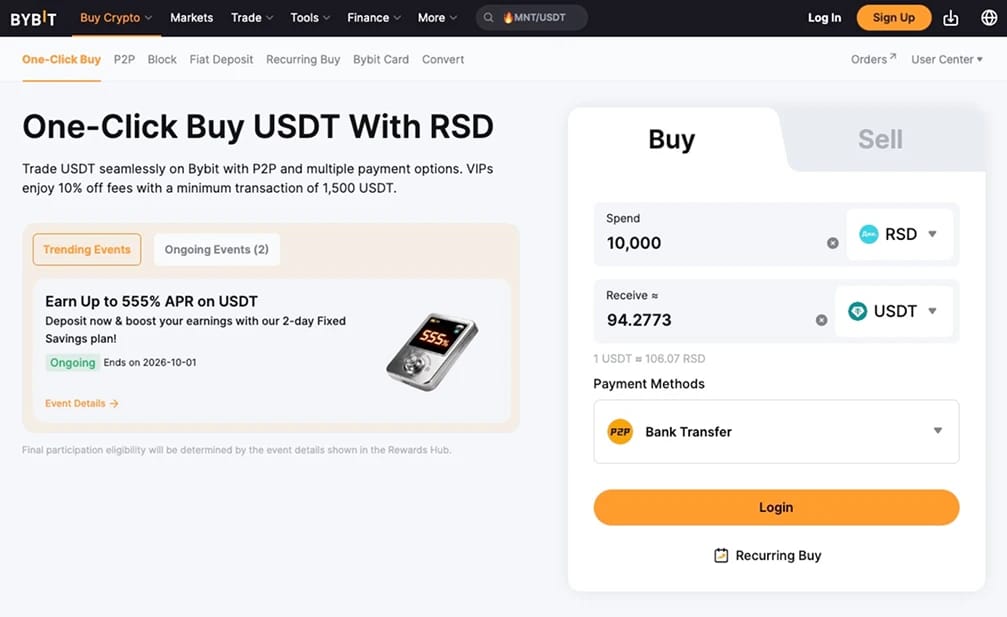
Funding from Serbia works three ways: a direct EUR deposit, an RSD P2P order via bank transfer, or a crypto transfer from another exchange. Our card test from a Raiffeisen-issued Visa cleared on the first attempt, though the card processor adds a markup of roughly 2%, so larger amounts are better routed as USDT bought elsewhere and transferred in. The full feature set is covered in our Bybit review.
The downsides are structural. Bybit holds no Serbian license, meaning no local recourse if something breaks, and derivatives carry real risk for anyone new to leverage. Every swap on the platform is also a taxable disposal under Serbian rules, so export your trade history regularly rather than reconstructing it at filing time. The user interface is also not accessible in Serbian.
Pros
- 2,800+ assets with futures, options, copy trading, and Earn at 0.1% spot fees.
- Cards issued by Serbian banks worked reliably in our deposit tests.
- Monthly Proof-of-Reserves attestations back customer balances.
Cons
- No NBS license, so disputes have no Serbian regulator behind them.
- Card deposits carry a 2 to 3% processor markup over spot prices.
- The derivatives-first layout can pull beginners into leveraged products early.
2. Binance
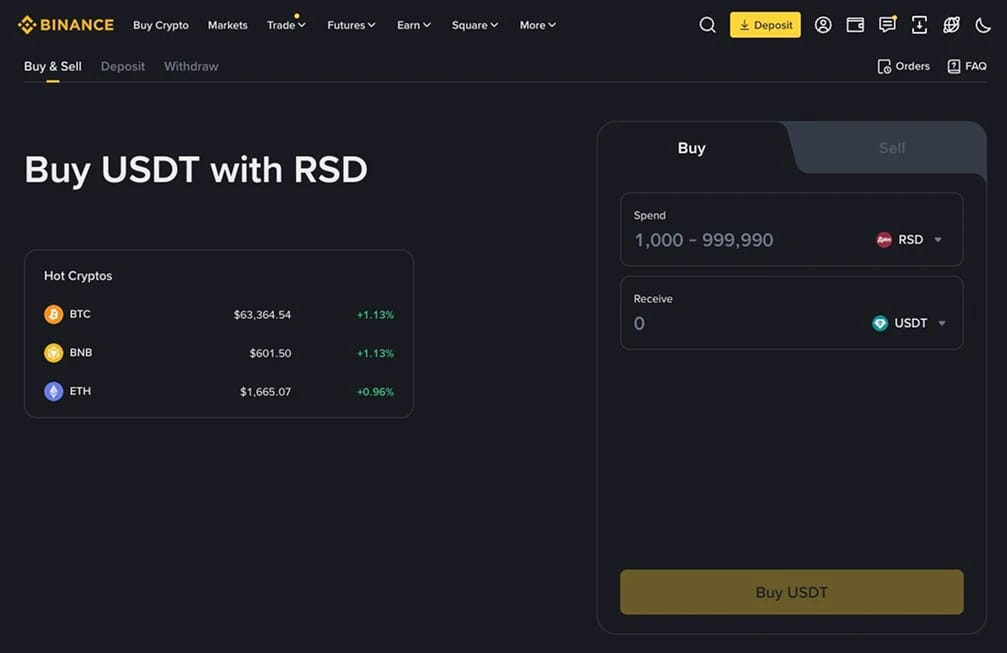
Binance is the venue most Serbian traders already know, and the SEPA change made it materially cheaper to use. Before May 2026, moving euros from a Serbian bank meant a SWIFT wire with fees that often ran €20 or more. A SEPA credit transfer from one of the 18 connected banks now lands in a Binance euro balance for a fraction of that, usually within one business day.
Liquidity remains the core argument. Binance lists 500+ assets, and its order books on majors are deep enough that fills barely move the price, something thin regional books cannot offer. Spot fees start at 0.1% before BNB discounts, with Earn, Launchpool, and Auto-Invest rounding out the passive side. Our Binance review breaks the tiers down.
Two things to consider when using Binance. The 2023 US settlement still shadows the compliance record, and because Serbian banks report crypto-linked payments to the NBS quarterly, the paper trail of your deposits exists whether you keep records or not. Keeping your own matching records is the only way to stay ahead of it.
Pros
- SEPA euro transfers from Serbian banks since May 2026 have cut funding costs sharply. RSD deposits are also accepted on P2P markets.
- The deepest spot liquidity of any platform accessible from Serbia.
- Broad Earn suite with Launchpool access and a long-running SAFU insurance fund.
Cons
- The 2023 US settlement remains a mark against the compliance history.
- Euro funding means a second conversion step for anyone earning in dinars.
- Feature sprawl makes the app heavy-going for a first-time buyer.
3. Kraken
Kraken is the pick for Serbians who rank custody safety above coin count. Operating since 2011, the exchange has never suffered a major hack, publishes Proof-of-Reserves audits verifying client assets are backed 1:1, and keeps the bulk of holdings in cold storage. For anyone parking any meaningful amount on an exchange rather than in self-custody, that record is important.
Serbia's SEPA accession plays directly to Kraken's strengths, since euro bank transfers have always been its preferred funding channel. We sent a test transfer from an OTP banka euro account, and the balance was tradable the next business day. Kraken Pro brings maker fees down to 0.16% and taker fees down to 0.26% at base volume, with 475+ assets, staking, and an OTC desk for size.
The trade-off is the lack of features. The listing policy is conservative, so newer small caps arrive late or never, and base-tier Pro fees run higher than Bybit or OKX. Casual instant buys also carry a spread, so anything beyond a trivial amount belongs on the Pro interface. More details can be found in our Kraken review.
Pros
- Fourteen years of operation without a major security breach.
- 1:1 Proof-of-Reserves audits, cold storage, and an OTC desk for larger orders.
- SEPA euro deposits from Serbian banks settle within a business day.
Cons
- Conservative listings mean fewer altcoins than in every other global venue here.
- Base fees of 0.4% and 0.8% are higher than the 0.1% standard elsewhere.
- Instant buy spreads punish anyone who skips the Pro interface.
4. OKX
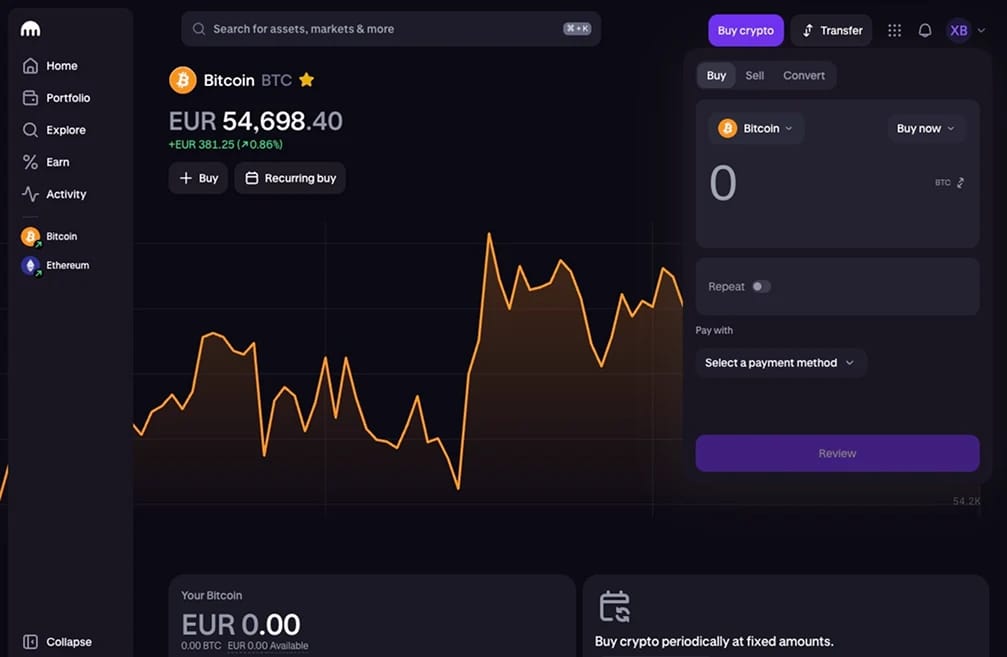
OKX wins on cost and on reach beyond centralized markets. Spot fees of 0.08% maker and 0.10% taker are the lowest among the major platforms serving Serbia, and the app ships with a Web3 wallet that opens DeFi, DEX trading, and on-chain tokens without installing anything else. For Serbia's sizeable developer and IT-freelancer crowd, that one-app setup is genuinely useful.
Funding comes from card purchases and the P2P marketplace, and the exchange publishes monthly Proof-of-Reserves reports, demonstrating one of the more consistent disclosure habits in the industry. Around 350+ digital assets are available to trade on spot, alongside a full suite of perpetuals and earn products. Our OKX review covers the platform end to end.
What holds it back locally is the absence of a euro bank-transfer channel as smooth as Kraken's or Binance's, so card markups or a USDT transfer from another venue remain the practical funding paths. The Web3 layer also adds surface area that a crypto beginner will never touch.
Pros
- 0.08% maker and 0.10% taker fees, the cheapest spot trading on this list.
- Integrated Web3 wallet covering DeFi and DEX access from a single app.
- Monthly Proof-of-Reserves with a steady publication history.
Cons
- Bank-transfer funding from Serbia is weaker than on Kraken or Binance.
- Card deposits carry processor markups like every other global venue.
- The Web3 toolset adds complexity that a simple spot buyer does not need.
5. Coinbase
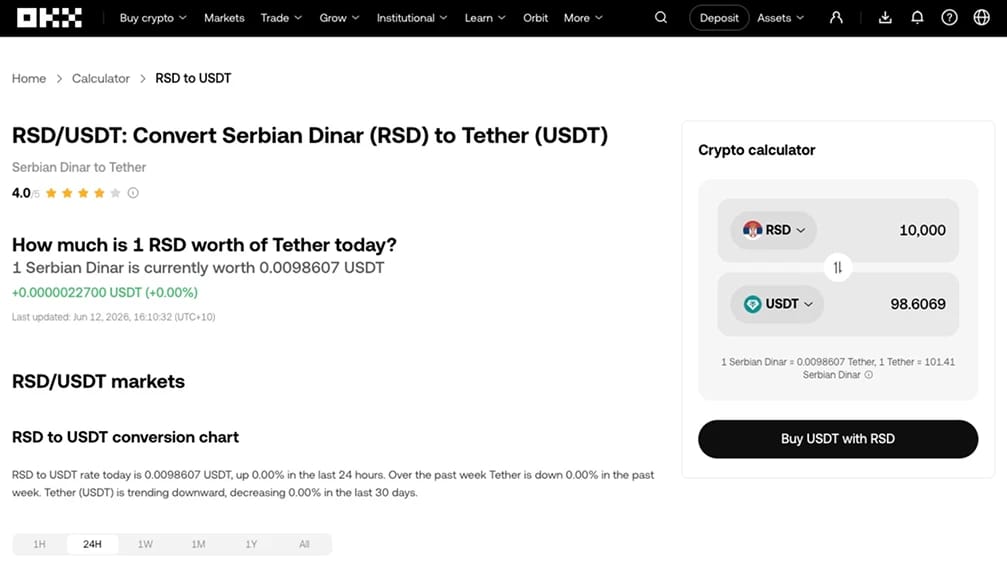
Coinbase brings something no other name on this list can: the accountability of a public company. Listed on NASDAQ under the ticker COIN since April 2021, it files audited financials with the SEC every quarter, which makes its solvency the most scrutinized in the industry. In a country where no offshore exchange answers to a local regulator, that external oversight is the closest substitute available.
Serbia has been on Coinbase's supported list since 2019, though access has centered on crypto trading rather than fiat rails. Most Serbian users fund the account with a USDC or crypto transfer from another venue, and card purchases depend on the issuing bank. Once funded, Advanced Trade offers 0.60% taker fees and volume across 250+ assets, with staking and one of the deepest USDC ecosystems anywhere.
The honest framing for Serbia is a secondary account. The asset list is the shortest among the global platforms here; the simple-buy screen carries a markup that Advanced Trade avoids, and the lack of a clean dinar or euro deposit channel keeps it from being a first stop for fresh money. Our Coinbase review covers the exchange in full.
Pros
- NASDAQ listing brings quarterly audited financials and SEC oversight.
- A strong custody record with no major loss of customer funds since 2012.
- Advanced Trade fees fall well below the headline rates as volume grows.
Cons
- Fiat funding from Serbia is thin, so most deposits arrive as crypto transfers.
- 250+ assets are the narrowest selection of the global venues listed here.
- The simple-buy interface carries a markup that catches casual users.
6. Bitpanda
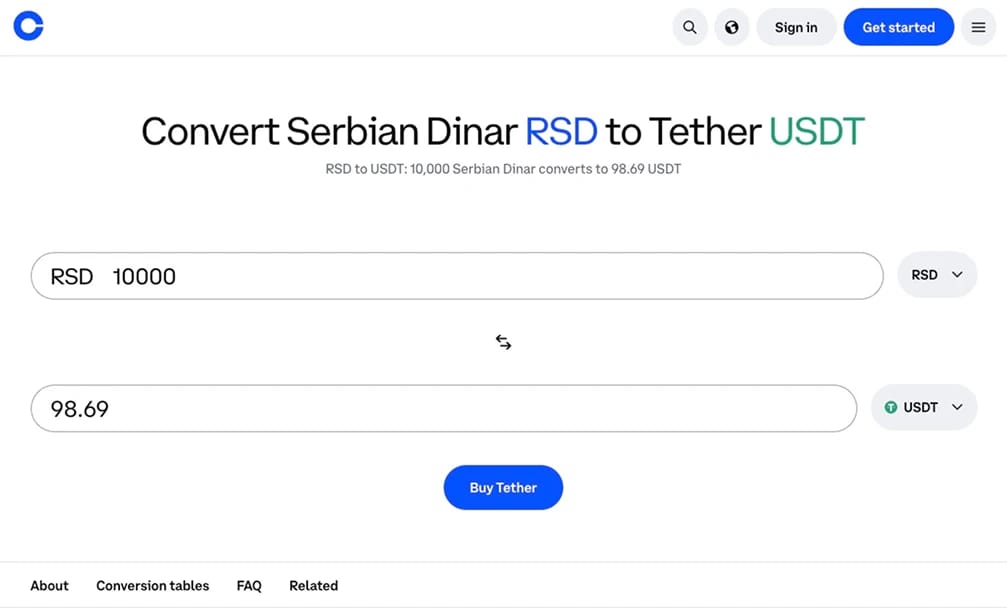
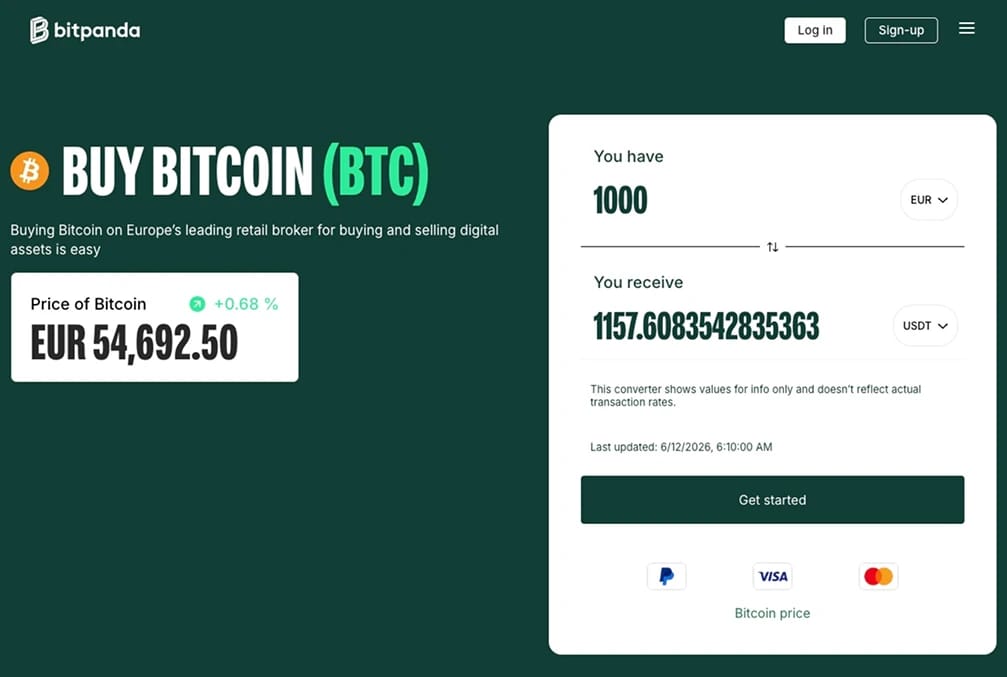
Bitpanda is the only platform on this list that explicitly lists Serbia as a supported country, with Serbian identity documents accepted for verification. The Vienna-based broker, founded in 2014 and holding a MiCA license since early 2025, treats the region as home turf rather than an afterthought, and the app ships in a clean, beginner-friendly layout.
The pitch is broad across asset classes rather than depth in crypto alone. Alongside 500+ cryptocurrencies, Bitpanda offers stocks and ETFs as fractional derivative contracts, precious metals and commodities, and staking, all from a single account, plus the Bitpanda Card for spending balances. Availability per product is listed on our Bitpanda countries page.
Cost is the catch. Standard buys and sells carry a premium of around 1.49% built into the price, which is more than ten times the 0.1% order-book fee on Bybit or Binance. That gap matters little on a €50 monthly savings plan and a great deal on a €5,000 position, so size your usage accordingly. Funding spans SEPA euro transfers, which now work cheaply from Serbian banks, as well as cards, PayPal, Apple Pay, and Google Pay.
Pros
- Serbia is explicitly supported, with Serbian ID documents accepted for KYC.
- Crypto, stocks, ETFs, metals, and commodities managed from one MiCA-licensed account.
- SEPA, card, PayPal, Apple Pay, and Google Pay funding with a polished beginner app.
Cons
- The 1.49% buy/sell premium is the most expensive pricing on this list.
- Stock and ETF contracts are derivatives, with availability varying by residence.
- Spread-based pricing is less transparent than an open order book.
How to Choose a Crypto Exchange in Serbia
The Serbian decision is less about picking one platform and more about pairing the right offshore venue with a workable way in and out of dinars. Here are four checks we do:
- Decide where your dinars enter and leave. Global exchanges accept Serbian-issued cards and, since May 2026, SEPA euro transfers, but none of them pays out to a dinar account.
- Test your own bank before committing. Banks cannot offer crypto services themselves, and they report crypto-linked card payments to the NBS, yet acceptance varies in practice. Cards from Raiffeisen, OTP, and UniCredit cleared our test deposits, and a small credit card purchase confirms whether yours works before you scale up.
- Keep acquisition records from day one. Serbian law taxes the entire sale price when the purchase price cannot be documented. Save card statements, exchange confirmations, and licensed-venue receipts for every buy, because that folder is the difference between paying 15% on your gain and 15% on your whole exit.
- Match the platform to what you actually do. Long-term holders are well served by Kraken plus a hardware wallet, active traders by Bybit or OKX, anyone who wants crypto besides stocks and gold by Bitpanda, and USDC-heavy users by Coinbase.
Crypto and Bitcoin Regulation in Serbia
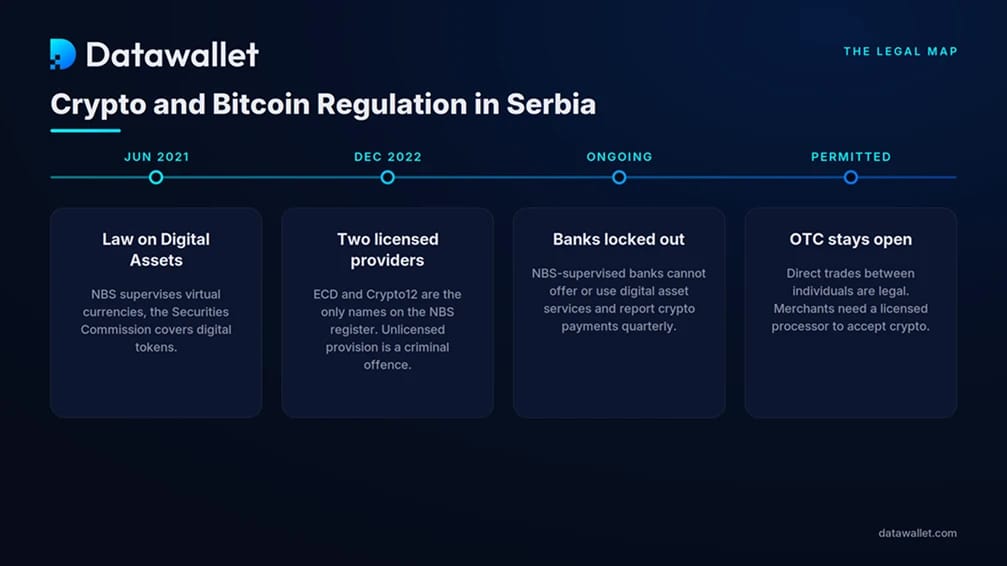
Serbia regulates crypto through one dedicated statute, which makes the boundaries unusually clear:
- The Law on Digital Assets (LDA): In force since 29 June 2021, the LDA splits supervision between the National Bank of Serbia for virtual currencies and the Securities Commission for digital tokens. Buying, holding, trading, and mining are all legal, though only the dinar is legal tender.
- A two-company licensed market: Service providers must be incorporated in Serbia and licensed before serving clients. The NBS has publicly warned that unlicensed provision of virtual currency services to the Serbian market is a criminal offense, which is why no global exchange markets itself locally.
- Banks are locked out: Financial institutions under NBS supervision are prohibited from providing or using digital asset services, and banks plus card systems must report crypto-related payment data to the central bank quarterly. That is why no Serbian bank offers crypto products and why your deposit history is visible to the regulator.
- OTC stays open: Direct trades between individuals without a licensed intermediary are expressly permitted under the LDA, keeping peer-to-peer activity legal even though merchants cannot accept crypto for goods without a licensed processor in the middle.
Individuals face no restrictions when using offshore platforms, but those platforms owe you nothing under Serbian law, and the licensed pair is the only channel backed by a regulator.
How is Crypto Taxed in Serbia?
Serbia's crypto tax regime is flat, predictable, and comes with one of the more generous reliefs in Europe. The Tax Administration applies the following:
- Capital gains tax: Gains on selling or swapping digital assets are taxed at a flat 15%, calculated as the sale price minus the documented acquisition cost. Crypto-to-crypto swaps count as disposals.
- The documentation trap: Both prices must be evidenced. Without proof of what you paid, the taxable base becomes the entire sale amount, which is the single most expensive mistake Serbian holders make.
- A 50% reinvestment relief: Invest the sale proceeds into the share capital of a Serbian company or a domestic investment fund within 90 days, and half the capital gains tax is waived; do it within 12 months, and you can claim a 50% refund of tax already paid.
- Income and VAT treatment: Mining and staking rewards and salaries paid in crypto are taxed as income at 15% when received. Transfers of virtual currencies are VAT-exempt, and corporate gains are subject to the standard 15% profit tax.
Compared with the regimes we cover in our guide to the best low-tax crypto countries, Serbia lands closer to the friendly end than most of the EU. This is general information rather than tax advice, so confirm your position with a Serbian tax adviser.
Cryptocurrency Adoption in Serbia
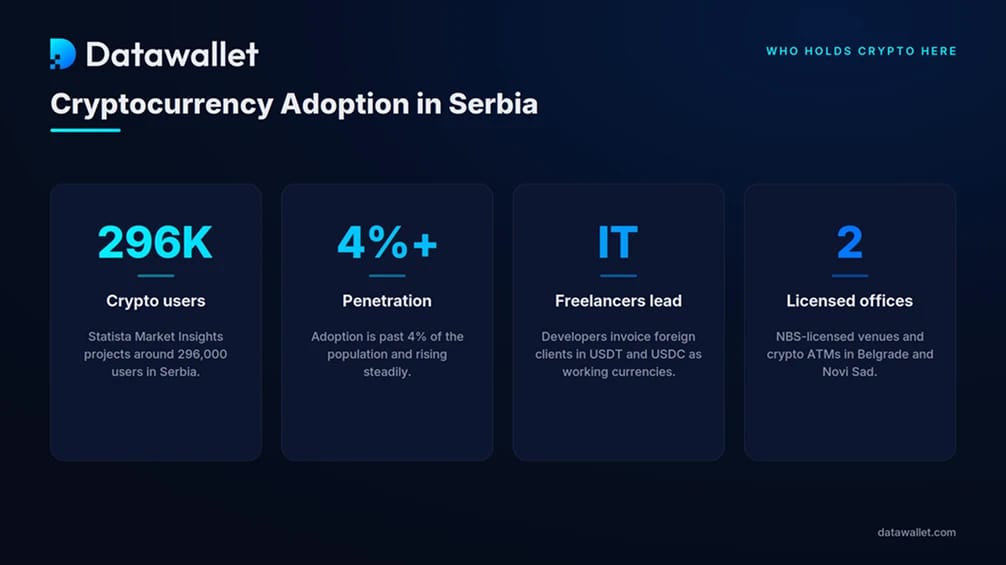
Serbian adoption is modest in headline numbers and concentrated in specific groups:
- A small but growing base: Statista Market Insights projects around 296,000 crypto users in Serbia, with penetration moving past 4% of the population, well below regional outliers like Turkey but rising steadily.
- Mining and the IT sector lead: Serbia has developed a notable mining sector, and the country's large IT and freelance workforce regularly invoices foreign clients in stablecoins, making USDT and USDC working currencies in parts of the economy long before they became investments.
- Infrastructure normalized early: Licensed crypto ATMs have operated in Belgrade and Novi Sad shopping centers since the early 2020s, and the existence of NBS-licensed exchange offices gives Serbian adoption a regulated retail layer most Balkan neighbors lack.
The broader numbers behind these trends are on our crypto adoption statistics page.
How to Buy Bitcoin in Serbia
The clean path pairs cheap funding with documented records. The sequence we use:
- Pick your venue by funding route. Card buyers and active traders should open Bybit or OKX, euro savers Kraken or Binance over SEPA, and multi-asset investors Bitpanda. Check that your card is a Visa or Mastercard rather than a domestic Dina card before starting.
- Clear KYC with Serbian documents. A lična karta or passport plus a selfie verified within hours on every platform we tested. Enter your name exactly as printed, including diacritics where the form accepts them.
- Fund the account. Send a SEPA euro transfer from your bank, make a card purchase for speed, or buy dinars' worth at a licensed exchange office and transfer the crypto over. Save the confirmation for each deposit, since it anchors your acquisition cost.
- Buy BTC with a limit order. On the exchange, place a limit order on the BTC/EUR or BTC/USDT pair rather than using the instant-buy screen, which carries a spread of 1% or more.
- Move long-term holdings to self-custody. Anything you are not actively trading belongs in your own wallet. Our best crypto wallets guide covers hardware and software options.
When it is time to exit, selling through one of the NBS-licensed exchange offices puts dinars back in your Serbian account with paperwork the Tax Administration recognizes.
Final Thoughts
Serbia offers a combination few markets do: a clear law, a flat 15% tax with real reliefs, and full freedom to use global platforms, set against a licensed local market of exactly two firms.
Bybit leads for overall capability, Binance and Kraken became far more practical the day SEPA transfers went live, OKX wins on cost, Coinbase adds public-company accountability, and Bitpanda covers anyone investing beyond crypto alone.
For a broader regional view, our guide to the best crypto exchanges in Europe covers the MiCA-regulated market next door.
Our Methodology
We assessed each platform by following the steps a Serbian user takes in practice: registering using local documents, funding with Serbian-issued cards and bank transfers, executing spot trades, and converting back to dinars where available. Six criteria shaped the rankings:
- Trust Score: A 5-point rating weighing licensing status, security history, reserve transparency, and years of operation.
- Serbian Funding Access: How cheaply and reliably money moves in, tested across cards from Serbian banks, SEPA euro transfers after the May 2026 go-live, and dinar transfers to licensed venues.
- Fees: Headline maker and taker rates plus the all-in cost of a funded round trip, including card markups and spreads.
- Asset Range: Coverage from majors and stablecoins through long-tail tokens, derivatives, and non-crypto asset classes.
- Tax Practicality: Whether the platform's statements and receipts hold up as acquisition-cost evidence under Serbian capital gains rules.
- Local Usability: App performance, KYC friction with Serbian documents, and the quality of the exit path back to dinars.
Funding access and reliability outweighed raw coin counts because a platform you cannot fund cheaply or exit cleanly is not worth ranking. Testing ran from March to June 2026.
.webp)