




Compare Top Slovenian Crypto Exchanges
1. Kraken
Kraken carries a permission that most authorized platforms lack. Running an actual exchange venue requires a separate approval that only around 14 firms across the bloc have obtained, and Kraken secured it through a pair of Irish companies answering to the Central Bank of Ireland. That combination of a strict supervisor and a genuine exchange venue is why it leads our list. It is also the only platform listed here with no history of serious security incidents.
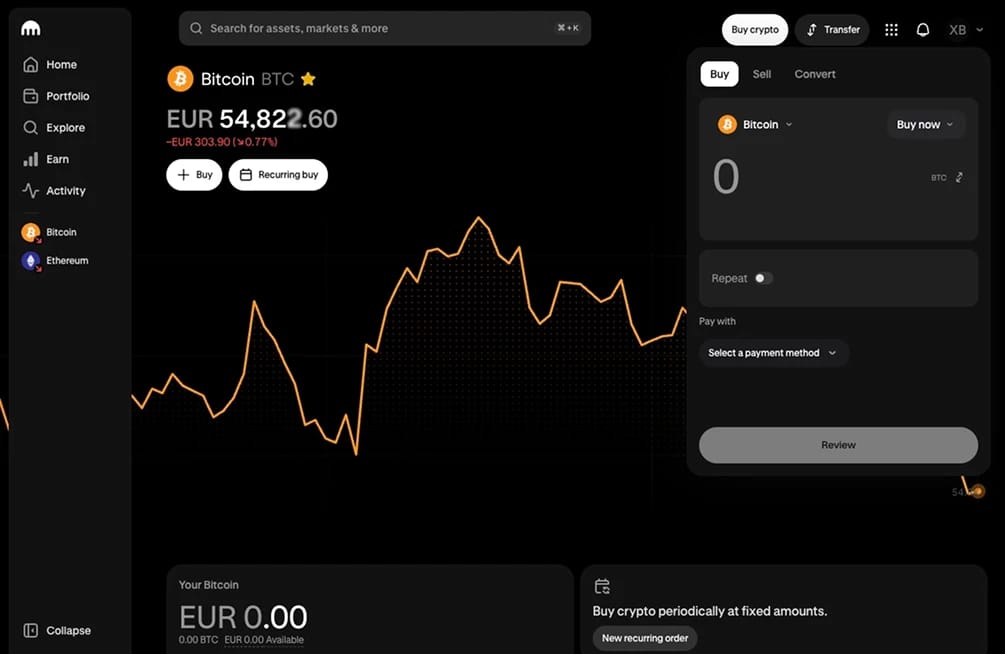
For a euro-denominated buyer, that distinction is not academic. You get a real exchange instead of a simplified purchase screen, and Kraken prices BTC/EUR more tightly than anywhere else in Europe. SEPA Instant deposits arrive free and settle in seconds, which matters when a Slovenian bank has already taken its cut on the way out.
The trade-offs sit on cost and complexity. Spot fees of 0.16% maker and 0.26% taker run above Bybit, OKX and Gate, while the European version of the platform no longer carries USDT pairs or a number of higher-risk listings. Kraken Pro is also heavier than a first-time buyer needs, though the simple interface handles a monthly purchase without trouble. Our full Kraken review covers the full product set.
Pros
- Payward Europe Solutions Limited holds a MiCA CASP authorization from Ireland's central bank under registration C468360, including the rarer trading-platform permission.
- Free SEPA Instant funding from a Slovenian account into the deepest euro order books in Europe.
- Reserve attestations published without a break since 2014, longer than anyone else here.
Cons
- The site runs in 28 languages, and Slovene is not among them.
- USDT is off the menu for European clients, adding a conversion step for dollar stablecoin holders.
- Anyone trading more than monthly pays more here than at Bybit, OKX or Gate.
2. Bybit
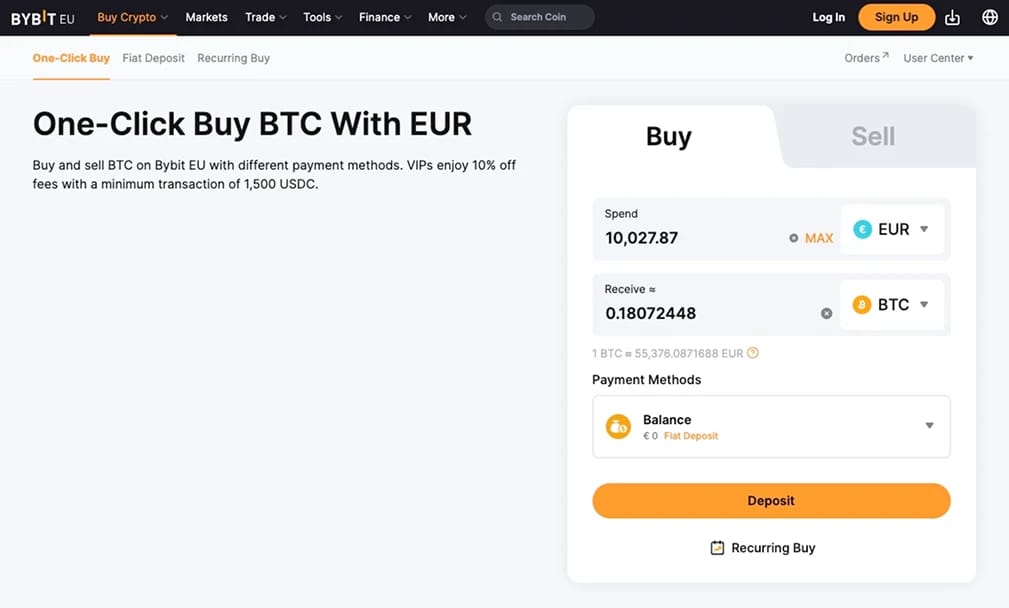
Bybit serves Slovenia through Bybit EU GmbH, which Austria's Financial Market Authority licensed to provide crypto-asset services on 28 May 2025, covering 29 EEA countries from the bybit.eu portal. Austria is a neighboring supervisor with a clean record so far. Bybit is the world’s second-largest exchange by trading volume and user count, serving more than 80 million registered clients.
The pricing is what places it this high. A flat 0.10% applies to both sides of a spot trade, with no volume tier needed to reach it, against a catalog of more than 600 assets. Euro funding is processed via SEPA, cards, and mobile wallets like Google Pay and Apple Pay. In addition to spot trading, Bybit offers demo trading, trading bots, staking, Bybit Card and Bybit Pay.
One limitation deserves a plain statement. The leveraged products that define Bybit outside Europe do not reach EEA retail clients through the licensed entity, so a Slovenian user expecting perpetual futures on the same login will not find them. The February 2025 theft of roughly $1.5 billion in ETH also belongs in any fair assessment, even though customer balances were made whole and reserves rebuilt.
Pros
- Bybit EU GmbH carries a MiCA CASP license from Austria's Financial Market Authority, granted 28 May 2025 and passported into Slovenia.
- One flat 0.10% on both sides of a spot trade, the cheapest rate a Slovenian buyer can reach without hitting a volume tier.
- Bybit EU runs a dedicated Slovenian community channel, a level of local attention the larger venues have not matched.
Cons
- The leveraged contracts sold outside the EEA never reach a Slovenian retail account.
- The February 2025 breach attributed to Lazarus remains on the file, though reserves were restored and nobody was left short.
- Campaigns, bonus offers and headline APRs crowd the screen and bury the real cost of a trade.
3. Coinbase
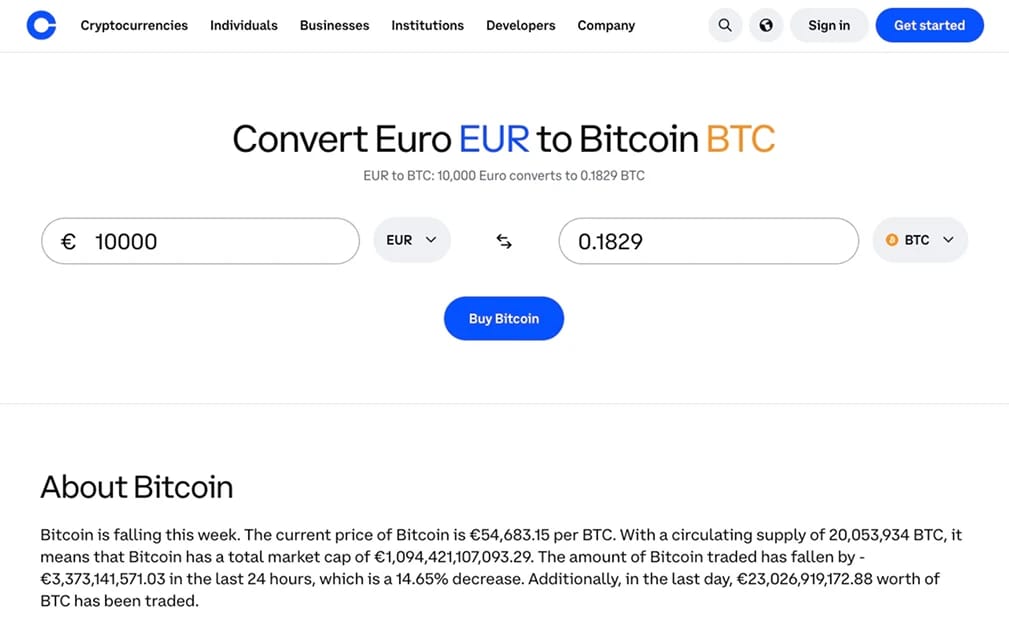
Coinbase is where we send a Slovenian reader who prioritizes compliance above everything else. Its European base sits in Luxembourg, where the CSSF granted the license that lets Coinbase Luxembourg S.A. hold client assets and execute orders throughout the single market. Coinbase is among the three largest exchanges, with over 120 million registered clients worldwide.
Onboarding was the smoothest we tested from a euro account. Identity checks resolved in minutes, SEPA Instant settled in seconds, and the interface keeps disclosures and the supervising entity in plain sight rather than three menus deep. For someone buying once a month and holding, that cuts down the number of ways to make a mistake.
You pay a premium for it. Fees of 0.40% maker and 0.60% taker sit at the top of this table, the one-tap purchase screen layers a spread on top, and the catalog is kept short on purpose with no Tether pair available. Anyone who trades weekly rather than monthly will find the cost difference against Bybit adds up faster than expected.
Pros
- Coinbase Luxembourg S.A. holds a MiCA CASP license from Luxembourg's CSSF, covering custody and order execution across the single market.
- The cleanest sign-up we completed with Slovenian identity documents, verified inside minutes.
- Idle USDC earns a published yield, useful if you park value in dollars between purchases rather than cashing back to euro.
Cons
- The dearest pricing on this page at every tier, with some of the highest fees globally.
- The one-click screen quotes a price with a margin already inside it, charged on top of the listed fee.
- A cautious listing policy that an active Slovenian trader will exhaust within months.
4. Bitstamp
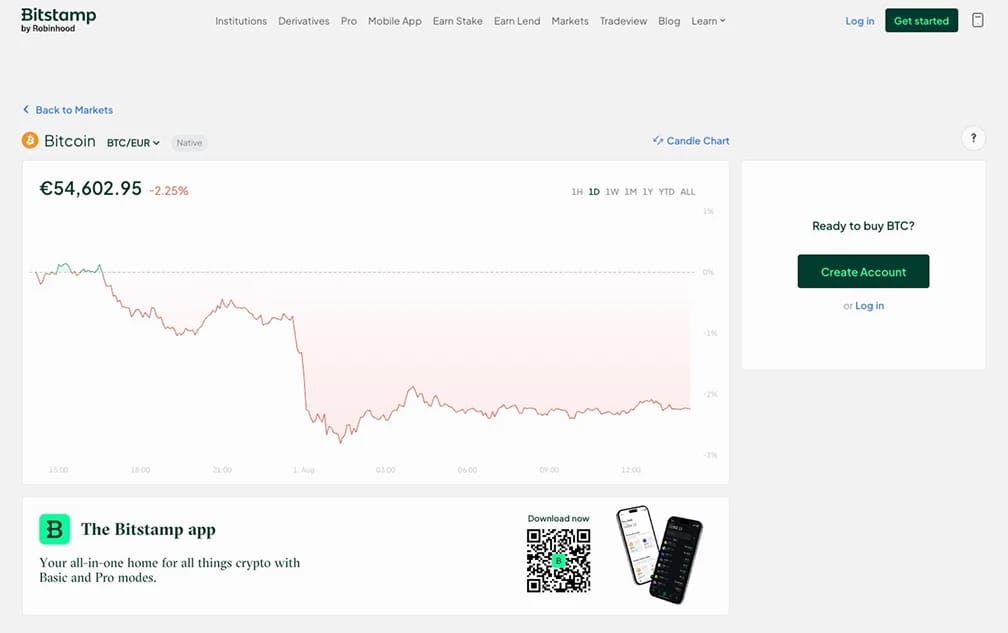
Bitstamp is the closest thing Slovenia has to a home exchange. Nejc Kodrič and Damijan Merlak founded it in Slovenia in 2011, making it the oldest major exchange still trading, and the group still runs a Slovenian office alongside Luxembourg, London, Singapore and the United States. Although it now services a global audience, the platform is still tailored for local investors.
The local connection goes beyond history. Bitstamp offers a Slovene-language interface, which none of the other platforms here do, and it is authorized and supervised by the Slovenian Securities Market Agency as a MiFID investment firm for crypto derivatives. The crypto-asset services themselves run under a MiCA license granted by Luxembourg's CSSF on 16 May 2025, the first issued in that market.
Cost and breadth are its downsides. The maker-taker schedule starts at 0.30% and 0.40%, which is competitive against Coinbase but not against Bybit. SEPA deposits are free, and withdrawals cost €3, though card, Apple Pay, Google Pay and PayPal purchases carry a 4% instant service fee that we would avoid entirely. The catalog sits near 100 assets by deliberate choice.
Pros
- Bitstamp Europe S.A. took its MiCA CASP license from Luxembourg's CSSF on 16 May 2025, the first granted in that market, and Bitstamp Financial Services Ltd answers to the ATVP as a MiFID investment firm.
- The only platform where a Slovenian user can operate in Slovene, translated originally by the local community.
- Fifteen years of trading with no breach since 2015, behind SOC 2 Type II and ISO 27001 certification.
Cons
- Card, Apple Pay, Google Pay and PayPal purchases carry a 4% instant service fee.
- Around 100 listed assets, the shortest shelf in this comparison.
- Every SEPA withdrawal costs €3, where Kraken and Coinbase return euros to a Slovenian bank for nothing.
5. OKX
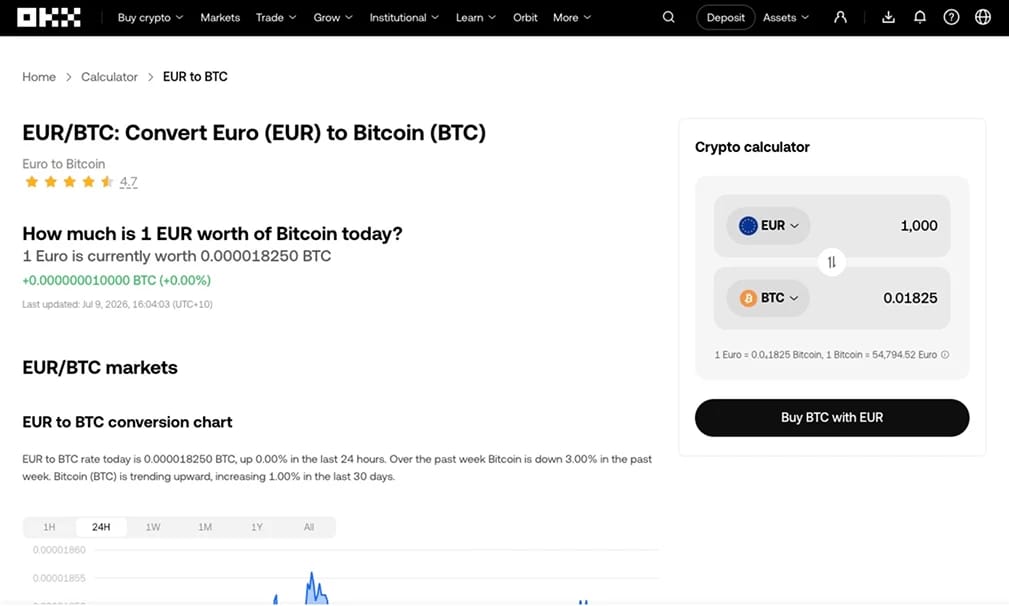
OKX reaches Slovenia through OKCoin Europe Limited, licensed in Malta, and it earns a place here on the wallet built directly into the app. A centralized account and a self-custody wallet sit side by side, so moving from a euro purchase into on-chain activity does not require exporting a seed phrase into an unfamiliar tool.
Pricing is among the lowest of any authorized venue at 0.08% maker and 0.10% taker, SEPA Instant funding works from Slovenian banks, and proof-of-reserves reports are published monthly. Execution on major pairs held up when we tested it, and moving value from the trading balance onto a supported network takes a couple of taps.
The regulator is the caveat. Malta has approved more crypto-native firms than any other member state, but a July 2025 ESMA peer review took issue with the MFSA approving a provider while significant questions stayed open, and urged tighter scrutiny. That does not invalidate the authorization, though it sits below an Irish or Austrian approval on supervisory depth.
Pros
- OKCoin Europe Limited operates under a MiCA CASP license from Malta's MFSA, passported across all 30 EEA countries.
- Spot pricing from 0.08%, the lowest a Slovenian resident can reach on a licensed venue.
- Reserve reports published every month without a gap, alongside a Web3 wallet reaching dozens of networks.
Cons
- The license comes from Malta, whose approval standards ESMA questioned in its peer review.
- The custodial account and the self-custody wallet share one app, and a wallet mistake cannot be undone.
- Far too much on screen for someone whose only goal is a monthly Bitcoin purchase.
6. Gate
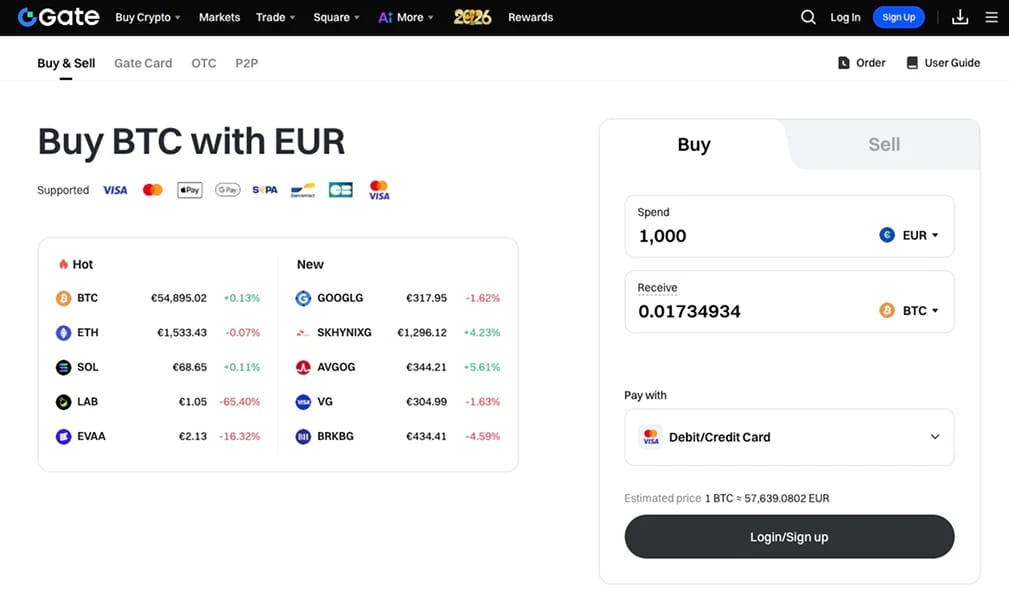
Gate closes the list for Slovenian traders who want smaller-cap exposure without stepping outside the regulated perimeter. Malta's MFSA licensed its European company, Gate Technology Ltd, on 1 October 2025, and even the compliant version of the platform carries more than 1,000 assets. Although the global platform is not available to Slovenian investors, users can still access spot trading, staking, and more.
That breadth is the entire argument for using it. Newer tokens reach Gate long before they reach Coinbase or Bitstamp, spot fees of 0.09% and 0.10% are competitive, and SEPA funding works. For anyone who wants exposure to names the conservative venues will never list, this is the authorized way to get it.
The Malta supervisory question raised against OKX lands here too, and a catalog this deep contains a great many illiquid listings that deserve real homework before you size anything. Confirm at login that Gate Technology Ltd is the entity serving your account, because MiCA protection attaches to the licensed entity and not to the global brand. Read our Gate review for a deeper look at the wider ecosystem.
Pros
- Malta's MFSA authorized Gate Technology Ltd as a CASP under MiCA on 1 October 2025.
- More than 1,000 tradable assets, the widest licensed selection a Slovenian account can reach.
- Makers pay from 0.09%, and holding GateToken cuts that further.
Cons
- ESMA's peer review put Malta's approval standards in question.
- Outside the majors, order books are thin enough to make exiting a small position slow.
- A non-EU Gate company can end up serving your account, and only the Gate Technology Ltd entity carries MiCA protection.
How to Choose a Crypto Exchange in Slovenia
Every platform above holds a MiCA permission, so the decision turns on which regulator vetted it, what your bank charges on the way out, and what your trading pattern costs.
- Look up the company name: Authorization sits with a named entity such as Bybit EU GmbH or Gate Technology Ltd, and an offshore company sharing the logo carries none of it. Confirm the name in the ESMA register and against warnings from Slovenia's Securities Market Agency.
- Weigh the regulator that granted it: Every permission opens the same door, but the files behind them were not tested to one standard. Ireland's Central Bank and Austria's FMA have drawn no public concern, while a July 2025 ESMA peer review faulted Malta's MFSA over one approval.
- Fund by bank transfer, never by card: Slovenian banks class card-channel transfers as quasi-cash, alongside gambling payments. Forbes Slovenija reports NLB charging 1.5% up to €150, Addiko 5%, and OTP banka 1% capped at €120 since 1 January 2026. An ordinary IBAN payment order avoids it.
- Test the real cost with your own money: A €1,000 purchase on the Coinbase simple screen gives up around €6 before spread, against roughly a euro on Bybit or OKX. Push a small sum through each candidate and reverse it the same day, since maker and taker pricing plus the withdrawal charge decide the true figure.
- Expect a thinner platform than the global one: Compliance stripped things out. Tether pairs are gone because the issuer never sought e-money approval, leaving USDC and EURC to fill the gap. Privacy coins were delisted, new tokens wait 20 business days after the white paper, and high-leverage derivatives are largely closed to EEA retail.
Crypto and Bitcoin Regulation in Slovenia
Owning and trading crypto is lawful in Slovenia. The controlling law is MiCA rather than domestic legislation, and supervision splits between the Securities Market Agency and the Bank of Slovenia.
Here is a timeline of crypto regulation in Slovenia:
- 23 November 2024: The act implementing the EU crypto-assets regulation entered into force, appointing the ATVP and the Bank of Slovenia as competent authorities and attaching penalties to unlicensed activity.
- 30 December 2024: The MiCA service-provider regime took effect bloc-wide. Slovenia allowed existing firms roughly six months of grandfathering rather than the full 18 the regulation permitted.
- 1 July 2025: The Slovenian transition closed. Firms without permission had to stop marketing to residents a full year before the same deadline reached the rest of the EU.
- September 2025: The ATVP granted its first MiCA permission, to the Ljubljana brokerage Ilirika. Incrementum and Orcabay followed, and those three remain the only Slovenian-licensed providers.
- 24 June 2026: Binance withdrew its Greek application and told EU customers it would stop serving them from 1 July, with withdrawals left open. Our Binance country guide tracks where that leaves account holders.
- 1 July 2026: The union-wide window shut. Delo reports 284 authorized providers left across the bloc, down from more than 3,000 national registrations.
ESMA has since flagged more than 160 firms still serving EU clients without permission. The ATVP has told Slovenian users to look up their provider and move the balance to a licensed platform or a wallet they control if the name is missing from the register.
.webp)
How Does FURS Tax Crypto?
Slovenia has no dedicated crypto tax law, and the bill written to create one never reached a vote. FURS falls back on general income tax rules, so what you owe turns on how you trade. Read this as background, not advice.
- The 25% disposal tax was drafted and then dropped: The government approved it on 17 July 2025, but the largest coalition party had it pulled from the December agenda. It lapsed when the parliamentary term ended before the 22 March 2026 election, and the coalition seated in June includes a party that campaigned against it.
- Occasional investing stays untaxed: FURS guidance leaves an individual buying and selling outside a business activity free of personal income tax on the gain, which is why Slovenia still reads as favorable for retail holders.
- Earned crypto is income on the day it arrives: Mining rewards attract a 25% advance payment on their euro value, with electricity and hardware not deductible. Salary, fees or rewards paid in crypto are taxed in kind at market value on receipt.
- Trading inside a company is taxed as company profit: Earnings held by a Slovenian entity meet corporate income tax at 22% for the tax years 2024 to 2028, a temporary rise funding flood reconstruction, before the rate returns to 19% in 2029.
- Reporting duties already apply: Slovenia ratified the OECD Crypto-Asset Reporting Framework agreement on 2 February 2026 and brought CARF and DAC8 into the Tax Procedure Act. Per FURS, due diligence began on 1 January 2026 and reporting of 2026 data starts a year later.
FURS publishes no numeric threshold separating an investor from a trading business, and that judgment drives everything above. Confirm where you sit with a Slovenian accountant before filing.
.webp)
Cryptocurrency Adoption in Slovenia
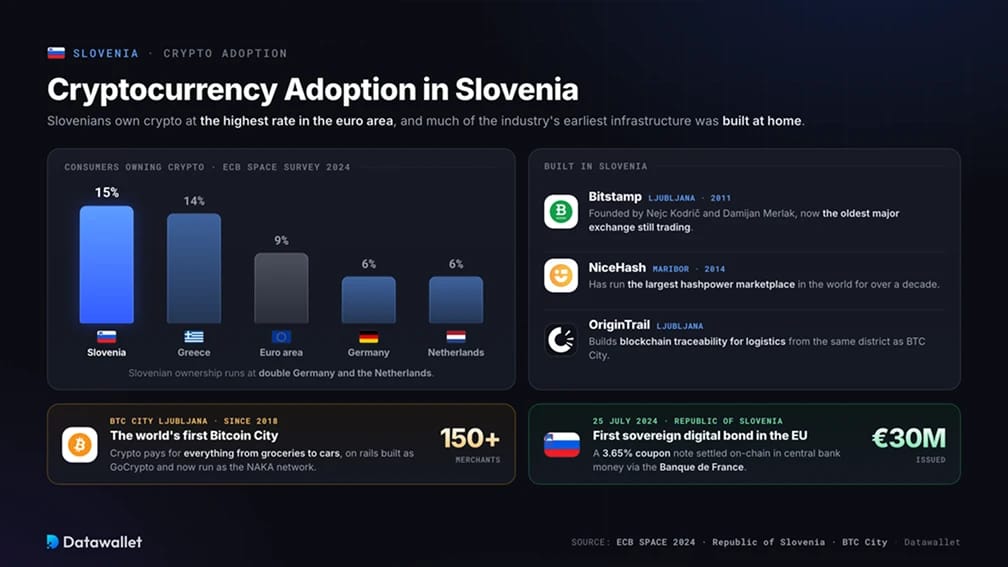
Slovenia is the most crypto-owning country in the euro area by a clear margin. The European Central Bank's consumer payment survey put ownership at 15% of Slovenian respondents against a euro-area average of 9%, ahead of Greece on 14% and double Germany and the Netherlands on 6%.
Adoption has physical roots too. BTC City Ljubljana branded itself the world's first Bitcoin City in 2018 and still hosts a blockchain cluster, with more than 150 merchants accepting crypto for everything from groceries to cars. The payment layer began as GoCrypto, built by Slovenian fintech Eligma, and is now the NAKA network.
Slovenia has produced infrastructure as well as acceptance. Bitstamp started here in 2011 and is the oldest major exchange still running; NiceHash has operated the largest hashpower marketplace from Maribor since 2014, and OriginTrail builds blockchain traceability for logistics in the same Ljubljana district.
On 25 July 2024, the Republic of Slovenia issued the first sovereign digital bond in the European Union, a €30 million note carrying a 3.65% coupon that matured on 25 November and settled on-chain in wholesale central bank money through the Banque de France platform.
How to Buy Bitcoin in Slovenia
The cheapest reliable method has not changed, but the shortlist has. Fund euros over SEPA on an authorized platform, then buy on the spot market rather than the one-tap screen.
- Confirm the platform’s MiCA license: Search the exact legal entity in the ESMA register before you create an account. If it is not listed as authorized, nothing else about the platform matters.
- Finish verification: Use your Slovenian ID card or passport, and check your registered details against your bank records character for character. Mismatched details are the usual trigger for a held deposit.
- Send euros with SEPA: Use a payment order from your online banking rather than a card top-up, which keeps you clear of the quasi-cash charges several Slovenian banks apply. SEPA Instant usually settles in under ten seconds.
- Buy on the spot market: Open the BTC/EUR pair and place a limit order. The instant-buy button is faster, but the spread built into it typically costs more than the trading fee itself.
- Secure assets: Active traders can leave a balance on the exchange. For long-term holdings, move it to a wallet you control, covered in our best crypto wallets guide.
Keep export files from every trade as you go. With DAC8 reporting starting on 2026 data, reconstructing a year after the fact is far harder than saving a CSV each quarter.
Final Thoughts
For most people in Slovenia, the practical shortlist is now short by design. Kraken takes the top position because it pairs the rare exchange-venue permission with an Irish supervisor, the tightest euro pricing in Europe, and free deposits and withdrawals to a Slovenian account.
After that, pick by need. Bybit for a flat 0.10% fee and the broadest euro funding, Coinbase for the simplest first purchase, Bitstamp for a Slovene interface and home-market record, OKX for a bridge into self-custody, and Gate for smaller-cap exposure inside the licensed perimeter.
Two habits save more money than any platform choice. Fund by ordinary SEPA transfer rather than card so your bank does not treat it as quasi-cash, and buy on the spot market instead of the instant-buy screen. Then keep records, because reporting runs even though the tax bill never passed.
Our Methodology
We restricted this list to platforms with full MiCA authorization able to serve Slovenian residents after the 1 July 2026 deadline, then tested each from a euro account. Every platform scored across the same six criteria:
- License and regulator: Which legal entity holds the authorization, which national authority granted it, how many of the ten crypto-asset services it extends to, and whether that supervisor has drawn public criticism.
- Euro funding from Slovenia: SEPA and SEPA Instant settlement times, card availability, and how domestic bank charges affect the real cost of getting money onto the platform.
- Total round-trip cost: Deposit charges, maker and taker fees, the spread on the instant-buy screen and the euro withdrawal charge, measured on a live BTC/EUR order.
- Asset availability: Which markets survived on the European version of each platform once the stablecoin, privacy-coin and new-listing restrictions took effect.
- Security and transparency: Proof-of-reserves practice, custody arrangements, certification, and how each platform handled past incidents.
- Local relevance: Language support, Slovenian entity presence, and whether the platform behaves predictably with Slovenian banks.
Testing ran through July 2026, after the transitional period closed. Read our full editorial methodology for how we research and fact-check.
.webp)