







Compare Tether (USDT) Yield Opportunities
1. Bybit
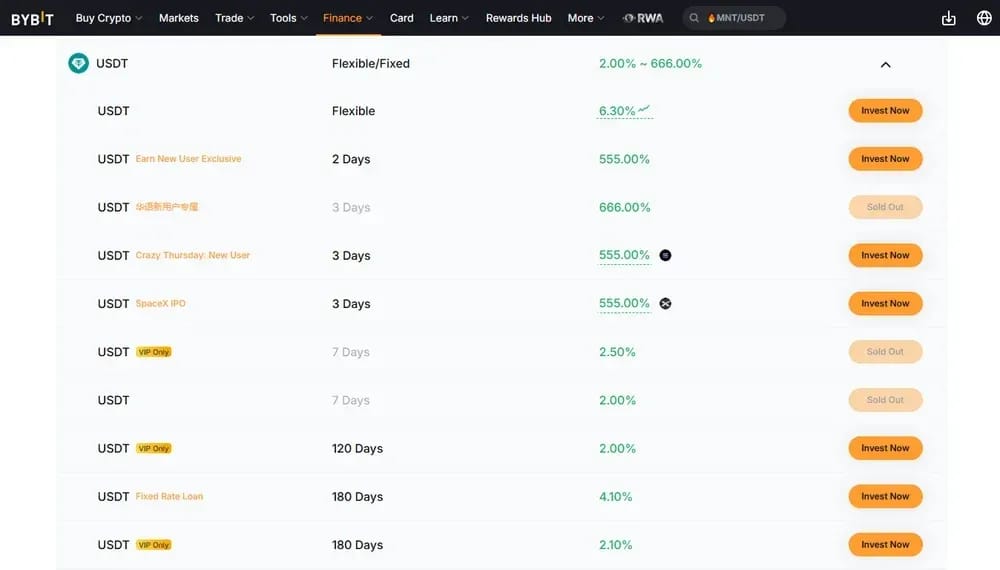
Top on the list, Bybit is strongest for users chasing headline USDT promos without giving up flexible access. Its USDT page shows Flexible/Fixed products from 2.00% to 666.00% APR, including a flexible line around 6.30% and multiple short new-user deals for smaller allocations today.
Bybit’s range is unusually wide: flexible USDT, two- and three-day new-user offers at 555% to 666%, VIP-only fixed terms, and a 180-day fixed-rate loan around 4.10%. We like the segmentation, because users can separate idle cash parking from limited campaigns instead of comparing every yield equally.
The trade-off is availability. The highest USDT rates are usually capped, time-sensitive, or restricted by user status, while standard flexible yield is closer to the mid-single digits. For a stablecoin interest rates comparison, Bybit works best when promos are treated as bonuses, not base-case income.
Pros
- Wide USDT range across flexible, fixed, and promotional products.
- Very high short-term rates for eligible new users.
- Flexible product keeps idle stablecoins relatively liquid.
Cons
- Top yields are capped, temporary, or user-restricted.
- VIP-only rows reduce access for smaller accounts.
- Promo APRs can distort realistic long-term expectations.
2. Binance
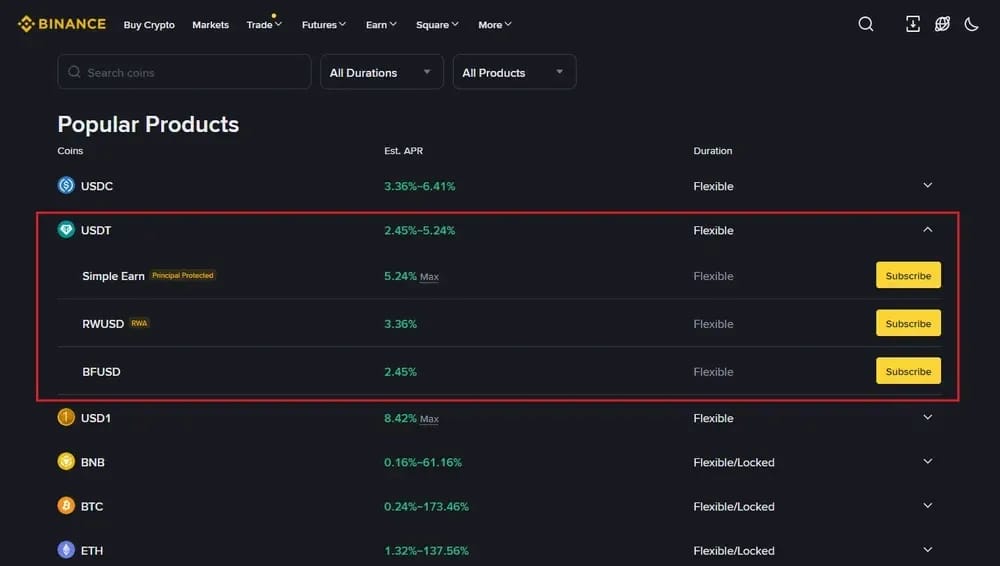
A strong second choice, Binance suits users who prioritize scale, flexible access, and product clarity over extreme promotional APRs. Its USDT Earn section shows a 2.45% to 5.24% range, with Simple Earn at 5.24% max and additional RWUSD and BFUSD lines for stablecoin yield today.
Binance is more conservative than Bybit or MEXC, but the product mix is broader than a plain savings account. Users can compare Simple Earn, principal-protected flexible products, RWUSD exposure, and other stablecoin-linked options in the Earn dashboard, while Flexible Products can begin accruing rewards after subscription.
The main appeal is consistency. Binance’s USDT rates are not the highest in this group, yet the platform gives users a clear split between liquid yield and structured Earn products. Its APR calculator also reminds users that APR is an estimate, adjusted daily, and not a fiat return guarantee.
Pros
- Clear Earn interface with flexible and locked product categories.
- Principal-protected options suit more conservative stablecoin users.
- Large ecosystem makes USDT management easier across products.
Cons
- Headline USDT APR is lower than several competitors.
- Availability may vary by region and account eligibility.
- APR estimates can change daily without much warning.
3. Gate
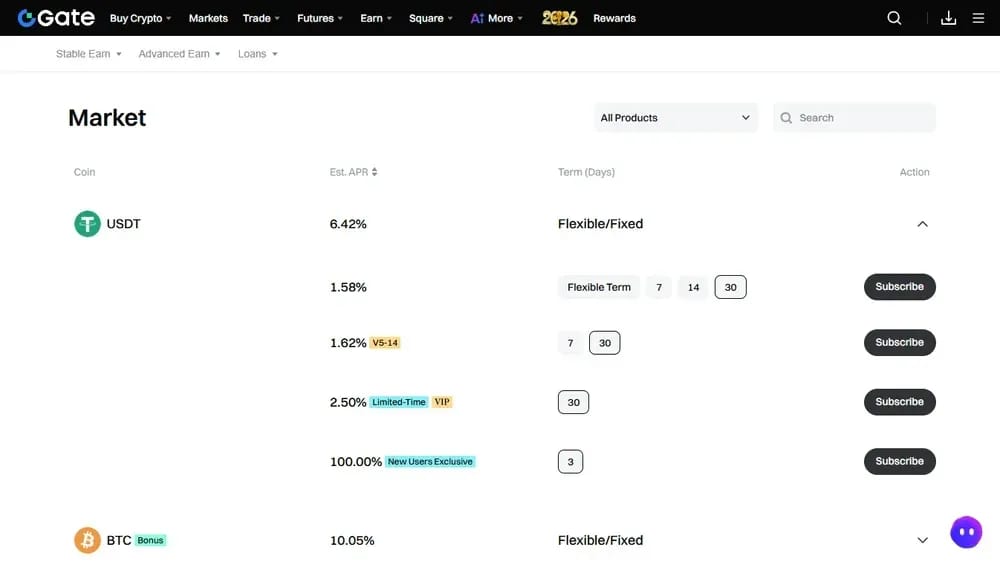
For term variety, Gate stands out with a USDT table that mixes flexible deposits, short fixed terms, VIP products, and new-user campaigns. The attached screen shows USDT at 6.42% overall, plus options around 1.58%, 1.62%, 2.50%, and a 100% three-day new-user offer for active users today.
Gate is useful for users who want small, clearly labeled choices rather than one generic savings rate. The page separates flexible terms, seven-, fourteen-, and thirty-day buttons, limited-time products, and VIP offers, which helps users match liquidity needs with yield. That structure makes APR comparison easier.
The downside is that Gate’s strongest numbers are concentrated in specials, not everyday USDT parking. Standard products sit much lower than the headline 100% new-user campaign, and some rows depend on VIP status or short windows. Treat Gate as a flexible marketplace, not a single yield product.
Pros
- Good spread of flexible, fixed, VIP, and new-user products.
- Short terms help users avoid long stablecoin lockups.
- Interface makes term and APR differences easy to scan.
Cons
- Highest USDT yield is mainly promotional, not recurring.
- Some products require VIP access or limited availability.
- Standard flexible yields can be less competitive.
4. MEXC
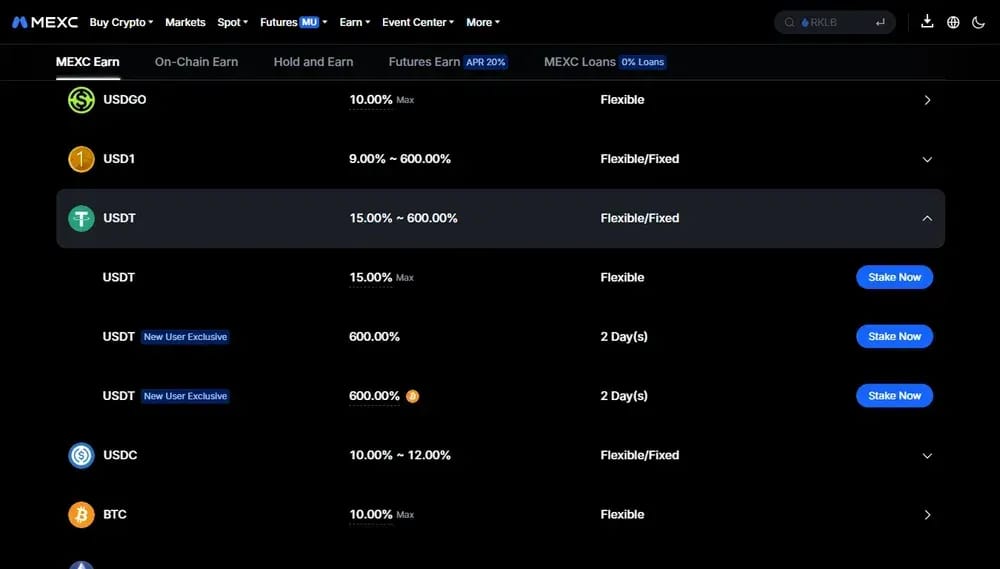
Highest promotional ceiling, we recommend MEXC for users willing to monitor campaigns closely instead of leaving funds idle. Its USDT Earn page shows a 15.00% to 600.00% range, including a flexible product at 15.00% max and two-day new-user fixed offers advertised at 600.00% APR today.
MEXC is aggressive in stablecoin yield positioning. Beyond the screenshot, its Earn materials describe flexible stablecoin savings with daily interest and campaign rates that can rise sharply, while separate product updates mention two-day USDT fixed savings for new users at 600% APR. That is eye-catching, but very conditional.
We would treat MEXC as a promotion-led exchange for USDT yield, not a passive set-and-forget platform. The 15% flexible rate is attractive versus most competitors, yet caps, eligibility, and rate changes matter. For users comparing Tether exchanges, product access may matter as much as headline APR.
Pros
- Highest displayed USDT promotional ceiling among the six platforms.
- Flexible USDT rate is competitive even before promos.
- New-user fixed terms can deliver unusually large short bursts.
Cons
- Extreme APRs are unlikely to be broadly available.
- Campaign rates may change quickly or sell out.
- Requires active monitoring to capture the best terms.
5. Bitget
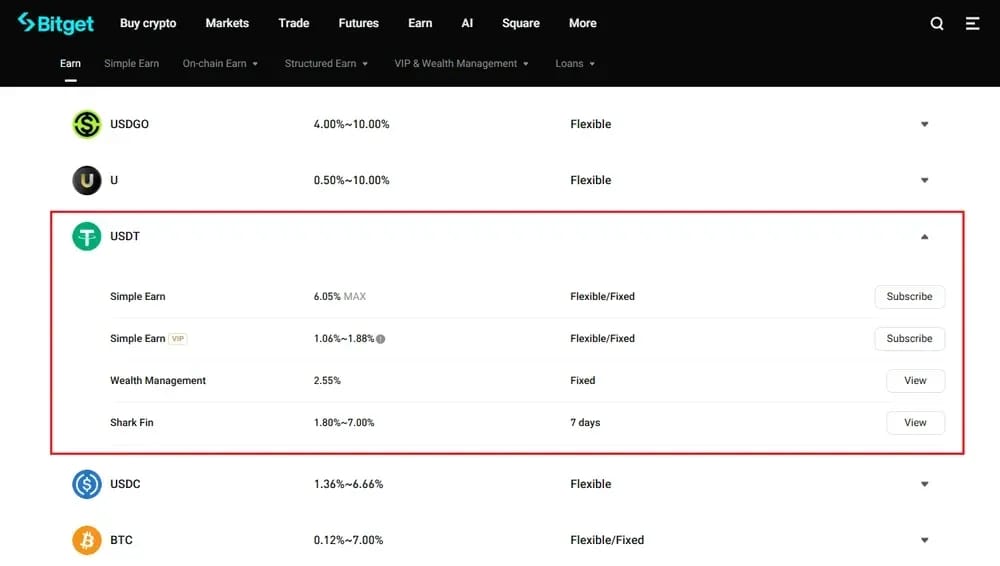
Balanced for everyday savers, Bitget offers one of the cleaner USDT Earn layouts among the six. The attached screen shows USDT Simple Earn at 6.05% max, a VIP Simple Earn range of 1.06% to 1.88%, Wealth Management at 2.55%, and Shark Fin from 1.80% to 7.00%.
Bitget’s strength is balance rather than spectacle. Flexible and fixed Simple Earn products sit beside Wealth Management and Shark Fin, giving users a path from liquid USDT income into structured products. Its official materials also describe flexible savings as daily-interest products with no lock-up, while fixed products trade liquidity for higher returns.
The main limitation is that Bitget’s highest USDT number is not as dramatic as Bybit, MEXC, or KuCoin promotions. That can be a positive for conservative users. Still, structured options such as Shark Fin require different risk expectations from simple savings, especially when returns depend on market conditions.
Pros
- Clean layout across Simple Earn, VIP, and structured products.
- Flexible savings supports daily interest and withdrawals.
- Moderate yields may suit conservative stablecoin allocation.
Cons
- Lower headline APR than heavier promotion-led exchanges.
- VIP rows may not help regular retail users.
- Structured products need more risk awareness than savings.
6. KuCoin
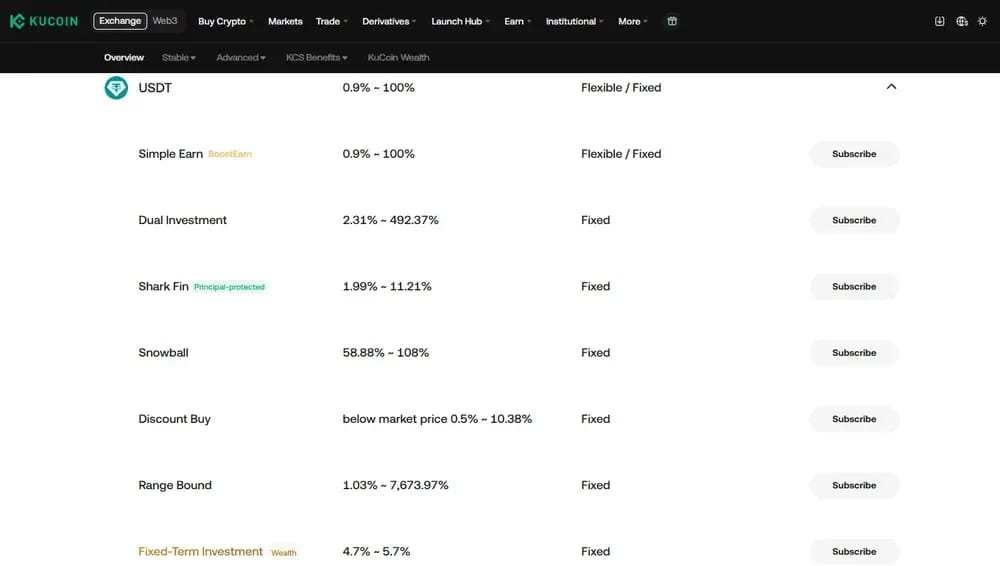
Most product-diverse, KuCoin is ideal for users comparing simple USDT yield with structured Earn strategies in one dashboard. Its screenshot shows Simple Earn from 0.9% to 100%, Dual Investment from 2.31% to 492.37%, Shark Fin from 1.99% to 11.21%, and Snowball from 58.88% to 108%.
KuCoin’s Earn hub splits products into Stable and Advanced categories, which matters. Stable products include Simple Earn and staking-style options, while Advanced products include Dual Investment, Shark Fin, Snowball, Discount Buy, and Range Bound. That breadth makes KuCoin powerful for experienced users, but less intuitive for beginners.
The key is not to compare every KuCoin APR as if it were the same product. Simple Earn is closer to standard USDT yield, while Dual Investment and Range Bound behave more like structured strategies. For context on the asset itself, see this guide to TRC20 USDT.
Pros
- Broadest product mix across simple and advanced USDT strategies.
- New-user and event campaigns can materially increase APR.
- Good choice for users comparing multiple yield structures.
Cons
- Advanced products are harder to evaluate than Simple Earn.
- Very high APRs often come with complex payoff mechanics.
- Beginners may find the Earn menu overwhelming.
What is Tether USDT?
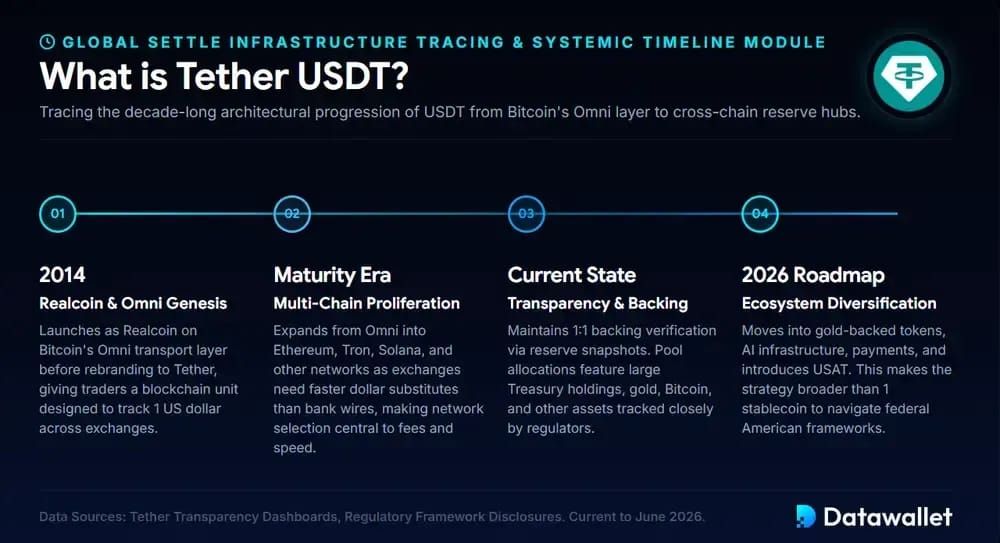
Tether USDT is the earliest dollar stablecoin to become global crypto settlement infrastructure. It began as Realcoin in 2014, issued tokens on Bitcoin’s Omni layer, and was soon renamed Tether, giving traders a blockchain unit designed to track one US dollar across exchanges.
The product matured as exchanges needed a faster dollar substitute than bank wires. USDT expanded from Omni into Ethereum, Tron, Solana, and other networks, making network selection central to fees, speed, and wallet support. For chain-level context, see this TRC20 USDT guide.
Today, Tether describes each token as 1:1 backed by reserves and publishes reserve snapshots through its transparency page. USDT remains the largest stablecoin by circulation, while its reserves now include large Treasury holdings, gold, Bitcoin, and other assets tracked closely by regulators and rating agencies.
The roadmap is broader than one stablecoin. Tether has moved into gold-backed tokens, AI infrastructure, payments, and a US-focused stablecoin called USAT. That makes USDT both a trading asset and part of a wider digital-dollar strategy worth monitoring through Tether statistics.
How Does USDT Generate Yield?
USDT yield does not come from Tether paying holders. It comes from platforms that lend, route, lock, or structure deposited stablecoins, then pass part of trading, borrowing, or incentive revenue back.
Centralized Exchange Earn Products
On CEXs, USDT yield usually looks simple because dashboards quote APR upfront, but the engine can mix lending demand, fixed deposits, and campaign budgets.
The main yield paths are worth separating before comparing APRs:
- Flexible Earn: Platforms like Binance Simple Earn let users subscribe and redeem USDT with high liquidity, usually paying lower APR than fixed or promotional products.
- Fixed Terms: Locked products commit USDT for a stated period, so the exchange can offer clearer duration-based rewards while reducing daily withdrawal flexibility for users.
- Promo Rates: Bybit-style USDT campaigns can show very high APRs, but allocation caps, eligibility rules, and short terms limit realistic annualized earnings.
- Structured Yield: Shark Fin, Dual Investment, and similar products may reference USDT balances, but returns depend on payoff rules, price paths, and product-specific conditions.

Onchain Lending, Liquidity, and Tokenized Strategies
Onchain USDT yield is more transparent because users can inspect protocol markets directly. In lending systems like Aave, depositors supply USDT, borrowers pay variable interest, and utilization helps set the supply rate. That makes APY more market-driven than exchange promotional APR.
Money markets such as Compound formalize this with interest-rate models based on utilization. When more USDT is borrowed relative to supplied liquidity, rates can rise. When liquidity is plentiful and borrower demand is weak, supply APY usually compresses.
DEX pools work differently. USDT liquidity providers can earn trading fees, token incentives, or both, but they also take pool-specific risks. Stable pairs may reduce volatility, while USDT-altcoin pools add impermanent loss. This is why stablecoin staking needs product-level analysis.
Best Decentralized Tether USDT Yield Pools
DeFi pools require more filtering than exchange products because APY, TVL, audits, and pair composition can change quickly, especially when rewards depend on token incentives.
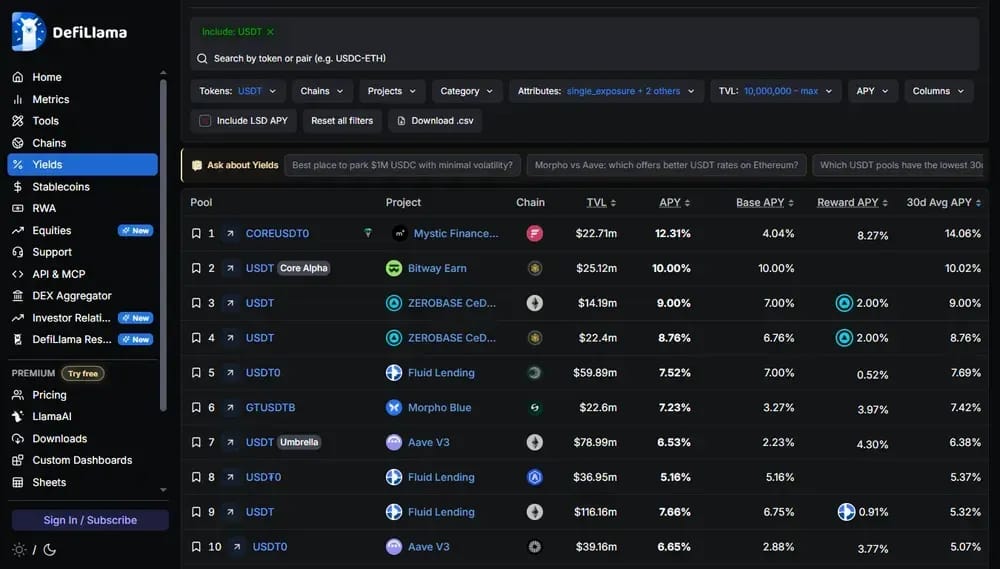
These DefiLlama pools currently show the clearest USDT opportunities:
- Mystic: c0REUSDT0 on Mystic Finance leads the screenshot at 12.31% APY, with $22.71m TVL and rewards contributing 8.27 percentage points above a 4.04% base rate.
- Bitway: USDT Core Alpha on Bitway Earn pays 10.00% APY from base yield only, with $25.12m TVL and a 10.02% 30-day average in the screenshot.
- ZEROBASE: USDT on ZEROBASE CeDeFi Ethereum shows 9.00% APY, combining 7.00% base yield with 2.00% rewards on $14.19m TVL and a flat 9.00% 30-day average.
- ZEROBASE: USDT on ZEROBASE CeDeFi’s Core listing pays 8.76% APY, with 6.76% base yield, 2.00% rewards, $22.4m TVL, and matching 30-day average in the table.
- Fluid: USDT0 on Fluid Lending shows 7.52% APY with $59.89m TVL, mainly from 7.00% base yield plus a 0.52% reward component and 7.69% 30-day average.
- Morpho: GTUSDTB on Morpho Blue shows 7.23% APY, splitting between 3.27% base yield and 3.97% rewards, with $22.6m TVL and 7.42% 30-day average shown there.
- Aave: USDT Umbrella on Aave V3 Ethereum pays 6.53% APY, with $78.99m TVL, 2.23% base yield, and 4.30% reward APY in the filtered view shown.
- Fluid: USD₮0 on Fluid Lending Arbitrum offers 5.16% APY, all from base yield, with $36.95m TVL and 5.37% 30-day average in the same filter set.
- Fluid: USDT on Fluid Lending Ethereum posts 7.66% APY with $116.16m TVL, made from 6.75% base yield and 0.91% rewards despite a 5.32% 30-day average.
- Aave: USDT0 on Aave V3 shows 6.65% APY, with $39.16m TVL, 2.88% base yield, 3.77% rewards, and 5.07% 30-day average at the screenshot cutoff point.
USDT Regulations & Licenses
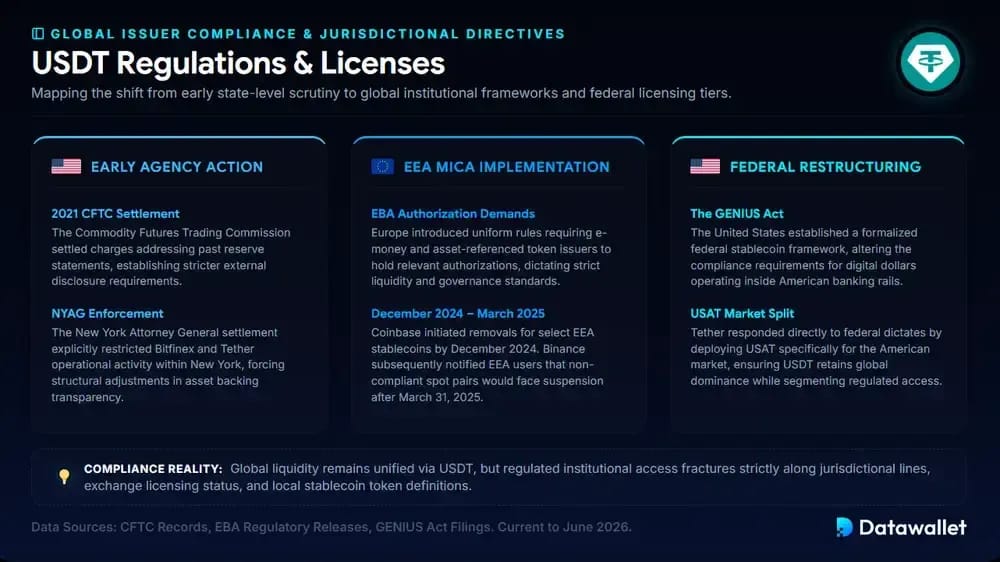
Tether’s regulatory history starts before MiCA. In 2021, the CFTC settled charges over past reserve statements, while the New York Attorney General settlement restricted Bitfinex and Tether activity in New York. Those cases shaped later scrutiny around disclosures and backing quality.
Europe became the major turning point. MiCA created uniform rules for crypto-assets, including e-money tokens and asset-referenced tokens. The EBA requires issuers of those tokens to hold relevant authorization, with liquidity, reserve, governance, and disclosure standards.
USDT’s practical consequence was delisting. Coinbase moved first for certain EEA stablecoins by December 2024. Binance then told EEA users that non-MiCA compliant stablecoin spot pairs, including USDT, would be suspended after March 31, 2025, while holdings and withdrawals remained possible.
The US moved differently. The GENIUS Act created a federal stablecoin framework, and Tether responded with USAT for the American market. USDT remains globally dominant, but regulated access increasingly depends on jurisdiction, exchange status, and whether the token fits local stablecoin licensing rules.
Risks of Farming Yield With Tether USDT
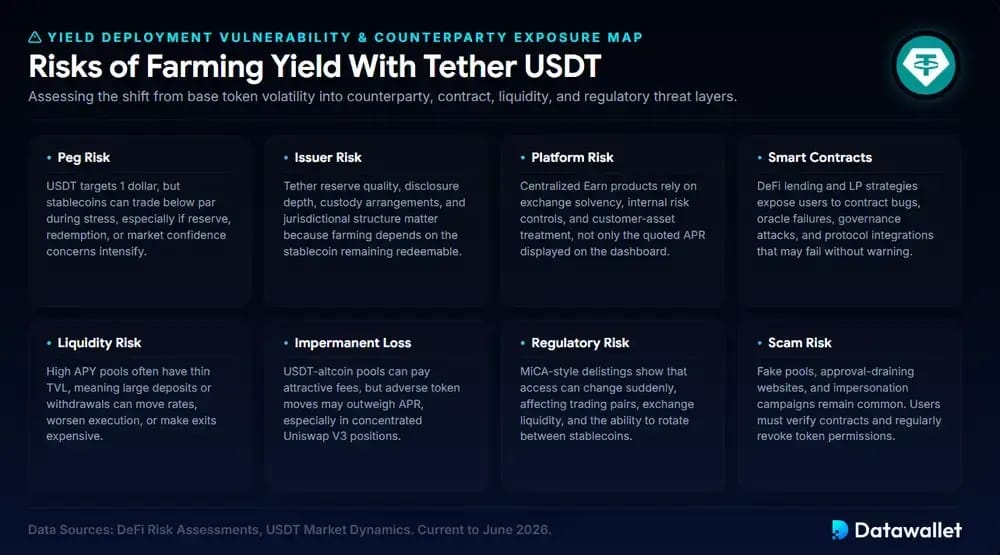
USDT yield can look safer than volatile crypto farming, but the risk shifts into counterparties, contracts, liquidity, regulations, and product design rather than disappearing.
Key risks to assess before farming USDT:
- Peg Risk: USDT targets one dollar, but stablecoins can trade below par during stress, especially if reserve, redemption, or market confidence concerns intensify.
- Issuer Risk: Tether reserve quality, disclosure depth, custody arrangements, and jurisdictional structure matter because yield farming still depends on the underlying stablecoin remaining redeemable.
- Platform Risk: Centralized Earn products rely on exchange solvency, internal risk controls, and customer-asset treatment, not only the quoted APR displayed on the dashboard.
- Smart Contracts: DeFi lending and LP strategies expose users to smart contract bugs, oracle failures, governance attacks, and protocol integrations that may fail without warning.
- Liquidity Risk: High APY pools often have thin TVL, meaning large deposits or withdrawals can move rates, worsen execution, or make exits expensive.
- Impermanent Loss: USDT-altcoin pools can pay attractive fees, but adverse token moves may outweigh APR, especially in concentrated Uniswap V3 positions.
- Regulatory Risk: MiCA-style delistings show that access can change suddenly, affecting trading pairs, exchange liquidity, and the ability to rotate between stablecoins.
- Scam Risk: Fake pools, approval-draining websites, and impersonation campaigns remain common, so users should verify contracts and regularly revoke token permissions.
Final Thoughts
USDT yield is most useful when treated as a cash-management tool, not a guaranteed income stream. Flexible Earn suits idle balances, while fixed, promotional, and structured products require closer attention.
The best platform depends on how often you rotate funds. Bybit and MEXC favor campaign hunters, Binance and Bitget suit conservative users, while Gate and KuCoin offer broader product menus.
Before subscribing, compare APR caps, redemption windows, regional access, and whether yield comes from lending or structured payoffs. Small differences matter when stablecoin returns change daily across leading platforms during volatile market conditions.
Our Methodology
USDT yield rankings can be misleading when every APR is treated as the same product. We reviewed each exchange and DeFi option as a full yield stack, separating liquid savings from fixed terms, campaigns, and structured strategies.
Our scoring framework focused on practical repeatability, not just the largest number shown on a product page:
- APR Quality: We compared displayed USDT APR ranges, then discounted rates that were capped, new-user-only, time-limited, or tied to complex settlement conditions.
- Product Depth: We favored platforms with multiple USDT paths, including flexible savings, fixed terms, VIP tiers, lending markets, and clearly labeled structured products.
- Liquidity: We checked whether users could redeem daily, wait for maturity, or face strategy-specific settlement rules before accessing funds again.
- Access Rules: We considered regional restrictions, KYC requirements, allocation caps, and whether a yield product was broadly available or limited to specific users.
- Risk Profile: We separated simple Earn and lending products from pools with impermanent loss, smart-contract exposure, counterparty risk, or altcoin price dependency.
- Data Sources: We cross-checked official platform pages, Tether’s transparency page, DefiLlama stablecoin yields, and ESMA’s MiCA overview.
- Final Ranking: We prioritized realistic access, product clarity, and repeatable yield over one-off promotions, so a lower APR with cleaner terms could rank above a larger but less durable offer.
%20Yield%20Opportunities%202026.webp)