




About Bitunix
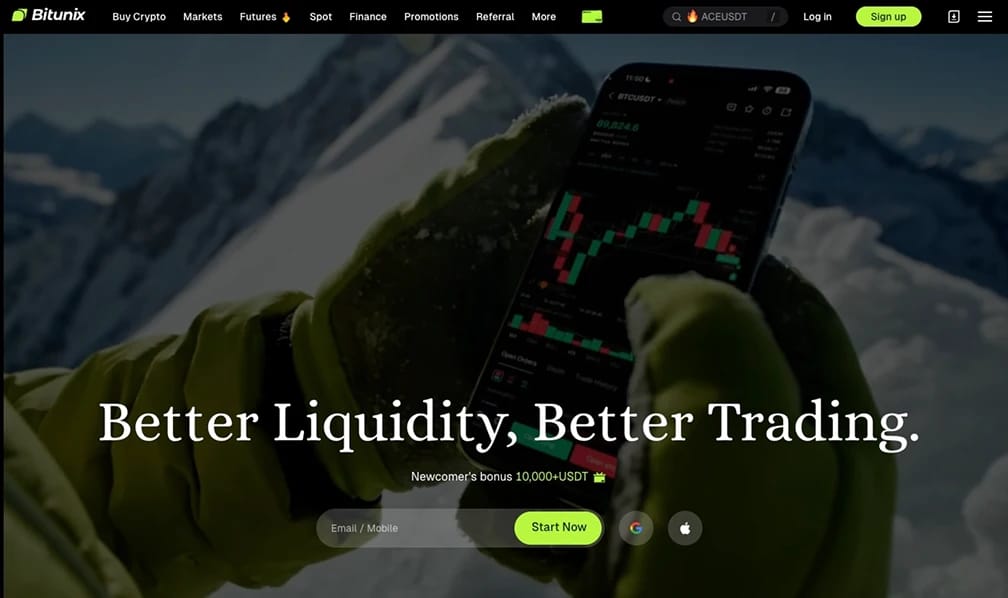
Founded in 2021, Bitunix began trading in 2022 through Bitunix Fintech LLC, an entity incorporated in Saint Vincent and the Grenadines. Perpetual futures are the core business. Its execution speed, charting tools, and high leverage are aimed at active traders rather than beginners buying their first assets.
The exchange has grown quickly. According to the CoinGlass 2025 annual report, Bitunix ranked seventh among global exchanges for derivatives trading volume and tenth for open interest, the value of futures positions traders keep open. These results put a relatively new exchange alongside Bybit, Bitget, and OKX.
Traffic comes mainly from emerging markets. Similarweb shows Argentina contributing the largest share of visits by a wide margin, followed by Ukraine, Germany, Taiwan, and Saudi Arabia. Bitunix also leads Argentina’s investing category. Latin America has become its main source of growth, while Europe presents its most serious regulatory problem.
That divide shapes our 2026 assessment. The trading product has matured, and the security framework has been rebuilt to an institutional standard. Yet Bitunix holds no full trading license anywhere. France has banned the exchange outright, and Trustpilot has placed a regulatory attention notice on its profile.
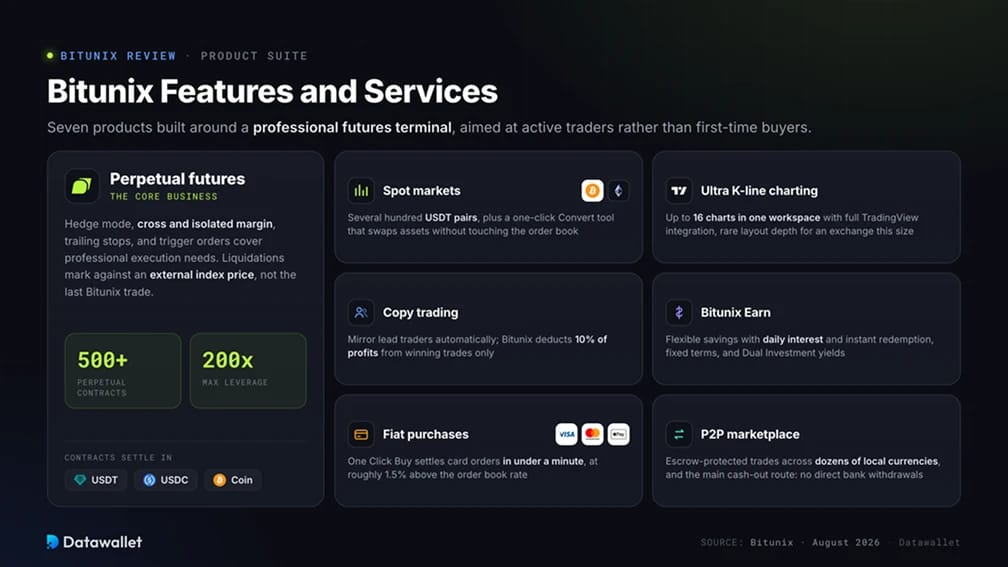
Bitunix Features and Services
The account covers most tools an active trader would expect, but the experience is structured around a futures terminal rather than a basic purchase screen.
Here are the main products available on a Bitunix account:
- Spot markets: Several hundred USDT pairs include major assets, mid-caps, and newer listings. A one-click Convert tool also lets users swap assets without placing an order on the book.
- Perpetual futures: More than 500 contracts are available, with leverage reaching 200x on the most liquid pairs. Contracts can settle in USDT, USDC, or the underlying coin.
- Ultra K-line charting: The multi-window workspace can display up to 16 charts simultaneously and includes full TradingView integration. Few exchanges of this size offer comparable layout depth natively.
- Copy trading: Followers can automatically mirror positions taken by lead traders. Bitunix deducts 10% of profits from winning trades only. Our best crypto copy trading platforms ranking compares this structure with rival programs.
- Bitunix Earn: Flexible savings generate daily interest and allow instant redemption. Fixed terms lock assets in return for higher advertised rates, while Dual Investment pays elevated yields in exchange for accepting settlement in one of two assets.
- Fiat purchases: Visa, Mastercard, and Apple Pay purchases run through the One Click Buy screen, with MoonPay and Banxa supporting additional currencies. Our test card purchase settled in under a minute, although the quoted price was roughly 1.5% above the order book rate.
- P2P marketplace: The escrow-protected marketplace connects buyers and sellers across dozens of local currencies. It is also the main cash-out route because Bitunix does not provide direct bank withdrawals.
New users must understand margin modes, funding payments, and order types from their first session. The interface provides little separation between basic trading and more complex derivatives tools.
Bitunix Futures Trading
Bitunix is built around futures trading. Traders who are new to leveraged contracts can review our guide to perpetual versus spot trading before using the platform.
These are the core futures products and risk controls:
- USDT-margined contracts: The deepest markets settle in USDT, which keeps the value of collateral stable while positions remain open. Leverage reaches 200x on flagship pairs.
- USDC-margined contracts: A separate group of perpetual contracts uses USDC as collateral and for settlement.
- Coin-margined contracts: Traders can collateralize positions with BTC or another base asset. This format suits long-term holders who want profits paid in the asset they are already accumulating.
- Hedge mode: Users may hold long and short positions on the same contract at the same time. This can protect an existing position during volatile events without requiring it to be closed.
- Cross and isolated margin: Cross margin uses the full account balance to support every open position. Isolated margin limits the loss on a single trade to the collateral assigned to that position.
- Advanced order types: Trailing stops, trigger orders, and post-only instructions cover most professional execution requirements. One-way mode provides a simpler setup for directional traders.
Liquidations use a dual-price system. Positions are marked against an index built from prices on major external exchanges, rather than the last trade recorded on Bitunix. This reduces the chance that one manipulated print will force a liquidation.
Funding payments are exchanged periodically between long and short positions. On heavily crowded contracts, this recurring expense can exceed the trading fees charged on the position.
.webp)
Is Bitunix Regulated?
Bitunix is partially regulated, but its registrations are limited to anti-money laundering reporting. They require transaction reporting and user screening. No regulator supervises the exchange’s trading conduct, client asset custody, or handling of complaints.
These are the registrations Bitunix holds today:
- United States (FinCEN): Bitunix has held a Money Services Business registration since 2022. It imposes federal reporting duties but does not permit the exchange to serve US residents, who remain blocked.
- Canada (FINTRAC): Its Canadian money services registration covers dealing in virtual currencies on paper. Retail access in Canada remains disabled.
- Australia (AUSTRAC): Bitunix joined the Australian regulator’s register in January 2026. The registration covers digital currency exchange and remittance activity under local reporting rules.
- Philippines (BSP): A virtual asset service provider license announced in 2024 permits custody and conversions between crypto and Philippine pesos.
- El Salvador (BCR): Announced in July 2026, its Bitcoin Service Provider license permits bitcoin exchange, custody, and payment services. It is the closest Bitunix has to a substantive operating license.
Europe presents a more serious issue. France’s markets regulator, the AMF, placed Bitunix on its blacklist in March 2025 after finding that it marketed unauthorized crypto derivatives to French residents. Bitunix responded by adding France to its restricted list instead of contesting the decision.
MiCA’s transition period ended on 1 July 2026, and Bitunix remains absent from ESMA’s register of authorized providers. Any remaining EEA users therefore hold accounts with a platform that owes them none of the regulation’s client asset or complaint protections.
The exchange’s eligibility notice lists 23 excluded jurisdictions. Our Bitunix restricted countries page tracks each entry.
.webp)
Bitunix KYC Policy
Bitunix has tightened its verification rules, ending the privacy model that once allowed six-figure daily withdrawals with only an email address. Under the current KYC tier structure, withdrawals are treated as a regulated service and require completed identity checks.
The verification structure now works as follows:
- Unverified accounts: Users can explore the platform and deposit crypto, but withdrawals remain locked until identity documents have been approved.
- Basic verification: A government-issued ID and selfie check unlock withdrawals. Users also receive full access to spot trading, futures, and Bitunix Earn. Our approval was completed within minutes.
- Advanced verification: Proof of residence raises account limits further and opens tools intended for larger accounts.
Bitunix no longer publishes fixed withdrawal limits for each tier. The applicable cap depends on the user’s registered country and internal risk score, as displayed in the account settings. Traders who require withdrawals without identity checks can consult our best no-KYC crypto exchanges roundup.
Is Bitunix Safe?
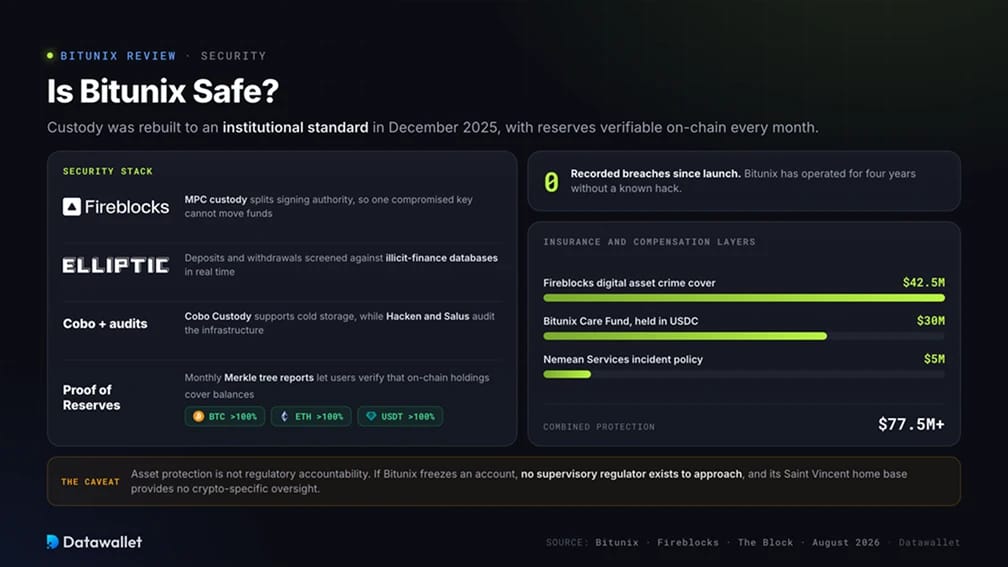
Bitunix has a strong technical security and custody record. It has operated for four years without a recorded breach. In December 2025, the exchange integrated Fireblocks and Elliptic. Fireblocks provides multi-party computation custody, splitting signing authority so one compromised key cannot move funds. Elliptic screens deposits and withdrawals against illicit-finance databases in real time.
Insurance and compensation reserves are divided across three layers. The Fireblocks arrangement provides $42.5 million of coverage for digital asset crime and operational failures. A separate $5 million policy with Nemean Services covers unexpected incidents. The Bitunix Care Fund holds another $30 million in USDC as a standing compensation reserve.
Cobo Custody supports cold storage, while Hacken and Salus audit the infrastructure. Monthly Proof of Reserves reports use Merkle tree cryptography, allowing users to verify that on-chain holdings fully cover their balances. Published reserve ratios exceed 100% for BTC, ETH, and USDT.
Asset protection is different from regulatory accountability. Funds appear well defended against hackers, but users have no supervisory regulator to approach if Bitunix freezes an account. Its home registration in Saint Vincent and the Grenadines provides no crypto-specific oversight. That weakness is reflected in the user complaints discussed below.
Bitunix Fees Explained
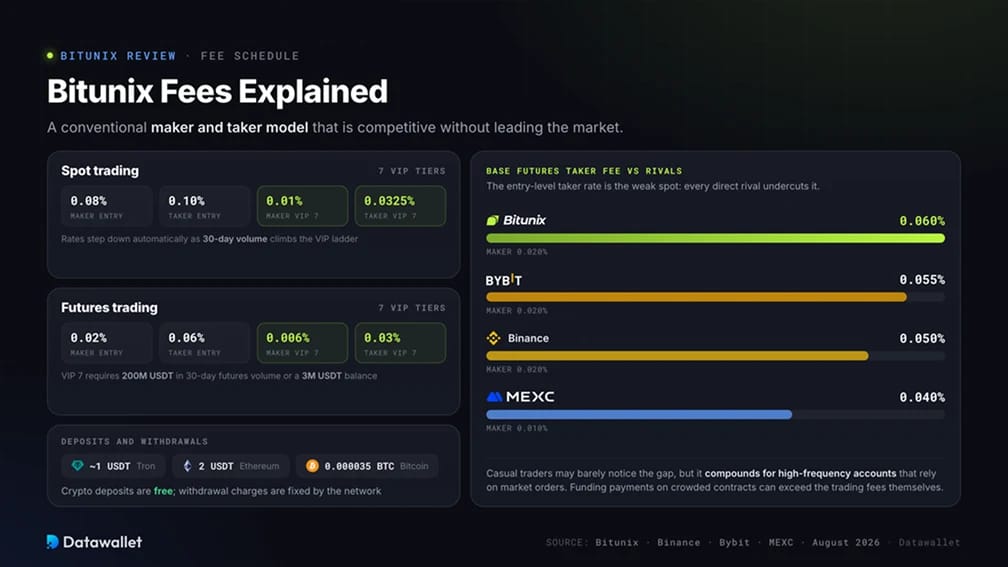
Bitunix uses a conventional maker and taker model. Its published schedule is competitive, although it does not lead the market. Our guide to maker versus taker fees explains when each rate applies.
The current rates break down as follows:
- Spot trading: Entry-level accounts pay 0.08% maker and 0.10% taker. Across seven VIP tiers, rates fall as low as 0.01% maker and 0.0325% taker.
- Futures trading: Standard rates are 0.02% maker and 0.06% taker. VIP 7 reduces them to 0.006% maker and 0.03% taker, but requires either 200 million USDT in 30-day futures volume or a balance of 3 million USDT.
- Deposits: Bitunix does not charge for crypto deposits. Users still pay any fee imposed by the sending network.
- Withdrawals: Charges are fixed by the network. Examples include roughly 1 USDT for Tron transfers, 2 USDT for Ethereum, and 0.000035 BTC for Bitcoin.
The base futures taker fee compares poorly with direct rivals. Binance charges 0.02% maker and 0.05% taker, while Bybit charges 0.02% and 0.055%. MEXC publishes rates of 0.01% maker and 0.04% taker.
A strategy that relies heavily on market orders will therefore cost slightly more on Bitunix than on any of those three exchanges. Casual traders may barely notice the difference, but it compounds for high-frequency accounts.
Bitunix User Reviews
Public sentiment splits along a line we see on most offshore derivatives venues, with the trading experience rating far better than the withdrawal experience.
- Trustpilot: The profile holds an Average rating of about 3.1 out of 5 across roughly 540 reviews, and Trustpilot has attached a regulatory attention notice to the listing. Negative reviews describe risk controls triggering at withdrawal, compliance reviews lasting weeks, and handoffs between support and a retention team.
- Google Play: The Android app holds 4.4 out of 5 across roughly 4,600 reviews and more than 1 million installs. Recent reviews repeat the withdrawal theme, including an account restricted at the point of cashing out, and developer replies direct complainants to the support desk and retention team.
- App Store: The iOS app shows 4.8 out of 5 on the Australian storefront, though the base is small at 59 ratings. Written reviews split between praise for execution speed and complaints about captcha lockouts that blocked access to deposited funds and support that was hard to reach.
Our read is that people trading actively inside the app get a fast, capable product, while the serious grievances almost all begin when money tries to leave, which is exactly the point where an unsupervised exchange faces no external check on its own decisions.
Final Thoughts
Bitunix enters 2026 with a better trading product but greater regulatory risk than it carried a year earlier. Its place among the top ten derivatives venues is supported by the CoinGlass rankings. The Fireblocks upgrade and combined insurance reserves also put its technical security ahead of most offshore peers. For active futures traders, the 16-chart terminal remains a meaningful advantage.
Regulatory conditions have moved in the other direction. France has banned the platform, and Bitunix reached the MiCA deadline without European authorization or a transition plan. Mandatory identity checks have ended its no-KYC period. Trustpilot complaints also describe a withdrawal dispute process with no regulator behind it.
Eligible traders seeking high leverage, professional charting, and deep altcoin futures markets may use Bitunix as a trading venue, but not as a place for long-term storage. Accounts should be funded only with position capital and after a small test withdrawal has cleared.
Anyone who requires supervised custody or dependable regulatory recourse should choose a platform from our best crypto futures exchanges guide. Licensed rivals such as Bybit provide a comparable product with regulatory supervision.