




Can I Buy Bitcoin with Ally Bank?
You can buy Bitcoin through a US-licensed exchange using dollars from your Ally Spending Account. Ally provides no crypto wallet, trading screen or custody service. Its brokerage arm also confirms that it does not offer cryptocurrency spot trading or accept crypto deposits.
Exchange payments follow the same process as transfers to any other external payee. We connected an Ally Spending Account through Coinbase's bank link, approved Ally's security-code prompt, and verified the account in under a minute. Our $500 deposit was immediately tradable. Two business days later, the debit posted as an ordinary ACH, without a call or hold.
That experience puts Ally near the top of our crypto-friendly US banks guide. For comparison, our Capital One and Chime pages explain how those two branchless banks handle the same transfer.
Ally Invest offers indirect exposure through Bitcoin funds and crypto stocks that trade as ordinary listed shares. These provide price exposure only, as covered in the dedicated section below.
How to Buy Crypto with Ally Bank
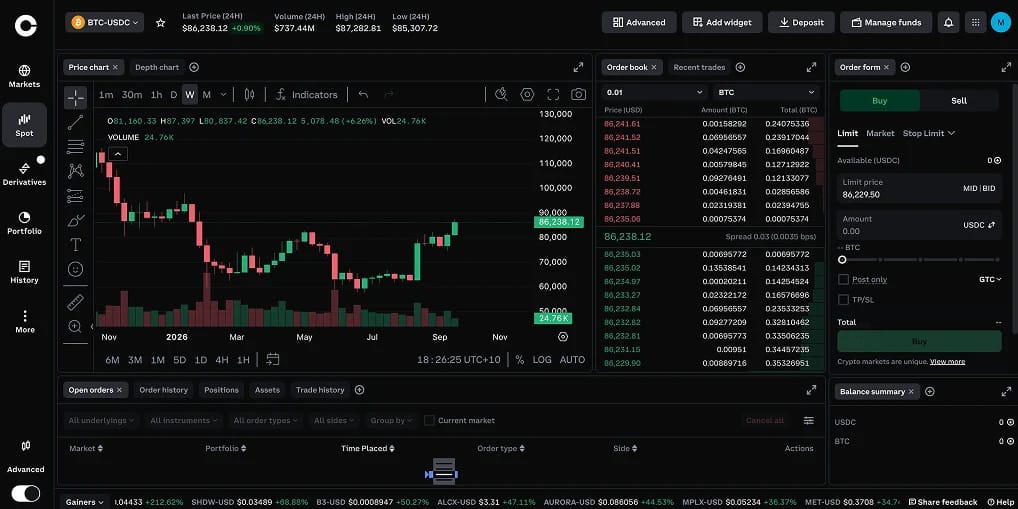
The cheapest route to Bitcoin you can withdraw is to let Coinbase pull an ACH transfer from your Ally Spending Account, then place a limit order on Coinbase Advanced. The transfer is free on both sides. A limit order that rests on the order book incurs a 0.40% maker fee with no spread.
Steps to buy crypto with Ally Bank:
- Open and verify a Coinbase account: Register at Coinbase using a government ID, your Social Security number, and a US address. Your legal name must exactly match the Ally account. A mismatch sends the bank link to manual review for up to three business days.
- Link your Ally Spending Account: Open Settings, Payment methods, Add a payment method, then Bank account. Search for Ally and sign in with your Ally username and password. Approve the security code Ally sends. Our Plaid guide explains what information the exchange receives through this connection.
- Check both sets of limits: Find your Coinbase ACH deposit limit under Payment methods. Ally displays its limit in the app when you move money and publishes no fixed figure. During a new Ally account's first 90 days, wires also carry a $25,000 cap.
- Add cash: Choose Add cash in Coinbase, enter an amount, and select your Ally account. The dollars are normally available to trade immediately, but a separate hold determines when you can send the resulting coins off the platform. Keep enough money in Ally until the debit posts. A returned ACH costs $30.
- Buy on Coinbase Advanced: Switch to Advanced and open BTC-USD or another market. Place a limit order below the current price to pay the 0.40% maker fee with no spread. On the simple buy screen, Coinbase adds both a fee and a markup, called a spread, to the quote. Simple limit orders carry a separate 1% execution charge.
If your same-day purchase exceeds the ACH limit, a domestic wire costs $20 at Ally and $10 to receive at Coinbase. The wire must clear Ally's review before 3 pm ET.
Fees, Tax and Transfer Limits for Ally Bank Customers
ACH deposits carry no Ally fee. Purchase costs sit with Coinbase, while tax obligations fall under IRS rules. Ally's transfer rules affect timing and the caps on new accounts.
Ally Bank costs and limits
- ACH transfers: Transfers to and from other institutions are free. Standard delivery takes around three business days, with a Next Day option for established accounts. Failed transfers incur a $30 returned ACH fee.
- ACH limits: There is no published fixed dollar cap. Under Ally's deposit agreement, the limit is disclosed online, in the app, or by phone when you make a transfer. It rises with account age, balance, and history.
- 90-day wire cap: Total outgoing wires are capped at $25,000 during the first 90 days after opening your first Ally account. Exceptions are available on request.
- Domestic wires: Each wire costs $20. Requests reviewed before 3 pm ET leave by 6 pm ET that business day. Ally processes none on weekends or holidays and sends no international wires.
- Debit card: After an account reaches 30 days old, purchases are capped at $5,000 a day. Newer customers have a $2,000 daily limit, which Ally can reduce to $500. Coinbase's 3.99% card fee makes this route worthwhile only when coins must leave the same day.
- Savings and Money Market: Certain withdrawals count toward a limit of ten per statement cycle. Use the Spending Account to fund an exchange.
- Zelle: Payments are limited to individuals. Coinbase does not accept Zelle deposits.
- Credit cards: Ally's cards moved to the Ollo brand under Merrick Bank. Coinbase does not accept credit cards from US customers.
- FDIC: Ally deposits have insurance up to $250,000 per depositor, per ownership category. That coverage does not extend to balances held on an exchange.
Coinbase fees and holds
- ACH in and out: Free in both directions. Settlement takes one to five business days, although deposits are normally available to trade immediately.
- Cash deposit hold: Held cash can be traded, but assets bought with it cannot be withdrawn until the hold expires. Older accounts with clean histories receive shorter holds. Support cannot release funds early.
- Wire: Incoming wires cost $10 and outgoing wires $25. Both fees are waived for Coinbase One Preferred and Premium subscribers.
- Debit card: Each purchase costs 3.99%, with the crypto immediately available to send.
- Advanced trading: Maker and taker fees are 0.40% and 0.60%, respectively, until 30-day volume reaches $10,000. Rates then fall to 0.25% and 0.40%. See our Coinbase fees guide for every tier.
- Simple trade: Quotes include a spread plus a variable fee. Simple limit orders add a 1% execution fee, which Coinbase One does not waive.
- Crypto withdrawal: Only the network fee applies, except for USDT withdrawals, which also incur a 0.01% processing charge capped at 20 USDT.
US tax on crypto
- Property treatment: The IRS classes digital assets as property. Selling, swapping or spending coins therefore creates a disposal that you must report. Gains on coins held for more than twelve months qualify for lower long-term tax rates.
- Form 1099-DA: Coinbase reports your gross proceeds to the IRS on this form. From this year, it also includes cost basis for coins bought on Coinbase, meaning the purchase price used to calculate your gain. Keep separate records for assets transferred from a wallet, as Coinbase does not have their purchase prices.
- Staking rewards: Rewards are ordinary income, valued in dollars when each payment is credited.
For a $5,000 purchase, Ally charges nothing and Coinbase Advanced costs about $20. Buying the same amount by debit card costs roughly $200 before the order fills.
Best Exchanges for Ally Bank Customers
Ally supports ACH payments to any licensed exchange. Your choice therefore depends on fees, state coverage, and withdrawal holds. Coinbase serves all states, including New York, while Kraken offers lower Pro fees but imposes a week-long hold on ACH-funded withdrawals.
Gemini operates under a New York trust charter, and Robinhood keeps crypto alongside stocks. Our best crypto exchanges in the USA ranking covers the full field.
Bitcoin ETFs Through Ally Invest
You can gain exposure to Bitcoin's price through Ally Invest without leaving your Ally login, though you never receive Bitcoin itself. A Self-Directed Trading account offers commission-free trading in US-listed shares, including spot Bitcoin ETFs such as the iShares Bitcoin Trust (IBIT) and Grayscale Bitcoin Trust (GBTC).
Available investments also include futures-based funds such as the ProShares Bitcoin Strategy ETF (BITO) and crypto-linked stocks such as Coinbase (COIN). Ally's cryptocurrency page identifies trusts, futures funds, and stocks as its three supported forms of exposure.
Assets bought through Ally Invest cannot be sent to a hardware wallet, staked, or converted into stablecoins. Orders fill only during US market hours. Funds also charge management fees that do not apply to coins held on an exchange. To compare funds with direct ownership, our Bitcoin ETF tracker shows daily inflows and outflows for each product.
Transfers between Ally Bank and Ally Invest are free. If you send a wire to an Ally Invest account, Ally refunds the $20 wire fee within two business days.
Ally Bank Cryptocurrency Policy
Ally has no crypto product to govern, publishes no crypto policy, and has announced no plans to launch one. Exchange payments remain unrestricted in practice. They undergo the same fraud screening as other external payments, with no merchant type singled out for refusal.
Regulatory restrictions have also eased over the past 18 months. Ally Bank is a Utah-chartered state member bank supervised by the Federal Reserve. In 2022, the Fed instructed state member banks to notify it before starting any crypto-asset activity. It withdrew that letter on April 24, 2025, along with the joint 2023 statements that had warned banks off the sector. Ally can now offer custody or trading under ordinary supervision but has so far chosen not to.
Licensing for the exchange side of a transaction operates at state level. The New York Department of Financial Services granted Coinbase, Inc. a virtual currency license in January 2017. Coinbase also holds money transmitter licenses in other states that require them and is registered with FinCEN, the Treasury unit responsible for policing money laundering.
The GENIUS Act now provides federal law for stablecoins. Federal exchange rules would come through the CLARITY Act, but that bill failed to clear a Senate procedural vote on September 15 despite passing the House. Exchanges therefore remain subject to a patchwork of state licenses and federal registration.
About Ally Bank
Founded in August 2004 as GMAC Bank, Ally Bank was the Utah-chartered deposit-taking arm of General Motors' finance company. It adopted the Ally name in May 2009 during GMAC's restructuring with US Treasury support after the financial crisis. The parent became Ally Financial the following year, listed on the New York Stock Exchange in April 2014, and saw the Treasury sell its remaining shares that December.
With roughly $185 billion in assets and $156 billion in deposits, Ally ranks among the country's two dozen largest banks. It operates without branches from a single office at 200 West Civic Center Drive in Sandy, Utah.
Customers use the app and website for banking, with phone support available around the clock. Cash withdrawals are available through Allpoint ATMs, and Ally refunds up to $10 in out-of-network ATM fees each statement cycle. Its checking product is the Spending Account, offered alongside Savings, Money Market, and CD accounts.
Detroit-based Ally Financial remains one of the largest US auto lenders. Ally Bank is a Member FDIC and is supervised by the Federal Reserve and Utah Department of Financial Institutions. Ally Invest Securities LLC is a FINRA member and SIPC participant.
Bottom Line
Ally places few obstacles between customers and licensed exchanges. Transfers work like other payments, without a separate crypto allowance or card block, and ACH limits grow with the account. The only restrictions are the 90-day wire cap and lower initial debit card limit, both of which expire automatically.
We recommend Coinbase for its licensing in every state, including New York, and free funding from an Ally Spending Account. Match your legal name across both accounts and use a resting limit order on Advanced instead of the Buy screen. Before scheduling a transfer to your own wallet, allow the deposit hold to expire. Our Coinbase review covers the platform in full.