
How to Buy Bitcoin & Crypto with Bank of Melbourne
Summary: Bank of Melbourne customers can buy Bitcoin by sending AUD via PayID or bank transfer to an AUSTRAC-registered crypto exchange. You cannot buy crypto inside the Bank of Melbourne App or Internet Banking.
Bank of Melbourne runs on Westpac Group infrastructure, which means Westpac’s cryptocurrency blocks and scam-detection tools apply here too. The default daily transfer limit is $5,000 per payee, and Osko payments to a PayID are capped at $5,000 per transaction.

Top Crypto Platform for Australian Banks
CoinSpot is the best crypto exchange for Australian bank customers because it supports free AUD deposits from all major banks and offers low trading fees starting from 0.1%.
Available Assets
500+ Cryptocurrencies
AUD Deposit Methods
Bank Transfers, PayID, BPAY, Cards & Cash
Regulation
Registered with AUSTRAC in Australia
Can I Buy Bitcoin with Bank of Melbourne?
Yes, but not through the Bank of Melbourne App or Internet Banking. There is no in-app crypto trading, so the purchase happens on a separate platform. The best route is sending AUD from your Bank of Melbourne account to a crypto exchange in Australia registered with AUSTRAC.
We tested transfers from a personal Bank of Melbourne account. PayID to CoinSpot settled almost instantly without friction. A standard bank transfer cleared within a few hours on a business day.
One thing to know upfront: Bank of Melbourne is a Westpac Group subsidiary. It shares the same fraud monitoring and scam-protection tools as Westpac. That means the crypto blocks that Westpac applies to certain high-risk exchanges also apply to Bank of Melbourne customers.
We would not assume every exchange will work smoothly. Payments to trusted AUSTRAC-registered platforms go through cleanly. Payments to unregistered or offshore exchanges are far more likely to be declined or held.
How to Buy Crypto with Bank of Melbourne
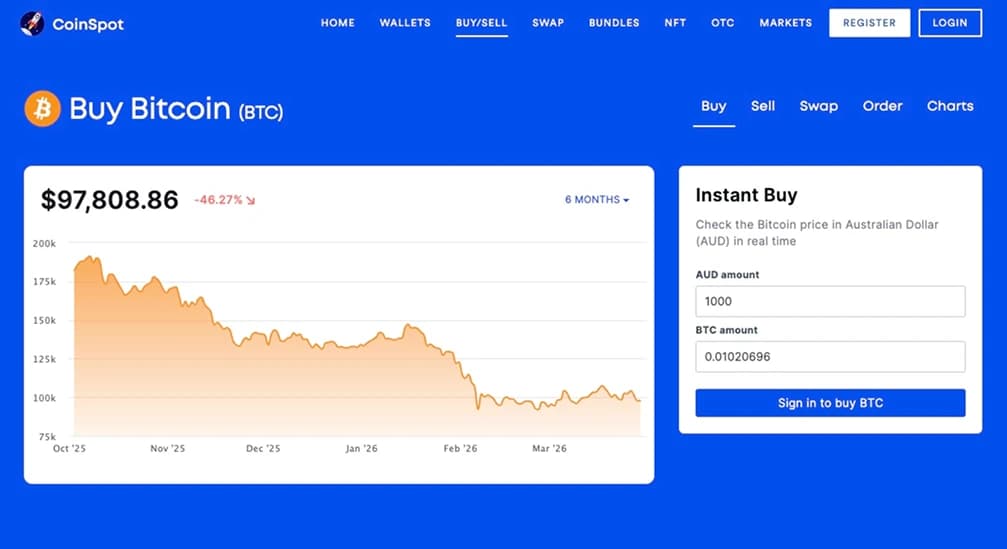
When we buy crypto from a Bank of Melbourne account, we use CoinSpot. It is a local exchange with AUSTRAC registration, 500+ assets, and it accepts PayID from Bank of Melbourne without extra steps.
PayID is the fastest way in. We set it up in the Bank of Melbourne App in under a minute using a mobile number, and the first transfer landed in CoinSpot almost immediately. Bank transfer works as a fallback, and BPAY is also an option if you prefer it.
Here is how to start:
- Account Setup: Create your CoinSpot account and finish the KYC identity check before sending money, so your deposit is not stuck waiting for verification.
- Fund Account: Open CoinSpot, tap Deposit Funds, and load the AUD deposit instructions for your chosen method.
- Select Payment Method: Use PayID first for speed. In the Bank of Melbourne App, go to Transfer & Pay, select PayID, and enter the details CoinSpot provides. Verify the registered payee name before confirming.
- Buy Crypto: Once the AUD arrives, open Buy/Sell and purchase Bitcoin, Ethereum, USDT, or any other listed asset.
Fees and Deposit Limits for Bank of Melbourne Customers
When we use Bank of Melbourne to buy crypto, the goal is simple: send AUD by PayID or bank transfer to an AUSTRAC-registered exchange. That route is cheaper than card deposits, which attract extra fees or risk being declined.
Deposits and limits
- Default daily limit: Bank of Melbourne defaults to $5,000 per payee per day via Internet Banking or the Bank of Melbourne App. This is a cumulative total for all payments made to that payee and PayID combined.
- Maximum daily limit: You can request an increase up to $100,000 per payee through Internet Banking. To do this, you will need to enter your Secure Code to authenticate the change.
- Cumulative daily limits: If you log into Internet Banking with your personal access details, a cumulative daily limit of $25,000 applies across all payees. Business customers logging in with company credentials get a $1 million cumulative daily limit.
- Scam-triggered limits: Bank of Melbourne notes that there are times when the bank may detect activity consistent with scams and introduce a lower payment limit to some payees or payment types.
Trading and withdrawals
- Deposit fees: On CoinSpot, PayID and direct AUD deposits are free. Card deposits cost 1.88%, PayPal 0.5%, and cash 2.5%. Bank transfer is almost always the cheapest option for Bank of Melbourne users.
- Trading fees: CoinSpot charges 1% on instant buy/sell/swap orders, while market orders cost 0.1%. We check the fee at the order screen before confirming. The gap between 0.1% and 1% adds up fast on larger buys.
- Withdrawals back to Bank of Melbourne: CoinSpot says AUD withdrawals to Australian bank accounts are free. First withdrawals may take up to one business day; later ones are usually faster.
If a Bank of Melbourne payment fails or is held, we check three things first: whether the transfer exceeds the daily or per payee limit, whether the payee name matches exactly, and whether Westpac Group's fraud detection flagged the payment. Fixing one of those usually clears it.
Bank of Melbourne Cryptocurrency Policy
Bank of Melbourne does not publish a standalone crypto policy page. The practical rules come from its parent, Westpac Group, which applies the same scam-detection infrastructure across all four of its banking brands: Westpac, St.George, Bank of Melbourne, and BankSA.
Westpac Group introduced cryptocurrency blocks for payments to certain digital currency exchanges in mid-2023 as part of its anti-scam strategy. Those blocks apply to Bank of Melbourne customers too.
What this means in practice:
- Bank transfers and PayID to exchanges registered with AUSTRAC are not blocked by default. Payments to trusted local platforms like CoinSpot, Kraken, Swyftx, and Independent Reserve should settle without issue.
- Payments to unregistered or high-risk exchanges may be automatically declined. Westpac does not publish a list of blocked platforms, but user reporting consistently points to offshore exchanges being affected.
Some third-party sources report that Westpac imposes a $ 10,000 monthly cap on payments to crypto exchanges. While we could not confirm this specific cap in Bank of Melbourne's own documentation, it is worth being aware of if you are planning larger monthly transfers.
Best Crypto Exchanges for Bank of Melbourne Customers
When we fund crypto from Bank of Melbourne, we focus on AUSTRAC-registered exchanges that accept PayID and AUD bank transfer. Those methods work most reliably without triggering avoidable payment blocks from Westpac Group's fraud systems.
See the table below for the exchanges we rate most highly for Bank of Melbourne users.
About Bank of Melbourne
Bank of Melbourne is a financial institution operating in Victoria, Australia. It is a wholly owned subsidiary of Westpac Group and commenced operations in its current form on 25 July 2011, when Westpac relaunched the brand by rebadging the Victorian business of St.George Bank.
The original Bank of Melbourne was established in 1989 after RESI Statewide Building Society received a banking licence. Westpac acquired the bank in 1997 for $1.43 billion and retired the brand in 2004, before reviving it in 2011 as a regional brand focused on Victoria.
.webp)
Final Thoughts
Bank of Melbourne works well for crypto funding when you use the right method: send AUD by PayID or bank transfer to an AUSTRAC-registered exchange, check your daily and per-payee limits cover the size, and start with a small test deposit before going larger.

.webp)
.webp)
.webp)
