Can I Buy Bitcoin with ING?
Yes, in two ways. The first is ING's own crypto ETPs. On 22 January 2026, ING Netherlands and Belgium added five products to Self Invest: WisdomTree Physical Bitcoin, Ethereum, Solana and XRP, plus the iShares Bitcoin ETP from BlackRock. A mandatory knowledge test (kennistoets) applies before first trade.
ING-DiBa in Germany went broader on 2 February 2026, opening its Direct Depot to around 50 crypto ETPs and ETNs from Bitwise, VanEck, WisdomTree, BlackRock and 21Shares. Coverage runs from Bitcoin and Ethereum through Solana, XRP, Algorand, Avalanche, Chainlink, Polkadot and Polygon.
The second path is a SEPA transfer to a MiCA-licensed exchange, then spot buy. ING doesn't block payments to regulated CASPs in any of its three main EEA markets. The ETPs track price but you don't own the coin: no wallet withdrawals, no staking, no on-chain use. For direct ownership, the exchange option is the only one that works.
How to Buy Crypto with ING
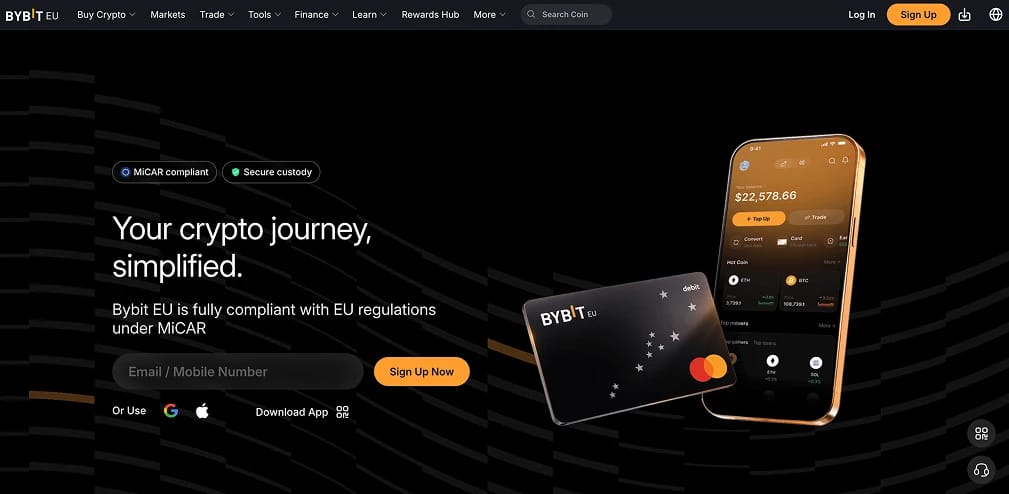
A SEPA transfer from ING to Bybit is the cheapest path to actual Bitcoin or Ethereum. Both legs are free, SEPA Instant settles in seconds, and Bybit charges 0.10% on spot.
Steps to buy crypto with ING:
- Create a Bybit account: Sign up on Bybit and complete KYC. Dutch ID card, Belgian eID, or German Personalausweis all work through Bybit EU GmbH under Austria's FMA.
- Get the SEPA details: In Bybit go to Buy Crypto > Deposit > EUR and select SEPA. Copy the IBAN, beneficiary name (Bybit EU GmbH), and payment reference exactly. A typo in the reference is the single most common reason a deposit sits in manual review.
- Raise your ING limit first: The Netherlands app default is €2,000 per day, cut from €5,000 in February 2023, with a four-hour cooldown after every increase. Belgium and Germany each apply their own defaults inside Home'Bank / ING Smart Banking and the ING-DiBa app respectively. Raise it before you need it.
- Send the SEPA transfer: Create a new transfer with Bybit's IBAN. First transfers to a new counterparty usually trigger an extra in-app confirmation. Under the EU Instant Payments Regulation, ING must support outgoing SEPA Instant across all euro countries since October 2025, so most transfers clear in seconds.
- Buy the crypto: Once EUR hits your Bybit Funding wallet, move it to Spot and search BTC/EUR, ETH/EUR, or your preferred pair. I use limit orders above a few hundred euros because Instant Buy builds a wider spread into the quoted price than 0.10% spot.
ING Crypto ETPs vs Buying Crypto on an Exchange
ING's ETP launches are convenient inside a brokerage account, but the trade-offs against direct ownership are material:
- No ownership: You hold a security that tracks crypto's price, not the coin. No sending to Ledger, no staking, no stablecoin use.
- Stacked costs: Fund TER runs 0.15% to 0.25% (BlackRock's iShares Bitcoin ETP at 0.15% through end of 2026 before rising to 0.25%) plus platform fees. Dutch and Belgian Self Invest customers pay €1 + 0.10% per trade on top of a €20 basisfee and 0.24% servicefee. Germany's Direct Depot is commission-free on Bitwise orders ≥€1,000 and €3.90 below.
- Counterparty risk: ETPs are securities backed by the issuer. WisdomTree, BlackRock, Bitwise and VanEck hold the underlying coins in cold storage via regulated custodians, but an issuer default still affects the product independent of the coin's price.
- Limited selection: Five products in Netherlands and Belgium, around 50 in Germany, against 2,000+ on Bybit.
The ETP product fits if you want exposure inside an existing Self Invest account and never plan to withdraw. For direct ownership, staking, or anything beyond the listed set, SEPA to Bybit is cheaper and more flexible.
Fees and Transfer Limits for ING Customers
Costs split between the ING transfer leg and the exchange leg. The transfer leg is where first-time buyers get stuck.
ING costs and limits
- Standard SEPA: Free across all three countries, 1 to 2 business days across the SEPA Zone.
- SEPA Instant: Free, seconds to settle. ING participates in the scheme and must support outgoing instant payments across the euro zone since October 2025.
- Transfer limits: Netherlands default is €2,000 per day in-app, adjustable to €50,000 online and €1 million at a branch. Belgium and Germany apply their own defaults configurable in the local app.
- Card deposits on exchanges: ING Visa and Mastercard work, but gateway surcharges run 1.5% to 3.5%. I only use cards for small test deposits.
- AML checks: ING is supervised by the AFM and DNB in the Netherlands, the FSMA and NBB in Belgium, and BaFin in Germany. Inbound transfers above €10,000 can trigger a source-of-funds request. Exchange statements clear these in a few days.
Bybit costs
- SEPA deposit: Free.
- Spot trading: 0.10% maker / 0.10% taker at the standard tier.
- Crypto withdrawal: Network fee only. USDT on Tron (TRC-20) is usually under a dollar.
- EUR withdrawal via SEPA: Free or minimal flat fee.
Free SEPA plus 0.10% spot is materially cheaper than the ETP stack at any realistic size, and you own crypto you can actually withdraw.
Best Exchanges for ING Customers
Dutch, Belgian and German users have several MiCA-licensed alternatives, including an Amsterdam-based option that was among the first through AFM's MiCA process.
ING Cryptocurrency Policy
ING's position has shifted materially across its three EEA retail markets. The bank doesn't offer direct spot trading, custody or wallet services, but it now provides indirect exposure via ETPs in all three countries and allows unrestricted SEPA transfers to MiCA-licensed exchanges.
At group level, ING is part of a European bank consortium working on a euro stablecoin, running alongside the European Central Bank's digital euro project. ING Wholesale Banking has been active in tokenisation pilots for several years.
The regulatory backdrop changed on 30 December 2024 when MiCA came into force across the EU. Each ING market has its own CASP supervisor: the AFM in the Netherlands, the FSMA in Belgium, and BaFin in Germany.
Bitvavo received its Dutch MiCA licence in June 2025 and Bitpanda holds German BaFin authorisation. Full MiCA enforcement for all CASPs lands on 1 July 2026.
About ING
ING Group is headquartered in Amsterdam and ranks among Europe's largest banks, serving around 40 million retail and business customers across the Netherlands, Belgium, Germany, Luxembourg, Australia, Spain, Italy, Poland and Romania. The group is supervised by the European Central Bank under the Single Supervisory Mechanism.
Dutch customers bank via Mijn ING and the Mobiel Bankieren App, with Zelf op de Beurs for brokerage. Belgian customers use Home'Bank and ING Smart Banking, with Self Invest for securities. ING-DiBa in Germany is the country's largest direct bank with around 9 million customers, offering Girokonto accounts and Direct Depot brokerage, which now lists roughly 50 crypto ETPs and ETNs.
.webp)
Bottom Line
ING customers in the Netherlands, Belgium and Germany have two real options: the new crypto ETPs inside Self Invest or Direct Depot if you want exposure through your brokerage account with no wallet management, or SEPA to a MiCA-licensed exchange if you want to own Bitcoin directly.
On cost, asset range, and real ownership, the exchange path wins. Spot fees of 0.10% at Bybit sit well below any of the ETP fee stacks, and SEPA transfers from ING to Bybit are free on both sides. Bybit EU is MiCA-licensed by Austria's FMA and passported into all three ING markets, which closes the regulatory question that applied to non-EU exchanges until mid-2025.
Raise your ING daily limit in your local banking app before your first transfer. The cooldown after an increase will delay any urgent buy, and the defaults in all three countries are low enough that most first-time buyers hit them immediately.