



Can I Buy Bitcoin with Alipay?
Yes, though not through anything Ant Group operates. After the People's Bank of China summoned it alongside four state banks in June 2021, the company pledged a monitoring system that blacklists merchants involved in virtual currency. What survives is peer-to-peer trading, where you pay a seller's personal Alipay account and an exchange holds the crypto in escrow so neither side can vanish mid-trade.
That P2P market prices in yuan and sits inside the September 2021 notice from the PBOC and nine other bodies declaring every crypto business activity illegal, offshore exchanges serving mainland residents included. Trading here runs against local law and Alipay's own screening, which is why experienced sellers write careful terms.
Hong Kong sits on different legal ground. AlipayHK is a separate Hong Kong dollar wallet, and the city licenses crypto trading through the SFC's platform regime. Those licensed venues onboard by bank transfer and FPS rather than e-wallet, so the compliant path bypasses Alipay altogether. Our Hong Kong exchange guide covers that side. Choose Alipay and you are trading the mainland yuan book.
How to Buy Crypto with Alipay
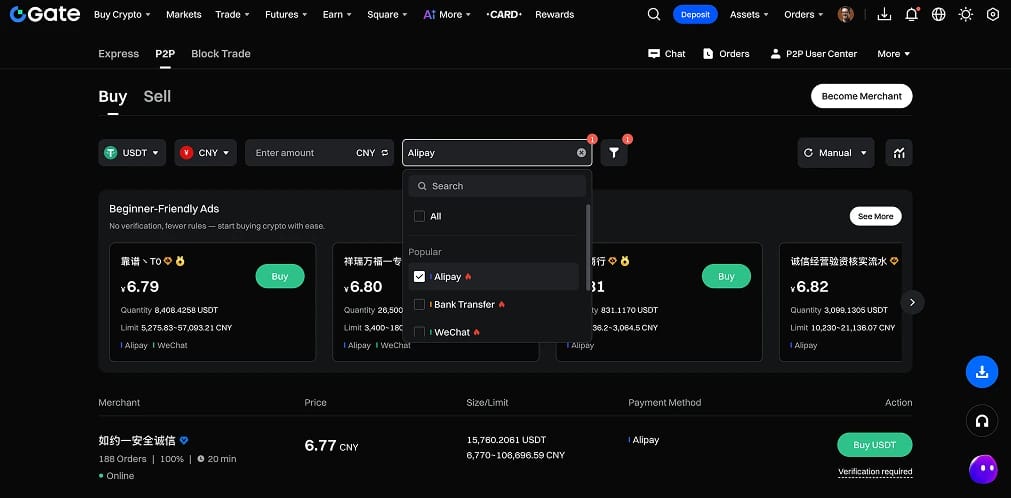
On Gate the trade runs through the P2P marketplace, a USDT and CNY order book filtered to merchants who list Alipay. The crypto stays locked in platform escrow until your payment lands. Our last test order for 500 USDT released in under ten minutes, and the seller's terms required payment from an Alipay account matching our verified exchange name.
Steps to buy crypto with Alipay:
- Create an account: Sign up on Gate and complete identity verification (KYC) with your ID. P2P stays locked until KYC passes, and the name on your Alipay real-name profile must match your Gate account or sellers will refuse the payment.
- Open P2P and filter for Alipay: Go to Buy Crypto and select P2P, pick USDT, set the fiat currency to CNY, and choose Alipay as the payment method. Set it before browsing, since sellers only accept the method on the order.
- Choose a seller carefully: Sort by completion rate and total orders, then read the terms line by line. Many Alipay merchants demand payment from your own real-name account, ban corporate accounts, and refuse transfers arriving with any remark attached.
- Pay through Alipay and confirm: Place the order, open Alipay, and transfer the exact amount to the seller's account or QR code. Leave the note field empty, since a coin name typed into a memo is enough to freeze an account. Tap Paid on Gate once the transfer sends.
- Buy your asset: The seller releases USDT from escrow into your funding account. Move it to spot, search BTC/USDT or your preferred pair, and place a limit order, which avoids the wider spread built into the one-click buy screen.
Fees, Limits and the Freezing Risk for Alipay Users
Visible fees on this trade are close to zero. What decides your outcome are Alipay's transfer ceilings, the risk-control engine watching every payment, and the freezing exposure that follows crypto-linked yuan.
Alipay costs and limits
- Transfers to another user: Free through the app, and the ceiling follows the payment method behind them. Web transfers cap at 20,000 yuan per day, and moving money onward to a bank card runs to 50,000 yuan per transaction.
- Verification tiers: Yearly balance-payment allowances scale with how much identity proof sits behind an account. A fully verified account bound to your bank card clears the most headroom, so finish verification before a larger order.
- Funding source: Pay sellers from a balance topped up by your own bank account. Money arriving from someone else's card or a business account is what risk control flags first, and most sellers reject it anyway.
- Foreign cards: Visitors who bind an overseas Visa or Mastercard get merchant payments capped at 5,000 US dollars per transaction and 50,000 a year, and that tier covers shop QR codes rather than personal transfers, so it does not reach P2P sellers.
- No reversal: An Alipay transfer settles instantly and cannot be recalled, so the exchange escrow matters. Never pay outside the platform, whatever a counterparty proposes.
Gate costs
- P2P trades: Free on both sides of the trade.
- Spot trading: 0.20% standard, cut by GT holdings or volume tiers.
- One-click buy: A spread hides inside the quote. Acceptable for a small first purchase, costly at size.
- Crypto withdrawal: Network fee only. USDT on Tron (TRC-20) usually costs about a dollar.
The freezing risk
Frozen accounts are the real cost of this market. Mainland banks and police screen for virtual currency money, and an Alipay wallet or linked card that receives tainted funds can be frozen while you prove the money is clean, which can take weeks. Because sellers recycle the same receiving accounts across hundreds of trades, one bad counterparty upstream can freeze buyers downstream who did nothing wrong.
Our defences are boring and effective. Trade through escrow only, keep single orders small, pick sellers with long clean histories, and never let a memo, nickname, or chat message mention crypto. Gate's broader record, including its licensing footprint and past security incidents, is covered in our Gate review.
Best Exchanges for Alipay Users
No major exchange takes Alipay as a direct deposit method, so every real option is a CNY P2P desk where sellers list it. The comparison that matters is order book depth, escrow quality and seller vetting, and Gate leads on the first while matching the rest.
Alipay Cryptocurrency Policy
Alipay's policy is prohibition enforced by software. After the 2021 PBOC meeting, Ant Group committed to detecting crypto-related transactions and banning any merchant caught dealing in them, and its risk-control engine has flagged suspicious payment patterns ever since. Personal accounts that repeatedly receive trade-sized transfers from strangers face limits, forced verification, or closure.
The legal base is the September 2021 Notice, which declared all virtual currency business activity illegal, barred non-bank payment institutions from providing any crypto-related service, and reached offshore exchanges serving mainland residents. Holding coins is not itself criminalised, which is the gap the P2P market lives in, but the payment you send through Alipay sits squarely inside the prohibition.
Hong Kong runs the mirror-image regime. The SFC has licensed virtual asset trading platforms since June 2023 under the Anti-Money Laundering Ordinance, with retail access allowed under investor-protection rules, while AlipayHK operates under a Monetary Authority stored-value licence that sits outside the crypto regime. Legal buying there happens on licensed venues funded by bank transfer, without either Alipay wallet involved.
About Alipay
Alipay is the payment platform of Ant Group, the Alibaba affiliate based in Hangzhou, and serves more than a billion users. It began in 2004 as an escrow service protecting Taobao shoppers and grew into mainland China's default money layer. It splits mobile payments with WeChat Pay, holds yuan balances against real-name verified bank cards, and answers to the People's Bank of China. Yu'ebao, its in-app money market fund, at one point ranked as the largest in the world.
The wider family stretches past the mainland. AlipayHK is a separate Hong Kong dollar wallet run under an HKMA stored-value facility licence (SVF0004) through a joint venture with CK Hutchison, and Ant International's Alipay+ network connects dozens of partner wallets across Asia for cross-border spending.
For the closest siblings in the same market, our guides on WeChat Pay and Bank of China map how the other two big yuan channels handle crypto.
Bottom Line
Buying crypto with Alipay means accepting what the trade really is, a yuan P2P purchase against the grain of both the platform and the law it answers to. There is no in-app product, no direct exchange deposit, and no version of this that Ant Group will not try to detect.
Gate earns the recommendation because its CNY Alipay book pairs depth with escrow, charges nothing on the P2P side, and opens 3,800+ assets once the crypto lands. Keep orders small, pay from your own verified account, write nothing in the transfer note, and pick sellers whose history runs long and clean. Hong Kong residents wanting the lawful version should skip Alipay and fund an SFC-licensed exchange by bank transfer instead.
Here the frozen account is the fee schedule, and everything above is how you avoid paying it.