




Can I Buy Bitcoin with PNC Bank?
Partly, and only if you sit in the right tier. On December 9, 2025, PNC announced direct spot Bitcoin trading on its digital banking platform. However, the service is only available for eligible PNC Private Bank clients, the bank's high-net-worth segment.
It is also narrow on assets. The product is Bitcoin-only, built on Coinbase's Crypto-as-a-Service rails, so Coinbase handles custody while PNC maintains the client relationship. That means the Bitcoin you buy is not FDIC-insured and may carry custody fees that PNC has not fully published.
For the typical PNC retail customer, the best route is the same one millions of Americans already use: open an account at a regulated exchange in the USA, send USD from your PNC account, and buy on the exchange side.
How to Buy Crypto with PNC Bank
Investing in cryptocurrency like Bitcoin, Ethereum, and Solana from a PNC account is a two-step system: move USD to a FinCEN-registered exchange, then buy on that exchange.
We use Kraken because the US entity is FinCEN-registered, it supports ACH, wire, PayPal, and debit card funding, and Kraken Pro at 0.4% / 0.8%.
Steps to buy crypto with PNC Bank:
- Create a Kraken account: Sign up on Kraken and complete Intermediate verification with your legal name, date of birth, SSN, and a state ID or passport.
- Link PNC via Plaid: In Kraken, go to Funding > Deposit > USD and choose ACH (Plaid). Sign in to PNC Online through the widget.
- Send the transfer: Letting Kraken pull the funds via Plaid is the standard path and is free on the PNC side. A first pull from a new payee usually triggers a PNC fraud text or a hold; approve it, and the deposit clears.
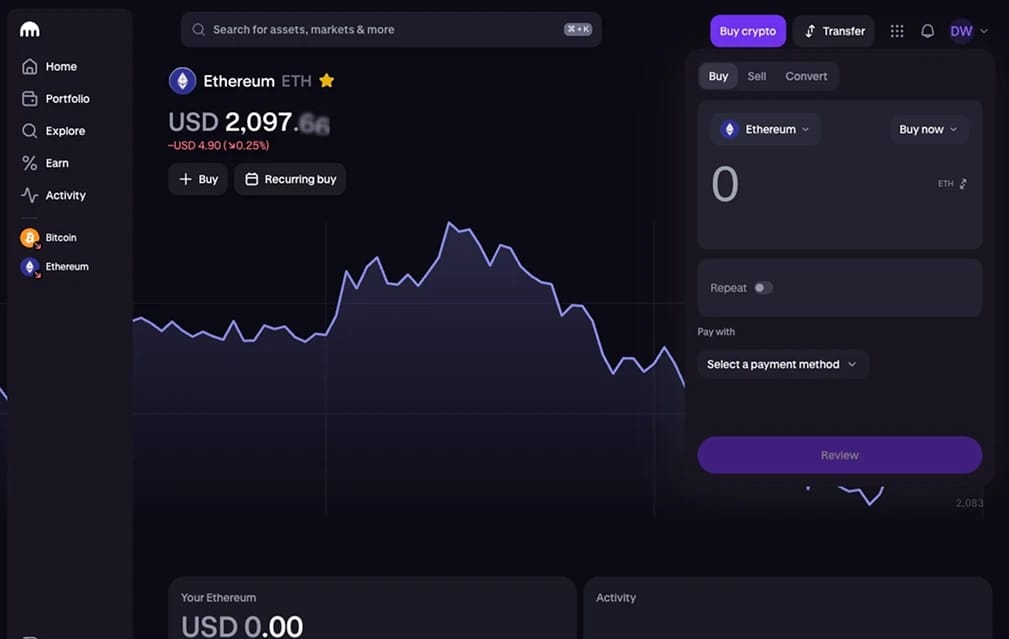
- Buy crypto: On Kraken Pro, search BTC/USD and place a limit or market order. On a $5,000 buy, the 0.40% taker fee on Pro is $20. The Instant Buy widget adds roughly 1.5%, or about $75, on the same trade.
Fees and Deposit Limits for PNC Bank Customers
There are two costs in this process: what PNC charges to move the money out, and what the exchange charges to deposit and trade. PNC holds most of the friction here, mainly because its outbound ACH cap is low for a bank this size.
PNC Bank Costs and Limits
Figures below are from PNC's Consumer Schedule of Service Charges and Fees, current for 2026. Limits are relationship-based, so confirm yours in PNC Online.
- Outbound ACH to a crypto exchange: Free, whether pushed from PNC or pulled by the exchange through Plaid.
- ACH and external transfer daily limit: PNC commonly caps outbound transfers at $2,000 to $2,500 per day on standard accounts, one of the lower limits among large US banks.
- Self-service domestic wire (online or mobile): $25 per outgoing wire, no minimum amount. Free for Performance Select Checking. Online domestic wires can run up to $50,000.
- Agent-assisted domestic wire (phone or branch): $50 per outgoing wire. Same-day settlement before the daily cutoff.
- Self-service international wire: $40 if sent in US dollars, $5 if sent in foreign currency, with a $100 minimum on USD wires. PNC also offers a cheaper International Money Transfer to select countries at $5 self-service or $10 agent-assisted.
- Debit card: $2,000 per day on PIN point-of-sale purchases, $5,000 per day on signature purchases. ATM withdrawals are capped at $500 per day.
Kraken Fees
- ACH deposit (Plaid): Free. Instant for trading. 7-day fiat-and-crypto withdrawal hold on the deposited amount.
- USD wire deposit (FedWire): Free on Kraken's side. You still pay the PNC outgoing wire fee. Same-day settlement, no withdrawal hold.
- Debit card deposit: 3.75% + $0.25 per transaction. I use this only for small first-time test deposits.
- PayPal deposit: 2.5% + $0.25 per transaction. A linked PNC account works as the underlying funding source.
- Spot trading on Kraken Pro: 0.4% maker / 0.8% taker at the base tier. Volume discounts begin at $50,000 in 30-day volume.
- Instant Buy: Around 1.5% added to the quoted price. Fine for sub-$100 test trades, expensive at scale.
The cheapest path for a PNC customer is a free ACH in, a Kraken Pro spot trade at 0.40% taker, and a free ACH out. Round-trip transfer cost is $0, and the total exchange cost on a $5,000 buy is about $20.
Best Exchanges for PNC Bank Customers
Every option below is registered with FinCEN, holds state money transmitter licenses where required, and accepts ACH or debit card funding from a PNC checking account.
PNC Bank Cryptocurrency Policy
PNC's posture changed sharply in late 2025. After announcing a partnership with Coinbase in July, PNC went live in December as the first major US bank to offer direct spot Bitcoin trading to clients, delivered through PNC Private Bank Online via Coinbase's Crypto-as-a-Service infrastructure.
The bank kept Bitcoin off its balance sheet and relied on Coinbase for custody and execution, an arrangement regulators have so far tolerated because deposits and crypto assets remain separate.
That makes PNC crypto-friendly for a traditional bank, but the day-to-day controls are still standard for a large US institution:
- Bank Secrecy Act reporting. Cash deposits or withdrawals at or above $10,000 generate a Currency Transaction Report. Activity flagged as unusual can prompt a Suspicious Activity Report at the bank's discretion, with FinCEN guidance treating crypto transfers as a higher-risk category.
- FinCEN registration of the receiving exchange. ACH and wire transfers to Money Services Businesses registered with FinCEN flow as normal payments. Transfers to unlicensed offshore platforms can be held or returned.
- OFAC screening. Standard on every outgoing payment, and tightest on international wires.
- Fraud monitoring. PNC's systems flag first-time and unusually large transfers to crypto exchanges and route them through text verification or a short hold before release.
One point worth repeating for anyone tempted by the Private Bank product: Bitcoin bought through PNC is not FDIC-insured, the same as Bitcoin bought on any exchange. The bank wrapper does not add deposit protection to the coin.
About PNC Bank
PNC Bank is headquartered at the Tower at PNC Plaza in Pittsburgh, Pennsylvania. Its roots reach back to 1845, and the modern PNC was formed in 1983 through the merger of Pittsburgh National Corporation and Provident National Corporation, the largest US bank merger of its time.
By balance sheet, PNC is one of the largest US commercial banks, with roughly $560 billion in assets, and is among the seventh-largest nationally. It runs about 2,300 branches across 27 states and Washington, D.C., concentrated east of the Mississippi.
Core personal products run on the Virtual Wallet system, pairing a Spend checking account with Reserve and Growth savings, alongside Standard, Performance, and Performance Select Checking. Customers manage it all through PNC Online and the mobile app, with Zelle built in.
.webp)
Final Thoughts
PNC is in a strange spot. It is the first big US bank to put real Bitcoin in front of clients, yet that door is open only to its wealthiest customers, and only for Bitcoin. For the rest of the customer base, buying crypto still means routing USD to a regulated exchange.
The cleanest funding path is letting the exchange pull the deposit via Plaid. The one thing to plan around is PNC's low daily ACH cap. When a buy runs past it, the $25 self-service wire (free on Performance Select) is the simplest workaround.
Kraken is the strongest overall fit for most PNC customers on cost, asset coverage, and US regulatory profile. Coinbase is a good alternative, since it is the same engine behind PNC's own Bitcoin product. Gemini suits anyone who wants a NYDFS-licensed company with free ACH funding.