






Compare the Best Danish Crypto Exchanges
1. Bybit
Bybit is the best crypto exchange for Danish investors thanks to its diverse product suite. It offers spot and margin trading with a flat 0.1% spot trading fee, plus copy trading, grid bots, demo trading, the Bybit card and Bybit Earn for passive yield. Bybit operates its European entity under a MiCA license held by Austria's FMA, so a Danish user signing up on Bybit.eu trades within a regulated EU framework.
We funded an account with a Danish Visa card and had a tradable balance within minutes, at a 1.5% card markup. A euro SEPA transfer is the cheaper path once you accept the kroner-to-euro conversion your own bank applies, and Apple Pay, Google Pay, and the P2P marketplace fill the gaps. There is no direct Krone bank transfer channel, which is the standard limitation across all exchanges here.
Two points deserve attention before committing. The layout pushes new users toward leverage faster than a plain spot screen would, so a first-time buyer should stay on the spot tab. Every swap also counts as a disposal under Danish tax rules, so export your trade history on a schedule rather than rebuilding a year of activity in spring. Our Bybit review covers the wider product set.
Pros
- The widest asset range of 2,800+ cryptocurrencies to trade with fees starting at 0.1%.
- Card, SEPA, Apple Pay, Google Pay, and P2P funding all work after verification.
- Bybit EU (Commercial Register no. FN 636180i) was granted authorization as a crypto-asset service provider under the Markets in Crypto Assets Regulation (MiCA).
Cons
- No direct DKK bank transfer, so funding runs through a card or a euro conversion.
- The user interface nudges beginners toward leverage and is intimidating at first.
- Frequent swaps create a long list of taxable disposals to track.
.webp)
2. Coinbase
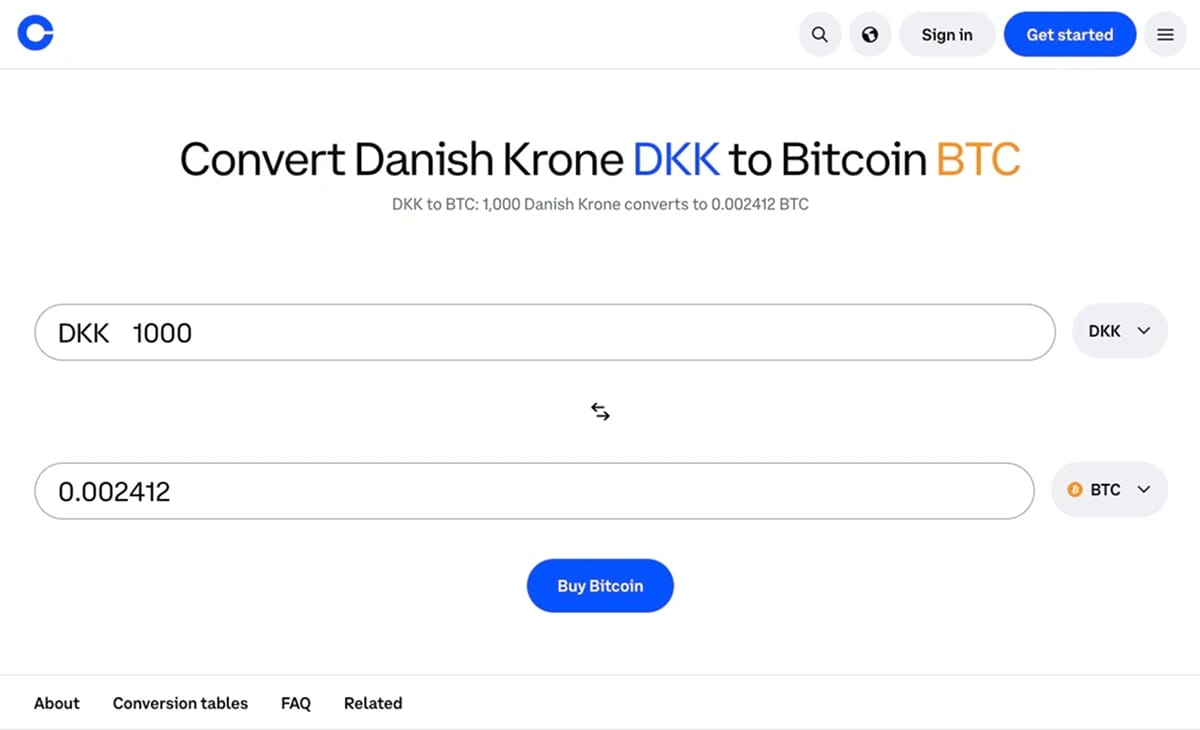
Coinbase is the simplest place to start, and it remains one of the most common first exchanges for Danish buyers. It is a Nasdaq-listed public company, holds a MiCA license through Luxembourg’s CSSF, and keeps onboarding short. We verified a Danish passport and selfie in under an hour, linked a euro SEPA transfer, and had a balance ready the next business day, with cards and mobile wallets available for faster top-ups.
The catch is the price. The one-tap simple-buy screen builds in a spread that can reach 1.5% or more, well above what a Danish user should pay. The fix is the Advanced Trade interface, where maker and taker fees drop to roughly 0.4% and 0.6% at entry volume and fall further as you trade more. Coinbase also ships robust tax-reporting exports, which lighten the spring filing burden in a country that scrutinizes crypto returns closely.
For a beginner who values a regulated, listed operator and a clean app over the lowest possible fee, Coinbase fits. Anyone trading regularly should switch to Advanced Trade from the first order and treat the simple screen as a convenience tax. Costs are broken down in our detailed Coinbase fees guide.
Pros
- Coinbase operates as a CASP under MiCA, overseen by the Commission de Surveillance du Secteur Financier (CSSF) under license #N00000004.
- The simplest onboarding and app among the larger venues here.
- Strong tax-export tools that ease Denmark's documentation burden.
Cons
- The simple-buy screen carries a spread that beginners often overpay.
- Fewer listed assets than Bybit or the order-book venues.
- No direct DKK funding, so euros or a card sit in the path.
3. Kraken
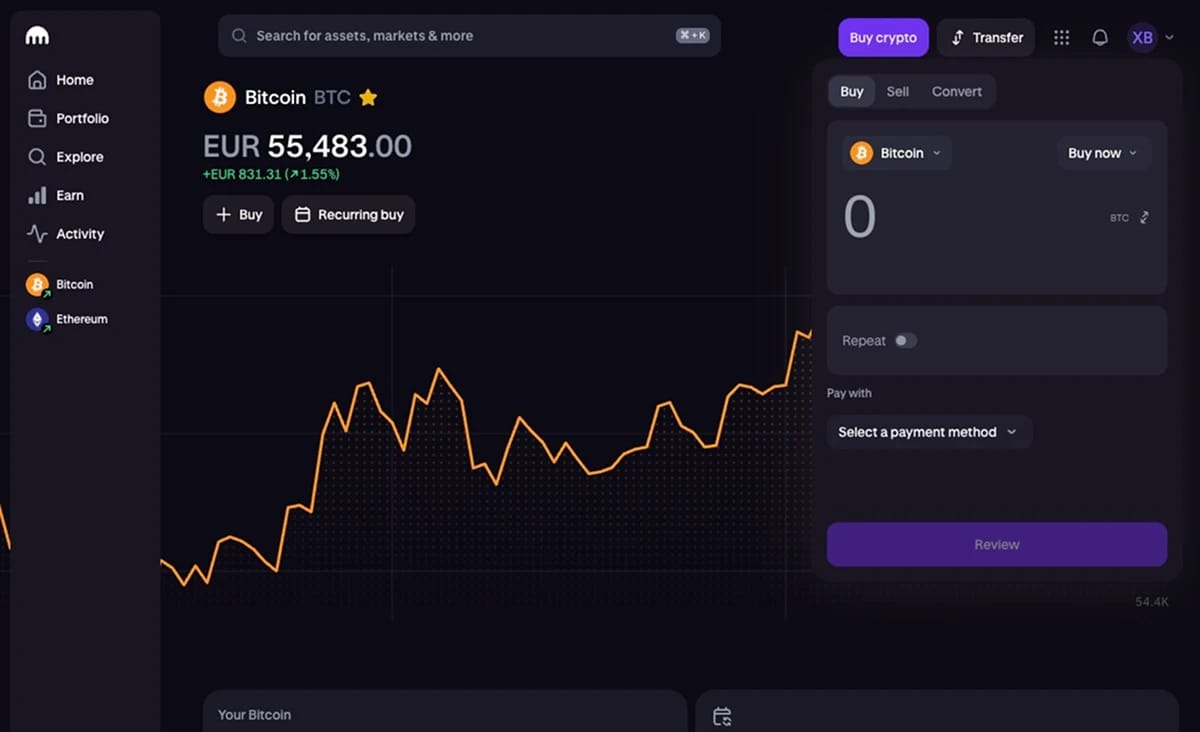
Kraken is the choice for anyone who ranks custody safety and clean records above raw asset count. The exchange has run since 2011 without a major breach, publishes Proof-of-Reserves attestations confirming client balances are fully backed, and holds a MiCA license from the Central Bank of Ireland that passports across the EEA. For a Danish saver, parking real money on an exchange rather than in self-custody carries weight.
The practical advantage for Denmark is the funding and the paperwork. Euro deposits via SEPA arrive free, and in testing, a transfer from a Danish account converted to euros at the bank landed as tradable funds the next business day. When it came time to prepare figures for the årsopgørelse, Kraken's CSV export mapped cleanly onto a FIFO calculation, which matters more in Denmark than almost anywhere else.
Kraken Pro lists 400+ assets at 0.40% maker and 0.80% taker on entry-tier volume, with staking and an OTC desk for larger orders. The full details about the products and features are in our Kraken review. The trade-offs are a conservative listing policy that skips many small caps and an instant-buy screen outside Kraken Pro that carries a spread a limit order avoids.
Pros
- A 14-year clean record of no security incidents with audited proof of reserves.
- Free euro SEPA deposits and CSV exports that suit Denmark's documentation-heavy filing.
- Kraken's Markets in Crypto-Assets (MiCA) license is registered with the Central Bank of Ireland (CBI) under Registration Number C468360.
Cons
- No direct Krone funding, so a euro conversion still sits in the chain.
- Cautious listings mean fewer altcoins than the largest venues here.
- Instant buys outside Kraken Pro carry a spread that punishes casual orders.
4. OKX
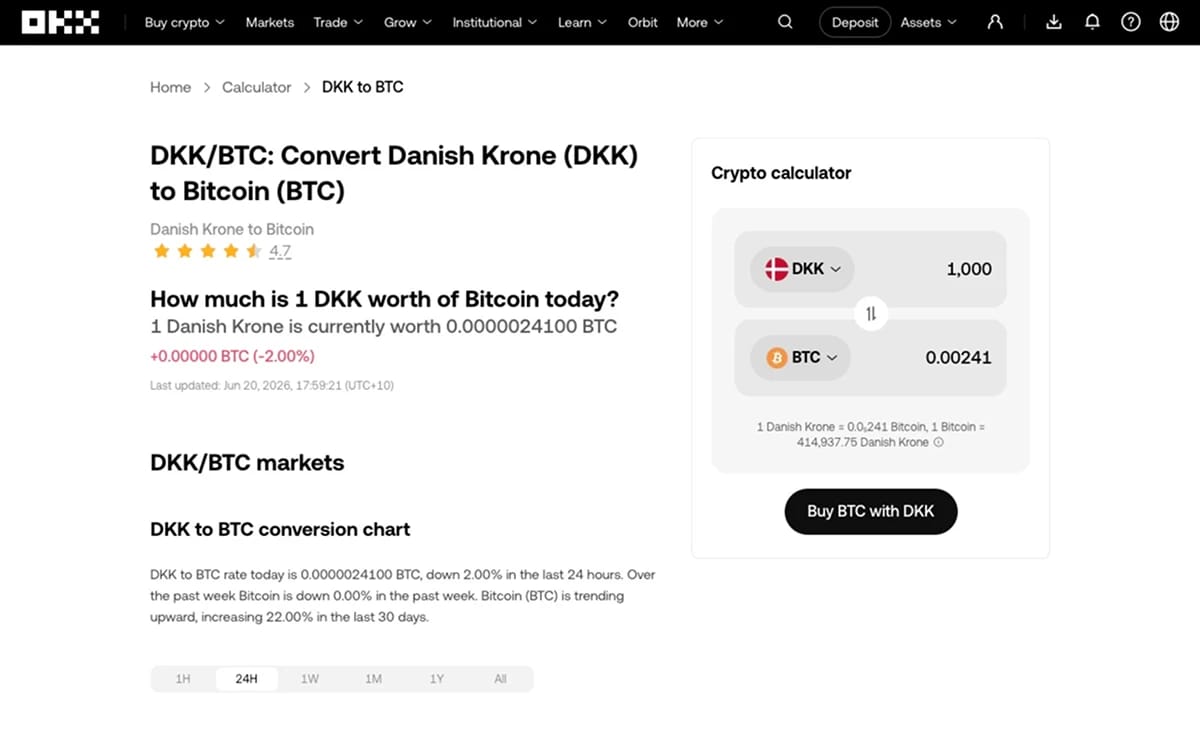
OKX is the cost leader and the pick for users ready to move past simple holding. Spot fees of 0.08% maker and 0.10% taker are the lowest among the licensed platforms serving Denmark, and the app bundles a self-custodial Web3 wallet that opens DeFi, DEX trading, and on-chain tokens without a separate install. OKX operates its EU service under a MiCA license issued by Malta's MFSA.
The krone reaches OKX through a Danish card or the P2P marketplace, since there is no direct bank channel. Our P2P test, settled by bank transfer, cleared escrow in roughly 10 minutes at a spread within 2% of the mid-market price, and a card top-up was instant at a higher markup. The exchange publishes monthly Proof-of-Reserves attestations and lists over 240 spot assets alongside a full derivatives suite.
There are a couple of downsides for Danish users. OKX settled with US authorities in early 2025 over anti-money-laundering failings, a mark the cleaner records on this list do not carry. The Web3 layer also adds complexity that a first-time spot buyer doesn’t need. If you want to learn about the exchange in detail, you can find more details in our OKX review.
Pros
- The cheapest order-book pricing among the licensed venues is at 0.08% maker and 0.10% taker.
- An integrated Web3 wallet for DeFi and DEX access from one app.
- OKX operates under a MiCA CASP Authorization granted by the Malta Financial Services Authority (MFSA) under registration number C88193.
Cons
- No DKK channel, leaving cards and P2P as the only krone entries.
- The 2025 US settlement weighs on an otherwise strong record.
- Web3 depth adds complexity that a simple spot buyer can skip.
5. Bitpanda
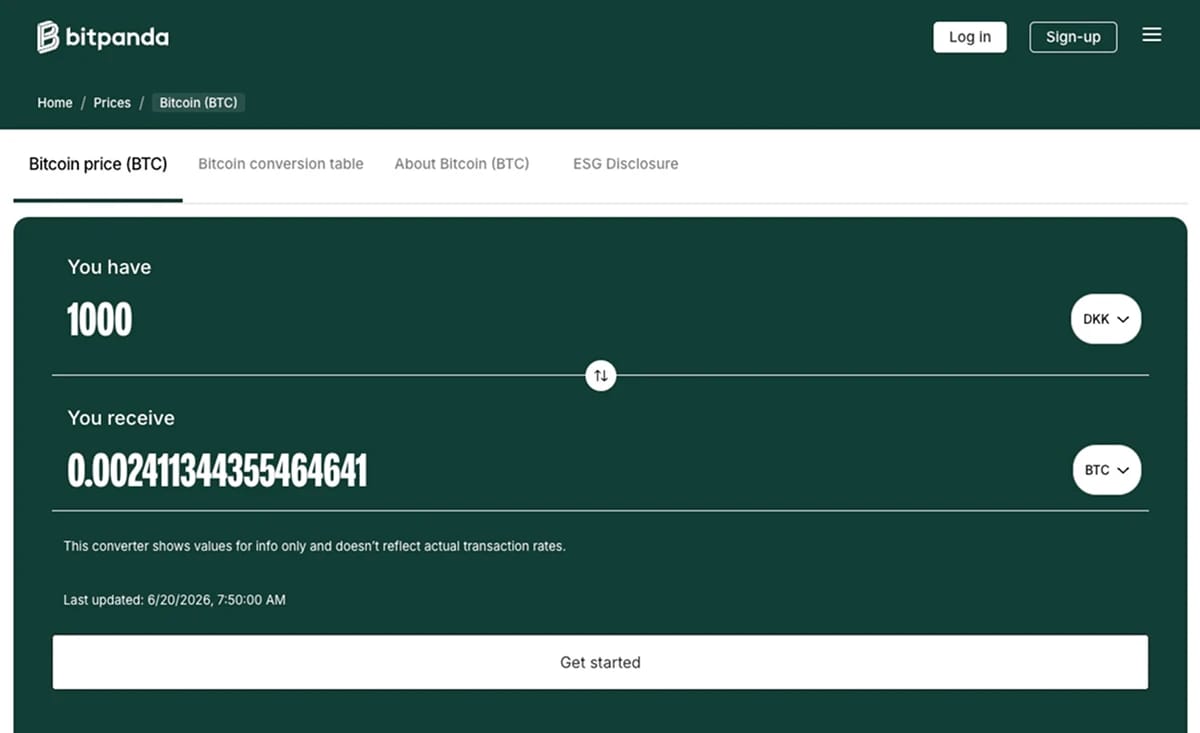
Bitpanda is one of the platforms here that takes Danish kroner directly, which is a real edge for local buyers. The Vienna-based broker holds a MiCA license through Austria's FMA and pairs 600+ cryptocurrencies with fractional stocks, ETFs, precious metals, and a spending card in one beginner-friendly app, so a Danish investor can hold a mixed portfolio without leaving it.
Funding is where it stands out. Bitpanda runs a DKK account, so you deposit kroner by bank transfer with no euro conversion, alongside cards, Apple Pay, and Google Pay. In testing, a Danish ID cleared verification, and a krone deposit was tradable the next day. The minimum DKK deposit is low enough for a small first buy.
Cost is the limitation. Standard buy and sell orders carry a spread of nearly 1.49%, more than 10 times the 0.1% order-book fee on Bybit. That gap is trivial on a small monthly plan and painful on a large lump sum, so match your usage to the size you trade. Per-product availability for Denmark sits on our Bitpanda countries page.
Pros
- Direct DKK deposits by bank transfer, with no euro conversion, plus cards and mobile wallets.
- A MiCA license with crypto, stocks, ETFs, and metals in one regulated account.
- A polished, beginner-friendly app that verified Danish documents without trouble.
Cons
- The 1.49% spread is the most expensive pricing on this list.
- Spread-based pricing is less transparent than an open order book.
- Fewer trading tools than a dedicated order-book exchange.
6. MEXC
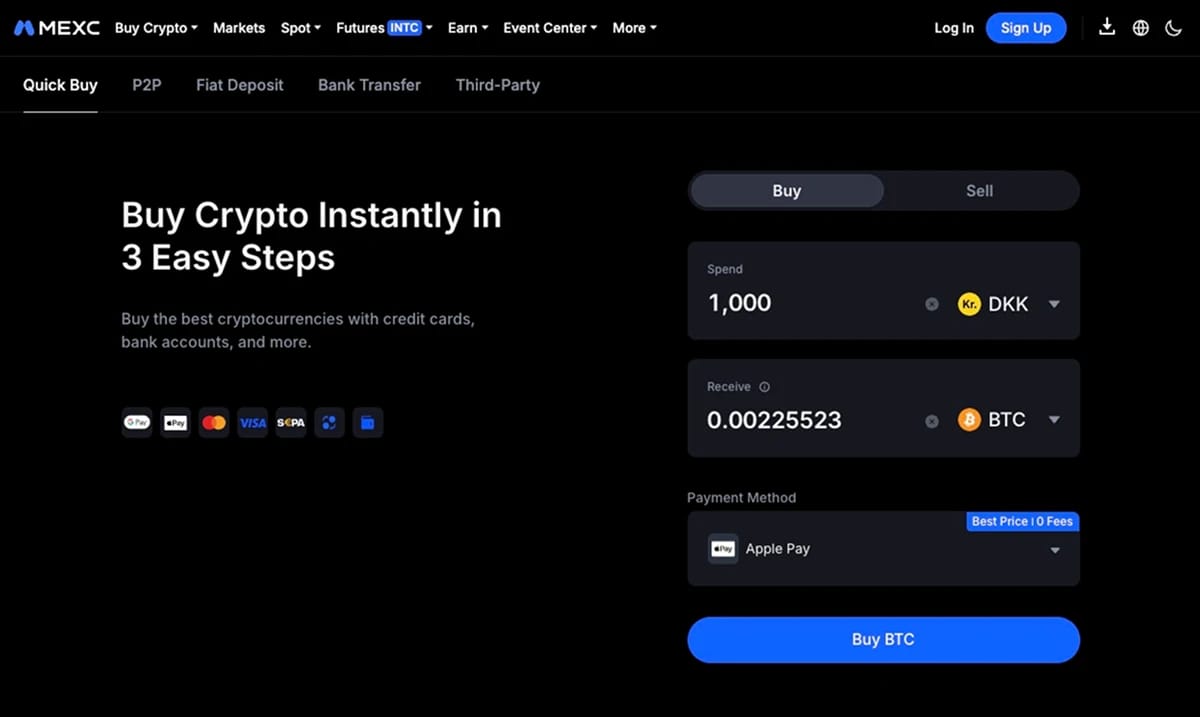
MEXC is the specialist venue for traders chasing the widest token list and the highest leverage. It lists more than 3,000 assets, adds new and early-stage tokens at a pace that licensed venues cannot match, offers futures with leverage up to 400x, and charges near-zero spot fees, with no maker fee and a taker fee of around 0.05%. For finding a small cap before it reaches a regulated exchange, nothing else here comes close.
Funding for Danish users is available via a card, the P2P marketplace, or a crypto transfer, with no direct krone rail. MEXC's verification is lighter than the licensed platforms, which speeds onboarding, and unlike the regulated exchanges, it still lists USDT pairs that MiCA pushed off the others. Our MEXC review covers the trading engine and product set in full.
The reason it ranks last is regulatory, and it is significant. MEXC has not secured a MiCA license, and analyses of the 1 July 2026 deadline group it among platforms expected to restrict service to EU users. That makes it a tool for experienced traders who understand both the leverage risk and the risk of changes to access or withdrawal, rather than a first account for a Danish saver. Check its current standing on our MEXC available countries page before funding anything.
Pros
- More than 3,000 assets, with frequent early listings that the licensed exchanges lack.
- Near-zero spot fees and futures leverage up to 400x for active traders.
- Light verification and fast onboarding, plus continued USDT access.
Cons
- No MiCA license, with likely EU service restrictions after July 2026.
- High leverage magnifies losses and suits only experienced traders.
- Lighter KYC means weaker consumer protection, and there is no DKK rail.
How to Choose a Crypto Exchange in Denmark
In Denmark, the deciding factors are local rather than global. Before you compare fees or features, confirm that a platform can legally serve you beyond the July 2026 licensing cutoff, then look at how it converts kroner into a trade and whether its records will hold up at tax time.
Work through the five checks below before funding an account.
- Accept that most exchanges only accept Euros: Every platform here takes either a euro SEPA transfer, where your bank converts DKK to EUR, or a Danish card at a markup. Send a small amount first, since Danish banks differ in how they treat transfers to crypto exchanges.
- Check your bank's policies: Some Danish banks still flag or slow payments to exchanges, a hangover from years of discouraging crypto. If you would rather stay inside a bank app, Danske Bank and Nordea now offer crypto-linked exchange-traded products, though those give price exposure rather than coins you can withdraw.
- Confirm MiCA registration: From 1 July 2026, only exchanges holding a MiCA licence may legally serve Danish clients. Five of the six here hold one, while MEXC does not, so weigh that before sending funds to an unlicensed platform.
- Keep records: Denmark taxes gains as personal income and allows losses only at a lower rate, so the maths has to be exact. Save every exchange statement, transfer confirmation, and trade export so the spring filing is a copy job rather than a reconstruction.
- Match the platform to your use: Long-term holders fit Kraken plus a hardware wallet, first-timers fit Coinbase, value-focused traders fit OKX or Bybit, mixed-asset investors fit Bitpanda, and experienced futures traders who accept the regulatory and leverage risk fit MEXC.
Crypto and Bitcoin Regulation in Denmark
Denmark regulates crypto through EU law applied at the national level, split between two authorities. The Danish Financial Supervisory Authority (Finanstilsynet) supervises service providers, implements MiCA, and enforces anti-money-laundering rules, while the Danish Tax Agency (Skattestyrelsen) handles everything tax-related.
- MiCA Regulation Takeover: The EU's Markets in Crypto-Assets Regulation has applied in full since 30 December 2024. The transitional window for firms operating under older national rules closes across the EU on 1 July 2026, after which only platforms holding a Crypto-Asset Service Provider license may legally serve Danish clients.
- Cross-country Licensing: A CASP license issued by any EU member state passports into Denmark, so an exchange authorized in Ireland, Malta, or Austria can serve Danish users without a separate Danish approval.
- Tether Ban: MiCA bars stablecoins without EU authorization, and Tether declined to apply for authorization. Regulated platforms removed USDT for EU accounts, so Danish users on those venues trade against euros or USDC and EURC instead.
Using an offshore platform is not itself illegal, but after July 2026, an unlicensed venue cannot lawfully serve Danish customers, and only a CASP-authorised provider falls within the EU's protection framework.
.webp)
How is Crypto Taxed in Denmark?
Denmark has one of the heaviest crypto tax regimes in Europe, and the structure is the main reason ownership remains low. The Danish Tax Agency treats most crypto gains as personal income rather than applying a flat capital gains rate.
- Gains taxed as personal income: Profit from selling, swapping, or spending crypto is added to your personal income and taxed at your marginal rate, which can reach roughly 52% once bottom-bracket, top-bracket, and municipal taxes combine. The 8% labor-market contribution does not apply to crypto.
- Losses are relieved at a lower value: This is the asymmetry that defines the Danish system. Gains can be taxed at up to about 52%, but losses are deductible only as a lower-value deduction worth closer to 26%, and matching rules limit how freely they offset. A profitable year and a loss-making year do not cancel out evenly.
- Every disposal counts: Selling to kroner, swapping one coin for another, and paying for goods are all taxable events, valued in DKK at the moment of the trade. Denmark applies a First-In-First-Out cost basis, with gains reported in box 20 and losses in box 58.
- Income from rewards: Staking, mining, and airdrop rewards are taxed as personal income at their krone value when received.
- A stablecoin nuance: Certain instruments, including some stablecoin positions treated as financial contracts, can fall under mark-to-market taxation as capital income at 42%, which carries more symmetric loss treatment. The classification is technical, so confirm it for your own holdings.
On the horizon sits a far larger change. In 2024, the Danish Tax Law Council recommended taxing unrealized crypto gains under an inventory model at 42%, applying even to coins bought as far back as 2009 and pairing the levy with broader loss offsets.
As of mid-2026, that remains a proposal under parliamentary review rather than law, with no confirmed start date, but it is the most consequential reform any Danish holder should watch.
None of this is tax advice. Because the rules are intricate and a reform is pending, confirm your position with a Danish tax adviser.
Cryptocurrency Adoption in Denmark
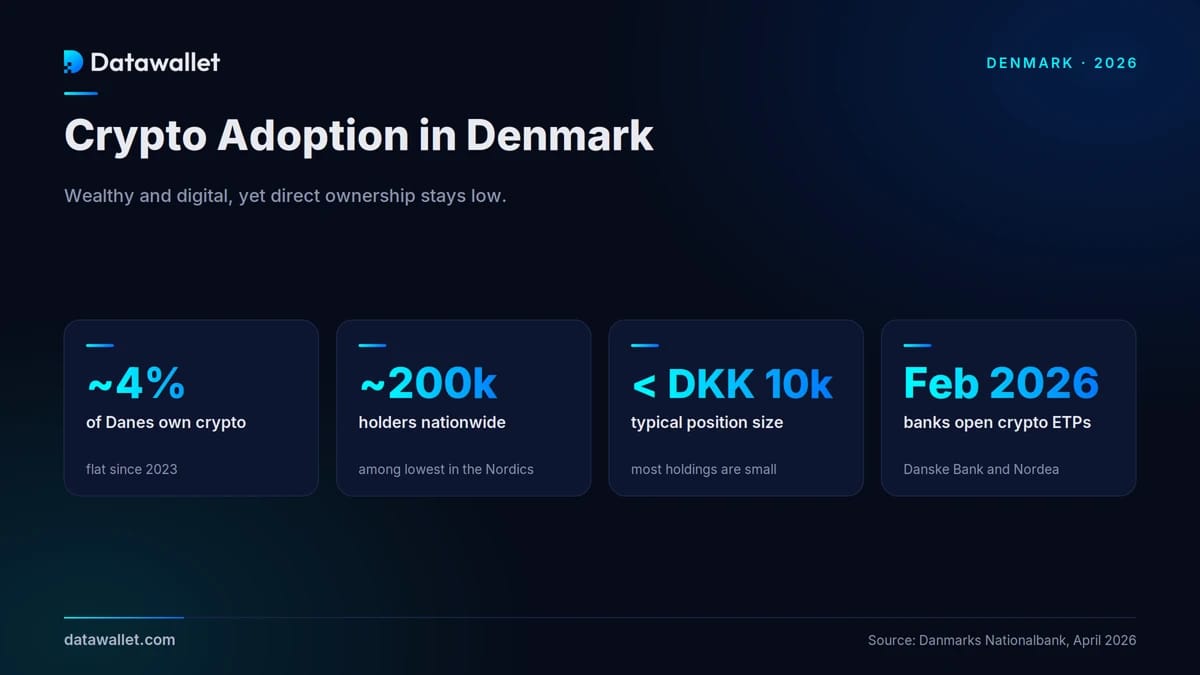
Denmark is wealthy, highly digital, and cautious about crypto in roughly equal measure, and the data shows it. A Danmarks Nationalbank study published in April 2026, based on an Epinion survey of more than 3,000 residents, put the numbers in context.
- Flat at a low base: Around 4% of the population, close to 200,000 people, owned crypto in 2025, unchanged from 2023 and well below the rates above 10% seen in Norway, Finland, and the UK.
- Small positions: Most holders reported balances under DKK 10,000, with total national holdings estimated at roughly US $317 million to $847 million, modest for a country with one of Europe's highest per-capita incomes.
- A specific profile: Ownership skews toward younger, higher-income individuals, concentrated in Bitcoin and Ether, with the majority relying on custodial providers rather than self-custody.
- Why it lags: The central bank pointed to cautious banks, earlier tax treatment that discouraged investment, and a general perception of crypto as high risk.
- A possible turn: The February 2026 launch of crypto-linked exchange-traded products by Danske Bank and Nordea gave conservative investors a regulated entry for the first time, and indirect exposure through such products has been climbing, even if it remains small against total equity holdings.
The wider global comparison sits on our crypto adoption statistics page. What stands out for Denmark is the gap between its financial sophistication and its low direct participation, a gap that regulated products and clearer MiCA rules may slowly narrow.
How to Buy Bitcoin in Denmark
Buying BTC in Denmark requires finding an exchange, creating an account, depositing funds, and exchanging them for Bitcoin. Follow these steps to get started:
- Open an account: Beginners can start with Coinbase, value-focused buyers with Bybit, Kraken, or OKX, and experienced futures traders with MEXC, keeping its unlicensed status in mind.
- Clear KYC: A passport or national ID plus a selfie verified within hours on the platforms we tested. Enter your name exactly as printed.
- Deposit funds: Use a euro SEPA payment or a Danish card, since most of these platforms don’t fund in kroner directly, and a conversion or markup sits in the path. Send a small amount first to confirm your bank passes the payment, then scale, and keep the confirmation as your acquisition record.
- Buy BTC: Place a limit order on the order-book screen rather than using an instant-buy button, which prices through a spread of 1% or more that a limit order avoids.
- Secure your coins: Anything you are not actively trading belongs in your own wallet. Our best crypto wallets guide covers hardware and software options.
Exiting reverses the path: sell to kroner or euros, withdraw to your Danish account, and report the year's disposals and any reward income on your return.
Final Thoughts
Denmark gives crypto buyers a clearly regulated market and a banking system that is finally opening the door, set against a tax regime that remains among the strictest in Europe. The mechanical constraint is the krone, since most major exchanges move it without conversion, and that shapes the funding decision.
Bybit leads for all-round capability and range, Coinbase for first-time simplicity, Kraken for security and the cleanest euro funding, OKX for cost and on-chain access, and Bitpanda for investors who want crypto beside stocks and metals. MEXC caters to experienced traders seeking the highest leverage.
For the wider region, our guide to the best crypto exchanges in Europe covers the MiCA market across the continent.
Our Methodology
We assessed each platform by repeating the steps a Danish resident takes in practice: registering with a passport or national ID, funding through a Danish card, euro SEPA, and P2P settlement, executing spot trades, and withdrawing to a local account. Six criteria set the rankings:
- Trust Score: A 5-point rating weighing security history, reserve transparency, regulatory standing, and years of operation.
- Funding Access: How the krone moves in, tested across euro SEPA, Danish cards, and P2P for speed and cost.
- Fees: Headline maker and taker rates plus the full round-trip cost, including spreads and card markups.
- Asset Range: Coverage from majors and stablecoins through long-tail tokens and derivatives, noting that MiCA delistings have trimmed some EU-tradable sets.
- Tax Practicality: Whether statements and exports hold up as acquisition and disposal evidence under Danish rules.
- Local Usability: KYC friction with Danish documents, app performance, and the quality of the krone exit path.
Asset counts are approximate and shift as platforms adjust their EU listings. Testing ran from March to June 2026.
.webp)