



Can I Buy Bitcoin with Zelle?
Not as a direct exchange deposit, whatever some guides claim. Zelle was built by US banks to pay people you already know, and it runs inside roughly 2,200 banking apps. No exchange can plug into it, so it never shows as a card or ACH funding option.
Two paths remain, with very different risk.
The safe one is what we use. Your Zelle sits on a normal checking account that already runs ACH and wires, so you fund a regulated US exchange from it over those rails and buy there. We have done this dozens of times without a blocked deposit.
The other is peer-to-peer - you pay a seller directly for crypto. A Zelle payment is instant and final, so a seller who disappears keeps your money. Our P2P exchange guide shows how to trade more carefully, but it is no place to start.
How to Buy Crypto with Zelle
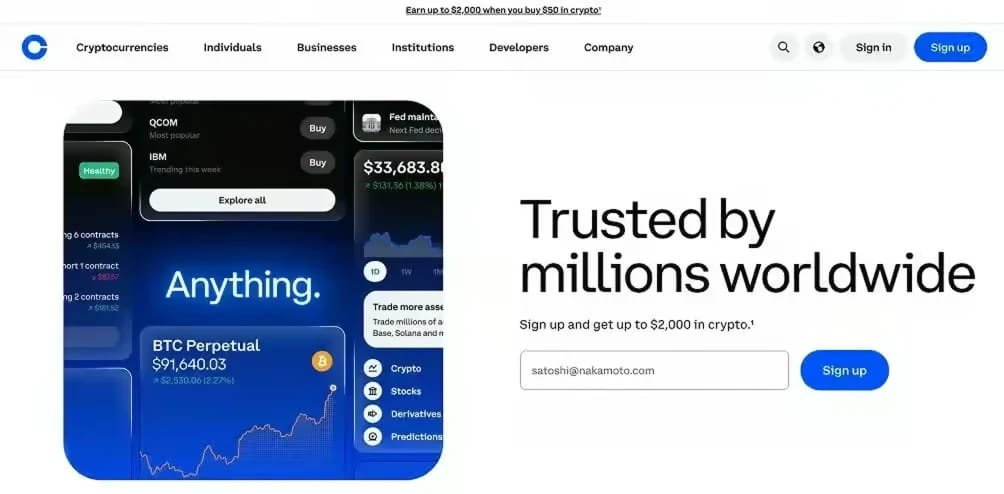
The reliable method has two parts: move dollars from your Zelle-linked checking account into Coinbase by ACH, then buy. We lean on Coinbase for US first-timers because the Plaid bank link is instant and the interface leaves a beginner little room for a costly error.
Steps to buy crypto as a Zelle user:
- Open and verify an account: Sign up on Coinbase and clear identity verification with your driver's license or passport and a selfie check. US rules require this before any deposit or trade.
- Link the bank behind your Zelle: In the funding area, choose Add Cash and connect that same checking account by ACH. Coinbase uses Plaid, so you usually log in with your online banking credentials instead of typing routing and account numbers.
- Send a small ACH test first: On a new link we move $20 to $50 to confirm the connection and check for holds. ACH is free and usually clears for trading fast, though Coinbase may hold the funds from withdrawal for the first few days.
- Add your real amount: Once the test lands, fund what you plan to invest. For larger sums, a wire settles faster at a flat fee, covered next.
- Buy on the cheaper screen: Search BTC or your asset and place the order. We use a limit order on the Advanced screen, since the one-click simple buy bakes a wider spread into the price than Advanced maker and taker fees.
Fees and Limits for Zelle Users
Your real cost has two parts: what your bank lets you move, and what the exchange charges once the dollars land. Zelle itself adds nothing.
Zelle and bank-side costs and limits
- Transfer fee: Zelle charges nothing to send or receive, and transfers settle in minutes.
- Send limits: There is no universal Zelle limit. Each bank sets its own daily and monthly caps, so two people on the same network can have very different ceilings. Check yours in your banking app before a large move.
- No credit cards: Zelle links to checking or savings accounts only, so you cannot route a purchase through credit.
- ACH and wire (the rails you will use): The same account sends free ACH transfers and same-day or next-day wires. These fund the exchange, not Zelle.
- Irreversibility: Treat any Zelle payment like cash. Under federal Regulation E, a bank must refund a transfer you never authorized, but a payment you were tricked into approving usually is not covered.
Coinbase costs
- ACH deposit: Free, settling in about one to five business days, with a short withdrawal hold on new accounts.
- Wire transfer: A flat $10 in and $25 out, cheaper than card rails on larger amounts.
- Debit card: Instant but pricey at about 3.99%, fine only for tiny top-ups.
- Spot trading: Coinbase Advanced runs maker and taker fees from about 0.40% and 0.60%, dropping with volume. The simple buy screen costs more on its embedded spread, so an Advanced limit order saves the most.
- Crypto withdrawal: Network fee only, varying by asset and congestion.
A free ACH deposit plus an Advanced limit order is the lowest-cost route, well below any instant card flow.
Best Exchanges for US Buyers
Every option below is a US-regulated venue you fund from your own bank account, the one your Zelle runs on. None accept Zelle on a deposit screen, so the USD Deposits column shows the rails that actually work.
Our best crypto exchanges in the USA guide ranks each one by state coverage and funding speed.
Zelle Cryptocurrency Policy
Zelle's own guidance is plain: send money only to people you know and trust, and treat investment requests, crypto included, as a red flag. Instant settlement and finality leave little time to undo a mistake, which is why fraud clusters on the network. A congressional review and a later regulator filing put hard numbers on the losses at the largest member banks.
The legal backdrop shifted across late 2024 and early 2025. The Consumer Financial Protection Bureau sued Zelle's operator, Early Warning Services, with JPMorgan Chase, Bank of America and Wells Fargo over fraud handling, then dropped the case with prejudice in March 2025. Federal oversight of this issue has eased, which puts more of the burden of care on you.
None of this blocks you from buying crypto as a Zelle user, because the banks behind the network allow transfers to licensed exchanges. The institutions that co-own Zelle are among the most transfer-friendly in the country.
If you bank with a Zelle owner, our guides cover the exact funding steps for Wells Fargo and Chase, both of which clear ACH transfers to regulated platforms without issue. Our crypto-friendly banks guide compares which US banks handle exchange transfers most smoothly.
About Zelle
Zelle is a peer-to-peer payment service run by Early Warning Services, LLC, a fintech co-owned by seven of the largest US banks, among them Bank of America, Capital One, JPMorgan Chase, PNC, Truist, US Bank and Wells Fargo. It launched in 2017 as an instant alternative to Venmo and Cash App, settling directly between insured bank accounts rather than holding a balance.
It is now the dominant US P2P rail. By the end of 2024 it held more than 151 million enrolled accounts and moved over $1 trillion across roughly 5 billion transactions, the most ever sent through a P2P service in one year. It sits inside more than 2,200 banking and credit union apps, works only in the US, and handles US dollars only.
One change matters if you are hunting for "the Zelle app." The standalone purple app shut down on April 1, 2025, once only about 2% of activity still ran through it. There is nothing to download now: you reach Zelle inside your bank or credit union app, so your bank, not Zelle, controls your limits and disputes.

Bottom Line
Buying crypto as a Zelle user is about picking the right rail. No regulated exchange accepts Zelle as a deposit method, whatever the funding-screen guides claim.
The dependable route is the one we use: fund Coinbase by free ACH from the same checking account your Zelle runs on, then buy with an Advanced limit order to skip the simple-buy spread. It keeps your bank-level protections and costs almost nothing to deposit.
A peer-to-peer trade is the one method that actually moves money over Zelle, and its finality is unforgiving. If you take it, use vetted merchants and escrow, never a stranger's promise. For most US buyers the ACH path into a licensed exchange is cheaper and safer.
For stablecoins rather than Bitcoin, our how to buy USDT in the USA guide covers the state-by-state rules, and our Coinbase review looks closer at the platform before you sign up.