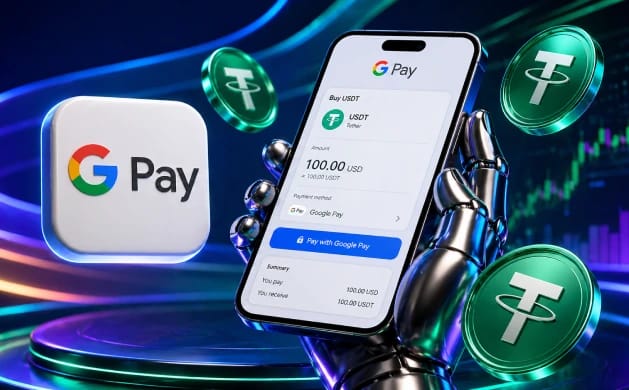



Can I Buy USDT with Google Pay?
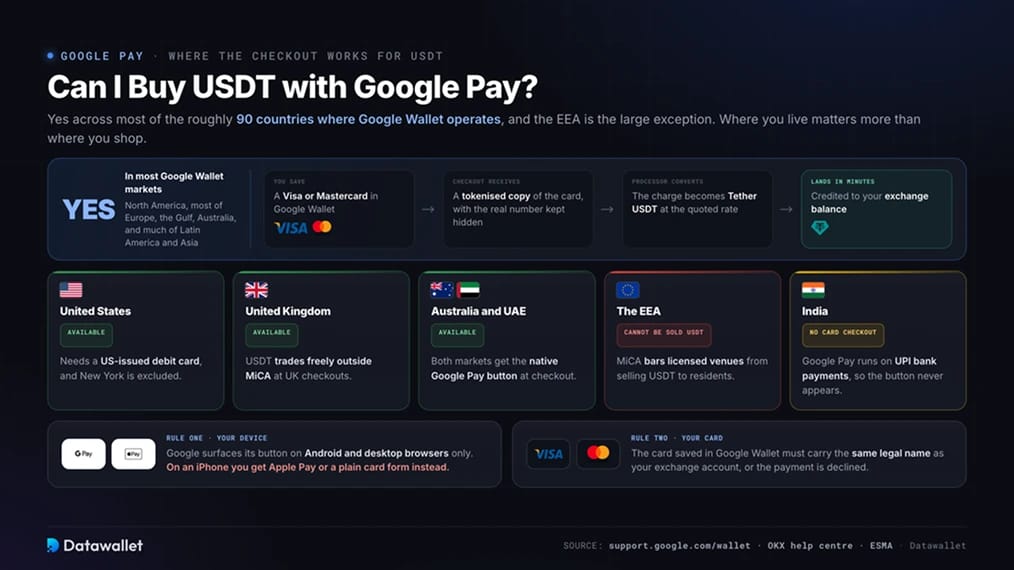
Yes across most of the roughly 90 countries where Google Wallet operates, and the EEA is the large exception. At an exchange checkout, Google Pay hands over a tokenised copy of your Visa or Mastercard, a digital stand-in that keeps the real card number hidden, and a payment processor turns the charge into USDT in your account. Google's supported country list covers North America, most of Europe, the Gulf states, Australia, and large parts of Latin America and Southeast Asia.
Google Pay in India runs on UPI bank payments rather than saved cards, so a card-based exchange checkout never shows the option and Indian buyers pay over UPI instead. Across the EEA the block comes from regulation, since MiCA bars licensed venues from selling USDT to European residents after Tether declined to seek e-money token authorisation, and the transition for unlicensed platforms closed on 1 July 2026. The EEA section below has the detail.
The device restriction surprises people mid-checkout. Google surfaces its payment button on Android and the web, so iPhone owners see Apple Pay or a plain card form in its place, and the comparison section below links our guide for that side.
How to Buy USDT with Google Pay
Our preferred setup is a verified OKX account with a card already saved in Google Wallet before the app is opened. When we tested the native checkout, the purchase settled in under two minutes, though a first-time card check added a few taps and the card name had to match our account exactly.
Steps to buy USDT on OKX with Google Pay:
- Create and verify your account: Register at OKX and complete identity verification with a passport or national ID plus a selfie. Card purchases and the full payment menu unlock once verification clears, usually within the hour.
- Add your card to Google Wallet: Save a Visa or Mastercard held in your own legal name. American accounts need a US-issued debit card, while Australian, EU, and UAE accounts can use credit or debit.
- Open Buy Crypto and set the order: Select USDT, enter the amount in your local currency, and choose Google Pay from the payment list. Where the native button is absent, OKX offers partner checkouts from providers such as Banxa and MoonPay, and each quotes its own rate, so compare two before committing.
- Approve the payment: Confirm with your fingerprint or screen lock and the USDT credits your balance within minutes. A short withdrawal hold after a first card purchase is normal fraud control.
- Withdraw long-term holdings to self-custody: Tron (TRC-20) transfers cost about a dollar, Solana costs cents, and Ethereum (ERC-20) suits DeFi destinations when gas is reasonable. Our USDT wallet guide compares the options.
Because Tether tracks the US dollar, the local price of one USDT follows your currency's exchange rate and shifts a little each day.
Google Pay to USDT Fees
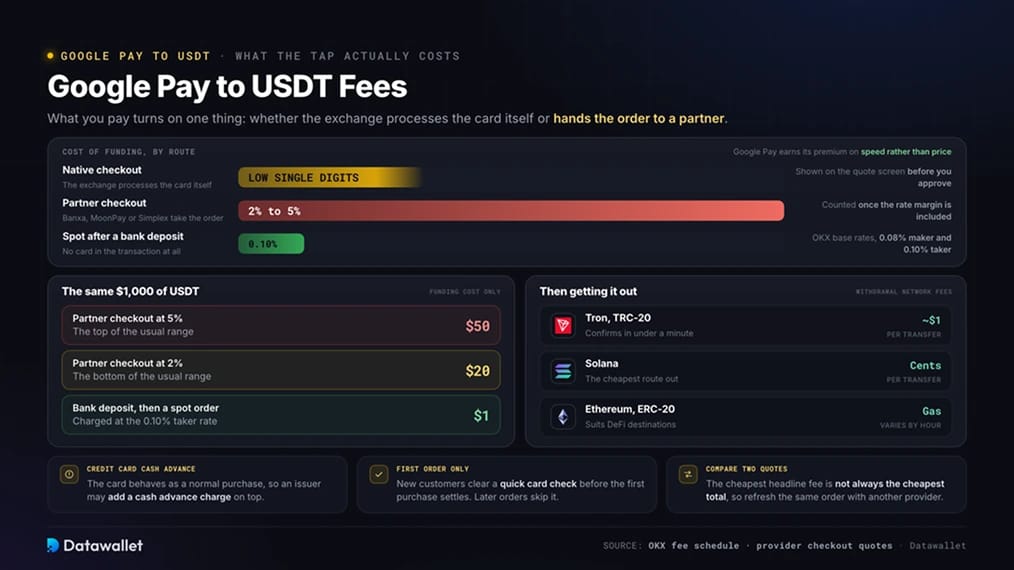
What you pay depends on whether the exchange processes the card itself or hands the order to a partner.
Funding and processing
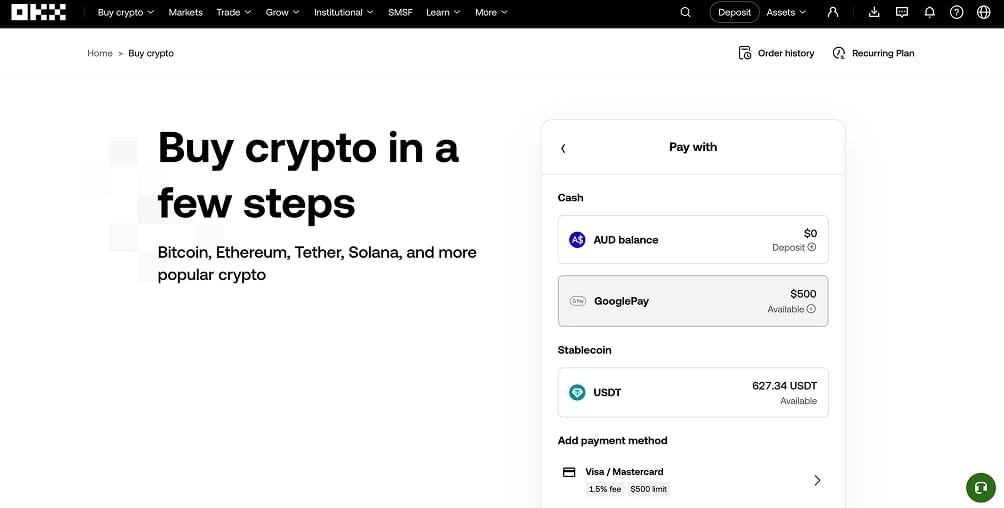
- Native checkout: OKX charges its standard card processing fee when Google Pay runs through its own system, typically in the low single digits and shown on the quote screen before you approve. The card behaves as a debit or credit purchase, so a credit card issuer may add a cash advance charge on top.
- Partner checkout markup: Orders passed to providers such as Banxa, MoonPay, or Simplex commonly cost 2% to 5% once the rate margin is counted. The cheapest headline fee is not always the cheapest total, so refresh the quote across a couple of providers on the same order.
- First-order verification: New customers clear a quick card check before the first purchase settles, and later orders skip it.
Withdrawals
- Network fees: Moving USDT to self-custody costs about a dollar on TRC-20 and confirms in under a minute, Solana costs cents, and ERC-20 tracks Ethereum gas. Our TRC-20 USDT explainer covers the cheapest network for transfers.
Above a small, time-sensitive buy, a bank deposit into the same account skips the card cost, and a spot order then fills at OKX's base fees of 0.08% maker and 0.10% taker. Google Pay earns its premium on speed rather than price.
Best Exchanges to Buy USDT with Google Pay
The table weighs how each venue takes Google Pay, whether it can sell you USDT where you live, and the licensing behind the checkout. Broader rankings sit in our best USDT exchanges guide.
OKX leads for the widest native Google Pay coverage paired with low fees once the account is funded. Kraken is the safer legal answer for British buyers, since its FCA registration backs a native USDT market. Gate brings the deepest token catalogue for buyers relying on partner checkouts, and Coinbase suits anyone wanting a US-listed counterparty at higher trading costs.
Google Pay USDT Rules in the US, UK, and EEA
The entity serving you and your region's stablecoin rules decide what the checkout can legally sell. OKX reaches all three markets, and in one of them a rival is the better call.
In the US, OKX operates a dedicated local platform with Google Pay built into the buy screen, and USDT is legal to purchase under the GENIUS Act everywhere except New York, where the token sits off the NYDFS approved list. Tether has until 2028 to bring USDT into line with the federal framework and launched USAT in January as its compliant American token, listed on OKX from day one. Our USA guide has the state-level detail.
In the UK, Google Pay works at exchange checkouts and USDT trades freely outside MiCA, but OKX serves British customers without an FCA registration, so its spot platform carries none of the local consumer protections. Kraken pairs FCA registration with Google Pay card processing at 3.75% plus a small fixed fee, and our UK guide covers the domestic picture.
In the EEA, OKX's Maltese entity holds the very licence that stops the sale, since offering a non-authorised e-money token would put its MiCA authorisation at risk. Deposited USDT can only be converted into USDC, and Google Pay still funds compliant tokens. Our Europe guide and MiCA exchange list cover the alternatives.
Google Pay Versus Bank Transfer for USDT
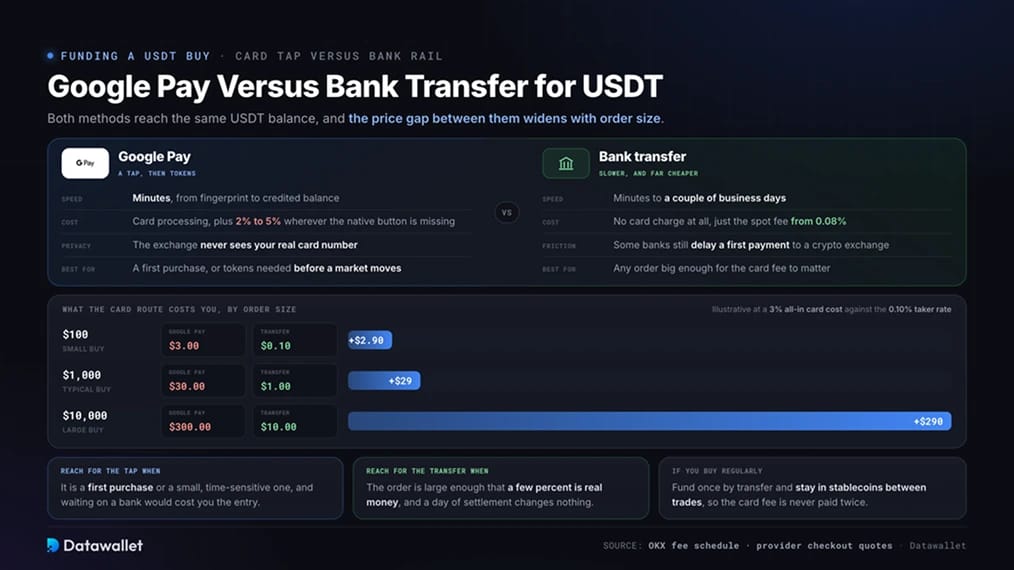
Both methods reach the same USDT balance, and the price gap between them widens with order size.
Google Pay suits a first purchase or any moment you want tokens in the account before a market moves. The tap is fast and secure, the exchange never sees your real card number, and settlement takes minutes. The cost is the card processing charge, plus a partner markup of 2% to 5% wherever the native button is missing, defensible on a small order and expensive on a large one.
A bank deposit carries no card charge, so the only cost is the spot fee at order time, from 0.08% on OKX. It settles slower, from minutes to a couple of business days, and some banks still delay a first payment to a crypto exchange.
Recurring buyers do better funding once by transfer and staying in stablecoins between trades. To compare the other card wallets, see our Apple Pay and credit card USDT guides, or our Google Pay crypto guide for tokens beyond Tether.
Tax When You Buy USDT with Google Pay
Paying by phone changes nothing about how the purchase is taxed. Buying USDT with your own currency is an acquisition, and tax arrives later when you dispose of it.
- The purchase itself is not taxed: Acquiring USDT with Google Pay creates no gain in the major markets, whether the funding currency is dollars, pounds, or dirhams.
- Disposals are the taxable moment: Selling USDT for currency, swapping it into another token, or spending it counts as a disposal. HMRC applies its cryptoassets rules in the UK and the IRS treats crypto as property in the US, so gains are reportable even when the price barely moves.
- A pegged token still moves against your currency: One USDT is worth whatever the dollar is worth in local terms that day, so a stablecoin balance quietly accrues small gains or losses as the exchange rate drifts. Record each disposal in your home currency.
- Reporting keeps tightening: International frameworks now push exchanges to share user and transaction data with tax authorities, so export your history regularly.
💡 For active users: card purchases spread across several processors are harder to reconcile than one bank deposit, so keep records of every buy, sell, and swap as you go. A tax adviser familiar with crypto is worth the cost once turnover climbs. This is general information rather than tax advice.
Final Thoughts
OKX is the platform we reach for when buying USDT with Google Pay across most of the world, because the native checkout removes the partner markup in four major markets and the funded account then trades at some of the lowest spot fees anywhere.
The licensing is the other half of the case. OKX Europe Limited holds a MiCA CASP authorisation from Malta's MFSA granted in January 2025 and passported across the EEA, alongside a MiFID II permission for derivatives and a Maltese payment institution licence added this February for stablecoin payments. Separate entities hold a full VASP licence from Dubai's VARA, a Major Payment Institution licence from Singapore's MAS, AUSTRAC registration in Australia, FSA approval in Japan, and state money transmitter coverage in the US, all mapped in our OKX review and OKX countries guide.
Region settles the final call. Buyers in the US, Australia, the UAE, and most partner-checkout markets get the full OKX experience, British buyers who want local oversight should pay through Kraken, and anyone in the EEA should reach for USDC or self-custody while regulated USDT access stays shut.