







Can I Buy USDT in Italy?
Italian law does not prohibit owning USDT. You may keep it in a self-custody wallet, transfer it across supported chains, or use it on-chain. The restriction applies to public sales through licensed platforms.
Title V of MiCA took effect on 30 December 2024. It permits a licensed exchange to offer an e-money token, the regulatory category for a stablecoin linked to an official currency, only when the issuer has EU authorisation. Tether did not seek approval, prompting every regulated venue serving Italians to remove USDT.
Italy provided a separate wind-down period. Exchanges listed on the OAM register, maintained by the Organismo Agenti e Mediatori, could continue trading while their MiCA applications were assessed. Banca d'Italia confirms that this transitional period ended on 30 June 2026. Only crypto-asset service providers (CASPs) recorded in the ESMA register may now operate in Italy, and none lists USDT.
Activities short of a public sale remain legal. Italians can receive USDT in self-custody, acquire it through a decentralised exchange, or send it abroad because holding and transferring a token are distinct from selling it. Licensed platforms offer USDC as the alternative. The restriction also applies across all 30 EEA states, as explained in our guide to buying USDT in Europe.
How to Buy USDT in Italy
There are two practical options for buying USDT in Italy. You can use USDC as the regulated equivalent on a licensed exchange or move outside EU oversight through an offshore platform.
For the regulated route, we recommend funding Kraken through SEPA, the shared network for euro bank transfers across Europe. Any euro account held in your name can be used, including a traditional current account, Fineco, or a Postepay Evolution card with its own IBAN.
Steps to buy USDC on Kraken from Italy:
- Open and verify an account: Register with Kraken, provide a passport or carta d'identità elettronica, then complete the selfie check. Intermediate verification unlocks euro funding and took us a few hours.
- Generate your SEPA deposit details: Select EUR under Funding and choose Banking Circle. Kraken will create a personal named account with a German IBAN, removing the need for a payment reference. Euro deposits carry no charge on Kraken's side.
- Test with a small payment: Transfer €10 or €20 first to check that your bank processes the German IBAN correctly. SEPA Instant payments from Italian banks arrive within seconds, whereas standard transfers can take one or two working days.
- Deposit the rest: Once the test payment appears, repeat the transfer with the full amount. Our instant payment from an Italian current account was available for trading within minutes.
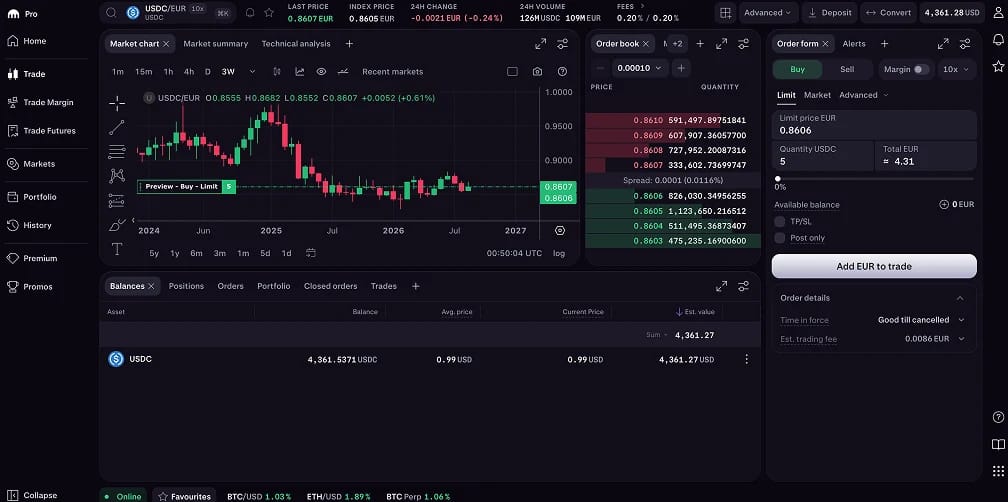
- Place a limit order on USDC/EUR: Open the pair through Kraken Pro rather than using the quick-purchase screen, which includes a markup in the quoted price. When checked, the USDC/EUR spread was below 0.1%.
USDC follows the US dollar, so each token costs slightly less than €0.90 instead of a full euro. Its euro price changes daily with the EUR/USD exchange rate.
EUR to USDT Fees
Your funding method and order type have a greater effect on total cost than the platform's headline fee schedule.
Deposits
- SEPA transfer (recommended): Kraken charges nothing for the deposit, while Italian banks rarely impose a fee on outgoing euro transfers. At most banks, SEPA Instant now costs the same as a standard payment.
- Cards, Apple Pay, and Google Pay: These methods settle immediately but combine processing charges with a markup. The total usually reaches 2% to 4% of the purchase, making them suitable only for small, urgent transactions.
- Card purchases on BloFin: BloFin processes euro card payments through an external provider that applies its own markup. Buying USDT this way is noticeably more expensive than sending SEPA funds to a licensed exchange.
Trading
- Kraken Pro: Stablecoin pairs start on a flat 0.20% schedule for both makers and takers, with lower rates available as volume increases. Kraken+ subscribers can trade without fees up to a monthly cap. See our full Kraken review for more information about the platform.
- Instant buy: Kraken's quick-purchase interface includes a spread in the quote. As a result, an identical trade may cost several times more than a Pro limit order.
Withdrawals
- Moving stablecoins off the platform: Transfers using TRC-20 on Tron cost roughly one dollar and settle within a minute. Solana charges cents, while Ethereum fees range from one to ten dollars depending on gas, the network charge for processing a transaction. Check that the receiving wallet supports your selected network before withdrawing.
- Cashing out to an Italian account: Convert the stablecoin to euros and submit a SEPA withdrawal. The service costs about one euro and generally reaches an Italian bank within one or two working days.
Best Exchanges for USDT and USDC in Italy
This ranking considers each platform's licence, euro funding methods, and the stablecoins it may legally sell to Italian customers. Licensed exchanges offer USDC instead of USDT. BloFin is the only listed option that continues to sell Tether, but it operates offshore without an EU licence.
Our guide to the best crypto exchanges in Italy compares the broader market. The best USDT exchanges roundup focuses on global platforms for trading Tether.
Kraken ranks first due to its Irish MiCA licence, free instant euro deposits, and flat 0.20% stablecoin trading fee. Coinbase provides e-money safeguarding for euro balances alongside a liquid USDC/EUR market. OKX offers the lowest spot pricing for higher-volume traders, while Bitstamp has the longest operating history among EU venues.
BloFin occupies a separate category. It still sells USDT to Italians but provides no European regulatory oversight.
Regulatory Status of USDT in Italy
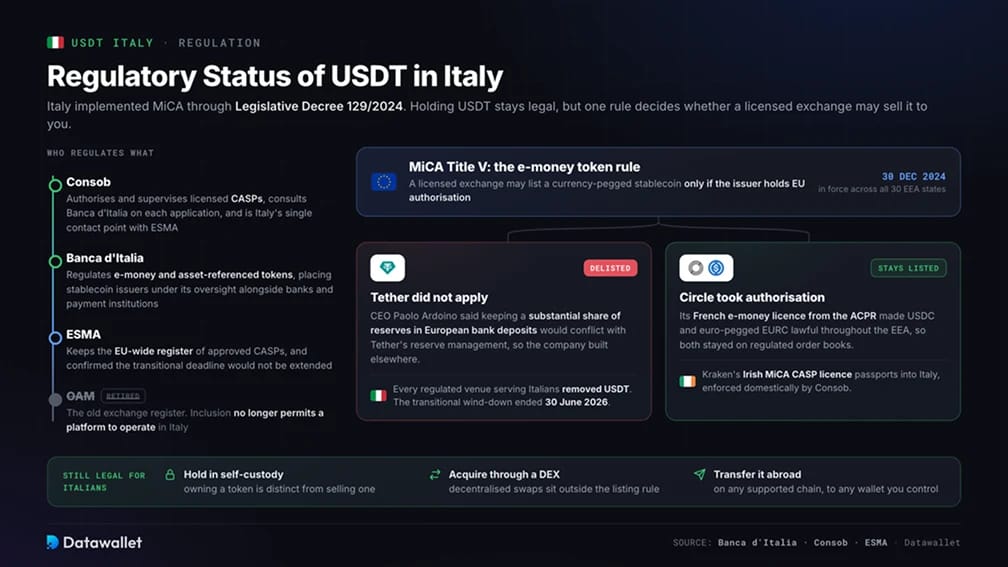
Italy implemented MiCA through Legislative Decree 129/2024. The law divided oversight between the country's two financial regulators and replaced the previous registration framework.
- Consob: Authorises and supervises licensed crypto platforms known as CASPs. It consults Banca d'Italia on each application and serves as Italy's single point of contact with ESMA.
- Banca d'Italia: Regulates e-money and asset-referenced tokens, placing stablecoin issuers under its oversight. Its responsibilities also cover banks and payment institutions offering crypto services.
- OAM: Previously maintained the register governing crypto exchanges. A joint Consob and Banca d'Italia notice explained how registered operators had to seek authorisation or close. Inclusion on the register no longer permits a platform to operate.
- ESMA: Keeps the EU-wide register of approved CASPs and confirmed that the 1 July transitional deadline would not be extended.
Tether chose not to pursue authorisation. Chief executive Paolo Ardoino has said that MiCA's requirement for e-money issuers to keep a substantial share of their reserves in European bank deposits would conflict with Tether's reserve management. The company instead decided to develop elsewhere.
Circle took the opposite approach. Its French e-money authorisation from the ACPR made USDC and euro-pegged EURC lawful throughout the EEA. Both remained listed while USDT disappeared from regulated exchanges.
Our recommended platform, Kraken, holds a MiCA CASP authorisation from the Central Bank of Ireland, which can be passported across the EEA. It is also registered with the FCA in the UK and FinCEN in the US. Although your account is not covered by an Italian licence, Kraken remains subject to the EU framework enforced domestically by Consob.
Tax Implications of USDT in Italy
Italy now applies one of Europe's heavier crypto tax regimes. Stablecoins receive no special treatment unless they are pegged to the euro.
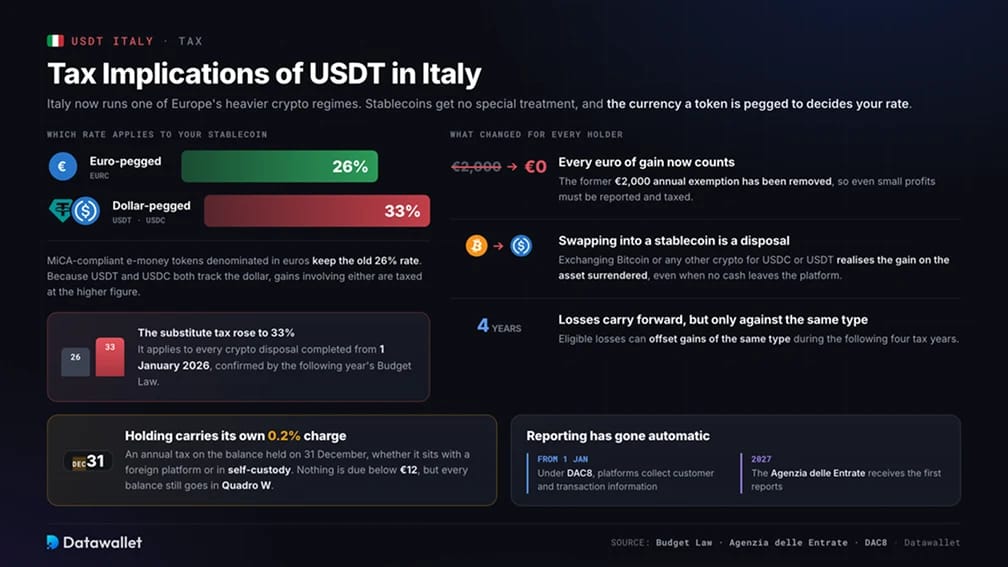
- Gains are taxed at 33%: Crypto disposals completed from 1 January 2026 are subject to a 33% substitute tax, up from 26%. The following year's Budget Law confirmed the increase.
- Euro stablecoins keep the old rate, dollar ones do not: MiCA-compliant e-money tokens denominated in euros remain subject to the 26% rate. Because USDT and USDC track the dollar, gains involving either token are taxed at 33%.
- Every euro of gain now counts: The former €2,000 annual exemption has been removed. Even small profits must therefore be reported and taxed. Eligible losses can offset gains of the same type during the following four tax years.
- Swapping into a stablecoin is a disposal: Exchanging Bitcoin or another cryptocurrency for USDC or USDT realises the gain on the asset surrendered, even if no cash leaves the platform.
- Holding carries its own 0.2% charge: Crypto held on 31 December attracts an annual 0.2% tax, whether stored through a foreign platform or in self-custody. No payment is due when the total tax is below €12, but all balances must still be entered in Quadro W regardless of value.
- Reporting has gone automatic: Under DAC8, the EU crypto tax directive, platforms must collect customer and transaction information from 1 January. The Agenzia delle Entrate will receive the first reports in 2027.
💡 For active users: Export a complete transaction history from every platform and record the euro value of each disposal on the transaction date. Gains now span two tax rates and platform reporting is automatic. Anyone trading significant volume should consult a commercialista before the filing deadline rather than waiting for a tax notice.
USDT vs USDC in Italy
Both tokens track the US dollar but operate under different legal frameworks. That distinction determines where Italian buyers can access and use them.
- Regulation and recourse: Circle is accountable to EU regulators and must redeem USDC at a one-to-one rate. Italian holders therefore receive legal protection within the bloc. Tether sits outside MiCA, meaning claims against the issuer must be pursued abroad.
- Where each trades: USDC has euro pairs on every licensed exchange. USDT remains available through offshore platforms, self-custody wallets, and decentralised markets.
- Liquidity and reach: USDT is still the larger stablecoin globally and serves as the main pricing unit for many markets outside Europe. Although USDC has less worldwide liquidity, it has become the standard dollar token within Europe's regulated market.
- Picking between them: USDC is better suited to regulated custody and inexpensive euro conversion while retaining EU protections. USDT is relevant when an offshore or on-chain platform specifically requires it. Our no-KYC USDT guide explains those options.
Final Thoughts
Most Italian buyers should use Kraken, deposit euros by SEPA, and choose USDC as their dollar stablecoin. Kraken's Irish MiCA authorisation extends to Italy, its euro deposits are free and instant, and USDC has the EU approval needed to remain on regulated order books.
After verifying your account, start with a small SEPA payment before submitting the full transfer. Use limit orders through Kraken Pro and record the euro value of every swap on its transaction date. Crypto-to-stablecoin conversions count as disposals, the exemption threshold has been removed, and platforms now report information to the Agenzia delle Entrate automatically.
USDT remains accessible through offshore exchanges such as BloFin or a decentralised swap from self-custody. Either route gives up EU protections, so use it knowingly and keep the position appropriately sized.
.webp)