



Can I Buy Bitcoin with Postepay?
Yes, but not directly. Postepay does not run a crypto desk or list crypto products inside the app. What it allows is unrestricted SEPA and SEPA Instant transfers from your Evolution IBAN to exchanges authorised by Consob under MiCA or passported in from another EU regulator, plus Visa and Mastercard payments at exchange card gateways.
You open an account at a regulated Italian or EU exchange, send euros from the Postepay app via bonifico SEPA istantaneo, and buy on the exchange side. We have done this from a Postepay Evolution several times without a block, though the fraud team called me once on a first transfer above €1,500. It cleared in about two minutes after we confirmed the beneficiary by phone.
Card variant matters here. Only Postepay Evolution and Evolution Business carry an IBAN, which is what you need for SEPA. Standard yellow Postepay sits on Visa without an IBAN, so it only works for card-based deposits where the exchange supports Visa prepaid, and most issuers route those through PosteID 3D Secure.
How to Buy Crypto with Postepay
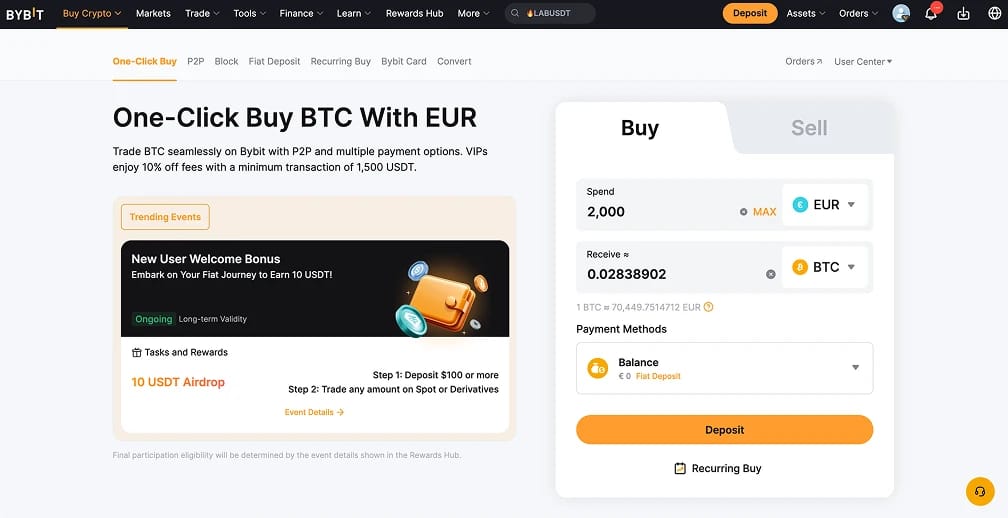
The fastest way to buy crypto with Postepay is a SEPA Instant transfer from your Evolution IBAN to a MiCA-licensed exchange, then a buy order on the exchange side. We use Bybit because Bybit EU is MiCA-authorised through Austria's FMA, SEPA deposits are free, and funds usually land in seconds.
Steps to buy crypto with Postepay:
- Create an account: Sign up on Bybit and complete KYC with your codice fiscale and a valid carta d'identità or passport.
- Get the SEPA details: In Bybit, go to Buy Crypto > Deposit > EUR and choose SEPA. Copy the IBAN, beneficiary name, and reference code exactly. Mistyping the reference is the most common reason a deposit lands in manual review.
- Check your massimali: In the Postepay app, open Impostazioni > Massimali. The institutional ceiling is €5,000 per day across two SEPA Instant transfers, with the first transfer to a new IBAN capped at €2,000 for 48 hours per the official Foglio Informativo.
- Send the bonifico: Tap Operazioni > Bonifico SEPA > Istantaneo, paste Bybit's details, and confirm with PosteID. Since 9 October 2025 you also get a Verification of Payee (VoP) check before authorisation. Expect a non-match warning if Bybit's beneficiary name is abbreviated, and re-check before proceeding.
- Buy crypto: Once EUR lands, search for BTC/EUR (or another pair) and place your order. We use limit orders above a few hundred euros to skip the instant-buy spread.
Fees and Deposit Limits for Postepay Customers
Total cost has two pieces: the bank transfer leg and the exchange leg. The transfer leg is where first-timers get stuck.
Postepay Costs and Limits
- Standard SEPA bonifico: €1.00 from app or postepay.it, €3.50 at the Ufficio Postale, settles in 1 to 2 business days.
- SEPA Instant bonifico: €1.00 from the app since 9 October 2025, parity with standard SEPA under EU Regulation 2024/886. Settles in under 10 seconds, 24/7.
- Daily SEPA Instant cap: €5,000 across a maximum of two transfers, with the first transfer to a new IBAN capped at €2,000 for 48 hours. Configurable downward in Massimali, not above the institutional ceiling without a verification request.
- Card deposits: Postepay Evolution (Mastercard) and standard Postepay (Visa) work on most exchange gateways with PosteID 3D Secure. Gateway surcharges run 1.5% to 4.5%, so cards make sense for small first-time test deposits only.
- Plafond: Evolution maxes out at €30,000 in card balance and €100,000 in rolling annual inbound. Withdrawals from the exchange that would push you past either get bounced.
- POS and ATM: Card spend caps at €3,500 per day and €10,000 per month at POS, and €600 per day and €2,500 per month at ATMs. These do not affect SEPA transfers.
- AML and source of funds: PostePay S.p.A. operates as an Istituto di Moneta Elettronica (IMEL) supervised by Banca d'Italia under D.Lgs. 231/2007. Larger inbound transfers from exchanges can trigger a source-of-funds request. Exchange statements, prior Modello Redditi PF, and original EUR purchase receipts resolve these without escalation.
Bybit Fees
- SEPA deposit: Free.
- Spot trading: 0.10% maker / 0.10% taker at standard tier. Young Platform's Smart fees from 0.65% and Coinbase's 1%+ all-in cost open a real gap above a few hundred euros.
- Instant buy: Wider spread baked into the quoted price. Fine for a first test, uncompetitive at size.
- Crypto withdrawal: Network fee only, varies by asset. USDT on Tron (TRC-20) is usually under a dollar.
- EUR withdrawal via SEPA back to Postepay: Free or a small flat fee depending on size. Postepay caps inbound SEPA at €15,000 per online transaction, so larger withdrawals will need to be split.
A free SEPA Instant transfer paired with 0.10% spot is one of the cheapest ways to buy Bitcoin in Italy, well below the all-in cost of card-only flows on Crypto.com or Coinbase, and it keeps you on a MiCA-authorised venue.
Best Exchanges for Postepay Customers
Italian users have several MiCA-aligned options, including one Italy-domiciled exchange that took an early role in the OAM-to-MiCA transition.
Postepay Cryptocurrency Policy
Postepay and parent Poste Italiane do not offer direct crypto trading, custody, or wallet services. The position mirrors most Italian retail banking incumbents: no in-app Bitcoin buying, but no obstruction of SEPA transfers to regulated exchanges.
Italy's regulatory framework has tightened sharply over the last two years. Consob's December 2025 communication closed the OAM-only window for VASPs on 30 December 2025, and the MiCA transitional regime hard-stops on 30 June 2026.
After that date only entities authorised as Crypto-Asset Service Providers (CASPs) under MiCA, including firms passported in from another EU member state, can serve Italian users. Consob supervises conduct and market integrity, and Banca d'Italia handles prudential and AML supervision.
Tax treatment also changed on 1 January 2026. Capital gains on most cripto-attività moved from 26% to 33% under the 2025 Budget Law, with euro-denominated e-money tokens kept at 26% by Article 13 of the 2026 Budget Law. The €2,000 annual exemption was removed at the start of 2025, so even small disposals are now declarable.
Italian residents calculate gains using LIFO and declare them in Quadro RT of the Modello Redditi PF, with foreign-held wallets going in Quadro RW. An 18% substitute tax on portfolio value as of 1 January 2026 is available in lieu of the 33% rate. IVAFE at 0.2% applies to assets held on foreign exchanges, while Italian-licensed platforms charge a 0.2% imposta di bollo. Running alongside is DAC8, in force from 1 January 2026, which obliges CASPs to report client transaction data directly to the Agenzia delle Entrate.
About Postepay
Postepay is the prepaid card division of Poste Italiane, operated by PostePay S.p.A., an authorised Istituto di Moneta Elettronica supervised by Banca d'Italia. The first card launched in 2003 and the family now spans the standard Visa Postepay (without IBAN), Postepay Evolution and Evolution Business (Mastercard with IBAN), Postepay Digital, and the youth-targeted Green and Connect variants. Total stock crossed 19 million cards in 2024, including roughly 10 million Evolution cards.
For a crypto buyer, Evolution is the only practical variant. The IBAN brings full SEPA functionality, including incoming and outgoing transfers, salary deposit, direct debit, and SEPA Instant at parity pricing with standard SEPA. The annual canone is €15 with a one-off €5 issuance fee, well below the cost of running a current account at most Italian banks, which is one reason the card sits in roughly one in three Italian wallets.
Bottom Line
Buying Bitcoin with Postepay is two simple steps: use a Postepay Evolution rather than the standard card, and pick a MiCA-licensed venue on the other end of the SEPA Instant transfer.
Postepay does not block payments to regulated exchanges, SEPA Instant from the app costs €1 and clears in seconds, and the daily limit is configurable inside Massimali. Wait out the 48-hour €2,000 cap on first transfers to a new IBAN, paste the reference code exactly, and the deposit usually lands before you've closed the app.
Bybit is the best pairing for most Postepay customers on cost and asset coverage. Young Platform is the Italy-domiciled backup if you want OAM-registered support in Italian and the comfort of a Turin-based team. Either way, document every disposal, because DAC8 means the Agenzia delle Entrate now sees your Italian and EU exchange activity automatically.