







Can I Buy USDT in Oman?
Yes. Buying, holding, and selling USDT is legal for individuals in Oman. The Financial Services Authority makes every Virtual Asset Service Provider register and meet AML rules under Decision E/35/2023, while a full licensing framework is still in consultation. The Central Bank of Oman stays cautious, treating crypto as neither legal tender nor bank-protected, so the risk sits with you.
One thing to note. Oman bans privacy coins and mixers, so Monero is off the table, while a fully traceable stablecoin like USDT raises no flags. When we funded our first Rain order from a local account, the only friction was banking-side, and the OMR-to-USDT fill cleared in seconds.
How to Buy Tether (USDT) in Oman
The best method is a verified Rain account funded by OMR bank transfer from a Sultanate bank like Bank Muscat or Sohar International. Cards are faster but cost more, so we save them for small buys. A first transfer settles in one to four business days.
Steps to buy USDT on Rain in Oman:
- Create and verify your account. Sign up at Rain and verify with an Omani ID card or passport plus a liveness selfie. Expat residents use a passport and resident card. Verification usually clears the same day.
- Add OMR funds. Open the deposit screen, select OMR, and choose bank transfer. Rain shows its beneficiary details and a reference code. Send the exact amount from your bank app and keep the receipt, since Rain does not auto-pull funds. A linked card is the faster option for smaller amounts.
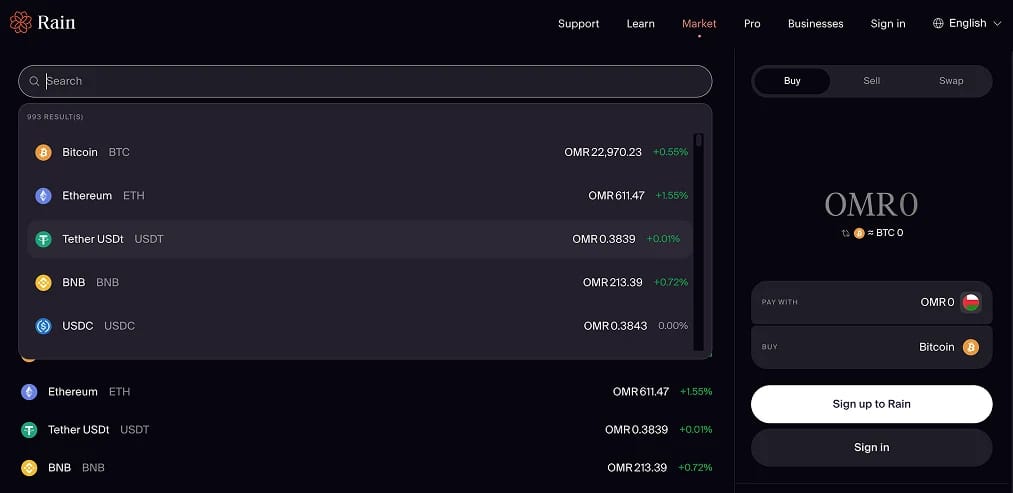
- Open the OMR market. Once the rial lands, select Tether (USDT) and set the pair to OMR. Rain prices USDT straight against the rial, with no detour through USD or BTC.
- Place the order. Enter the amount in OMR or USDT, check the quoted rate and spread, and confirm. The minimum trade is about $30, near 11.5 rial. The USDT lands in your Rain balance at once.
- Withdraw to self-custody. For anything you plan to hold or send onward, move the USDT to a private wallet. Choose TRC-20 (Tron) for cheap, fast transfers and remittances, or ERC-20 (Ethereum) for DeFi, which costs more in gas.
OMR to USDT Fees
The all-in cost of an OMR-to-USDT buy depends mostly on your funding method rather than the trade. Rain prices through a spread over the live rate, then adds a funding markup that varies by method.
Deposits
- OMR bank transfer (recommended): The cheapest entry. The deposit is free, and the cost sits in the spread, historically within a fraction of a percent of the international rate during banking hours. A first transfer settles in one to four business days.
- Debit or credit card: Near-instant, but pricier at roughly 4% all-in with the processor markup. Worth it only when you need USDT within minutes.
- Crypto deposit: Sending USDT or another asset from an outside wallet skips the fiat leg and costs only the network fee.
Trading and withdrawals
- Spread: Rain folds its margin into the buy and sell quote rather than charging a separate commission, so the displayed price is close to what you pay. Compare the OMR quote across a few refreshes before a large order.
- USDT network fees: TRC-20 transfers cost about $1 and confirm in under a minute. ERC-20 runs higher and tracks Ethereum gas. Solana and BNB Chain are cheaper where the destination supports them.
- Off-ramp to OMR: Selling USDT back to rial mirrors the buy side. Proceeds return to your Rain balance, then to your linked Omani bank account, usually within the same one-to-four-day window.
To compare the broader market first, our roundup of the best USDT exchanges covers fee structures across global venues.
Best USDT Exchanges in Oman
The table ranks the platforms most useful for buying USDT in Oman, weighted on OMR funding, licensing, fees, and depth. Rain leads on local fiat rails and Gulf regulation, while the offshore names offer deeper USDT liquidity but no OMR bank channel.
The working order is Rain for a regulated OMR-to-USDT path, Bybit for the deepest USDT book once funded, and Binance or OKX for breadth if you accept operating outside any Gulf licensing perimeter.
Regulatory Status of USDT in Oman
Oman is building its crypto regime rather than banning it. An interim AML regime under FSA Decision E/35/2023 already binds any provider serving Omani users, and the coming Virtual Assets Regulatory Framework will add full licensing once enacted.
Four bodies share oversight:
Two things matter for buyers. No exchange holds a full Oman licence yet, so platforms like Rain operate on their Bahrain and Abu Dhabi authorisations, and any claim of direct CBO licensing is a red flag. Registered providers also report into the NCFI, so activity on a compliant platform reaches authorities through formal channels.
Tax Implications of USDT in Oman
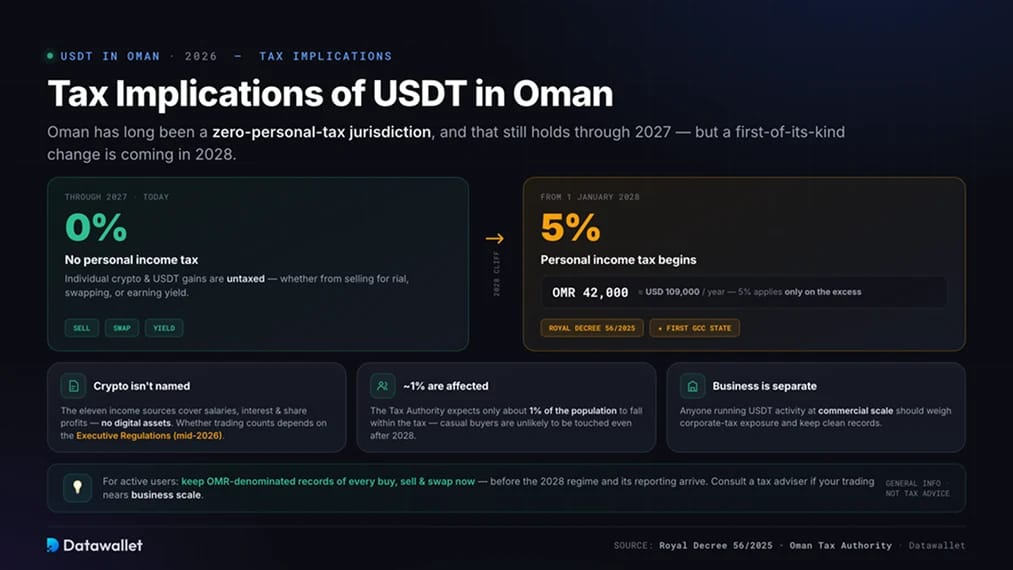
Oman has long been a zero-personal-tax jurisdiction, and that still holds. Through 2027, individuals pay no tax on crypto gains, whether from selling USDT for rial, swapping it, or earning yield. The detail of what comes next matters.
- No personal income tax applies until 2028. Individual crypto and USDT gains are untaxed for now.
- A 5% personal income tax begins 1 January 2028. Under Royal Decree No. 56/2025, individuals earning over OMR 42,000 a year (about USD 109,000) pay 5% on the excess, making Oman the first GCC state to tax personal income.
- Crypto is not named in the law. The eleven income sources cover salaries, self-employment, interest, and profits from shares and their disposal, with no reference to digital assets. Whether active USDT trading counts as self-employment income depends on the Executive Regulations, due by mid-2026.
- The threshold exempts most residents. The Oman Tax Authority expects only about 1% of the population to fall within the tax, so casual buyers are unlikely to be affected even after 2028.
- Trading as a business is separate. Anyone running USDT activity at commercial scale should weigh corporate-tax exposure and keep clean records.
💡 For active users: keep OMR-denominated records of every buy, sell, and swap now, before the 2028 regime and its reporting arrive. A tax adviser familiar with the coming Executive Regulations is worth consulting if your trading nears business scale. This is general information, not tax advice.
Why Omanis Hold USDT
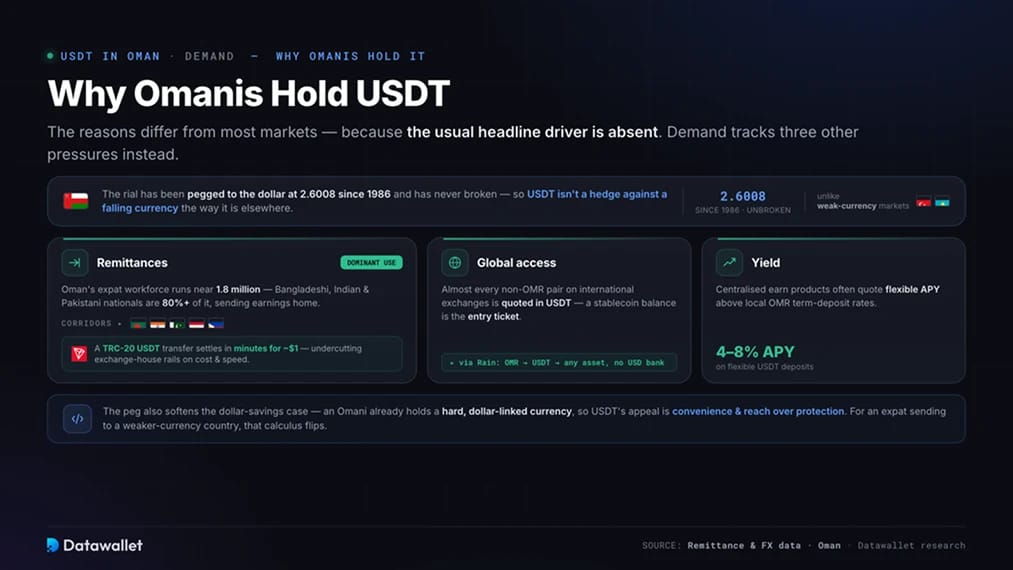
The reasons differ from most markets, since the usual headline driver is absent. The rial has been pegged to the dollar at 2.6008 since 1986 and has never broken, so USDT is not a hedge against a falling currency the way it is in Turkey or Kazakhstan. Demand tracks three other pressures.
- Remittances. The dominant use. Oman's expat workforce runs near 1.8 million, with Bangladeshi, Indian, and Pakistani nationals over 80% of it, and the main corridors point to South Asia, Egypt, and the Philippines. A TRC-20 USDT transfer settles in minutes for about a dollar, undercutting exchange-house rails on cost and speed. For workers remitting monthly, that gap compounds.
- Access to global markets. Almost every non-OMR pair on international exchanges is quoted in USDT. A stablecoin balance is the entry ticket, and on Rain you can move rial into USDT and onward to any listed asset without a USD bank account.
- Yield. Centralised earn products on USDT often quote 4% to 8% APY for flexible deposits, above OMR term-deposit rates at local banks. Our guide to USDT yield opportunities covers the structures and risk tradeoffs.
The peg also softens the dollar-savings case. An Omani saver already holds a hard, dollar-linked currency, so USDT's appeal is convenience and reach over protection. For an expat sending earnings to a weaker-currency country, that calculus flips.
Final Thoughts
Rain is the pick for buying USDT in Oman. Nothing else pairs a Gulf regulatory licence, native OMR rails through banks like Bank Muscat, and a direct rial-to-USDT market. Its CBB and ADGM standing hold even with Oman's own framework still pending.
One caveat. Rain was breached for around $16 million in April 2024 by North Korea's Lazarus Group, though it covered the loss and protected customer balances. Keep only trading capital on any exchange and self-custody the rest in a USDT wallet.
.webp)