


Can I Buy USDT in Ukraine?
Ukrainian law does not prohibit individuals from owning or trading USDT. The Law "On Virtual Assets", signed in March 2022, never took effect because it depends on Tax Code amendments that parliament has not passed. Its replacement, Bill 10225-d, passed a first reading in the Verkhovna Rada last September and remains in preparation for its second reading.
Funding a purchase is more difficult. The NBU's wartime Resolution No. 18 classifies crypto purchases as quasi-cash, meaning payments that convert directly into cash-like assets. Hryvnia accounts cannot make quasi-cash payments. Cards linked to foreign currency accounts have a monthly limit equivalent to UAH 100,000. Several household limits rose under the currency control easing effective from 11 August, but quasi-cash was not among them.
A P2P purchase uses a domestic hryvnia transfer between individuals, so the cross-border restriction does not apply. Bank transfer limits still do. Banks participating in the payment transparency memorandum cap outgoing transfers at UAH 100,000 a month for clients without documented income, falling to UAH 50,000 for high-risk clients. Our tests found that hryvnia card checkouts failed more often than they cleared. A P2P payment to a seller at the same bank completed in minutes.
How to Buy Tether (USDT) in Ukraine
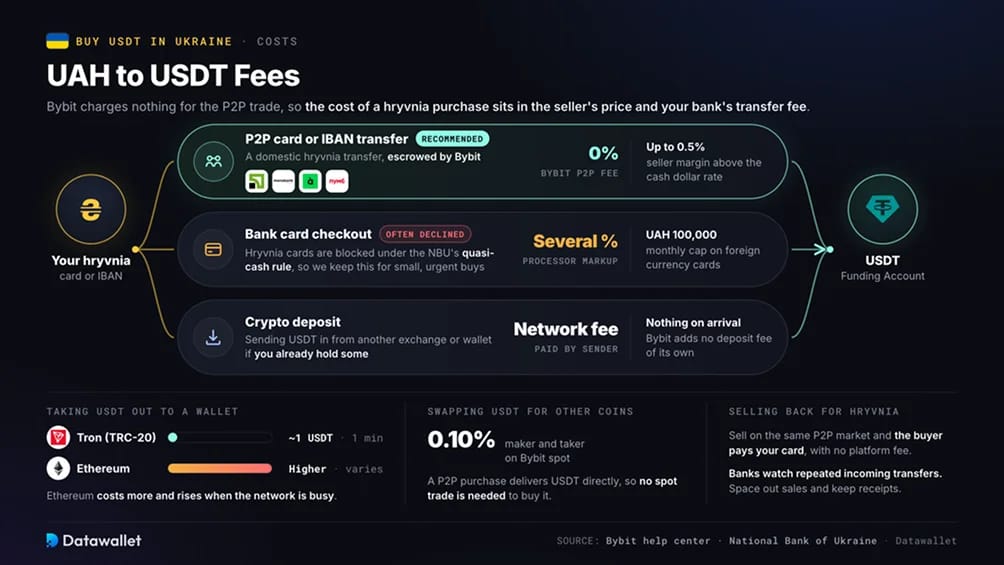
We recommend using a verified Bybit account and paying for a P2P order from a card or IBAN account in your name. Hryvnia does not appear on Bybit's list of supported fiat deposits, so each purchase is a direct exchange of hryvnia for a seller's USDT. Before placing an order, PrivatBank customers should read our PrivatBank crypto guide. The bank includes P2P card transfers in its monthly cap.
Steps to buy USDT on Bybit in Ukraine:
- Register and pass identity checks: Create a Bybit account and switch to Ukrainian if preferred. Complete verification with a biometric passport or ID card, entering your name with the same Latin spelling shown on the document.
- Open the UAH P2P market: Under Buy Crypto, select P2P Trading and choose USDT against UAH. Filter offers by your bank and purchase amount. Look for sellers with several hundred completed orders and a completion rate above 95%.
- Pay the seller from your own account: Transfer the exact hryvnia amount before the order expires, often within 15 minutes. Keep the payment comment blank, as references to crypto can trigger a bank review. Save your receipt.
- Confirm and wait for release: Mark the payment as complete in the app. Bybit holds the seller's USDT in escrow from the moment the order opens, releasing it after the seller sees your transfer. Our Monobank orders were released in under three minutes.
- Hold, trade, or withdraw: Your USDT arrives in the Funding Account. Transfer it to the trading account to buy other coins, or send it to your own USDT wallet on a network supported by the destination.
At recent rates, one USDT costs about 45 hryvnias. Sellers base their prices on the cash market, placing USDT slightly above the NBU's official dollar rate of roughly 44.7.
UAH to USDT Fees
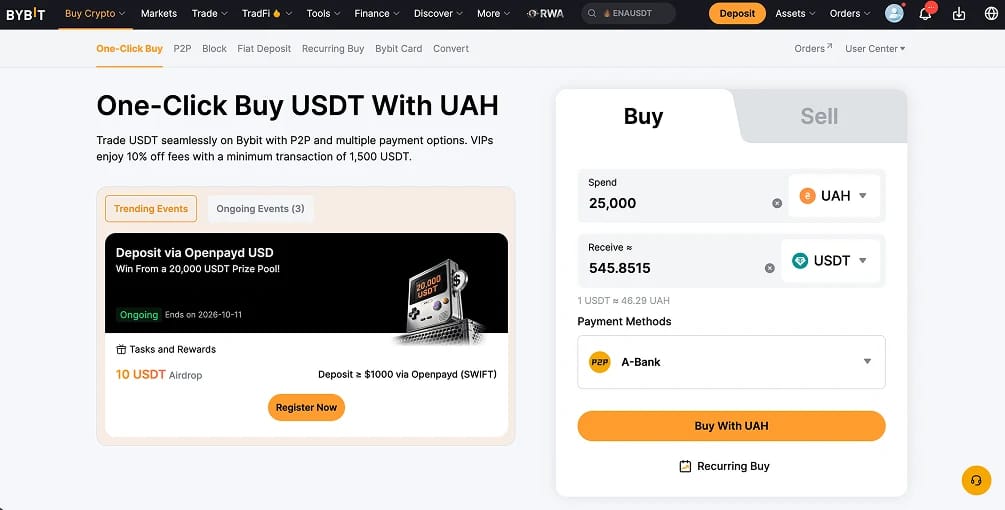
The seller's quoted price and any bank transfer charge determine the cost of a hryvnia P2P purchase. Bybit charges no fee for the trade itself.
Deposits
- P2P card or IBAN transfer (recommended): Bybit charges neither party a P2P fee for UAH. Sellers include their margin in the exchange rate. In our tests, the best offers at major retail banks were no more than 0.5% above the cash dollar rate. Using a seller at your own bank usually avoids a card-to-card charge.
- Bank card checkout: Checkout is convenient when successful, but the quasi-cash rule causes frequent declines for hryvnia cards. Payment processor markups also make it several percent more expensive than P2P. We reserve this option for small, urgent purchases with a foreign currency card.
- Crypto deposit: Transferring USDT from another wallet or exchange costs only the network fee charged by the sending platform.
Trading
- Spot orders: You receive USDT directly through P2P, with no spot trade required. Bybit's 0.10% maker and taker fees apply only when exchanging USDT for other coins. These are the charges for placing an order on the order book or matching an existing one.
Withdrawals
- USDT to a wallet or another platform: At roughly 1 USDT per withdrawal, Tron (TRC-20) is the cheap option and confirms in about a minute. Ethereum withdrawals cost more, with fees rising during busy periods.
- USDT back to hryvnia: Sell through the same P2P market to receive the buyer's payment on your card. Banks monitor repeated transfers from unfamiliar senders, so space out sales and retain every receipt.
Best USDT Exchanges in Ukraine
UAH funding options and the availability of sellers at Ukrainian banks are the main practical differences between these exchanges. Fees and regulatory standing also matter. Our guide to the best crypto exchanges in Ukraine reviews each platform in full.
Bybit leads for active UAH sellers and language support, while Binance has a hryvnia P2P market of similar scale. OKX offers the lowest spot fees. For buyers who already hold USDT, Kraken suits long-term storage. Ukrainian-founded WhiteBIT is the only platform listed with a USDT/UAH order book.
Regulatory Status of USDT in Ukraine
Ukraine has no crypto licensing regime in force. Exchanges operate without a local licence, subject only to ordinary civil law and anti-money-laundering rules. Four institutions share oversight.
Bill 10225-d would align Ukraine's framework with the EU's Markets in Crypto-Assets Regulation (MiCA). It distinguishes between e-money tokens pegged to one official currency, asset-referenced tokens backed by other holdings, and other crypto assets. USDT would most likely fall into the e-money category. The finance committee chair has confirmed that the NSSMC would lead regulation, with NBU support. Crypto would remain prohibited as a means of payment.
Banking controls are tightening alongside these reforms. The payment transparency memorandum expanded to high-risk sole traders in May. On 15 September, parliament backed Bill 16013 at first reading, which would criminalise handing over bank cards or accounts for fraudulent use, commonly known as drop accounts.
Bybit serves Ukrainian residents through its global platform without a Ukrainian crypto licence, since no local licensing regime is active. Its overseas licences do not place these accounts under those regulators' direct supervision. Access is also restricted in Crimea, Donetsk, Luhansk, and Sevastopol.
Tax Implications of USDT in Ukraine
Without a dedicated crypto tax regime, Ukraine applies general income rules to sales. The State Tax Service's current treatment is harsher for stablecoin holders than the proposed law would be.
- Buying is not a taxable event: Exchanging hryvnia for USDT counts as an acquisition. Tax questions arise when you sell for hryvnia or another state currency.
- Sales fall under general income tax today: The State Tax Service includes money received from crypto sales in annual taxable income. The rates are 18% personal income tax and a 5% military levy.
- The tax office counts the full amount received: Its published position taxes the entire sum received, while current law provides no settled method for deducting the purchase cost. Selling USDT for UAH 100,000 after buying it for UAH 98,000 can therefore produce an assessment starting from the full 100,000.
- You declare it yourself: Private individuals buying through P2P do not withhold tax. Report the income in your annual declaration through the Electronic Cabinet by 1 May.
- Bill 10225-d would tax profit instead: Under the first-reading text, 18% plus 5% would apply to sale proceeds after deducting documented purchase costs. Assets acquired before the law takes effect would qualify for a 5% income tax rate if sold during its first year.
- Hryvnia devaluation creates taxable gains: Results under the bill would be measured in hryvnia, including exchange-rate differences. Buying USDT at 41 and selling at 45 produces a hryvnia profit despite no change in its dollar value.
- Swaps between tokens would not be taxed: The bill would allow USDT-to-Bitcoin exchanges without creating a tax liability. Sole traders using the simplified system would be prohibited from conducting crypto trades through it.
💡 For active users: Record each P2P purchase's hryvnia value on the transaction date and export your Bybit order history quarterly. If the profit-based regime takes effect, these records will be your only proof of cost. Consult a Ukrainian tax adviser before filing if you sell large amounts. This is general information, not a substitute for tax advice.
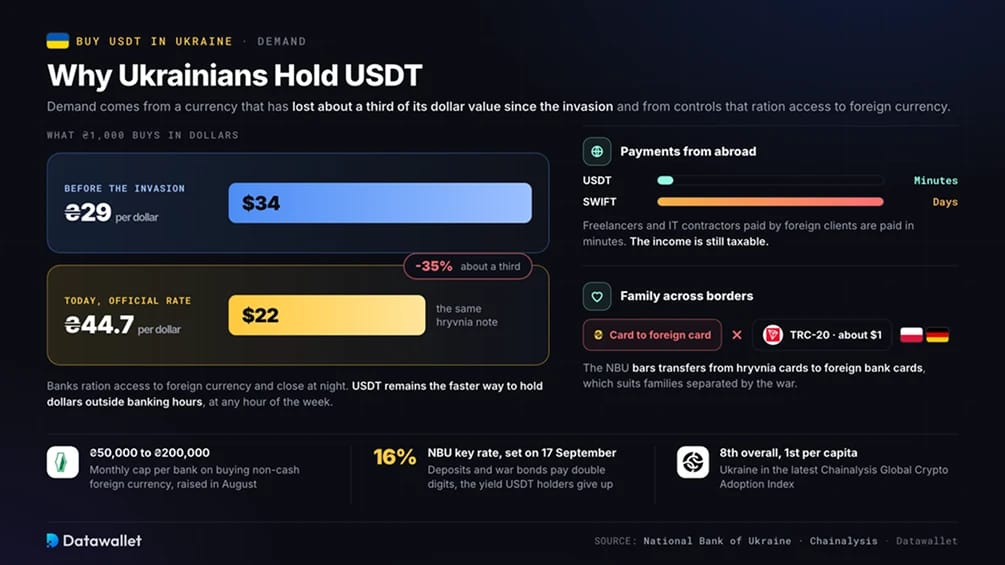
Why Ukrainians Hold USDT
The hryvnia has lost about a third of its dollar value since the invasion. That decline, together with controls limiting access to foreign currency, drives demand for USDT.
- A dollar balance available at any hour: Before the invasion, the official exchange rate was about 29 hryvnias per dollar. It is now roughly 44.7. August's easing increased the monthly limit for buying non-cash foreign currency from UAH 50,000 to UAH 200,000 per bank, though USDT remains the faster way to hold dollars outside banking hours.
- Hryvnia yields compete for the same money: Hryvnia deposits and war bonds offer double-digit returns, and the NBU raised its key rate to 16% on 17 September. Holding USDT means forgoing that yield for dollar exposure.
- Payments from abroad: Foreign clients can pay freelancers and IT contractors in USDT within minutes. SWIFT transfers take days and pass through bank currency checks. Income received in USDT remains taxable.
- Family across borders: With the NBU barring transfers from hryvnia cards to foreign bank cards, a TRC-20 transfer offers families separated by the war a way to send funds. It reaches a relative in Poland or Germany for about a dollar.
- One of the world's most active crypto populations: The latest Chainalysis Global Crypto Adoption Index places Ukraine eighth overall and first per capita. Tether's circulation is tracked on our USDT statistics page.
Final Thoughts
For hryvnia buyers, an exchange's usefulness depends on the availability of UAH sellers, including late on a Sunday. Bybit had the most active sellers at the banks Ukrainians use. Its Ukrainian interface and escrow on every order support a P2P market with no platform fee. See our Bybit review for the rest of the platform.
No exchange, including Bybit, can obtain a Ukrainian licence until Bill 10225-d passes. Ukrainian law therefore provides no complaint channel if your account is frozen. Bybit also lost roughly $1.5 billion in a hack linked to North Korea's Lazarus Group in February last year, although it covered every customer balance from its own reserves. Keep trading funds on the exchange and transfer savings to a wallet you control.
Begin with a test order of a few hundred hryvnias and pay only from your personal account. Before exceeding UAH 100,000 in monthly transfers, confirm your income in your bank's app. Record the hryvnia cost of every purchase as you make it, since those records protect you under either set of tax rules.