






Who is Cathie Wood?
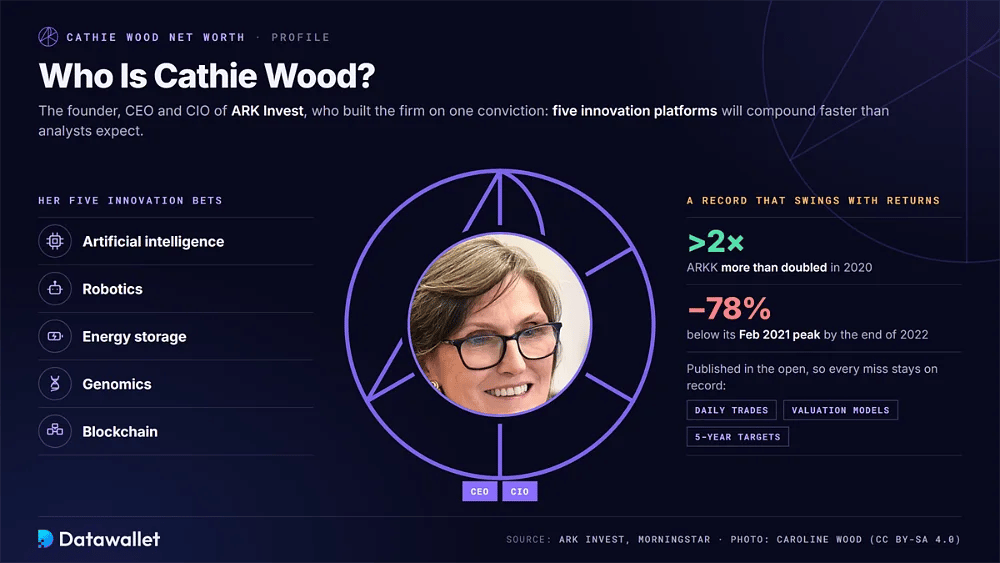
Cathie Wood is an American fund manager who built ARK Investment Management around one conviction: that artificial intelligence, robotics, energy storage, genomics and blockchain will compound faster than traditional analysts expect. She serves as both CEO and chief investment officer, so the firm's largest bets ultimately carry her personal sign-off.
Her reputation moves with her returns. The flagship ARKK more than doubled in 2020, then finished 2022 about 78% below its February 2021 peak. Since then, the fund has swung between sharp rallies and painful drawdowns, posting top-five annual rankings in some years while its five-year record stays negative.
Few managers expose their process this openly. ARK publishes its daily trades, releases its valuation models and broadcasts five-year price targets on social media and financial television. That openness built a loyal retail audience, but it also keeps every missed forecast, costly exit and badly timed purchase permanently on the public record.
Cathie Wood's Background
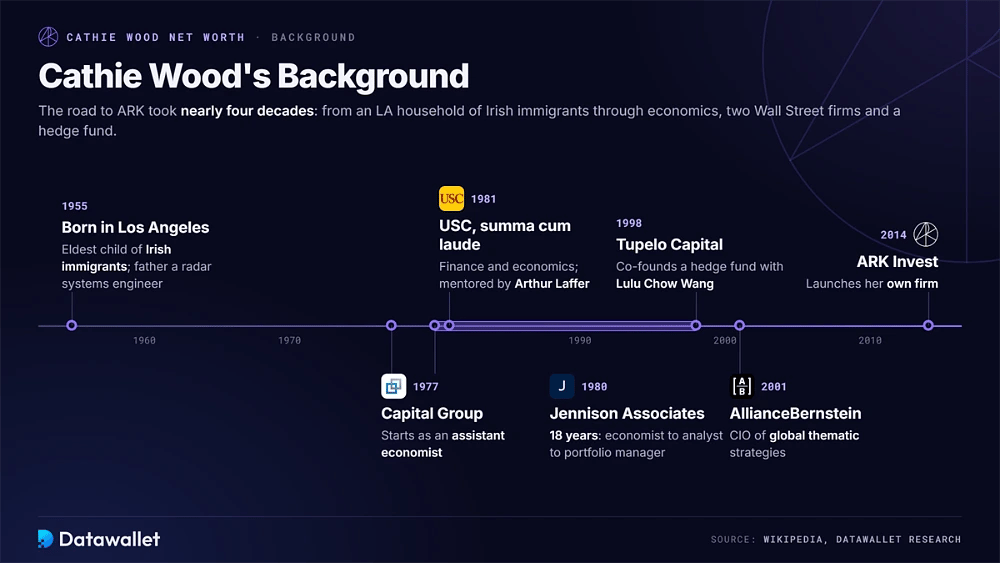
Wood's road to ARK took nearly four decades. It runs from a Los Angeles household of Irish immigrants through economics research, two Wall Street firms, a hedge fund and a rejected product pitch that eventually became her own company.
Early Life and Education
Catherine Duddy Wood was born on November 26, 1955, in Los Angeles, the eldest child of Irish immigrants. Her father worked as a radar systems engineer, and she has credited that household with her comfort around technical problems. A devout Catholic upbringing also shaped her worldview and, later, the name she chose for her firm.
She studied finance and economics at the University of Southern California, graduating summa cum laude in 1981. At USC she met supply-side economist Arthur Laffer, who became a mentor and helped open early doors in the industry. His influence still shows whenever she frames markets around productivity, deflation and long economic cycles.
From Economist to Stock Picker
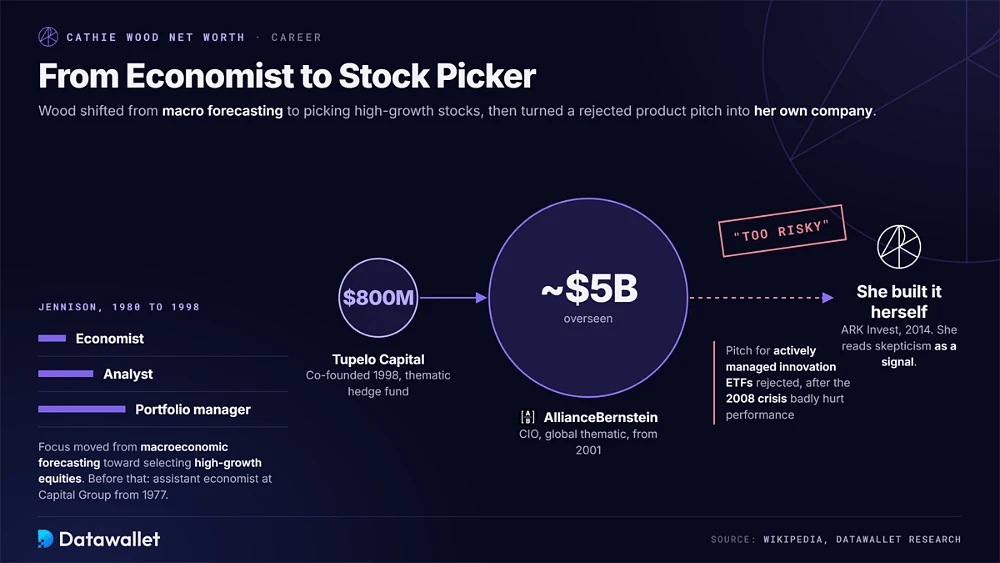
Wood began her career at Capital Group in 1977 as an assistant economist, then moved to New York in 1980 to join Jennison Associates. Over 18 years there, she progressed from economist to analyst and portfolio manager, steadily shifting her focus from macroeconomic forecasting toward selecting high-growth equities.
In 1998 she co-founded the hedge fund Tupelo Capital Management with Lulu Chow Wang, growing it to roughly $800 million in thematic strategies. She then joined AllianceBernstein in 2001 as chief investment officer of global thematic strategies, eventually overseeing about $5 billion before the 2008 crisis badly damaged her performance.
When AllianceBernstein rejected her proposal for actively managed ETFs built around disruptive innovation, calling the idea too risky, Wood decided to build it herself. That rejection became the founding story she still tells investors, and it explains why she treats institutional skepticism as a signal rather than a warning.
Founding ARK Invest
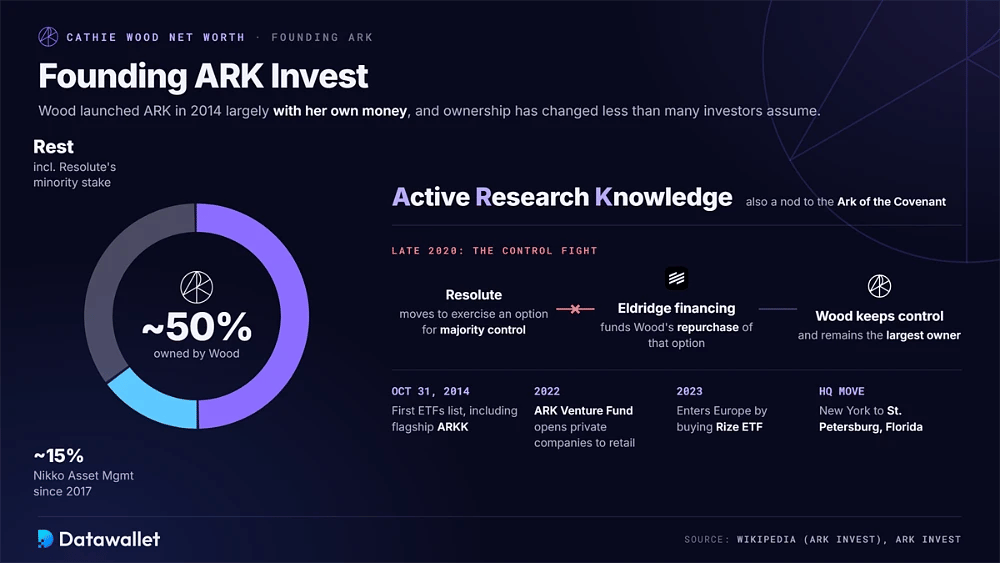
Wood launched ARK Investment Management in 2014, funding much of the early operation herself. The name stands for Active Research Knowledge and also references the Ark of the Covenant. ARK listed its first ETFs on October 31, 2014, including the ARK Innovation ETF (ARKK), which remains its flagship product.
Ownership has changed less than many investors assume. According to ARK's Wikipedia profile, Nikko Asset Management took a 15% stake in 2017. In late 2020, Resolute Investment Managers moved to exercise an option for majority control, but Wood repurchased that option with financing from Eldridge Industries and kept control.
ARK later moved its headquarters from New York to St. Petersburg, Florida, and entered Europe in 2023 by acquiring Rize ETF, Europe's first specialist thematic ETF issuer. It also manages the ARK Venture Fund, a retail-accessible interval fund launched in 2022 that holds private companies alongside listed ones.
Boom, Bust and Partial Recovery
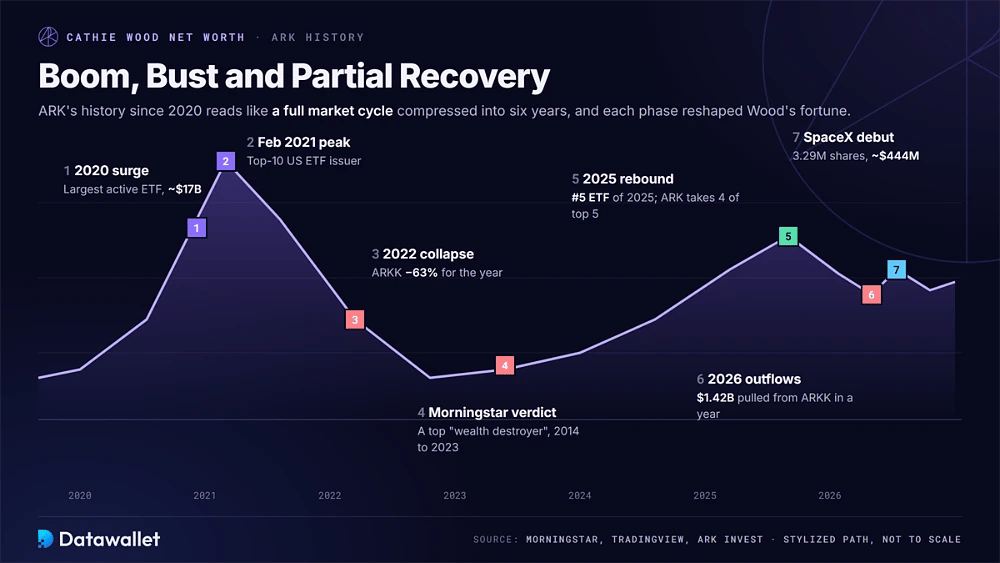
ARK's history since 2020 reads like a full market cycle compressed into six years. Each phase reshaped the firm's assets, its fee income and, by extension, the estimates attached to Wood's personal fortune over time.
The key turning points in ARK's recent history are summarized below:
- 2020 surge: Near-zero interest rates and lockdown-era enthusiasm for technology lifted ARK's speculative holdings, and by December 2020 ARKK had become the largest actively managed ETF, with roughly $17 billion.
- 2021 peak: ARKK set its record in February 2021, and ARK briefly ranked among the ten largest US ETF issuers as retail investors copied its daily trades in real time.
- 2022 collapse: As the Federal Reserve raised rates aggressively, ARKK fell 63% for the year. Unprofitable growth stocks were hit hardest, and investors who bought near the top redeemed billions.
- Morningstar verdict: Morningstar later ranked ARKK among the biggest "wealth destroyers" from 2014 to 2023, measuring the dollar value shareholders lost after stripping out the effect of inflows and outflows.
- 2025 rebound: Morningstar ranked ARKK as the fifth-best performing ETF of 2025, and ARK funds claimed four of the top five spots as AI, crypto and fintech holdings rallied together.
- 2026 reset: Despite that rebound, investors pulled about $1.42 billion from ARKK over the past year, according to TradingView, leaving the fund far below its former $29 billion peak.
- SpaceX debut: When SpaceX listed in June 2026, ARK bought roughly 3.29 million shares worth about $444 million, turning a long-held private conviction into one of its largest public positions.
Cathie Wood's Net Worth in 2026
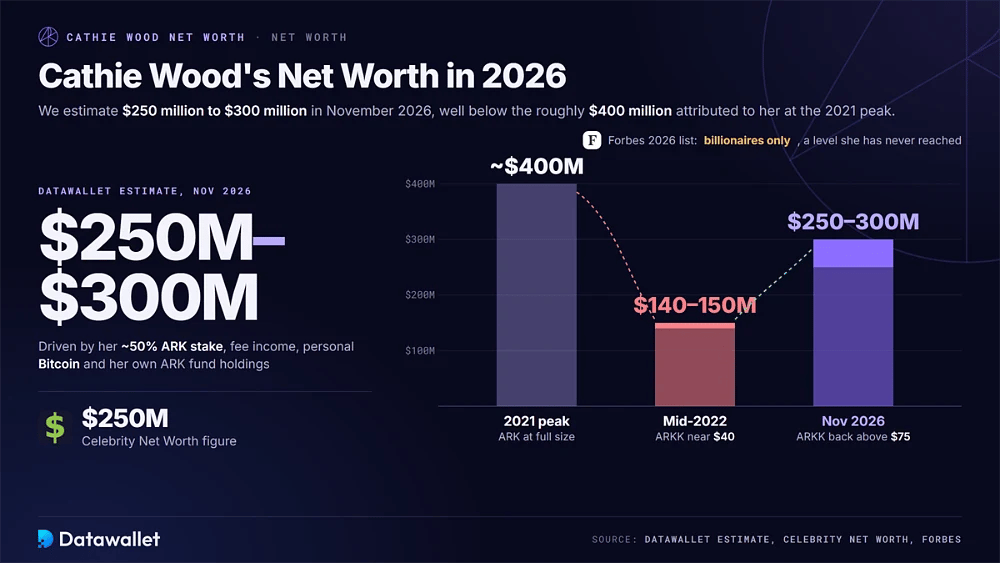
We estimate Cathie Wood's net worth at $250 million to $300 million in November 2026. Celebrity Net Worth places her at $250 million, well below the roughly $400 million attributed to her at ARK's 2021 peak.
Her wealth breaks down into several distinct components and drivers:
- ARK stake: Wood owns roughly 50% of ARK Investment Management. Because the firm is private, the stake has no market price and is valued using asset-manager multiples on estimated revenue.
- Partner dilution: Nikko Asset Management holds about 15%, and Resolute Investment Managers remains a minority owner. Those stakes cap how much of ARK's profits flow to Wood personally each year.
- Fee income: ARKK charges a 0.75% expense ratio, and ARK reports about $16 billion in regulatory assets. Every billion gained or lost shifts annual fee revenue by several million dollars.
- Bitcoin exposure: In January 2024, Wood said at least 25% of her financial net worth sits in Bitcoin, excluding ARK and real estate, so Bitcoin's 2026 slide weighs on her.
- ARK funds: Wood has said she invests personally in ARK's own strategies. The amounts are undisclosed, but a weak year for ARKK hits her portfolio and business together.
- Past swings: Estimates fell to roughly $140 million to $150 million by mid-2022, when ARKK traded near $40, before recovering toward $250 million as the fund climbed back above $75.
- Forbes status: Forbes has not listed her among America's richest self-made women since 2021, and its 2026 ranking admitted only billionaires, a threshold Wood has never reached.
How ARK Invest Makes Money
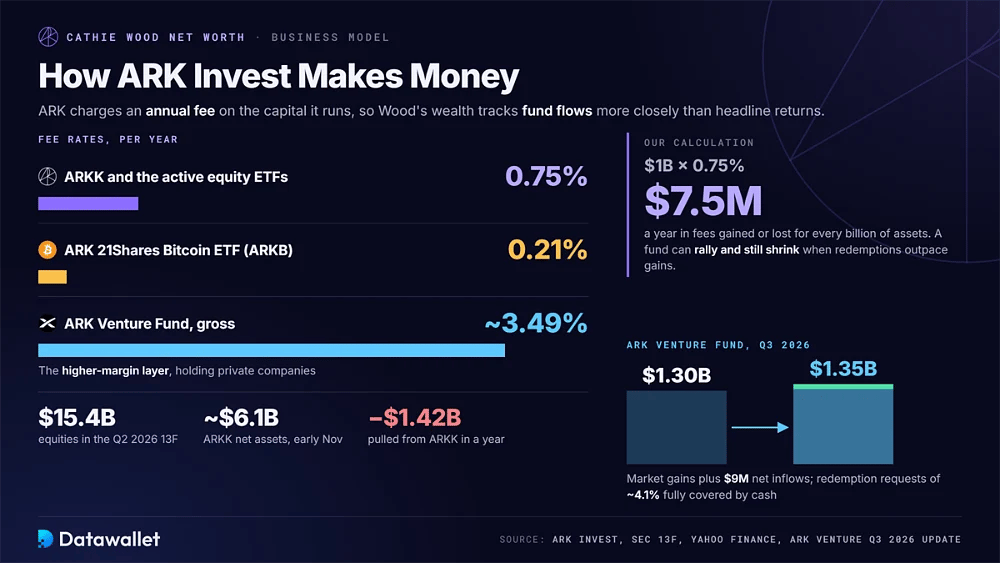
ARK earns revenue the way most asset managers do: by charging an annual fee on the capital it oversees. Its active equity ETFs, including ARKK, charge 0.75%, while the ARK 21Shares Bitcoin ETF charges 0.21%. The Q2 2026 13F filing showed about $15.4 billion in reported equities.
That structure explains why Wood's wealth follows fund flows more closely than headline returns. A fund can rally and still shrink if redemptions outpace gains, which is exactly what happened to ARKK through 2026. The fund's net assets stood near $6.1 billion in early November.
The ARK Venture Fund adds a higher-margin layer, with a gross expense ratio around 3.49%. According to ARK's third-quarter update, its assets grew from $1.30 billion to $1.35 billion on market gains and $9 million of net inflows, while redemption requests of about 4.1% were fully covered by cash.
Cathie Wood's Investment Portfolio
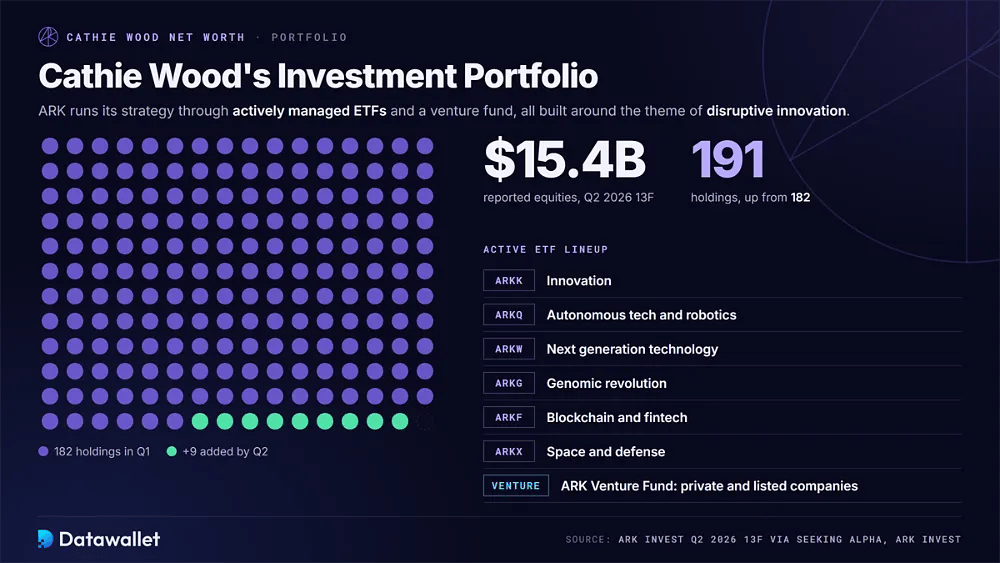
ARK runs its strategy through actively managed ETFs and a venture fund, all built around the theme of disruptive innovation. Its Q2 2026 13F showed about $15.4 billion spread across 191 holdings, up from 182 one quarter earlier.
ARKK's Largest Positions
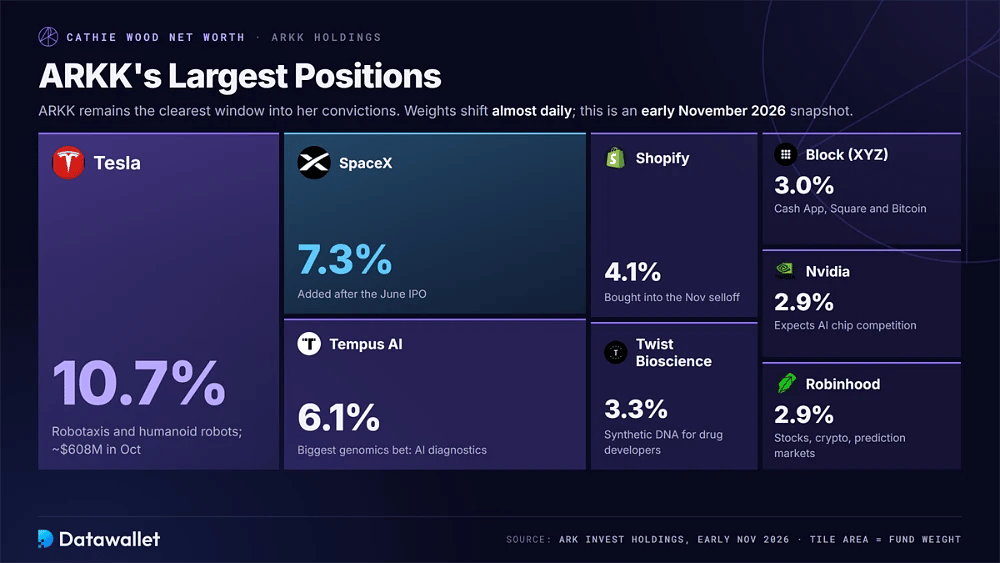
ARKK remains the clearest window into Wood's convictions. Its weights change almost daily because ARK routinely trims winners and adds to laggards, so the snapshot below reflects early November 2026 data rather than a fixed allocation.
These were among ARKK's most prominent holdings in early November 2026:
- Tesla (10.7%): Still ARKK's largest position, worth roughly $608 million in October. ARK has trimmed Tesla repeatedly in 2026 while keeping robotaxis and humanoid robots central to its thesis.
- SpaceX (7.3%): Added after the June IPO and expanded through the summer selloff. Wood argues Starlink, launch services and AI computing could make it the most important company ever.
- Tempus AI (6.1%): The AI-driven diagnostics company is ARK's biggest genomics bet, combining clinical data with machine learning. ARK significantly increased the position during the second quarter of 2026.
- Shopify (4.1%): ARK bought Shopify into its post-earnings selloff in early November, treating the commerce platform as an AI-enabled operating system for millions of independent merchants worldwide.
- Twist Bioscience (3.3%): A synthetic DNA manufacturer that supplies researchers and drug developers. It reflects ARK's long-running view that falling sequencing and synthesis costs will reshape healthcare.
- Block (3.0%): Jack Dorsey's payments company, now trading as XYZ, gives ARK exposure to Cash App, Square merchants and Bitcoin-native products such as its self-custody wallet.
- Nvidia (2.9%): A smaller weight than many tech funds hold, reflecting ARK's view that AI hardware competition will intensify as custom chips and rival accelerators reach volume production.
- Robinhood (2.9%): The retail brokerage blends equities, prediction markets and crypto trading. ARK continues adding shares, even after trimming the position during the second quarter of 2026.
The ARK Venture Fund and SpaceX
The ARK Venture Fund lets investors with as little as $500 access companies normally reserved for institutions. As of August 31, 2026, SpaceX was its largest position at 7.54%, followed by OpenAI at 5.26% and Anthropic at 3.86%, with prediction market Kalshi and payments giant Stripe also among its top holdings.
SpaceX, which absorbed xAI in early 2026, went public in June in the largest IPO on record. By late July, the stock traded nearly 47% below its June peak, yet ARK kept buying across ARKK, ARKQ, ARKW and ARKX, and Wood called it potentially the most important company in history.
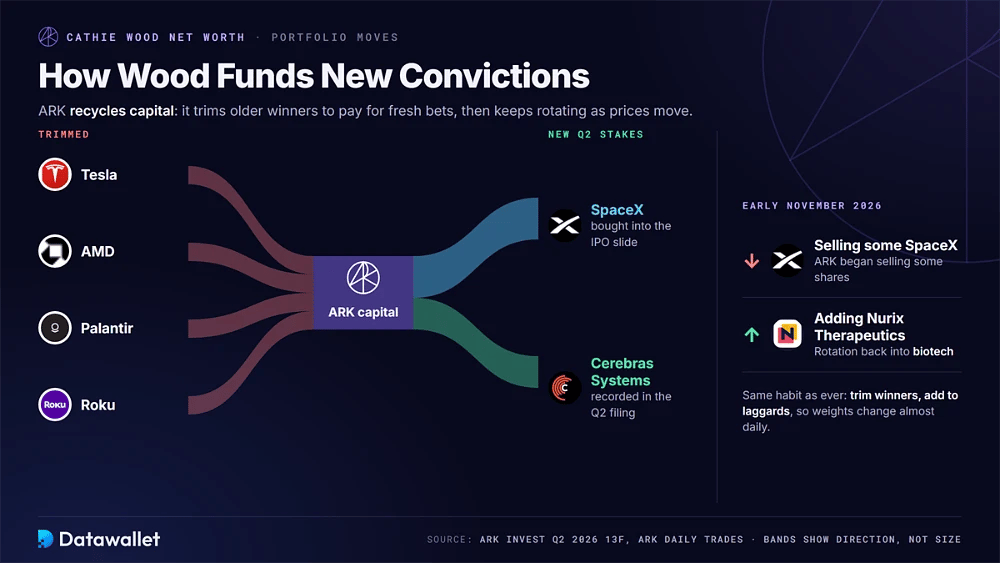
The trade shows how Wood now funds fresh convictions: by recycling capital. ARK trimmed Tesla, AMD, Palantir and Roku to make room, and its Q2 filing recorded new stakes in SpaceX and Cerebras Systems. In early November, ARK began selling some SpaceX shares while adding biotech names such as Nurix Therapeutics.
Personal Investments
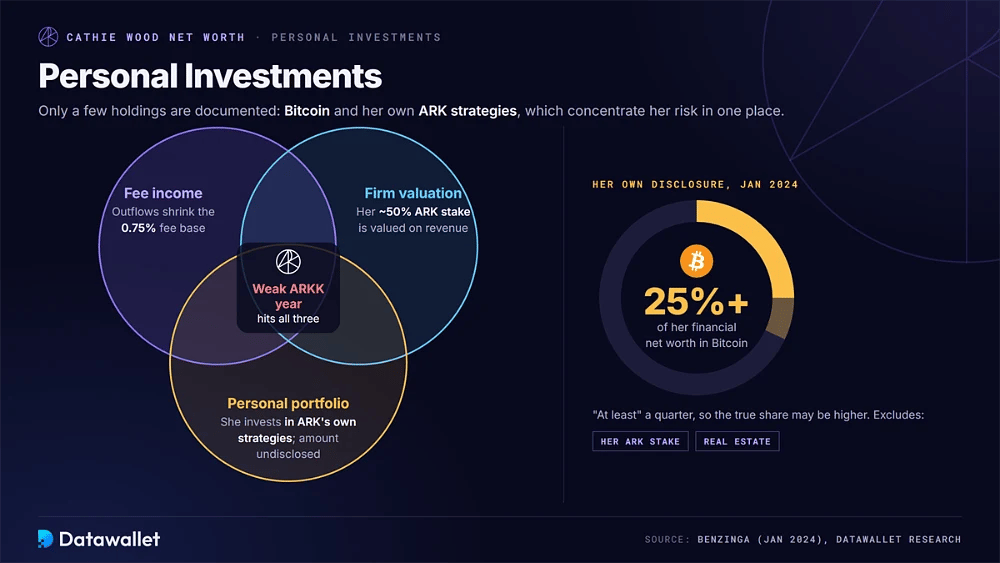
Wood has never published a full personal balance sheet, so only a few holdings are documented. Her most specific disclosure came in January 2024, when she said at least a quarter of her financial net worth sits in Bitcoin. That figure excludes both her ARK ownership and her real estate.
She has also said she invests her own money in ARK's strategies, aligning her savings with those of her clients. That alignment cuts both ways: a weak year for ARKK reduces her fee income, her firm's valuation and part of her personal portfolio simultaneously, concentrating risk in a way few founders accept.
How Has ARK Performed in 2026?
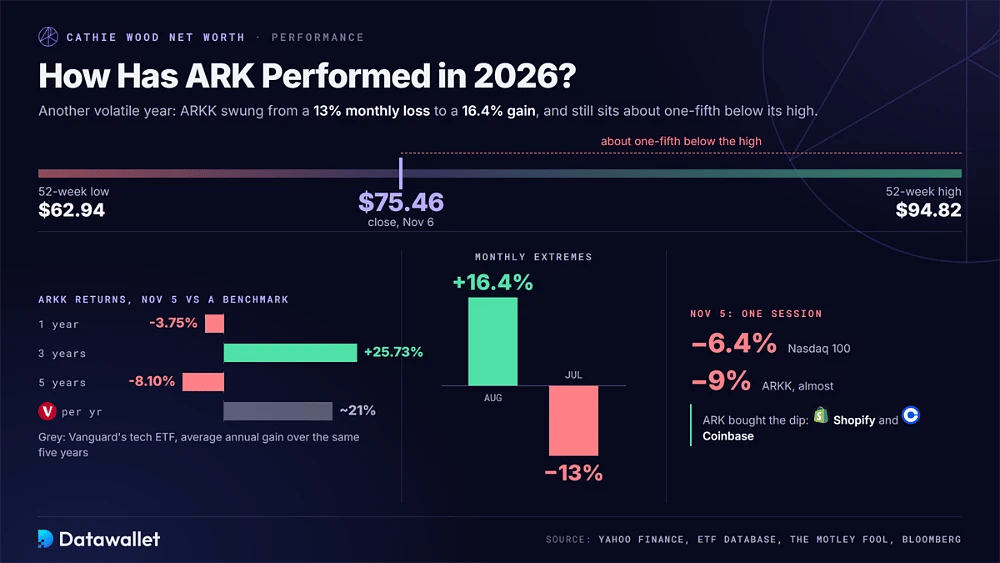
ARK's flagship has delivered another volatile year, with sharp reversals in both directions. ARKK's monthly returns ranged from a 13% loss in July to a 16.4% gain in August, and the fund closed at $75.46 on November 6, inside a 52-week range of $62.94 to $94.82, roughly one-fifth below its high.
The longer view remains uneven. As of November 5, ETF Database showed ARKK down 3.75% over one year and 8.10% over five years, yet up 25.73% over three years. The Motley Fool notes that Vanguard's technology ETF averaged roughly 21% annually across the same five-year stretch.
Early November showed how exposed ARK remains to macro shocks. On November 5, the Nasdaq 100 fell 6.4% as chipmakers slid and investors weighed Democratic control of Congress, and ARKK lost almost 9% in one session. ARK responded in familiar fashion, buying Shopify and Coinbase into the weakness.
What is Cathie Wood's Bitcoin Prediction?
Wood has backed Bitcoin since ARK first gained exposure in 2015, and she was the first high-profile investor to publish a $1 million target. ARK now frames its 2030 forecasts as scenarios, not one price.
ARK's current 2030 Bitcoin framework rests on these main elements:
- Base case: ARK's Big Ideas 2026 report projects Bitcoin's market capitalization reaching about $16 trillion by 2030, implying roughly $730,000 to $760,000 per coin and roughly 63% annual growth.
- Bull case: Wood cut the bull case from $1.5 million to $1.2 million in November 2025, though in 2026 interviews she has quoted figures between $1.25 million and $1.5 million.
- Bear case: ARK's Bitcoin valuation model puts its 2030 bear case near $300,000, assuming slower institutional adoption, weaker ETF demand and a smaller share of gold's store-of-value market.
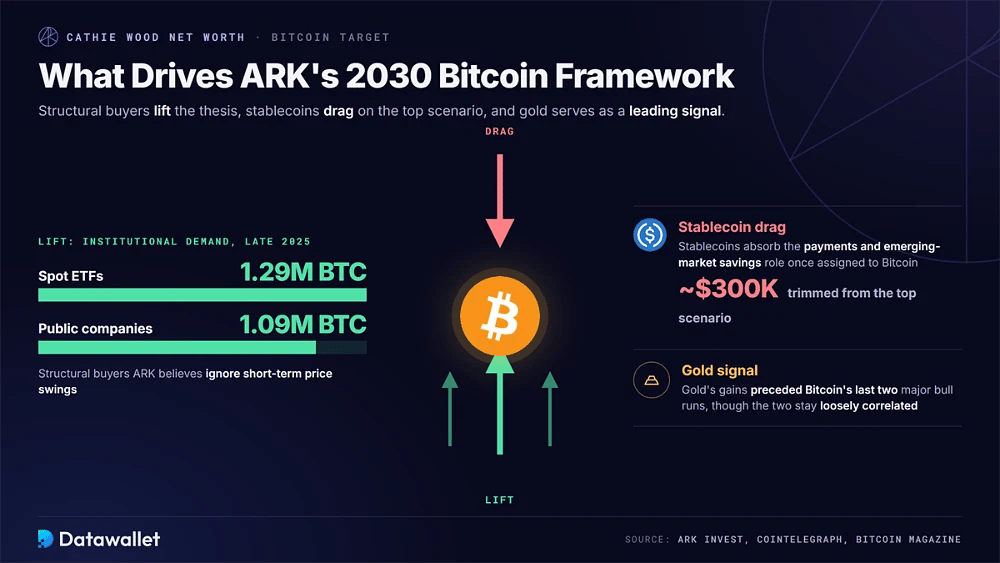
- Stablecoin drag: Wood argues stablecoins are absorbing the payments and emerging-market savings role she once assigned to Bitcoin, which is why ARK trimmed roughly $300,000 from its top scenario.
- Institutional demand: ARK reported that ETFs held 1.29 million BTC and public companies 1.09 million BTC by late 2025, structural buyers it believes ignore short-term price swings.
- Gold signal: Wood treats gold's rally as a potential leading indicator, noting that gold's gains preceded Bitcoin's last two major bull runs, though the assets remain loosely correlated.
- Current gap: With Bitcoin trading near $76,000 in early November 2026, reaching ARK's base case would require roughly a tenfold gain in about four years, a target critics consider unrealistic.
Cathie Wood's Crypto Holdings
ARK holds crypto exposure in two ways: directly through its spot Bitcoin ETF and indirectly through stakes in exchanges, stablecoin issuers and treasury companies. Together, those positions make ARK one of Wall Street's most crypto-exposed active managers.
The ARK 21Shares Bitcoin ETF
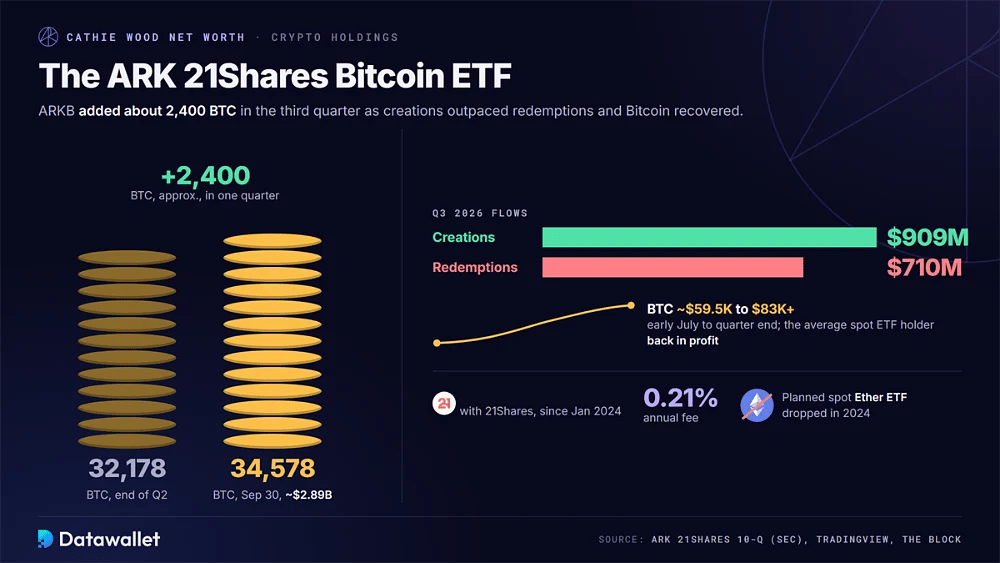
ARK partners with 21Shares, the fund's sponsor, on the ARK 21Shares Bitcoin ETF (ARKB), launched in January 2024 with a 0.21% fee. Its latest 10-Q shows 34,578 BTC worth about $2.89 billion on September 30, 2026, up from 32,178 BTC three months earlier, a net gain of about 2,400 coins.
Third-quarter creations of about $909 million outpaced roughly $710 million in redemptions as Bitcoin recovered from near $59,500 in early July to above $83,000. ARK said the average spot ETF holder returned to profit during that rally. Our Bitcoin ETF tracker follows ARKB's flows against rivals.
ARK has kept its direct crypto products Bitcoin-only. In 2024, it withdrew from a planned spot Ether ETF with 21Shares, saying it still believed in Ethereum's potential. Since then, its Ethereum exposure has come mostly through equities such as BitMine and Coinbase rather than through tokens or dedicated funds.
ARK's Crypto Equity Positions
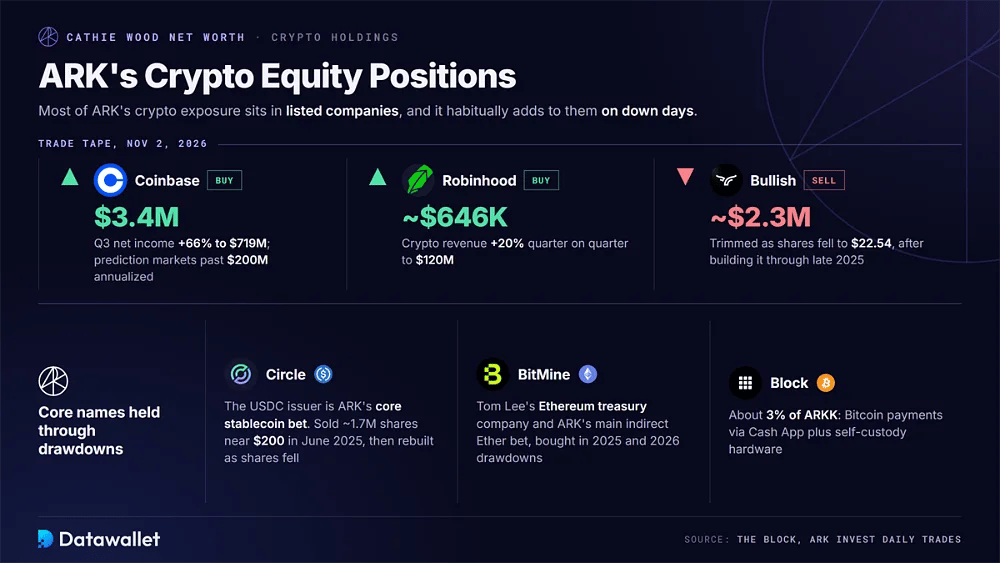
Most of ARK's crypto exposure sits in listed companies rather than tokens. The firm habitually adds to these names on down days, as it did on November 2, 2026, when Coinbase, Circle and Robinhood closed lower.
These are the crypto-linked companies ARK trades most actively right now:
- Coinbase: ARK bought $3.4 million of Coinbase on November 2, after third-quarter net income rose 66% to $719 million and prediction-market revenue passed a $200 million annualized pace.
- Circle: The USDC issuer remains ARK's core stablecoin bet. ARK sold about 1.7 million shares near $200 in June 2025, then rebuilt the position as shares fell.
- Robinhood: ARK added roughly $646,000 of Robinhood on November 2. The brokerage's crypto revenue rose 20% from the prior quarter to $120 million, offsetting softer trading activity.
- Bullish: ARK sold about $2.3 million of the Peter Thiel-backed exchange on November 2 as shares fell to $22.54, trimming a position it had aggressively built through late 2025.
- BitMine: The Ethereum treasury company chaired by Tom Lee is ARK's main indirect Ether bet. ARK bought repeatedly during 2025 and 2026 drawdowns, often alongside Circle and Bullish.
- Block: Roughly 3% of ARKK, Block connects ARK to Bitcoin payments through Cash App and its self-custody hardware, complementing the firm's direct Bitcoin exposure through ARKB.
Final Thoughts
Cathie Wood's net worth remains an estimate rather than a disclosed figure, and that is the most useful way to read it. Her roughly $250 million to $300 million reflects confidence in ARK, tied to a private ownership stake and a fee stream that expands and shrinks with investor sentiment.
The 2026 record is mixed. The SpaceX listing validated her private-market strategy, and ARKB gave ARK durable Bitcoin exposure. Yet ARKK's five-year returns remain negative, assets keep leaving, and Bitcoin trades far below her targets. Whether her fortune grows again depends on investors trusting that her long-horizon calls eventually land.
