







CoinSpot vs Swyftx Overview
CoinSpot launched in 2013 in Melbourne, founded by Russell Wilson and run by Casey Block Services. It is the largest Australian exchange, with roughly 3 million users and over 500 coins. The platform is built around one-tap simplicity: instant buy, sell, and swap, plus an NFT hub, a crypto card, an OTC desk, themed Bundles, and SMSF accounts. It is considered one of the best crypto exchanges in Australia.
We funded CoinSpot via PayID, and the deposit landed within a minute. Verification with an Australian driver's licence cleared quickly, and the Buy screen took two taps to buy Bitcoin. The catch is the Instant Buy charges 1% and adds a spread, while the Markets order book offers the same coin at 0.1%. Most users use the Instant Buy feature, which is where the convenience quietly costs them.
Swyftx launched in 2018 in Brisbane, founded by Alex Harper and Angus Goldman. It serves about 1.1 million customers across Australia and New Zealand and lists more than 440 assets. The product mix leans toward learning and automation: a flat fee, a practice mode, Auto-Invest for dollar-cost averaging, Bundles, TradingView charts, and entity accounts for companies, trusts, and SMSFs.
Opening Swyftx felt closer to a fintech app than a crypto exchange. We deposited via Osko, completed the KYC selfie step, placed a market buy on Ethereum, then cashed back to an Australian bank account. Order entry, charts, and the portfolio view sat in one clean layout, and the flat 0.6% fee was easy to predict before confirming. The table below sets the two side by side.
CoinSpot vs Swyftx Features
The product split is breadth versus polish. CoinSpot stacks more tools into the account, from an NFT marketplace to a crypto card to an OTC desk. Swyftx fits a tighter set around a cleaner interface, leaning on automation and beginner education over sheer surface area. Both cover instant buy and sell, recurring orders, Bundles, and SMSF support, so the difference is what sits on top.
CoinSpot Features
CoinSpot is organised around simplicity and variety, which keeps it the default first exchange for many Australians. The standout tools include:
- Two Trading Interfaces: A one-tap Instant Buy for newcomers and a separate Markets order book for the 0.1% rate. The gap between them is the single most important thing to grasp before funding the account.
- NFT Marketplace: Around 50 collections, including Bored Apes and Azukis, with trading settled in AUD rather than forcing users onto an external chain wallet.
- OTC Desk: Larger trades clear through a dedicated desk at a flat 0.1%, with a support agent handling the order instead of letting size slip through the public book.
- CoinSpot Card: A prepaid Mastercard that converts a crypto balance to AUD at the till, usable anywhere Mastercard is accepted.
- CoinSwap and Bundles: Direct coin-to-coin swaps across hundreds of pairs, plus curated baskets that buy several assets in one transaction for quick diversification.
- SMSF and Recurring Buys: Self-managed super fund accounts with reporting, alongside scheduled recurring purchases for hands-off accumulation.
- Broad Asset Range: More than 500 coins, including a long tail of smaller altcoins that rarely list on the global majors, a genuine draw for hunters of newer tokens.
.webp)
Swyftx Features
Swyftx built its reputation on a low-friction interface and tools aimed at people still finding their feet. Highlights include:
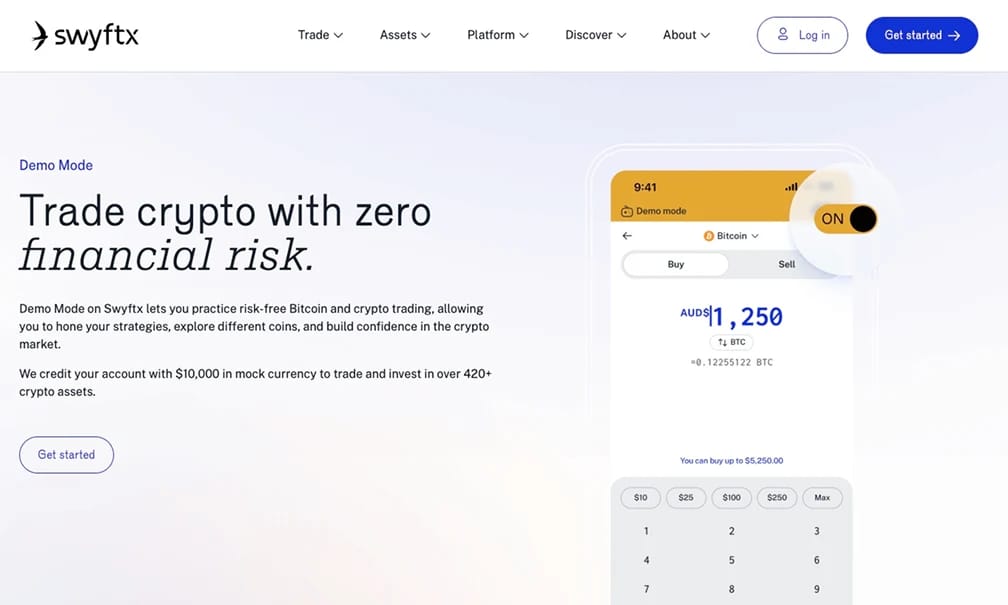
- Demo Mode: A practice account preloaded with virtual funds that mirrors live prices, letting newcomers rehearse orders risk-free. Few Australian exchanges offer this.
- Auto-Invest and DCA: Recurring buys from as little as $1 AUD, making dollar-cost averaging into majors or a custom bundle straightforward.
- TradingView Charts: Full charting with indicators and trigger orders built into the trading screen, a step up for users who want more than a buy button.
- Learn & Earn: Short educational modules that reward completion with small crypto payouts, paired with a TRM Labs partnership on scam awareness.
- Entity Accounts: Structured accounts for SMSFs, companies, and trusts, useful for crypto exposure inside a formal vehicle.
- Bundles: Themed baskets spanning sectors like DeFi or large caps, bought in one trade at the standard rate.
- ANZ Banking Integration: Instant AUD and NZD deposits through PayID and Osko, with the platform's New Zealand reach covered in our guide to the best crypto exchanges in New Zealand.
CoinSpot vs Swyftx Fees
This is the heart of the comparison for Australian retail users, and the headline numbers mislead both ways. CoinSpot advertises 0.1%, but only the Markets order book charges it; the default Instant Buy most people use sits at 1% plus a spread.
Swyftx charges a flat 0.6% with no hidden second interface, and its spreads on majors run tighter. Full context sits in our CoinSpot fees breakdown and our roundup of the lowest-fee crypto exchanges.
CoinSpot Fees
- Instant Buy, Sell, Swap: 1% per transaction, with a spread baked into the quoted price. This is the default screen, so it is what most users actually pay.
- Market Buy: 0.1% per trade on the order book, the cheapest rate either exchange offers, but it requires switching away from the simple interface.
- OTC Desk: A flat 0.1% on larger orders, with a dedicated agent.
- Deposits: Free via PayID, POLi, and bank transfer. BPAY costs 0.9%, debit or credit card 1.22%, PayPal 0.5%, and Blueshyft cash 2.5%.
- Withdrawals: AUD withdrawals to a verified bank account are free.
Swyftx Fees
- Spot Trading: A flat 0.6% maker and taker, tiering down through a 10-level volume system to as low as 0.1% for the highest brackets, recalculated hourly.
- Spreads: Typically tighter than CoinSpot on majors, with Bitcoin round trips often landing near 0.45% all in once spread is included.
- Deposits: Free via PayID, Osko, and bank transfer. Card deposits carry a surcharge through the third-party provider Banxa, and crypto deposits are free.
- Withdrawals: AUD withdrawals are free; NZD withdrawals carry a small fee after the first each month.
- Auto-Invest and Bundles: Charged at the standard 0.6% rate.
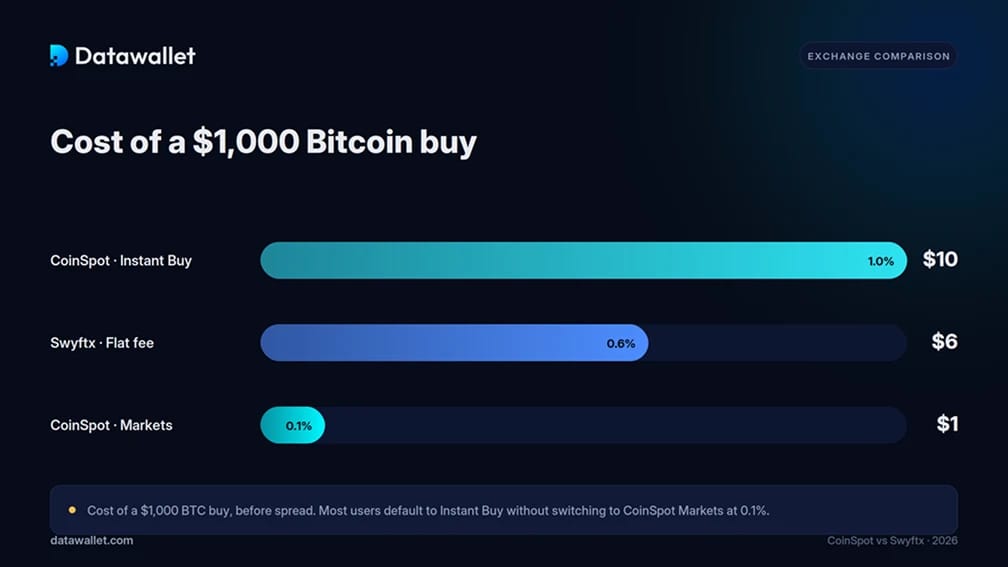
We ran a $1,000 Bitcoin buy across all three paths. CoinSpot's Instant Buy took roughly $10 at 1%, before the spread in the quote. The same coin through CoinSpot Markets cost about $1 at 0.1%. Swyftx sat between them at 0.6%, around $6, with its tighter spread narrowing the real gap further.
The takeaway: stay on the Instant screen and Swyftx is the cheaper default; learn the Markets order book and CoinSpot is the cheapest of the three. For an active trader moving $50,000 a month, CoinSpot Markets at 0.1% saves about $250 against Swyftx's 0.6%.
CoinSpot vs Swyftx Security
Both hold ISO 27001 certification and keep most customer assets in cold storage, so the baseline is solid each side. The useful questions are how reserves are verified, what account controls exist, and how each company behaved when something went wrong.
CoinSpot Security and History
- Certifications: CoinSpot was the first Australian exchange to earn ISO 27001, now maintained under the 2022 standard, and the first to complete an external statutory financial audit confirming 1:1 reserves.
- Account controls: Cold storage for most funds, 2FA, biometric login, anti-phishing codes, geo-locked logins, session timeouts, and custom withdrawal restrictions.
- Oversight: AUSTRAC registration plus voluntary membership of the Australian Financial Complaints Authority, which gives users an independent dispute channel that most exchanges lack.
- Incident history: In November 2023, on-chain investigator ZachXBT and security firm CertiK flagged a hot-wallet compromise of roughly 1,262 ETH, about $2.4 million AUD at the time, traced to a probable private key breach. No customer funds were lost, as CoinSpot absorbed the hit from its own reserves.
Swyftx Security and History
- Certifications: Swyftx holds ISO 27001 and an annually audited SOC 2 Type II certification, a recognised standard for service-organisation controls.
- Account controls: Around 90% of assets in cold storage, multi-signature wallets, 2FA, biometric login, and data encryption, with custody infrastructure provided through Fireblocks.
- Monitoring: Ongoing blockchain analytics through Chainalysis and scam-awareness work with TRM Labs.
- Incident history: Swyftx has not suffered a publicly reported exchange breach, and most negative user reports relate to verification holds on large withdrawals, which are typically a compliance step rather than a refusal to pay.
On balance, Swyftx has the cleaner incident record, while CoinSpot has the longer audit trail and the only AFCA membership of the two. Both kept customer balances intact through 2023's turbulence, and we would still treat either as a trading venue rather than long-term storage.
For holdings you do not intend to touch, a self-custody crypto wallet remains the safer option.
CoinSpot vs Swyftx Regulation and Tax
Australia is rewriting its crypto rulebook, and 2026 is the year the changes bite. Both exchanges operate as Digital Currency Exchanges registered with AUSTRAC, the financial intelligence regulator covering anti-money-laundering and identity obligations. That registration is a legal requirement to operate on Australian soil, and both have held it for years.
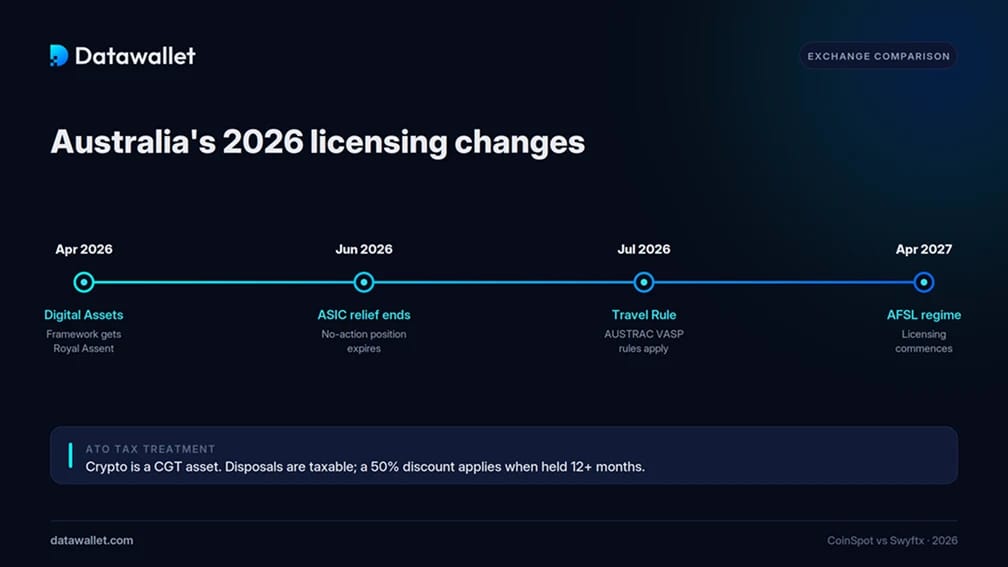
The bigger shift came in April 2026, when the Corporations Amendment (Digital Assets Framework) Bill received Royal Assent. It creates two regulated categories, digital asset platforms and tokenised custody platforms, and will require operators holding customer assets to obtain an Australian Financial Services Licence from ASIC.
The regime commences in April 2027 after a transition, with ASIC's no-action position ending in June 2026 and AUSTRAC's Travel Rule from July 2026. Both exchanges sit above the small-platform exemption, so both will need to obtain licences, giving users asset-segregation rules, standardised disclosures, and formal dispute resolution.
On tax, the Australian Taxation Office treats crypto as property subject to capital gains tax. Selling, swapping, spending, or gifting a coin is a CGT event, and holding more than 12 months before disposal qualifies for a 50% CGT discount. The ATO runs data-matching with Australian exchanges, so both CoinSpot and Swyftx transactions are visible to it.
One funding note worth flagging: Australian banks sometimes flag or delay transfers to crypto platforms. PayID and Osko deposits from major banks such as Commonwealth Bank, Westpac, and NAB work with both exchanges, though survey data suggests close to a third of Australian crypto buyers have hit a bank block or delay. If your transfer stalls, it is usually the bank, not the exchange.
Does CoinSpot or Swyftx Support Staking?
Neither CoinSpot nor Swyftx currently offers staking to Australian users, and the reason is regulatory, not technical. ASIC has treated crypto yield and staking products as potential financial products that may require licensing, so both exchanges withdrew their programs to stay clear of that line.
Swyftx closed its Earn product in early 2023, and CoinSpot suspended CoinSpot Earn in September 2023, with no reinstatement since.
That leaves Australians wanting staking rewards with two options: a self-custodial wallet that supports staking directly, or an offshore platform, weighing the added regulatory and counterparty risk. Given the licensing overhaul underway, on-platform staking may return once the framework gives exchanges clearer ground, but as of 2026 it is off the table on both.
Final Thoughts
For Australians choosing between the two, the decision tracks how you plan to trade. CoinSpot is the more complete package: over 500 coins, an NFT marketplace, a crypto card, an OTC desk, the longest local track record, and the cheapest trades of the two through Markets at 0.1%.
Swyftx is the better choice for cost and ease for most casual investors. Its flat 0.6% fee and tighter spreads beat CoinSpot's Instant Buy, the app is cleaner, and tools like demo mode, Auto-Invest, and Learn & Earn make it a gentler on-ramp.
Plenty of Australians keep accounts on both, leaning on CoinSpot for coin range and features and Swyftx for low-cost regular buys. Whichever you pick, verify your identity first, test a small PayID deposit and withdrawal, turn on every security control, and remember neither is a long-term vault. For a deeper look at one side, read our full CoinSpot review.
.webp)