







About CoinSpot
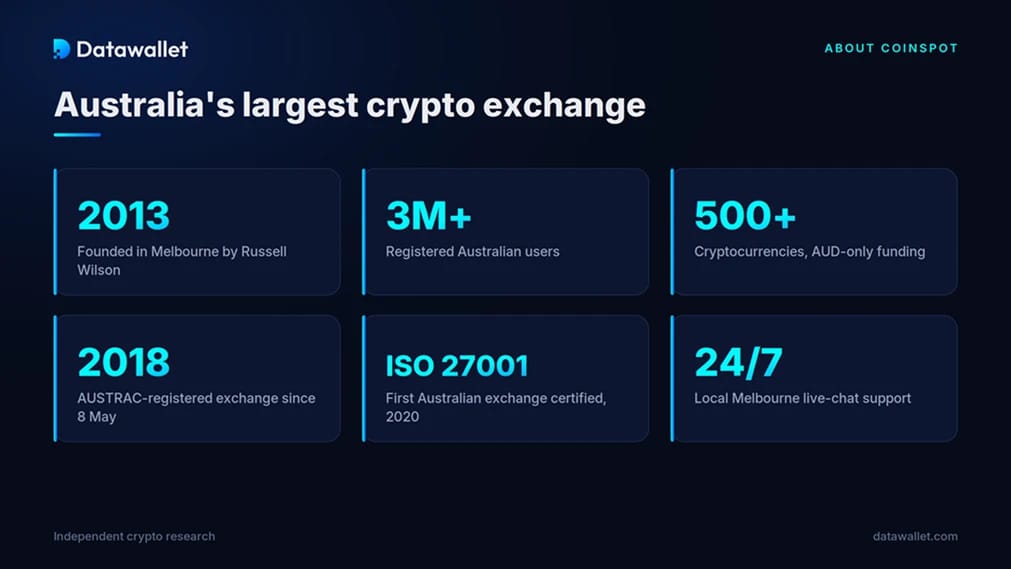
CoinSpot is a crypto exchange founded in Melbourne in 2013 by Russell Wilson. It operates under Casey Block Services Pty Ltd (ABN 19 619 574 186), remains privately held and fully Australian-owned, and now lists 3 million+ users on its homepage, which makes it the largest local exchange by reported user count.
The platform is built for one audience. You can only open an account as an Australian resident with an Australian photo ID, an Australian address, and an Australian bank account, and AUD is the only supported fiat currency. That focus shapes everything from the PayID deposit rails to the local support desk.
Two compliance anchors matter here. CoinSpot has been registered as a Digital Currency Exchange with AUSTRAC since 8 May 2018, a legal requirement for any exchange operating on Australian soil. CoinSpot is also a partner of the Digital Economy Council of Australia, formerly Blockchain Australia.
When we set up an account, verification ran on standard Australian KYC: a government-issued ID, a selfie check, and proof of address. Most applicants clear in minutes, and ours did, though larger deposits and unusual activity can trigger enhanced checks, which is normal for any AUSTRAC-registered platform.
CoinSpot Features
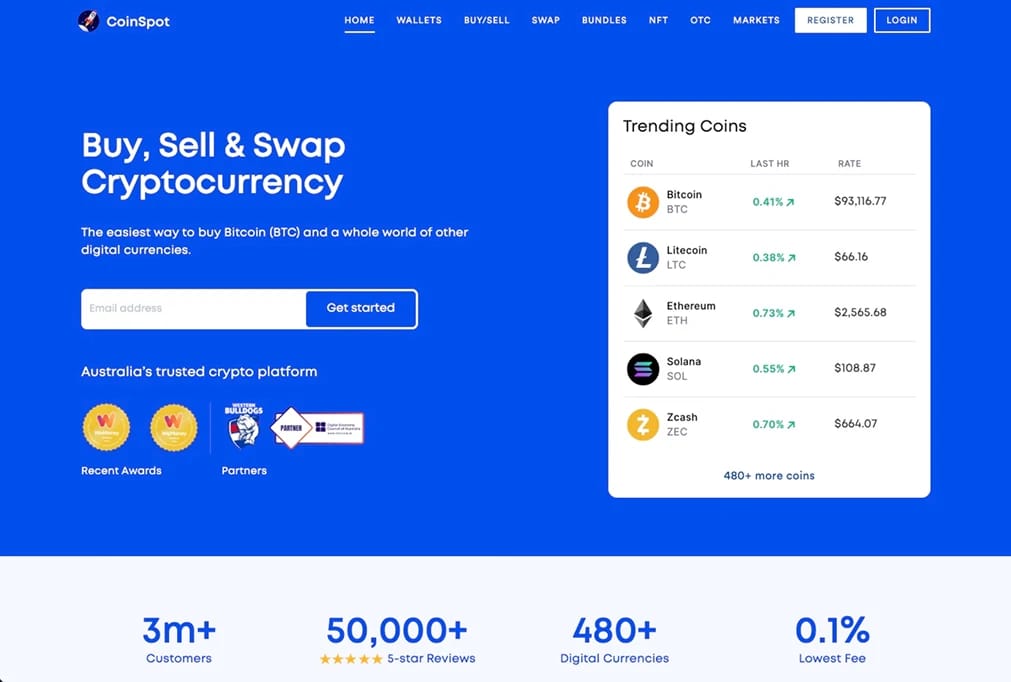
CoinSpot is built around fast, beginner-friendly buying, then layers on portfolio tools, an NFT marketplace, and account services. The feature mix favours people who want to buy, hold, and occasionally swap, rather than chart-heavy traders chasing the lowest possible execution cost.
Buying and Trading Options
CoinSpot offers two genuinely different ways to trade, and the gap between them is the single most important thing to understand about the platform. Most users never switch off the expensive default.
Main trading products on CoinSpot include:
- Instant Buy, Sell and Swap: The headline feature buys, sells, or swaps any listed coin at a confirmed price in one tap. It is fast and simple, but it carries a flat 1% fee plus a spread baked into the quoted price.
- CoinSpot Markets: The order-book interface (also branded CoinSpot Pro) charges 0.1% per trade, the cheapest path on the platform. The trade-off is that market trading is limited to major coins and is not pushed at beginners in the interface.
- OTC Desk: Trades of $20,000 AUD or more can route through the OTC team at a flat 0.1% with instant settlement and a dedicated agent, which sidesteps order-book slippage on large orders.
- Bundles: Pre-built baskets such as Top Ten Market Cap or themed DeFi and NFT sets let you buy a spread of coins in one transaction. Bundles use the 1% fee structure rather than the 0.1% rate.
- Recurring Buy: Automated dollar-cost-averaging purchases can be scheduled by day, time, and frequency. This convenience also attracts the 1% fee, so frequent small buys add up.
- Advanced Orders: Beyond market trades, CoinSpot supports limit, stop-loss, and take-profit orders for users who want to automate entries and exits.
- NFT Marketplace: An integrated marketplace lets members buy and sell NFTs across a growing set of collections without an external wallet, at a flat 0.9% fee plus network gas.
Portfolio and Investing Tools
Around the core trading screens, CoinSpot adds features aimed at long-term Australian investors, including some that are genuinely uncommon among local exchanges.
Key investing tools include:
- SMSF Support: CoinSpot offers a dedicated process and a specialist team for Self-Managed Super Funds, allowing Australians to hold crypto within a retirement structure. Few local exchanges support this directly.
- Tax Reporting: End-of-financial-year statements are free to download, and transaction history exports plug into Australian crypto tax software such as Koinly and CryptoTaxCalculator.
- Portfolio Dashboard: A single view tracks holdings across every coin you own, with daily, weekly, monthly, and yearly price charts for each asset.
- CoinSwap: Direct coin-to-coin swaps let you convert one asset into another without first selling back to AUD, using the 1% Swap pricing.
- Educational Material: CoinSpot publishes coin-level explainers and guides aimed at first-time buyers, which fit its beginner-heavy user base.
Account and Support Tools
CoinSpot's local presence is most evident in its support and account features, which Australian users consistently rate as strengths.
Supporting services include:
- CoinSpot Card: A prepaid Mastercard lets members spend their crypto balance in AUD at any merchant that accepts Mastercard, with Apple Pay and Google Pay support.
- 24/7 Live Chat: Support is staffed from Melbourne and runs around the clock. When we tested live chat, we reached a human agent in under a minute, which is rare for a crypto platform.
- Mobile App: The iOS and Android apps mirror the full platform, including biometric login, portfolio tracking, and both the Instant and Markets buying screens.
- Account Verification: KYC is automated for most applicants and typically clears within minutes, though higher transaction volumes may occasionally prompt additional checks.
- Security Controls: Account-level options include two-factor authentication, withdrawal whitelisting, anti-phishing codes, geo-locked logins, and session timeouts.
CoinSpot User Reviews
CoinSpot's reputation splits along a familiar line: mobile app users rate it extremely highly, while a smaller pool of complaint platform reviewers focuses on withdrawal holds and account freezes. Both pictures are real and depict different moments in the user journey.
Current review signals across major platforms include:
- Apple App Store: The CoinSpot app holds around 4.8/5 from more than 45,000 ratings, an unusually strong score for a financial app and among the highest of any Australian crypto platform.
- Google Play: The Android app sits in the low 4-star range across roughly 18,000 reviews, indicating broadly positive but slightly more mixed sentiment than on iOS.
- Trustpilot: CoinSpot has a smaller Trustpilot base of around 2,700 reviews, with more polarised sentiment. Positive reviews praise quick onboarding and PayID deposits, while critical reviews centre on frozen withdrawals and security holds.
- Product Review: On Australia's local review site, CoinSpot draws steady praise for its beginner-friendly interface and AUD support, alongside the same recurring complaints about withdrawal friction during security reviews.
The pattern is consistent. Sign-up, verification, and first purchase are smooth. Frustration shows up when a withdrawal is flagged for a security review, which CoinSpot deliberately does, sometimes pausing transfers until a user confirms the transaction is legitimate.
.webp)
Is CoinSpot Safe?
CoinSpot has one of the longer clean operating records among Australian exchanges, backed by certifications, cold storage, and customisable account controls. It is not flawless, and the November 2023 hot-wallet incident is the part of the story that affiliate-heavy reviews tend to skip.
Account Safety Measures
CoinSpot offers users several account-level controls, and the most effective ones are off by default, so enabling them is up to you.
Key protections users can enable include:
- Two-Factor Authentication: 2FA is required for withdrawals and sensitive account actions, with authenticator-app codes preferred over SMS for stronger protection.
- Withdrawal Whitelisting: Restricting withdrawals to pre-approved addresses is the single most underused control. Turning it on prevents most account-compromise losses before they happen.
- Anti-Phishing Code: A personalised code in CoinSpot emails helps users tell genuine messages from impersonation attempts and fake support scams.
- Geo-Lock and Session Timeout: Logins can be locked to specific regions, and idle sessions can be set to expire, reducing exposure from unfamiliar devices.
- Suspicious Activity Monitoring: CoinSpot flags unusual withdrawals and high-value actions for review, occasionally pausing them and contacting the user before release.
Asset Protection
Beyond personal settings, CoinSpot leans on storage practices, audits, and a bug bounty, though it stops short of insuring customer funds.
Important asset-protection layers include:
- Cold Storage: CoinSpot states that the majority of customers' crypto is held offline in cold wallets, with only operational liquidity kept in hot wallets for withdrawals.
- ISO 27001 Certification: The exchange holds ISO 27001 certification under the 2022 standard, covering how it manages digital-asset storage, staff and client data, suppliers, and intellectual property.
- Financial Audit: CoinSpot was the first Australian exchange to complete an External Statutory Financial Audit under Australian Auditing Standards, with an independent auditor confirming reserves covering user funds.
- Bug Bounty: A HackerOne bug bounty program pays external researchers to find and report vulnerabilities before attackers can exploit them.
- No Insurance: CoinSpot does not offer insurance on fiat or crypto held on the platform, and crypto balances are not government-guaranteed. For meaningful long-term holdings, moving funds to one of the best crypto wallets you control remains the safer approach.
Security History
CoinSpot's record is strong relative to its weight class, but it is not spotless, and one event in particular deserves an honest accounting.
Key context from CoinSpot's security history includes:
- 2023 Hot-Wallet Incident: In November 2023, on-chain investigator ZachXBT flagged roughly 1,262 ETH, around $2.4 million at the time, leaving a known CoinSpot wallet for a suspected attacker address.
- Probable Key Compromise: Security firm CertiK attributed the event to a probable private-key compromise affecting at least one hot wallet, with the stolen ETH bridged to Bitcoin via THORChain and a separate bridge to obscure the trail.
- No Customer Losses: No customer funds were lost. CoinSpot absorbed the hit from its own reserves, and the company never issued a public statement formally confirming the breach, so the details rest on blockchain analysis rather than an official disclosure.
- Attribution Caution: Some outlets later linked the attack to North Korea's Lazarus Group, but that attribution was never publicly confirmed and should be treated as speculation.
- Underlying Lesson: The incident is a clean illustration of hot-wallet risk on any centralised exchange. Use CoinSpot to buy and sell, then move long-term holdings into self-custody.
.webp)
Is CoinSpot Regulated?
CoinSpot is registered, not yet licensed in the fuller sense that Australia is now building toward. Understanding that distinction matters more in 2026 than it has in any prior year, because the rules are mid-overhaul.
CoinSpot operates as an AUSTRAC-registered Digital Currency Exchange, which binds it to anti-money-laundering and counter-terrorism-financing obligations, including identity verification and ongoing transaction monitoring. That registration is the baseline for any legal Australian exchange, and it is not the same as an investment-style licence.
That gap is closing. In April 2026, the Corporations Amendment Bill 2025 passed both houses and received Royal Assent on 8 April, bringing crypto exchanges and custody providers under the AFSL regime for the first time. Platforms that hold customer assets above defined thresholds will need an AFSL from ASIC, with the framework formally commencing in 2027 after a transition period.
The near-term milestones are already live. AUSTRAC's new Virtual Asset Service Provider regime and the Travel Rule take effect from 1 July 2026, and ASIC's INFO 225 no-action position expires at the end of June 2026, after which firms must align with existing licensing requirements while the new regime is built around them.
For an established operator like CoinSpot, this means more disclosure, asset-holding standards, and formal dispute resolution over time, which is broadly positive for users.
CoinSpot Fee Schedule
CoinSpot's pricing is genuinely cheap or noticeably expensive depending entirely on which screen you use. The platform does not steer beginners toward the cheaper one, which is why so many users overpay without realising it. Our breakdown of CoinSpot fees covers this in more detail.
Trading Fees
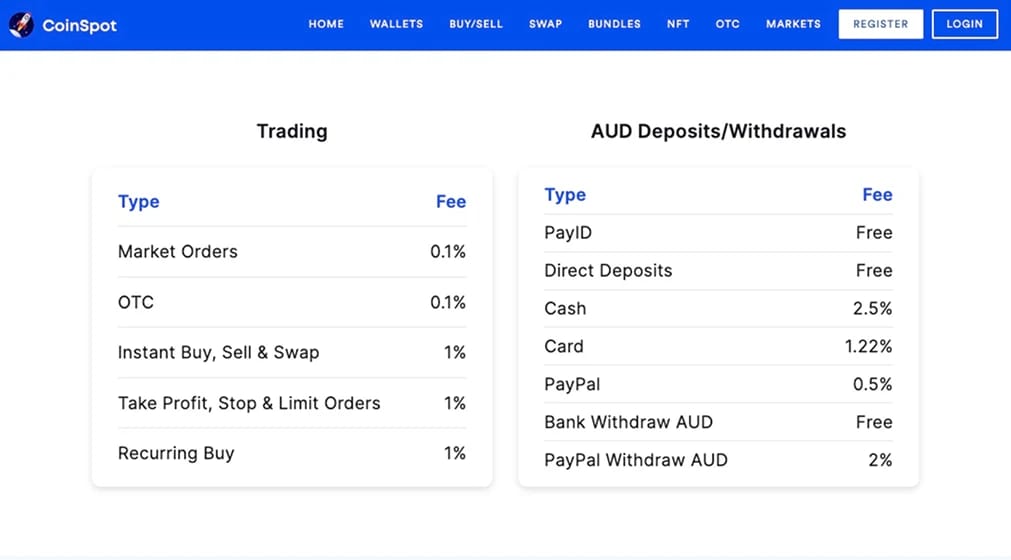
- Market Orders: Order-book trades through CoinSpot Markets cost 0.1%, competitive with major global exchanges and the cheapest way to buy on the platform.
- OTC Trades: Large trades above $20,000 AUD through the OTC desk also incur a 0.1% fee with instant settlement.
- Instant Buy, Sell, Swap: The default Instant flow charges a flat 1%, ten times the Markets rate, applied across all 500+ listed coins.
- Hidden Spread: Instant prices also include a spread baked into the quote. When we ran the same Bitcoin purchase through both paths, the all-in cost of Instant Buy landed meaningfully higher than Markets once the spread was counted.
- Bundles and Recurring Buys: Both use the 1% structure rather than the 0.1% rate, so automated dollar-cost averaging on CoinSpot costs more per buy than a manual market order.
- NFT Marketplace: NFT purchases and sales attract a flat 0.9% fee plus network gas, with listing free and royalties set per collection.
Deposits and Withdrawals
- Free AUD Deposits: PayID and direct deposits from major banks like ANZ, CommBank and NAB are both instant and free, with no fee and a low minimum.
- Fee-Bearing Deposits: BPAY carries a 0.9% fee, PayPal deposits cost 0.5%, and cash deposits through Blueshyft at participating newsagents cost 2.5%. Card deposits also attract a percentage fee.
- AUD Withdrawals: Withdrawals to a verified Australian bank account in your own name are free, with no minimum or maximum, and typically land the same or next business day.
- Crypto Withdrawals: Sending coins off-platform incurs only the standard blockchain network fee, which varies by asset and network conditions. CoinSpot does not add a withdrawal markup.
- PayPal Withdrawals: A 2% processing fee, capped at $1.25, applies to PayPal withdrawals and is shown before you confirm.
The practical takeaway is the same one most CoinSpot reviews underplay: fund with PayID, then use Markets rather than Instant Buy, and you cut your trading cost by roughly 90% on the same coin.
What is the CoinSpot Card?
The CoinSpot Card is a prepaid Mastercard product that lets members spend their crypto balance in Australian dollars anywhere Mastercard is accepted, including online and through Apple Pay and Google Pay. Crypto is converted to AUD at the point of spending rather than being loaded onto the card as a coin, so the card itself always settles in dollars.
Its appeal is convenience rather than rewards. Unlike some overseas crypto cards built around cashback tiers, the CoinSpot Card is closer to a straightforward spending tool, sitting in the usual convert-and-spend territory on cost. If card rewards are a priority, our guide to the best crypto debit cards compares the wider field.
For Australians who already keep a balance on CoinSpot, the card removes a step. You skip moving funds to a separate provider and can spend directly from the same account you trade in, which fits CoinSpot's broader pitch of keeping everything in one local, AUD-denominated place.
Final Thoughts
CoinSpot earns its position as the default Australian on-ramp. Thirteen years in the market, free PayID deposits, 500+ coins, ISO 27001 certification, an external financial audit, and genuinely fast local support add up to a platform most first-time buyers can trust and navigate without a learning curve.
The catch is cost. The platform is designed around Instant Buy, and Instant Buy is expensive once the 1% fee and spread are combined. Active traders also lose out on margin, futures, and the suspended Earn program, and deeper liquidity lives on larger global venues. None of that is hidden, but CoinSpot does little to push beginners toward its cheaper Markets screen.
For an Australian buying their first Bitcoin or Ethereum with AUD, we would still open a CoinSpot account, verify, fund with PayID, and use Markets to dodge the 1% fee, then move long-term holdings to a hardware wallet.
Anyone trading frequently or in size should compare it against Swyftx and weigh CoinSpot against the wider field in our best crypto exchanges in Australia guide before committing.
.webp)