



Which Countries Does Crypto.com Restrict?
Crypto.com publishes its full block list on the official App Geo-Restrictions page, which the company updated on 12 May this year. The list covers 74 countries and territories, plus New York at state level and five occupied regions of Ukraine.
The table below groups every entry on the official list by the reason behind the block, so you can find your country and see what drives its exclusion in one pass.
Sanctions drive the first group. Serving these markets would breach measures enforced by the US Office of Foreign Assets Control (OFAC), the Treasury unit that penalises firms dealing with embargoed regions, so Crypto.com excludes every one of them. In Ukraine, only the five occupied regions are barred, and the rest of the country retains full access.
Local law explains the second. China prohibits crypto exchanges outright, Nepal's central bank bars residents from holding digital assets, and Indonesia joined the list after its Financial Services Authority (OJK) began publishing a whitelist of the only platforms permitted to serve Indonesians, a register Crypto.com does not appear on. The remaining groups cover markets where anti-money-laundering screening is impractical to run, while New York stays blocked because Crypto.com does not hold the BitLicence the state requires of crypto businesses.
.webp)
Where Crypto.com Limits Specific Products
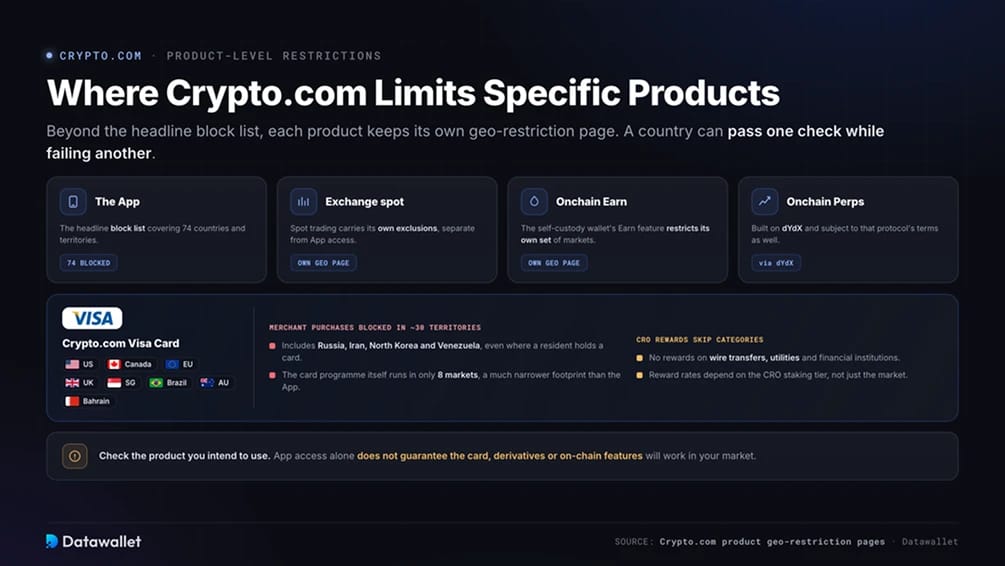
Beyond the headline block list, Crypto.com maintains separate geo-restriction pages for individual products, and a country can pass one check while failing another. Spot trading on the Exchange carries its own exclusions, as do the self-custody Onchain Wallet's Earn and Perpetuals features, the latter built on dYdX and subject to that protocol's terms.
The Crypto.com Visa Card adds a further layer. Card programmes run in the US, Canada, the EU, the UK, Singapore, Brazil, Australia, and Bahrain, but merchant purchases are blocked in roughly 30 territories, including Russia, Iran, North Korea, and Venezuela, and CRO rewards skip categories such as wire transfers, utilities, and financial institutions. Our best crypto debit cards guide compares how these limits stack up against rival cards.
Check the product you intend to use, because App access alone does not guarantee the card, derivatives, or on-chain features will work in your market.
Crypto.com Supported Countries
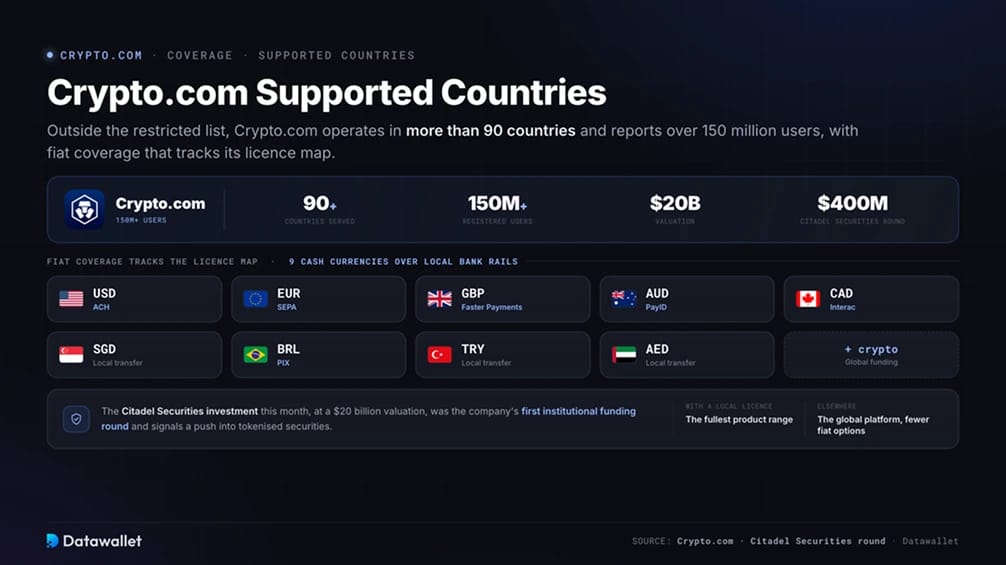
Outside the restricted list, Crypto.com operates in more than 90 countries and reports over 150 million users, a figure confirmed this month when Citadel Securities invested $400 million at a $20 billion valuation in the company's first institutional funding round.
Fiat coverage tracks the licence map. Cash accounts run in USD, EUR, GBP, AUD, CAD, SGD, BRL, TRY, and AED, funded through local bank networks such as SEPA in Europe, Faster Payments in the UK, ACH in the US, PayID in Australia, Interac in Canada, and PIX in Brazil. Markets with a local entity and licence get the fullest product range, while users elsewhere access the global platform with fewer fiat options.
Crypto.com Licences and Regulation
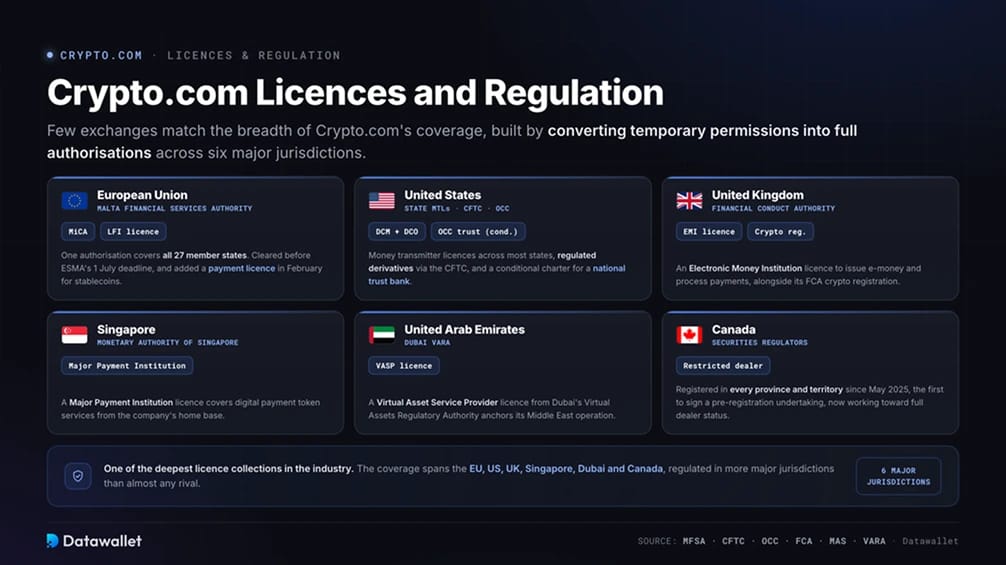
Few exchanges can match the breadth of Crypto.com's regulatory coverage, and the company has spent the past two years converting temporary permissions into full authorisations.
These are the principal licences and registrations:
- European Union: Crypto.com holds a MiCA licence from the Malta Financial Services Authority under the EU's Markets in Crypto-Assets framework, the single rulebook that lets one authorisation cover all 27 member states. It cleared the bar well before ESMA's transition deadline of 1 July this year forced unlicensed platforms out, and it added a Limited Financial Institutions licence this February so its stablecoin services also satisfy EU payment rules. We track the full field in our MiCA-licensed crypto exchanges guide.
- United States: The company holds money transmitter licences across most states, runs regulated derivatives through Designated Contract Market and Derivatives Clearing Organization licences from the CFTC, and received conditional approval from the Office of the Comptroller of the Currency this February to charter a national trust bank for custody and staking under federal oversight.
- United Kingdom: Crypto.com holds an Electronic Money Institution licence from the Financial Conduct Authority, the permission that lets a firm issue e-money and process payments, alongside its FCA crypto registration.
- Singapore: A Major Payment Institution licence from the Monetary Authority of Singapore covers digital payment token services from the company's home base.
- United Arab Emirates: A Virtual Asset Service Provider licence from Dubai's Virtual Assets Regulatory Authority (VARA) anchors its Middle East operation.
- Canada: Crypto.com became a restricted dealer across every province and territory in May 2025, having been the first platform to sign a pre-registration undertaking with Canadian securities regulators back in 2022, and it is now working toward full investment dealer status.
Does Crypto.com Require KYC?
Yes, every Crypto.com account must complete identity verification, known as KYC (Know Your Customer), before trading, depositing, or withdrawing. Users supply their legal name, date of birth, residential address, and nationality, then upload a government-issued ID and pass a selfie check.
Verification is also the enforcement point for the restriction list. Your declared country of residence determines which legal entity onboards you, and documents issued in a blocked jurisdiction stop the account before any money moves. Requirements deepen in regulated markets, where local entities can request proof of address or additional financial information to satisfy their supervisors.
Can I Use Crypto.com in the USA?
Yes, Crypto.com serves US customers in every state except New York, where the absence of a BitLicence keeps the App unavailable. American users get spot trading, the Visa Card, and access to regulated derivatives through the company's CFTC-licensed venue.
The US footprint is still expanding. The conditional OCC approval granted in February puts Crypto.com on a path to operate a federally supervised trust bank offering custody, staking, and settlement to institutions. New Yorkers, meanwhile, can compare properly licensed local options in our guide to the best crypto exchanges in the USA.
Is Crypto.com Available in Europe and the UK?
Yes, and Europe is where Crypto.com's compliance position is strongest. Its Maltese MiCA authorisation passports across the European Economic Area, so EU users deal with a fully licensed provider instead of a grandfathered offshore platform. Within Europe, only Andorra and Belarus appear on the App restriction list, and Andorra sits outside the EU framework.
The UK operates under a separate national regime, where Crypto.com combines FCA crypto registration with its Electronic Money Institution licence. British users keep access to the App and card, although UK rules ban the sale of crypto derivatives to retail consumers on every platform, so leveraged products stay out of reach regardless of the exchange.
About Crypto.com
Crypto.com was founded in 2016 by Kris Marszalek and grew from a payments-focused startup into one of the largest crypto platforms in the world, spanning an exchange, a retail app, the Visa Card programme, an NFT marketplace, and the Cronos blockchain. Our full Crypto.com review covers its fees, products, and security record in detail.
The brand is also among the most visible in the industry, holding the naming rights to the Crypto.com Arena in Los Angeles and sponsorships across Formula 1 and the UFC. The Citadel Securities investment this month, which valued the business at $20 billion, signals a push into tokenised securities and institutional markets on top of its retail base.

Final Thoughts
Crypto.com's restriction list is largely the price of its licensing strategy. The company blocks sanctioned states because it must, walks away from high-risk markets because screening them is impractical, and stays out of places like Indonesia and New York because it lacks the specific local permission those regulators demand.
For everyone else, the trade is straightforward. Users in the 90+ supported countries get a platform regulated in more major jurisdictions than almost any rival, and anyone in a blocked market is better served by a locally licensed alternative than by trying to reach around the wall.