






.svg)
Can I Get Bitcoin Testnet Tokens?
Yes, and they cost nothing. Testnet Bitcoin (tBTC) is handed out by faucets, which are websites that send small amounts of test coins to any valid testnet address you paste in. The coins cannot be sold or converted.
The important change is that Bitcoin no longer has a single testnet. Testnet3, the chain that served developers for over 13 years, was deprecated when Bitcoin Core version 28 shipped in October 2024, and testnet4 took over as the default public test network under BIP-94. Any faucet or tutorial still pointing at testnet3 is sending you to a chain the Core developers are phasing out.
Before claiming anything, set your wallet to testnet4. Sparrow Wallet switches through Tools, then Restart In Testnet4, while Electrum added testnet4 support in version 4.5.6. One naming trap deserves a warning. The tBTC ticker is also used by a wrapped Bitcoin token on Ethereum, which is a separate product with real market value. This guide covers only the valueless test coins on Bitcoin's own test networks.
How to Get Bitcoin Testnet Tokens
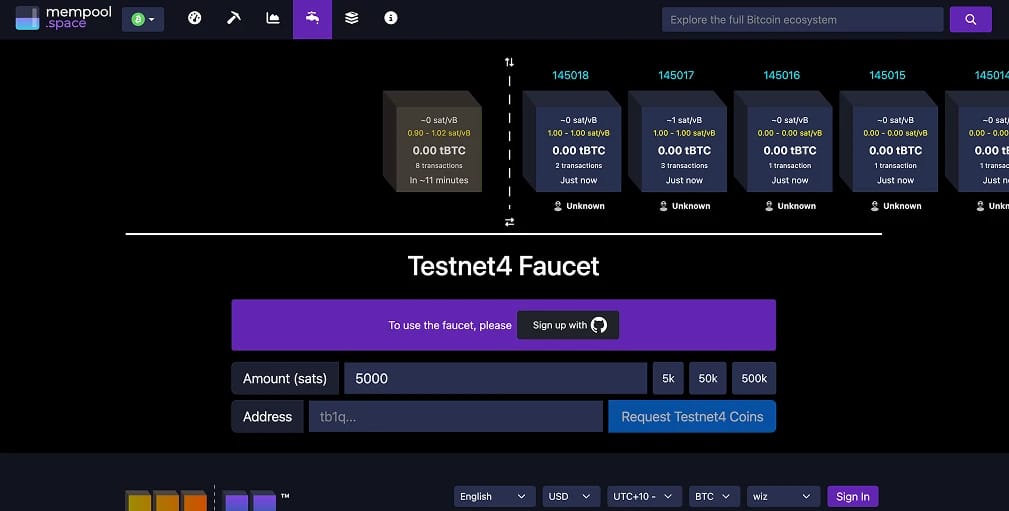
We rate the mempool.space Testnet4 Faucet as the first stop because it sits inside the most widely used Bitcoin block explorer, so the same page that pays you also lets you confirm the coins arrived. Claiming takes a few minutes.
Claim free tBTC in four steps:
- Prepare a testnet4 wallet: Open Sparrow or Electrum in testnet4 mode and generate a fresh receiving address, which will begin with tb1 rather than the bc1 prefix used on mainnet.
- Open the faucet: Visit the mempool.space Testnet4 Faucet and sign in with a GitHub account, since the faucet requires GitHub authentication as its anti-bot check and will not dispense coins without it.
- Request the coins: Paste your tb1 address, submit the claim, and note the transaction ID the faucet returns for tracking.
- Confirm arrival: Watch the transaction on the testnet4 explorer until it confirms, which normally takes one block but can stretch during unstable mining periods.
Testnet4 targets ten-minute blocks like mainnet, but block times swing far more because hobbyist miners join and leave constantly. If your claim sits unconfirmed for an hour, the network is usually the cause rather than the faucet.
Bitcoin Testnet Faucet Limits
Every reputable faucet caps claims, because a shared pool of test coins drains fast when bots or hoarders hit it. Limits differ, so match the faucet to your workload.
Here is how the main Bitcoin testnet faucets compare:
- mempool.space: Dispenses testnet4 coins to signed-in users with per-account caps, pairing modest payouts with an integrated explorer and fee dashboard.
- coinfaucet.eu: One of the longest-running Bitcoin faucets, now serving testnet4 with IP-based rate limiting; it has processed over 720,000 requests and sent more than 16,000 test BTC.
- faucet.testnet4.dev: A community faucet spun up alongside the testnet4 launch, dispensing small fixed amounts per claim while its reserve balance holds.
- testnet.help: Running since 2018 on a battery system; each confirmed request drains 2% of the battery, which recharges 4% per hour, so claims pause when demand spikes.
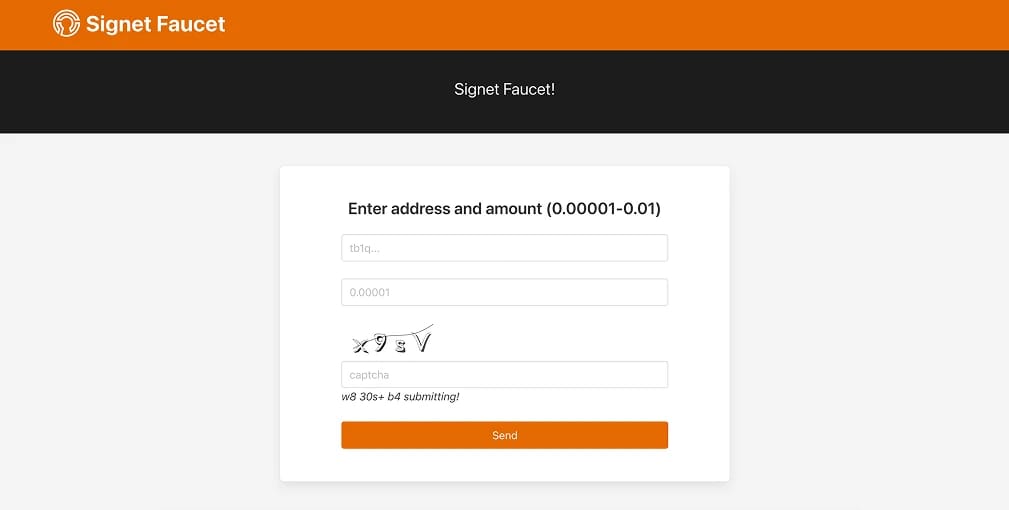
- signetfaucet.com: The default signet faucet, paying between 1,000 and 10,000 satoshis per request with daily limits per IP address and per receiving address.
If one faucet is dry or rate-limited, spreading requests across two or three sources is normal practice. Returning unused coins when a project wraps is equally standard etiquette, since hoarded test coins were a large part of what broke testnet3.
Alternative Bitcoin Testnet Faucets
When testnet4 faucets run empty or the chain is misbehaving, signet is the practical fallback. Signet, defined in BIP-325, replaces open mining with blocks signed by designated operators, which keeps block production steady and makes its coins (sBTC) easier for faucets to restock.
The default signet faucet covers most needs, and bitcoinsignetfaucet.com offers a second source when the first is offline. Both pay to the same tb1-style addresses your testnet wallet already generates, provided the wallet is switched to signet rather than testnet4.
Teams building on the Lightning Network have a further option in Mutinynet, a custom signet created by the Mutiny Wallet team with 30-second block times. The rapid blocks make payment channel testing far faster than waiting on ten-minute confirmations. Running your own Mutinynet node requires a modified version of Bitcoin Core, so most users rely on the hosted faucet and compatible wallets. For test coins on other chains, our best crypto faucets roundup covers the wider landscape.
Which Bitcoin Test Network Should You Use?
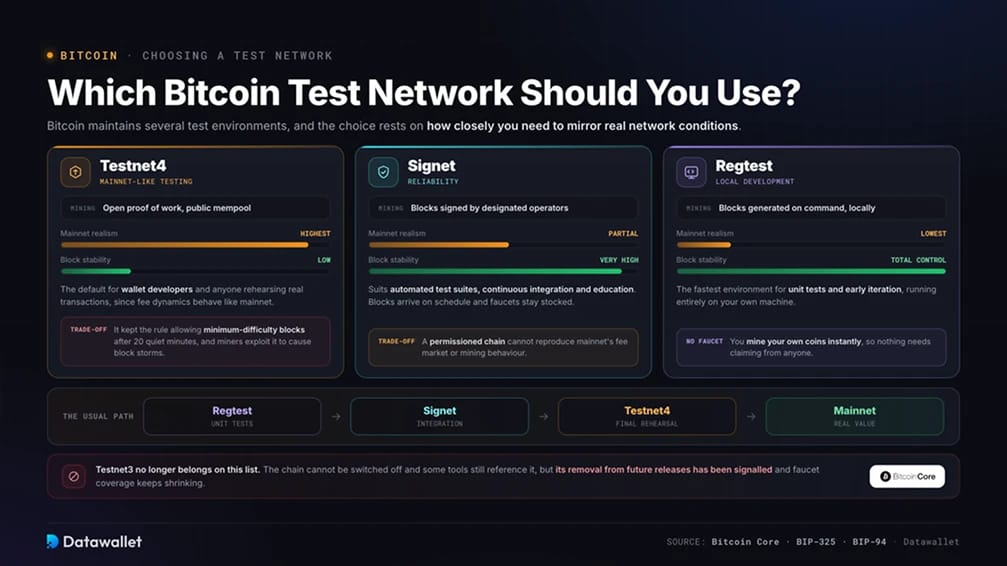
Bitcoin now maintains several test environments, and picking the wrong one wastes hours before the first transaction sends. The choice rests on how closely you need to mirror real network conditions.
1. Testnet4 for Mainnet-Like Testing
Testnet4 is the default for wallet developers and anyone rehearsing real transactions, because its open proof-of-work mining, public mempool, and fee dynamics resemble mainnet more closely than any alternative. The trade-off is instability. Testnet4 kept testnet3's rule allowing minimum-difficulty blocks after 20 quiet minutes, and miners have exploited it to produce block storms, bursts of hundreds of low-difficulty blocks that disrupt testing.
2. Signet for Reliability
Signet suits automated test suites, continuous integration, and education, since signed block production removes hash rate swings. Blocks arrive on schedule, faucets stay stocked, and the chain never rolls back recent blocks unexpectedly. The cost of that stability is realism, because a permissioned chain cannot reproduce mainnet's fee market or mining behaviour.
3. Regtest for Local Development
Regtest runs on your own machine with blocks generated on command, which makes it the fastest environment for unit tests and early iteration. No faucet is needed, as you mine your own coins instantly. Most serious projects start on regtest, graduate to signet for integration testing, and finish on testnet4 before touching mainnet.
Testnet3 no longer belongs on this list. The network cannot be switched off, and some third-party tools still reference it, but Core developers have signalled its removal from future releases and its faucet coverage keeps shrinking.
Why Are My Bitcoin Testnet Tokens Not Arriving?
Most missing-coin reports trace back to configuration rather than a failed faucet.
Check these points before assuming a claim failed:
- Wrong test network: Testnet3, testnet4, and signet all use the same tb1 address prefix, so a wallet on the wrong chain still produces a valid-looking address that the coins will never reach.
- Slow confirmation: Testnet4 block times are erratic, and a claim can sit in the mempool for an hour or more during a lull in mining before it confirms normally.
- Rate limits: Faucets track accounts, IP addresses, or both, and a claim inside the cooldown window is silently rejected or queued rather than paid.
- Drained reserves: Community faucets run on donated coins, so a claim submitted while the balance sits at zero goes nowhere until someone restocks it.
- Outdated software: Wallets and libraries that predate testnet4 still carry testnet3 parameters, and they will reject or misread transactions from the newer chain.
If none of these apply, paste your address into the testnet4 explorer and check for an incoming transaction. Seeing the payment there means delivery succeeded and the problem sits in your wallet's display or network setting, and seeing nothing means the faucet claim never broadcast.
About the Bitcoin Testnet
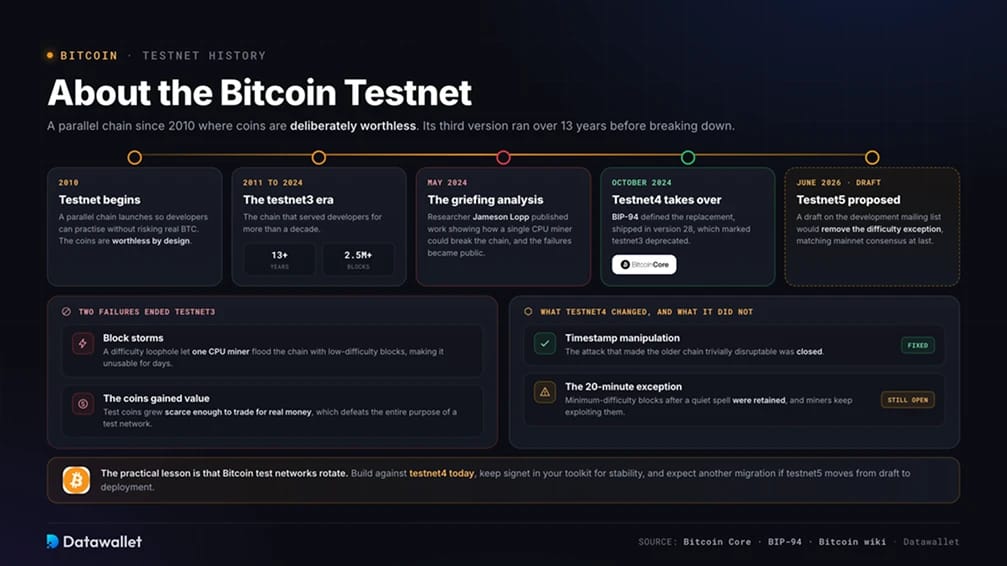
The Bitcoin testnet has existed since 2010 as a parallel chain where coins are deliberately worthless. Its third version, testnet3, ran for more than 13 years and over 2.5 million blocks before breaking down.
A difficulty loophole let a single CPU miner trigger block storms that made the chain unusable for days, a problem documented after researcher Jameson Lopp published his griefing analysis in May 2024. At the same time, its coins had become scarce enough to trade for real money, which defeats the purpose of a test network.
Those failures produced BIP-94 and the launch of testnet4, which Bitcoin Core supported from version 28 while marking testnet3 as deprecated. Testnet4 fixed the timestamp manipulation attack, yet it retained the 20-minute minimum-difficulty exception, and miners have kept exploiting it. In June 2026 a draft proposal for testnet5 was published on the Bitcoin development mailing list that would remove the difficulty exception so the test network finally matches mainnet consensus behaviour.
The practical lesson is that Bitcoin test networks rotate. Build against testnet4 today, keep signet in your toolkit for stability, and expect another migration if testnet5 moves from draft to deployment.
Final Thoughts
Getting Bitcoin testnet tokens is quick once your wallet points at the right chain. Claim tBTC from the mempool.space faucet or coinfaucet.eu for testnet4 work, switch to signet faucets when you need dependable block times, and return unused coins when a project ends.
The single mistake to avoid is following pre-2024 instructions onto testnet3, a deprecated network with dwindling support. Testnet4 is the current standard, signet is the stable companion, and watching the testnet5 discussion will tell you when the next migration lands.
If you also build on EVM chains, our guide to Sepolia testnet tokens covers the Ethereum side of the same workflow.
.webp)