


How to Get Devnet SOL From the Official Solana Faucet
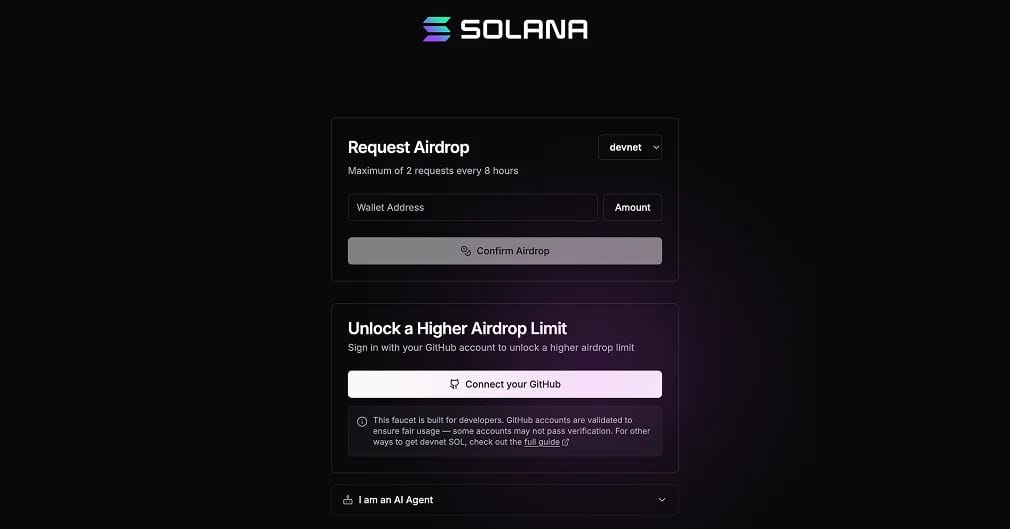
The Solana Faucet is operated by the Solana Foundation and supports both devnet and testnet. It caps anonymous users at 2 requests every 8 hours, and signing in with GitHub unlocks a higher allowance. GitHub accounts are validated before the limit increases, so fresh or empty accounts may not pass verification.
Here is how to claim free SOL:
- Open the faucet: Go to faucet.solana.com and select devnet or testnet. Devnet is the right choice for almost all application development.
- Paste your wallet address: Enter the public address of a Solana wallet like Phantom, Solflare, or Backpack. Make sure the wallet itself is switched to devnet before checking your balance.
- Choose an amount and confirm: Pick an amount from the dropdown and click Confirm Airdrop. Tokens usually land within seconds.
- Sign in with GitHub if you need more: Connect a GitHub account to raise your request limit once the anonymous allowance runs out.
One change worth knowing about in 2026 is that the faucet now explicitly tells AI agents not to use the web interface. Agentic coding tools running Solana tests are directed to the CLI airdrop, the proof-of-work faucet, or a local validator instead, a sign of how much automated traffic these faucets now absorb.
Alternative Solana Faucets
Public faucets get drained and rate-limited, so keep backups. Every option below appears in Solana's official faucet guide:
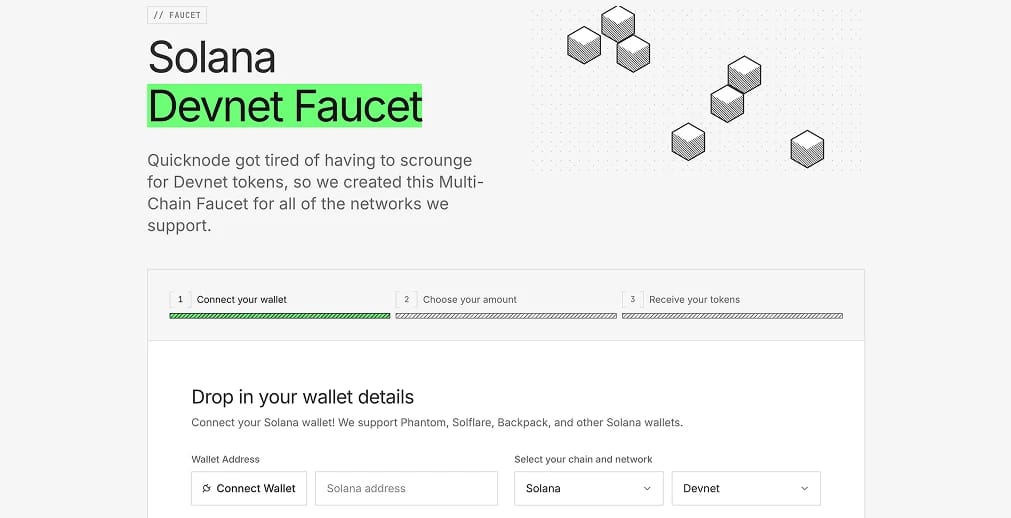
- QuickNode Faucet: The QuickNode faucet supports devnet and testnet and allows one drip per network every 12 hours. You connect a wallet rather than pasting an address.
- SolFaucet: A long-running community faucet at solfaucet.com that relays airdrops through the public RPC endpoints for devnet and testnet, so it fails when those endpoints are congested.
- DevnetFaucet.org: A community faucet at devnetfaucet.org with rate limits separate from the public RPC endpoints, useful when official channels are tapped out. Its sister site TestnetFaucet.org covers testnet.
- Proof-of-work faucet: Ellipsis Labs maintains a devnet PoW faucet that pays devnet SOL for your machine's compute. It installs as a small Rust tool and mines in the background, slower than a web faucet but effectively uncapped.
- Discord faucets: The 76 Devs and LamportDAO Discord servers run faucet bots that drop devnet SOL on command when every web option is rate-limited.
One correction to older guides, ours included: Stakely's Solana faucet no longer distributes devnet tokens. It now sends roughly 0.001 mainnet SOL to cover gas for stranded wallets, a different tool for a different problem.
Getting Devnet SOL From the Command Line
With the Solana CLI installed and pointed at devnet, solana airdrop 2 drops 2 SOL into your configured wallet in one step. The web3.js library exposes the same airdrop request programmatically, which is how most test suites fund throwaway keypairs.
Public RPC airdrops break first when devnet is busy. If requests keep failing, point your CLI at an RPC provider that opts into devnet SOL distribution. Helius, QuickNode, and Triton all currently do, and switching is a single config change to the provider's endpoint URL. Provider limits are usually far more forgiving than the shared public ones.
If transactions still fail after funding, congestion or priority fees are the likely cause, and our guide to fixing failed Solana transactions covers the usual culprits.
Skip the Faucet: Local Validators and Mainnet Forking
Many Solana teams have stopped using devnet for day-to-day testing. Two local options remove the faucet problem entirely.
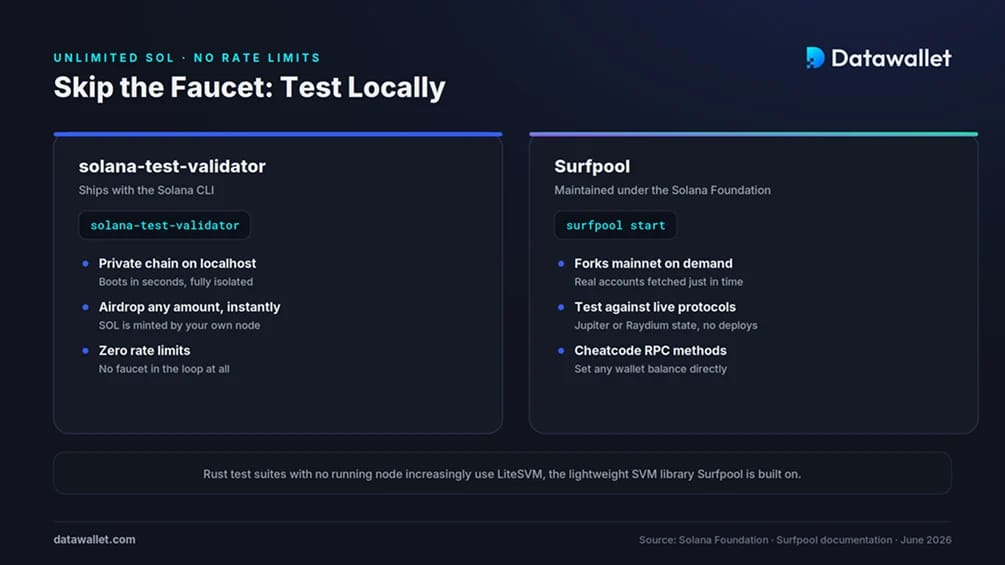
The first is the test validator that ships with the Solana CLI. Run solana-test-validator for a private chain on localhost where you can airdrop yourself any amount instantly, because the SOL is minted by your own node.
The second is Surfpool, an in-memory local network maintained under the Solana Foundation that forks mainnet on demand. It fetches real mainnet accounts and programs just in time, so you can test against live Jupiter or Raydium state without deploying anything, and its cheatcode RPC methods set any wallet's balance of SOL, USDC, or other tokens directly. For integration testing against real protocols it has largely replaced the devnet faucet grind. Rust test suites that need no running node increasingly use LiteSVM, the lightweight SVM library Surfpool is built on.
Faucets still matter for the last mile, since devnet remains the only public place to test wallet connections, RPC behaviour, and anything involving other people. For the build-and-iterate loop, local tooling wins.
Solana Devnet vs Testnet in 2026
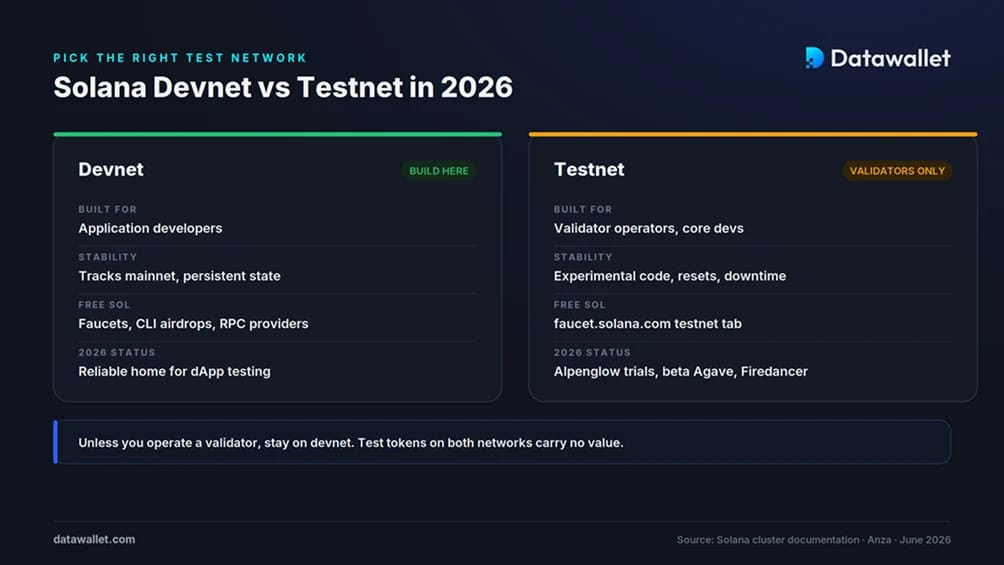
Devnet is the network application developers should use. It tracks mainnet's software closely, its tokens are free from the faucets above, and its state persists reliably enough for ongoing projects.
Testnet exists for validator operators and core contributors to stress-test releases, and in 2026 it is busier than usual. Anza's Alpenglow consensus overhaul, the largest change to Solana's consensus since launch, went live on a community test cluster in May 2026 ahead of a targeted mainnet rollout later this year, and testnet routinely runs beta Agave builds alongside Firedancer versions. Expect experimental code, intermittent resets, and downtime. Unless you operate a validator, stay on devnet.
Neither network's tokens carry value, and no mainnet faucet hands out meaningful amounts of real SOL. Anything claiming otherwise is a scam. On mainnet, every transaction costs real SOL in fees, which is what the test networks let you avoid.
How to Stretch a Limited Faucet Allowance
Devnet SOL is easiest to get by not spending it twice. Program deployments lock SOL in buffer accounts, and failed or abandoned deployments leave it stranded. Run solana program show --buffers to list them, then solana program close <buffer account> to recover the balance.
Closing programs you no longer need reclaims their deployment SOL too, though a closed program ID can never be reused. Teams running CI pipelines should recycle a funded devnet keypair across runs instead of hammering the faucet on every job.
Final Thoughts
Getting test SOL in 2026 is less about finding the one faucet that works and more about picking the right layer. The official faucet handles casual needs at 2 requests per 8 hours, the CLI and RPC provider faucets cover programmatic funding, and local validators or Surfpool remove the constraint altogether.
We would start every new project locally, move to devnet when you need a shared public environment, and leave testnet to the validators putting Alpenglow through its paces.