



Who is Ben Cowen?
Benjamin "Ben" Cowen (@benjamincowen on X) is a quantitative analyst who approaches Bitcoin as a dataset. He founded Into The Cryptoverse in 2019 and developed it into a subscription research platform with hundreds of charts and risk models. Organizers of his September keynote in New Zealand describe his audience as exceeding one million subscribers.
Cycle timing sits at the center of his research. Cowen measures how long Bitcoin takes to reach its highs and lows relative to halvings, US elections, and Federal Reserve policy. He then compares the current market with the historical range. This framework produced several of his most widely cited calls, including Bitcoin dominance rising above 60% and the market reaching its top in October 2025.
Unlike many large crypto commentators, Cowen regularly publishes bearish views while prices are rising. During the first half of 2026, he told followers to stay out of Bitcoin and described the spring rebound as a counter-trend rally. He marked July 1 as the start of accumulation, while continuing to allow for another low in the fourth quarter. That sequence has placed him at the center of the current cycle debate.
His work also covers the US business cycle, labor data, and liquidity conditions. Cowen's monthly macro memos resemble bank research notes, while his personal website serves an institutional audience alongside Into The Cryptoverse.

Ben Cowen's Background
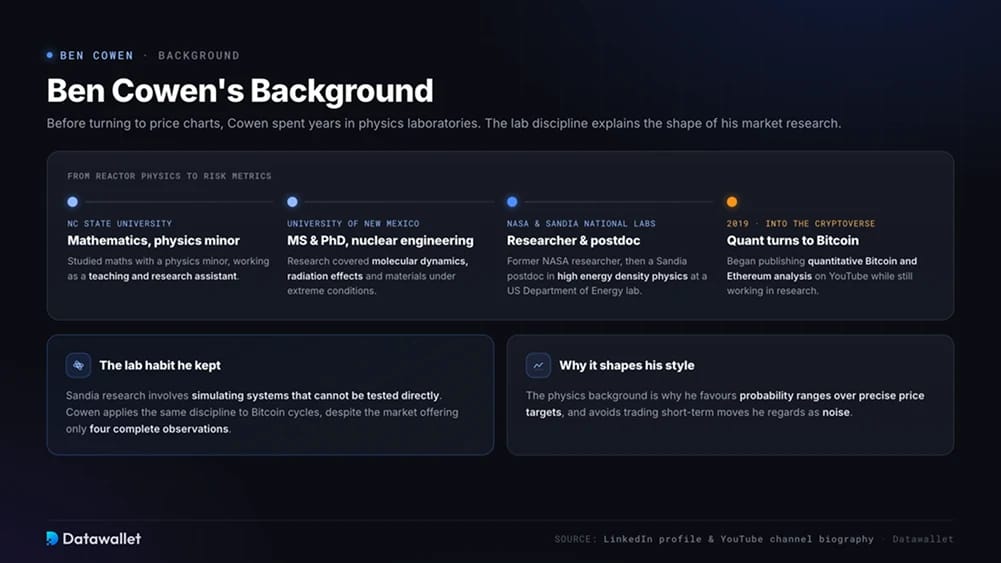
Before turning to price charts, Cowen spent years working in physics laboratories. That background helps explain why he favors probability ranges over precise price targets and avoids trading short-term moves that he regards as noise.
Education
According to his LinkedIn profile, Cowen studied mathematics at North Carolina State University and completed a minor in physics. He also worked there as a teaching and research assistant.
Cowen later earned a master's degree and PhD in nuclear engineering from the University of New Mexico. His research covered molecular dynamics, radiation effects, and how materials behave under extreme conditions.
NASA and Sandia National Laboratories
His YouTube channel biography identifies him as a former NASA researcher. He also completed a postdoctoral position in high energy density physics at Sandia National Laboratories, one of the US Department of Energy's national labs.
Research at Sandia involves simulating systems that cannot be tested directly. Cowen applies a similar discipline to Bitcoin cycles, despite the market having only four complete observations.
How Did Ben Cowen Build Into the Cryptoverse?
Into The Cryptoverse is a paid research platform, with Cowen's newer personal brand positioned above it. Operated by BC Analytics LLC, Into The Cryptoverse provides a private web app and mobile app, custom TradingView indicators, three premium videos each week, and access to private Telegram channels.
Key milestones in the business:
- YouTube launch (2019): Cowen started publishing quantitative analysis of Bitcoin and Ethereum while still working in research. His early Bitcoin Letters and Ethereum Letters remain available through his personal website.
- Risk metric (2020 to 2021): The Bitcoin Price Risk Indicator became the platform's flagship tool. It assigns a score from 0 to 1 using valuation and trend inputs. A dollar-cost averaging simulator was introduced alongside it.
- Premium launch (2021): Paid memberships added weekly premium videos and live AMAs, plus Telegram rooms. The accompanying chart library has since expanded beyond 300 charts.
- Portfolio tools (2022 to 2023): Members gained access to Modern Portfolio Theory simulations, exit strategy models, and a Risk Portfolio Tester. These tools measure exposure across an entire portfolio instead of evaluating one coin at a time.
- Team build-out (2023 onward): CTO Sebastian Desimone, senior developer Bram Merten, and engineer Paolo Rau assumed responsibility for the web and mobile applications. Dana Howell manages marketing and events.
- Workbench and Direct Access: Subscribers can use the no-code Workbench to create indicators from hundreds of metrics. A limited Direct Access tier includes monthly one-to-one video calls with Cowen.
- Research reports (this year): Cowen has published a monthly Crypto Macro Risk Memo on benjamincowen.com since January. A research paper released in May argued that widely used long-range price models, including stock-to-flow, contain a systematic optimistic bias.
- ITC Conference (November): The first in-person Investing Through the Cycles conference will run from November 20 to 22 at the JW Marriott Marquis Miami. Confirmed speakers include Mark Yusko of Morgan Creek and Mike McGlone of Bloomberg Intelligence. James Check of Checkonchain, Cem Karsan of Kai Wealth, and Guy Turner of Coin Bureau are also scheduled to appear. Standard tickets start at $299.
Cowen's personal website offers consulting to fund managers and executives through Macroeconomic Navigation Services. It also manages his speaking engagements, including Tech Summit '26 in Christchurch on September 16 and a paid Bitcoin cycle workshop the following day.
He sits on BeInCrypto's Market Intelligence experts council and appeared in the debut episode of Binance's Blockchain 100 series in March.

Ben Cowen's Net Worth
No public filing or disclosure confirms Cowen's wealth. Third-party estimates published during the past two years tend to place it near $4 million. None explain how they reached that figure, so we regard it as a floor.
Cowen has several documented sources of income. Into The Cryptoverse offers monthly and annual subscriptions across multiple tiers, while Direct Access costs substantially more than the standard service. BC Analytics sells merchandise as well.
Other income comes from consulting through Macroeconomic Navigation Services, keynote appearances, and conference ticket sales. VIP passes for the upcoming conference are listed at $4,999.
His personal website states that more than 100,000 investors learn from his analysis. Applying a conservative paid conversion rate and typical creator-business margins to that audience suggests annual revenue in the low millions of dollars.
Once his personal Bitcoin and equity holdings are included, a modeled net worth of approximately $5 million to $15 million appears supportable. The value of the crypto component changes with market prices.
Cowen does not disclose his portfolio, though his public views have remained consistent. He describes Bitcoin as the asset to which every other coin eventually loses value, and repeatedly said that he stayed out of Bitcoin during the first half of this year.

Key Concepts Ben Cowen Popularized
Cowen did not create the four-year cycle theory, but he gave it measurable rules. Several terms associated with his research are now used by analysts who have never subscribed to his platform.
The frameworks most associated with his work:
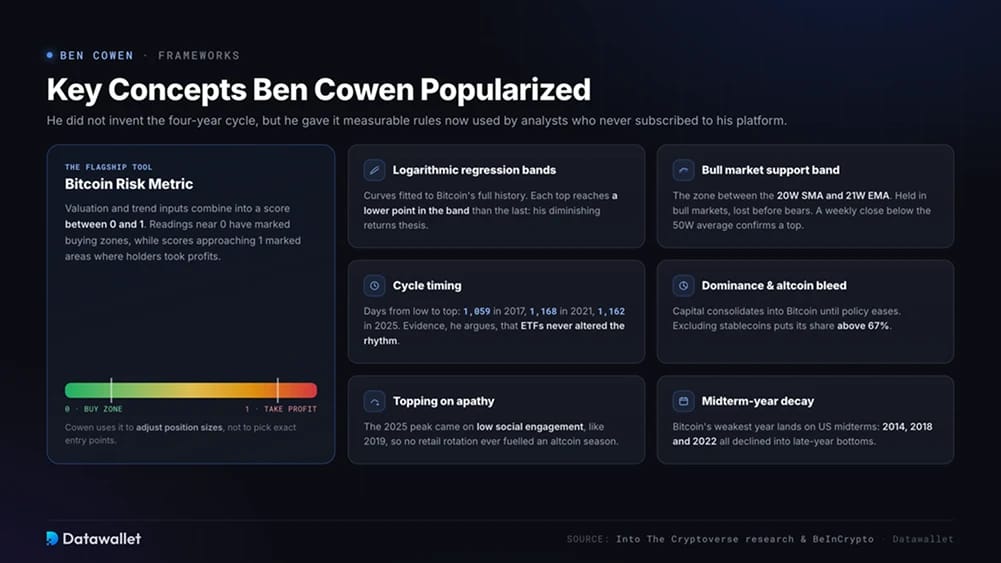
- Bitcoin Risk Metric: This indicator combines valuation and trend inputs to produce a score between 0 and 1. Readings near 0 have historically corresponded with buying zones. Scores approaching 1 have marked areas where holders took profits. Cowen uses the metric to adjust position sizes rather than select exact entry points.
- Logarithmic regression bands: These curves are fitted to Bitcoin's complete price history on a logarithmic scale. Cowen argues that each cycle top reaches a lower point relative to the upper band than the previous one, formally expressing his diminishing returns thesis. Our Bitcoin rainbow chart presents a related model.
- Bull market support band: This zone lies between the 20-week simple moving average and 21-week exponential moving average. Bitcoin generally holds the band during bull markets and loses it before bear markets. Cowen considers a weekly close below the 50-week average confirmation that a cycle has topped.
- Cycle timing: Cowen counts the days between each cycle low and top. The 2017 and 2021 peaks occurred on day 1,059 and day 1,168 from their respective lows. The October 2025 top arrived on day 1,162. He cites that timing as evidence that ETFs and treasury companies did not alter Bitcoin's established rhythm.
- Bitcoin dominance and altcoin bleed: Throughout the last tightening cycle, Cowen argued that capital consolidates into Bitcoin regardless of which direction prices move. In his model, altcoins continue losing ground against Bitcoin until monetary policy becomes less restrictive. Excluding stablecoins from the calculation raises Bitcoin's share above 67%.
- Topping on apathy: Cowen uses this idea to explain why the 2025 peak was not followed by an altcoin season. Bitcoin topped amid low social engagement rather than euphoria, similar to 2019, leaving no retail rotation into riskier coins. Our altcoin season index tracks this rotation in real time.
- Midterm-year decay: Bitcoin's weakest year in each cycle has coincided with US midterm elections. The asset declined during the second half of 2014, 2018, and 2022, reaching its bottom late in the year or soon afterward.
Ben Cowen's Fourth-Quarter Bitcoin Bottom Call
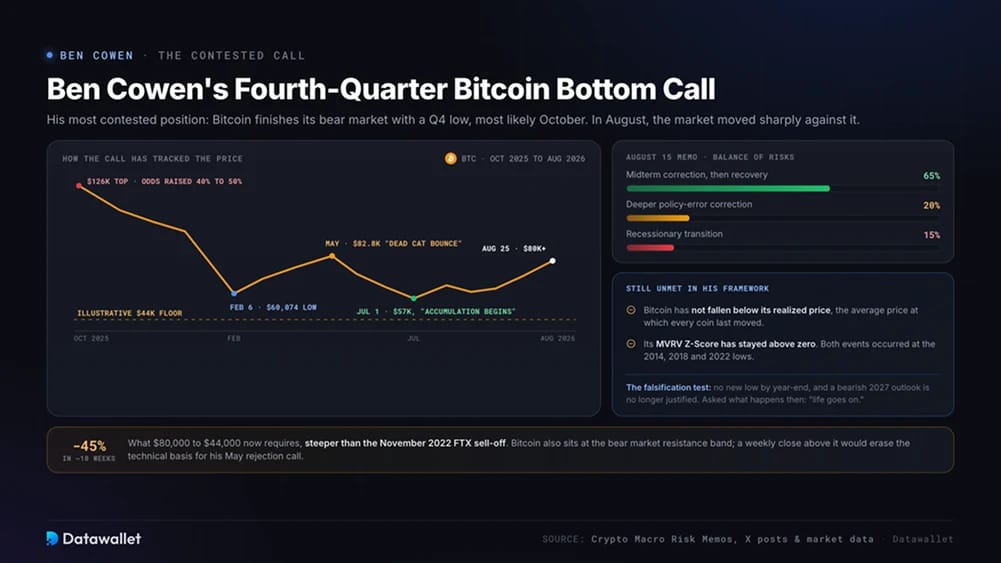
Cowen's most contested forecast is that Bitcoin will complete its bear market with another low in the fourth quarter, most likely October. This would match the previous three US midterm years, though Bitcoin's August rally has placed the scenario under pressure.
How the call has evolved:
- October 2025 to January 2026: As Bitcoin approached its $126,000 record, Cowen raised the probability that the top was in from 40% to 50%. He cited the 2019 pattern and the scheduled end of quantitative tightening, arguing that a bottom could follow roughly one year later. His January memo declared the 2023 to 2025 cycle complete and classified subsequent rallies as temporary moves within a bear market.
- February to May: Bitcoin fell to $60,074 on February 6. Cowen kept October as his base case while returns remained within the range of previous midterm years. When Bitcoin later rallied to $82,800, he called it a dead cat bounce and expected a break below the February low. The rejection at the 200-day moving average resembled the final stages of the 2018 and 2022 declines, in his view.
- July 1: Bitcoin dropped below its 200-week moving average and reached approximately $57,000. Cowen marked the start of accumulation, while his July memo retained a fourth-quarter bottoming window. It included an illustrative floor near $44,000 if the midterm decay pattern repeated.
- August 15: The Balance of Risks memo placed Bitcoin on bottom-watch near $63,000. Cowen assigned a 65% probability to a midterm correction followed by recovery, 20% to a deeper policy-error correction, and 15% to a recessionary transition.
Bitcoin then broke with previous midterm-year Augusts. It climbed from about $62,800 on August 14 to more than $80,000 on August 25, its highest level since May. The Treasury doubling its bond buyback size and renewed optimism around US crypto legislation helped drive the rally. Cowen's July memo had noted that Bitcoin fell between 15% and 18% during every previous midterm-year August.
Reaching $44,000 from $80,000 would now require a 45% decline in roughly ten weeks, steeper than the November 2022 FTX sell-off covered in our history of crypto crashes. Bitcoin has also entered the bear market resistance band that stopped earlier rallies this year. A weekly close above it would weaken the technical basis for Cowen's May rejection call.
Cowen maintains that the fourth-quarter decline was possible, not essential to his outlook. On August 20, he reminded critics that he had called for accumulation on July 1 and described another flush as a "decent chance." Asked what would happen if it never arrived, he replied that "life goes on."
His framework still lacks two signals seen at the 2014, 2018, and 2022 lows. Bitcoin has not fallen below its realized price, while its MVRV Z-Score has remained above zero. Cowen has also said that a bearish outlook for 2027 would no longer be justified if Bitcoin fails to make another low before year-end, providing a clear test for the forecast.
Ben Cowen's Latest Market Views
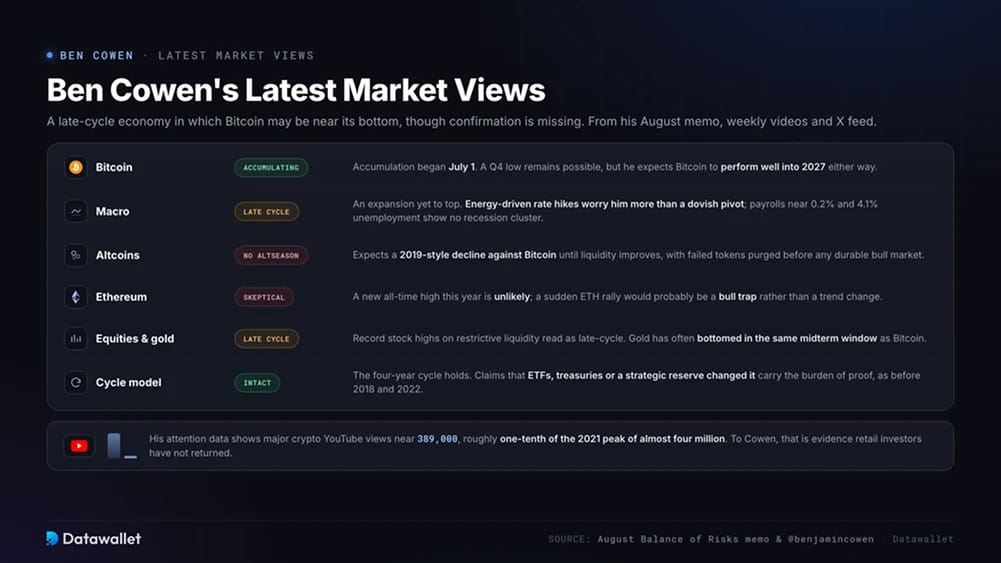
Cowen currently describes a late-cycle economy in which Bitcoin may be close to its bottom, though confirmation is still missing. The following positions come from his August memo, weekly videos, and X feed.
His most discussed positions right now include:
- Bitcoin: Cowen believes accumulation started on July 1. Another low in the fourth quarter remains possible, but he expects Bitcoin to perform well into 2027 whether or not that decline occurs.
- Macro: He views the economy as a late-cycle expansion that has yet to reach its top. In his assessment, rising energy prices forcing another Federal Reserve rate increase pose a greater threat than a dovish pivot. Payroll growth near 0.2% year over year and unemployment at 4.1% suggest that a recession cluster has not developed.
- Altcoins: Cowen does not expect a broad altcoin season this year. He forecasts a repeat of the 2019-style decline against Bitcoin until liquidity improves. Failed tokens must also be purged before a durable bull market can begin, in his view.
- Ethereum: He considers a new Ethereum all-time high this year unlikely. Cowen has warned that a sudden ETH rally would probably represent a bull trap rather than a lasting trend change.
- Equities and gold: Stocks reaching record highs while liquidity remains restrictive signal a late-cycle environment to Cowen. He also notes that gold has often bottomed during the same midterm window associated with Bitcoin's lows.
- Cycle model: Cowen maintains that the four-year cycle remains intact. Those claiming that ETFs, corporate treasuries, or a strategic reserve altered the pattern carry the burden of proof, he argues, because similar claims preceded the 2018 and 2022 bear markets.
- Attention: His data shows views across major crypto YouTube channels near 389,000. That is roughly one-tenth of the 2021 peak of almost four million, which he interprets as evidence that retail investors have not returned.
Ben Cowen's Track Record
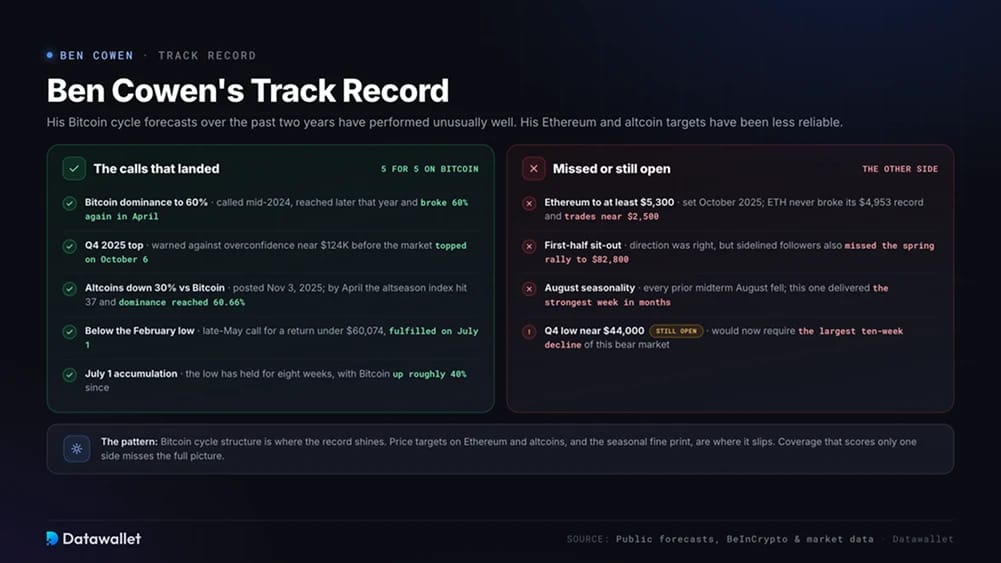
Cowen's Bitcoin cycle forecasts over the past two years have performed unusually well. His Ethereum and altcoin targets have been less reliable. Both sides of his record are set out below.
The calls that landed:
- Bitcoin dominance to 60%: Cowen made this forecast in mid-2024. Dominance reached 60% later that year and broke above the level again in April.
- Q4 2025 top: He identified the fourth quarter of the post-halving year as the likely cycle peak. Cowen warned against excessive confidence while Bitcoin traded near $124,000, before the market topped on October 6.
- Altcoins down 30% against Bitcoin: This forecast was posted on November 3, 2025. By April, the altcoin season index had fallen to 37 and Bitcoin dominance reached 60.66%.
- Below the February low: In late May, Cowen predicted that Bitcoin would return to $60,074 and continue lower. The market fulfilled that call on July 1.
- July 1 accumulation: Bitcoin's low has held for eight weeks, with the asset gaining approximately 40% since then.
The calls that missed or remain open:
- Ethereum to at least $5,300: Cowen established this minimum target in October 2025. Ethereum still holds its August 2025 record of $4,953 and currently trades near $2,500.
- First-half sit-out: The directional caution proved correct, but followers who remained on the sidelines also missed the spring rally to $82,800, which Cowen described as a dead cat bounce.
- August seasonality: His memo noted that Bitcoin had declined during every previous midterm-year August. This year, the asset instead recorded its strongest week in months.
- Fourth-quarter low near $44,000: The forecast remains open. Reaching that level would now require the largest ten-week decline of the current bear market.
Criticisms and Controversies Around Ben Cowen
Cowen attracts less severe criticism than many of the promoters with whom he shares an audience. Most objections focus on the confidence assigned to a limited dataset and the opportunity cost of his cautious positioning.
Recurring criticisms include:
- Four data points: Critics say that forecasting October lows from three midterm years and four halving cycles amounts to curve-fitting. In their view, Cowen presents a very small sample with more statistical precision than it can support.
- Lengthening cycles: During 2020 and 2021, Cowen considered the possibility that Bitcoin's cycles were becoming longer. He abandoned the theory after the 2021 and 2025 tops arrived according to the four-year schedule. Critics argue that this adjusted the model to fit the result after it occurred.
- Opportunity cost: Holding cash during the first half protected investors from Bitcoin's decline from nearly $98,000 in January to $57,000 in July. Those who continued waiting for an October bottom also missed a 40% rally from the July low.
- Paywall incentives: Bearish forecasts can keep readers subscribed to a paid research service. However, Cowen published both the bottom-watch memos and his July 1 accumulation call on his public feed, weakening the criticism without eliminating the underlying incentive.
- Tone with critics: Cowen frequently anticipates attempts to "dunk" on his forecasts through his X account. Supporters view these posts as evidence that he documents his previous statements, while critics consider the tone defensive.
- Selective scoring: Coverage often evaluates Cowen's successful Bitcoin cycle calls without giving equal attention to the Ethereum and altcoin targets that failed.
- Conference pricing: VIP passes priced at $4,999 and commercial sponsorship packages can appear inconsistent with a brand founded on skepticism toward hype cycles, despite the institutional speakers involved.
Final Thoughts
Ben Cowen occupies a distinct position within crypto research. While many influencers sell certainty, he presents a range of possible outcomes and encourages readers to size their positions around those probabilities. His public record over the past year is stronger than that of most peers, particularly his decision to raise the probability of an October 2025 top and his identification of the July low as an accumulation point.
The fourth-quarter scenario remains under pressure. If Bitcoin stays above $63,000 through late October, the midterm decay pattern will have failed during its first test since spot ETFs launched. Cowen has already said that his wider outlook would remain intact.
A shock that pushes Bitcoin back toward the mid-$40,000s would produce the opposite result, making the four-year cycle much harder to dispute.
Readers can test Cowen's framework against current market data by monitoring Bitcoin dominance, the crypto fear and greed index, the halving countdown, and spot Bitcoin ETF demand alongside price.