


Login to Track Your Live Crypto Portfolio
Sign Up and Track Your Live Crypto Portfolio for Free
Forgot your password?
Binance Increases Emergency SAFU Fund With $300 Million

This article has been reviewed and verified for accuracy by our editorial team. All claims, data points and platform details are cross-referenced against primary sources.
Some links on this page are affiliate links. Datawallet may earn a commission when you sign up through them, at no extra cost to you. This never influences our editorial ratings, rankings or recommendations.
Some links on this page are affiliate links. Datawallet may earn a commission when you sign up through them, at no extra cost to you. Ratings and rankings reflect our own testing and assessment criteria.

GM. Binance injected $300 million in Bitcoin into its SAFU fund, rebalancing the emergency reserve to $1 billion to safeguard user capital against market volatility.
Meanwhile, CoinShares dismissed immediate quantum threats to Bitcoin, Vitalik Buterin critiqued the counterparty risks in DeFi lending, and Strategy continued its BTC accumulation.
Here are the details on insurance boosts, quantum safety, and protocol risks. 👇
Binance Increases Emergency SAFU Fund With $300 Million
Binance executives injected an additional $300 million worth of Bitcoin into the Secure Asset Fund for Users to bolster its emergency reserves. This aggressive reallocation signals profound conviction in digital gold despite mounting pressure across global markets.
The tactical acquisition transpired on 9 February 2026 across major liquidity venues as the exchange finalized its month-long fund conversion strategy. These purchases arrived while Bitcoin prices languished near $60,000, testing the resolve of many institutional traders.
Leadership enacted this massive change because they seek to align the protocol’s primary insurance vehicle with the industry’s most resilient asset class. Management maintains that this $1 billion protection fund effectively safeguards client capital against potential hacks.
Engineers achieved this fortification by purchasing 4,225 Bitcoin (as seen on Arkham), lifting the total dedicated reserve holdings to more than $720 million today. Consequently, the exchange must rebalance these volatile assets if the fund's total valuation descends below $800 million.
CoinShares Dismisses Immediate Quantum Threat To Bitcoin
CoinShares lead researcher Christopher Bendiksen reported that only 10,230 BTC currently sit in addresses worth a quantum attack. While 1.63 million BTC have exposed public keys, most are spread across 32,000 small wallets averaging 50 BTC each. These smaller holdings would require roughly a millennium to crack even under the most optimistic technological scenarios.
The report highlights that 7,000 BTC sit in wallets with 100 to 1,000 BTC, while 3,230 BTC are in larger 10,000 BTC accounts. Breaking these keys within 24 hours would require 13 million physical qubits, which is 100,000 times the power of today's best hardware. Google’s latest Willow computer reaches only 105 qubits, leaving the $719.1 million at risk largely secure for now.
Vitalik Buterin Critiques Risks In Current DeFi Lending
Ethereum co-founder Vitalik Buterin recently challenged the definition of "real" decentralized finance during a public discussion on X. He argued that true value in the sector comes from managing risk rather than simply generating yield on centralized assets. Buterin specifically criticized products that rely heavily on fiat-backed stablecoins because they offer little reduction in issuer or counterparty risk.
The developer proposed two alternative paths including algorithmic stablecoins backed by Ether or diversified, overcollateralized real-world assets. He suggested that shifting counterparty risk to markets is a superior feature compared to relying on a single centralized entity. These comments arrive while USDC continues to dominate major lending protocols like Aave and Compound with billions in total deposits.
Strategy Continues Bitcoin Purchases Despite Paper Losses
Michael Saylor's Strategy acquired an additional 1,142 BTC for roughly $90 million between February 2 and February 8. According to a recent SEC filing, the firm now holds 714,644 BTC at an average cost of $76,056 per coin. This latest purchase demonstrates the company's commitment to its treasury model even as it faces over $5.2 billion in unrealized losses.
CEO Phong Le stated during an earnings call that the price would need to drop to $8,000 to threaten debt obligations. The company successfully funded these acquisitions by selling Class A common stock through its ongoing at-the-market issuance program. Despite the recent market downturn, analysts from TD Cowen believe the firm is well-positioned to lead a potential corporate recovery.
Data of the Day
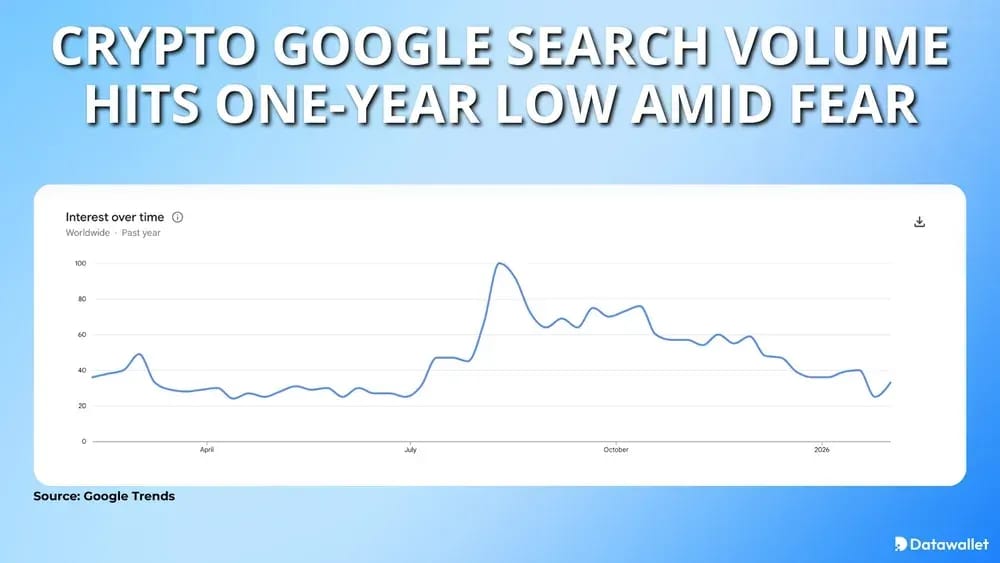
Worldwide Google search interest for "crypto" has plummeted to one-year lows as investor sentiment reaches levels of extreme fear. The total market capitalization for digital assets fell to approximately $2.4 trillion from its previous peak of over $4.2 trillion. Data from Google Trends reveals that worldwide interest currently sits at 30 out of 100 as trading volumes continue to decline.
The Crypto Fear & Greed Index hit a record low of 5 this Thursday, mirroring the panic seen during the 2022 Terra collapse. Market analysts from Santiment observed that negative commentary has reached its highest point in months as retail traders exit the space. Investors are now closely searching for social signals that might indicate the market has finally reached a definitive cycle bottom.
More Breaking News
- CryptoCom CEO Kris Marszalek acquired the ai.com domain for $70 million to launch a decentralized platform featuring autonomous agents for consumer tasks.
- BitMine Immersion Technologies added 40,613 ETH to its treasury last week, reaching 72% of its stated goal to hold 5% of circulating supply.
- Story Protocol co-founder S.Y. Lee defended delaying token unlocks until August, arguing the network needs more time to build its AI data marketplace.
- South Korea's financial regulator announced targeted investigations into crypto market manipulation and introduced punitive fines for IT-related accidents at major digital exchanges.
- Hyperliquid’s HYPE token surged over 40% after the protocol slashed monthly unlocks and integrated with Ripple Prime to offer institutional liquidity access.
- SlowMist identified a supply chain poisoning attack on OpenClaw, where 472 malicious plugins hide backdoors to steal user data and extort victims.
- French police arrested six suspects following the kidnapping of a crypto startup associate and her mother, highlighting an organized rise in physical attacks.
- Economist Lyn Alden predicted a gradual era of money printing that will mildly stimulate asset prices as the Federal Reserve expands its balance sheet.
For the latest updates on digital asset markets, follow us on X @Datawalletcom.
For the latest updates on digital asset markets, follow us on X @Datawalletcom.
Get tomorrow’s issue in your inbox