


Login to Track Your Live Crypto Portfolio
Sign Up and Track Your Live Crypto Portfolio for Free
Forgot your password?
Strategy Solvency Safe Unless Bitcoin Hits $8,000 Threshold

This article has been reviewed and verified for accuracy by our editorial team. All claims, data points and platform details are cross-referenced against primary sources.
Some links on this page are affiliate links. Datawallet may earn a commission when you sign up through them, at no extra cost to you. This never influences our editorial ratings, rankings or recommendations.
Some links on this page are affiliate links. Datawallet may earn a commission when you sign up through them, at no extra cost to you. Ratings and rankings reflect our own testing and assessment criteria.

GM. Kicking off the week, Strategy’s CEO revealed the company is safe unless Bitcoin hits $8,000, while the firm manages a $12.6 billion quarterly paper loss.
Meanwhile, Polymarket filed trademarks for a POLY token, Senator Lummis urged banks to adopt stablecoins, and Charles Hoskinson revealed $3 billion in personal crypto losses.
Here are the details on corporate floors, token filings, and personal convictions. 👇
Strategy Solvency Safe Unless Bitcoin Hits $8,000 Threshold
CEO Phong Le revealed that Bitcoin must plummet to $8,000 before the company faces critical insolvency regarding its massive convertible debt obligations. This extreme stress test highlights the firm's calculated resilience against the current market downturn.
The disclosure occurred on 5 February 2026 during a high-stakes webinar addressing the corporation's staggering $12.6 billion quarterly net loss. Executives presented these figures to calm panicked investors after the stock price plummeted 17% on Thursday.
Management identified this specific $8,000 threshold because it represents the point where total Bitcoin treasury reserves exactly equal the firm's net debt. Leadership argued that even a 90% price collapse would not trigger immediate liquidation for years.
The enterprise maintains $2.3 billion in cash reserves to comfortably service its $8.2 billion debt through 30 months of volatility. By utilizing mark-to-market accounting, Strategy remains transparent about unrealized losses while continuing its relentless accumulation.
Polymarket Files Trademarks For Native POLY Token
Prediction market Polymarket filed federal trademark applications for its long-anticipated POLY token this Thursday. The parent company Blockratize Inc. submitted these specific filings to cover cryptocurrency services and blockchain-based payment systems. This legal step suggests the platform is preparing for a public launch despite facing increased scrutiny from state gaming regulators.
Executives previously mentioned that any potential token would prioritize true utility and long-term ecosystem longevity for its users. Traders currently estimate a 30% probability that the asset will officially debut before May of this year. While Polymarket recently secured CFTC approval to operate domestically, it continues to navigate complex legal challenges within the Nevada court system.
Senator Lummis Urges Banks To Embrace Stablecoins
Senator Cynthia Lummis urged traditional financial institutions on Thursday to view stablecoins as a significant business opportunity. She argued during a televised interview that digital assets represent a faster and cheaper payment rail for global customers. This push comes as negotiations for the flagship market structure bill remain deadlocked due to concerns over banking deposit flight.
Lenders currently worry that stablecoin rewards could draw essential capital away from community banks and traditional savings accounts. Lawmakers attempted to resolve these disputes by labeling incentives as bonuses, but a committee agreement has not yet materialized. Treasury Secretary Scott Bessent also supported the legislation this week while criticizing those who continue to oppose the proposed framework.
Charles Hoskinson Addresses $3 Billion in Crypto Losses
Cardano founder Charles Hoskinson confirmed during a Tokyo broadcast that he is currently sitting on $3 billion in unrealized losses. He shared this specific figure to demonstrate that crypto founders are not insulated from the volatility affecting retail investors. Despite the sharp decline in ADA prices, Hoskinson emphasized his commitment to building decentralized systems rather than focusing on short-term gains.
The broader market recently experienced heavy selling pressure as Bitcoin dropped toward the $60,000 level last week. Hoskinson stated that he has no intention of exiting his positions and views the downturn as a transition for global finance. He remains focused on developing privacy-centric applications like Midnight to improve the long-term data integrity of the Cardano ecosystem.
Data of the Day
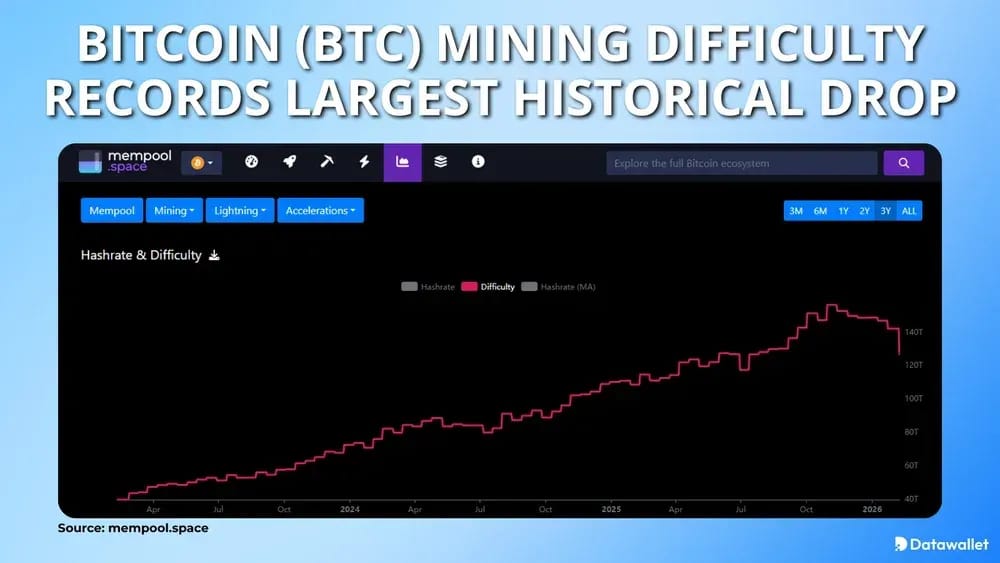
Bitcoin’s mining difficulty plummeted by 11.2% on Saturday, marking the largest negative adjustment since the 2021 China ban. This sharp decline was triggered by a 20% reduction in total network hashrate over the previous month. Widespread miner shutdowns occurred after Winter Storm Fern strained residential power grids and Bitcoin prices fell nearly 45% from their peak.
Average production costs currently sit near $87,000 per coin while the market price trades closer to the $69,000 range. Many operators using older hardware are now running at a deficit because transaction fees have also collapsed significantly. Mechanical relief from this difficulty drop provides surviving miners with better odds of earning rewards during this difficult period of reduced profitability.
More Breaking News
- Two California teenagers face felony charges after driving 600 miles to allegedly attempt a $66 million cryptocurrency robbery through a violent home invasion.
- The People’s Bank of China officially banned unapproved yuan-pegged stablecoins and tokenized assets, prioritizing the sovereign digital yuan over private digital competitors.
- NBA star Giannis Antetokounmpo acquired a minority stake in Kalshi, becoming the first active player to invest in a regulated prediction market platform.
- South Korean crypto exchange Bithumb accidentally credited users with $43 billion in Bitcoin due to a technical error, triggering a temporary internal price crash.
- ENS Labs canceled its Namechain Layer 2 project to deploy ENSv2 directly on Ethereum, citing lower mainnet costs and stronger infrastructure security guarantees.
- MegaETH Foundation will use revenue from its USDM stablecoin to fund MEGA token buybacks, tying the asset's release to specific ecosystem growth.
- Russia’s Sberbank is preparing to launch corporate loans secured by cryptocurrency collateral following a successful pilot with a domestic Bitcoin mining firm.
For the latest updates on digital asset markets, follow us on X @Datawalletcom.
For the latest updates on digital asset markets, follow us on X @Datawalletcom.
Get tomorrow’s issue in your inbox