


Login to Track Your Live Crypto Portfolio
Sign Up and Track Your Live Crypto Portfolio for Free
Forgot your password?
Vitalik Buterin Reverses Ethereum L2-Centric Scaling Strategy

This article has been reviewed and verified for accuracy by our editorial team. All claims, data points and platform details are cross-referenced against primary sources.
Some links on this page are affiliate links. Datawallet may earn a commission when you sign up through them, at no extra cost to you. This never influences our editorial ratings, rankings or recommendations.
Some links on this page are affiliate links. Datawallet may earn a commission when you sign up through them, at no extra cost to you. Ratings and rankings reflect our own testing and assessment criteria.

GM. Vitalik Buterin reversed Ethereum’s rollup-centric roadmap through Layer 2 chains, shifting focus to base-layer scaling with a 200 million gas limit to fix liquidity and centralization.
Meanwhile, Binance reserves remain stable despite misinformation, Tether’s CEO defended a $500 billion valuation, and Polymarket and Kalshi are fighting for users with free groceries.
Here are the details on scaling pivots, reserve audits, and grocery wars. 👇
Vitalik Buterin Reverses Ethereum L2-Centric Scaling Strategy
Vitalik Buterin declared a radical departure from the long-standing rollup-centric roadmap that previously positioned Layer 2 networks as the primary scaling engines. This ideological shift dismantles the central narrative that has defined Ethereum development for 5 years.
The critical pivot surfaced on 3 February 2026 across global digital networks as the co-founder addressed mounting concerns regarding fragmented liquidity. This announcement arrives amid a severe 30% price plunge for the network’s native ETH asset.
Leadership abandoned the original "branded shard" vision because most Layer 2 networks failed to achieve Stage 2 decentralization while the base layer advanced rapidly. Corporate interests and regulatory hurdles reportedly incentivized some teams to retain ultimate centralized control.
Developers must now forge a new path by introducing native ZK-EVM precompiles and expanding Layer 1 gas limits to 200 million. These technical enhancements, proposed by Vitalik, effectively reduce the desperate need for third-party scaling platforms to handle mass user activity.
CryptoQuant Analysts Find No Stress For Binance Reserves
Onchain analysts at CryptoQuant reported on Wednesday that Binance shows no signs of financial crisis despite recent market volatility. The exchange currently holds approximately 659,000 BTC, a figure that remains virtually unchanged from its total at the end of 2025. This data contradicts a wave of online criticism that suggested the platform faced material reserve erosion during the sell-off.
A cluster of suspicious social media accounts recently coordinated a campaign claiming they were closing their Binance accounts. Analysts identified these posts as potential misinformation due to identical usernames, shared avatar imagery, and mirrored posting behavior across X. Binance co-founder Changpeng Zhao responded to the situation by emphasizing that the platform continues to build trust through transparency.
Tether CEO Defends Massive $500 Billion Valuation
Tether CEO Paolo Ardoino denied reports on Wednesday that the stablecoin issuer ever planned a $20 billion capital raise. He clarified that the high figures discussed last fall were hypothetical maximums rather than an active fundraising target for the company. The firm continues to grow organically and does not require external funding to maintain its dominant position in the market.
Ardoino defended a $500 billion valuation by comparing his company's profitability to major artificial intelligence platforms like OpenAI. While Tether reported a $10 billion profit in 2025, the executive noted that many highly valued AI firms still operate with losses. The company currently manages $185 billion in its USDT stablecoin and holds over 130 metric tons of physical gold.
Prediction Markets Battle For Dominance With Free Groceries
Leading prediction platforms Polymarket and Kalshi have launched competing grocery giveaways to attract new users in New York City. Kalshi offered a $50 credit to over 1,795 residents in Manhattan this Tuesday at a local Westside Market location. This aggressive promotion comes as the sector sees a fourfold increase in daily trading volumes compared to the previous year.
Polymarket responded by announcing plans to open a permanent free grocery store in New York starting next Thursday. The platform also donated $1 million to the Food Bank for NYC to support local residents with limited access to affordable nutrition. Both firms are utilizing these high-impact physical marketing campaigns to establish brand authority in the global financial capital this February.
Data of the Day
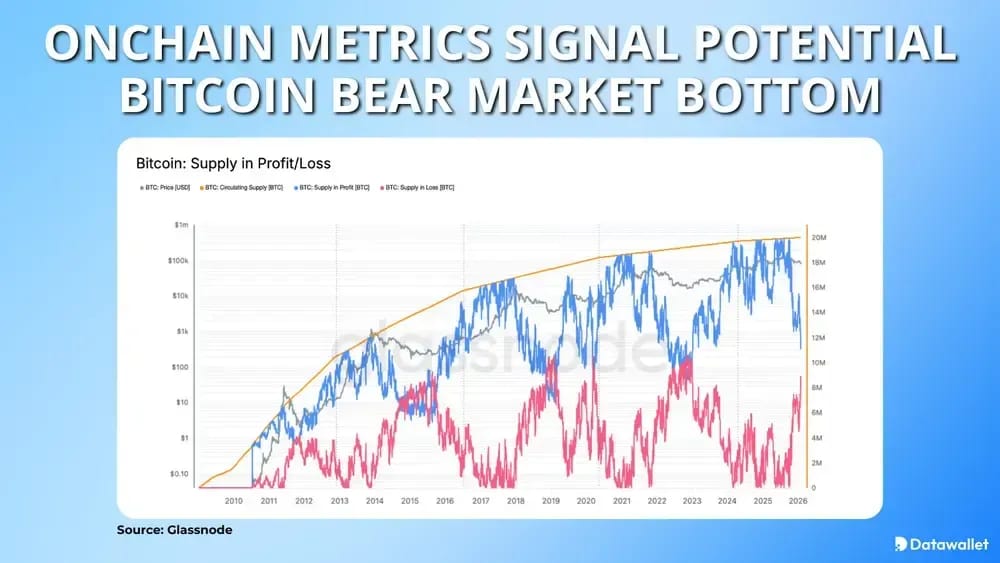
A battle-tested onchain indicator suggests that Bitcoin may be nearing a definitive cycle bottom, according to recent Glassnode data. The metric tracks the convergence between the volume of BTC supply held in profit versus the supply held in loss. Historically, when these two cohorts balance out, it signals a period of market capitulation and a long-term buying opportunity.
Current records show that 11.1 million BTC sits in profit while 8.9 million BTC remains underwater for global investors. This specific pattern previously identified major lows during the 2022 FTX collapse and the 2020 pandemic market shock. Bulls are monitoring these convergence points closely as spot prices move toward the aggregate cost basis of the entire circulating supply.
More Breaking News
- CryptoCom launched OG, a standalone US prediction markets platform offering CFTC-regulated sports event contracts as legal pressure mounts from several state regulators.
- Ripple integrated Hyperliquid into its Ripple Prime brokerage, marking the platform's first direct connection to a decentralized finance venue for institutional clients.
- The Nevada Gaming Control Board filed a civil action to block Coinbase from offering sports and election prediction markets without state licenses.
- Novogratz's Galaxy Digital reported a $482 million net loss for the fourth quarter, despite significantly growing its cash and stablecoin reserves during that period.
- Ark Invest spent $19 million on crypto-related stocks, including Coinbase and Robinhood, as Bitcoin’s price dipped to its lowest point in two years.
- Canada’s top investment regulator established a new tiered custody framework to safeguard digital assets and prevent losses from hacking, fraud, or poor governance.
- Coinbase’s Base network resolved transaction delays caused by a configuration error and is planning infrastructure upgrades to maintain its dominant L2 lead.
- Aave Labs is sunsetting the Avara brand and Family wallet to refocus on decentralized finance and simplify its global product surface area.
For the latest updates on digital asset markets, follow us on X @Datawalletcom.
For the latest updates on digital asset markets, follow us on X @Datawalletcom.
Get tomorrow’s issue in your inbox