Login to Track Your Live Crypto Portfolio
Sign Up and Track Your Live Crypto Portfolio for Free
Forgot your password?
Pavel Durov Claims 10x Speed Boost For TON Blockchain

This article has been reviewed and verified for accuracy by our editorial team. All claims, data points and platform details are cross-referenced against primary sources.
Some links on this page are affiliate links. Datawallet may earn a commission when you sign up through them, at no extra cost to you. This never influences our editorial ratings, rankings or recommendations.
Some links on this page are affiliate links. Datawallet may earn a commission when you sign up through them, at no extra cost to you. Ratings and rankings reflect our own testing and assessment criteria.

GM. Pavel Durov announced a 10x speed boost for the TON blockchain today, achieving sub-second transaction finality to support near-instant payments for its 1 billion users.
Meanwhile, ZachXBT exposed a $1 million monthly North Korean IT worker ring, BitMine moved to the NYSE with a $4 billion buyback, and Binance integrated gas-free prediction markets.
Here are the details on network upgrades, cyber-ops, and exchange expansions. 👇
Pavel Durov Claims 10x Speed Boost For TON Blockchain
Telegram founder Pavel Durov announced that the TON blockchain achieved a 10x performance surge to deliver near-instantaneous transaction finality for global users. This technical overhaul positions the network to handle high-frequency interactions across the messaging app’s ecosystem.
The performance breakthrough arrived on 9 April 2026 as the protocol transitioned to sub-second settlement for its 1 billion users worldwide. These improvements surfaced as part of an ambitious 7 step plan to optimize long-term network efficiency.
TON implemented the Catchain 2.0 consensus update because it seeks to eliminate confirmation lag for decentralized mini-apps and institutional commerce. By increasing block rates 6x, the protocol now provides the speed required for large scale retail adoption.
Engineers achieved these 400 millisecond block times by refining the validator communication layer and expanding staking rewards to strengthen network economics. Consequently, the team now intends to slash transaction fees 6x to further incentivize active onchain adoption.
ZachXBT Exposes Global North Korean IT Network
ZachXBT recently uncovered a sophisticated network of North Korean IT workers generating roughly $1 million every month. This criminal group utilized over 390 fraudulent accounts and forged identities to secure employment at various cryptocurrency projects across the globe. The onchain detective exfiltrated internal server data to reveal how these workers channeled millions into state-sponsored payment flows.
The operation relied on a central messaging tool where employees received specific instructions for receiving and remitting their illicit earnings. Funds were typically funneled through the Tron network before being converted into fiat currency using numerous Chinese bank accounts. While this ring appeared less advanced than the infamous Lazarus group, its steady revenue highlights the scale of foreign cyber operations.
Tom Lee's BitMine Moves To NYSE And Expands Buyback
The major Ethereum treasury firm BitMine Immersion Technologies officially moved its stock listing to the New York Stock Exchange this Thursday. Chairman Tom Lee also announced that the board of directors approved a massive increase to its share buyback program to $4 billion. This strategic move aims to provide the company with enough capital to retire common shares if they trade below intrinsic value.
The firm currently maintains a massive treasury portfolio including over 4.8 million ETH valued at approximately $10.6 billion. Despite the prestigious uplisting, the company’s stock has declined 63% over the last six months following a broader market downturn. Management intends to continue accumulating Ether tokens while using the expanded buyback authorization as a tool to protect long-term shareholder interests.
Binance Wallet Integrates Gas Free Prediction Markets
Binance Wallet officially integrated the PredictFun platform to provide its users with one-click access to decentralized probability trading. The exchange is currently sponsoring all associated gas fees on the BNB Smart Chain to encourage broader adoption of these event-based contracts. This new feature allows individuals to fund their unique prediction accounts using existing balances from their spot or funding wallets.
The move arrives as global trading volume for prediction markets surpassed $20 billion during the record-breaking month of March. Binance joins several other major intermediaries that have recently launched similar products to compete with established venues like Kalshi and Polymarket. By utilizing multi-party computation technology, the platform offers a secure way for retail traders to speculate on various real-world outcomes.
Data of the Day
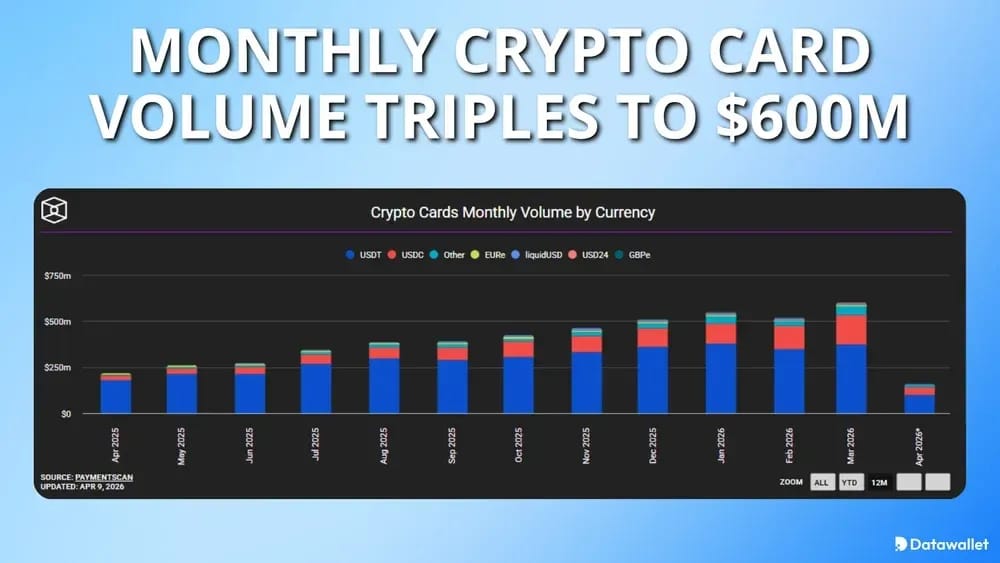
Monthly spending volume for crypto-linked cards reached $600 million in March as digital assets become more common for retail purchases. This steady growth represents a substantial increase from the much lower figures recorded just a year prior in the global market. These prepaid and debit cards allow onchain native users to pay for goods at any point-of-sale without using cumbersome banking rails.
Tether’s USDT remains the most popular settlement currency for these products across emerging regions like Southeast Asia and Latin America. However, USDC is gradually gaining ground in Western markets where institutional backing and regulatory clarity influence consumer behavior. Industry analysts believe the rising share of USDC indicates that the user base is broadening beyond traditional crypto-native strongholds.
More Breaking News
- A trader lost $3 million after a leveraged Fartcoin position unraveled, triggering auto-deleveraging on Hyperliquid and redistributing gains to opposing market participants.
- Disclosures for Donald Trump’s Mar-a-Lago memecoin gala suggest he may miss the event, despite conflicting promotional language promising a celebratory champagne toast.
- Securitize appointed former SEC official Brett Redfearn as president to lead its regulatory strategy ahead of a planned public stock market listing.
- Commodity perpetual swaps volume jumped 65,000% in the first quarter, fueled by traders seeking 24/7 exposure to gold, silver, and crude oil.
- A solo Bitcoin miner beat 1 in 100,000 daily odds to solve a block, securing a $225,000 reward with minimal computational power.
- Operation Atlantic, a joint international enforcement action, froze $12 million in crypto proceeds while identifying over 20,000 victims of sophisticated phishing scams.
- Strategy’s STRC preferred stock maintained its $100 par value during a $333 million trading day, allowing the firm to fund additional Bitcoin purchases.
- Dubai’s virtual asset regulator issued new guidance establishing three distinct pathways for the issuance of stablecoins, real-world assets, and other digital tokens.
For the latest updates on digital asset markets, follow us on X @Datawalletcom.
For the latest updates on digital asset markets, follow us on X @Datawalletcom.
Get tomorrow’s issue in your inbox