Login to Track Your Live Crypto Portfolio
Sign Up and Track Your Live Crypto Portfolio for Free
Forgot your password?
PayPal USD Stablecoin Goes Live on Solana

This article has been reviewed and verified for accuracy by our editorial team. All claims, data points and platform details are cross-referenced against primary sources.
Some links on this page are affiliate links. Datawallet may earn a commission when you sign up through them, at no extra cost to you. This never influences our editorial ratings, rankings or recommendations.
Some links on this page are affiliate links. Datawallet may earn a commission when you sign up through them, at no extra cost to you. Ratings and rankings reflect our own testing and assessment criteria.
It's another good day for crypto mass adoption. This time, PayPal officially launched on Solana, and Mastercard debuted its peer-to-peer crypto platform. While both companies aren't new to crypto, the expansion of on- and off-ramp solutions is key for Web3 going mainstream.
In other news, we will also review the latest regulatory wins for blockchain, and the hottest DeFi updates, covering protocols like Optimism, ZKasino, Hyperliquid, and Pump.fun among others.
PayPal USD Stablecoin Goes Live on Solana Network
PayPal USD (PYUSD) stablecoin is now available on the Solana blockchain, enhancing its speed and cost-efficiency for transactions. This integration offers users increased flexibility and control by supporting multiple blockchains, with Solana's high-speed, low-cost infrastructure being particularly beneficial for commerce applications, making fiat-to-crypto transactions seamless.
The launch aims to revolutionize digital commerce by providing a stable, fast, and inexpensive payment method, aligning with PayPal's longstanding commitment to innovative and trusted financial solutions. Users can manage PYUSD as a unified balance within PayPal and Venmo wallets, and it is also accessible on platforms like Crypto.com and the Phantom crypto wallet.
Mastercard Crypto Credential Debuts With P2P Transactions
Mastercard is piloting the Mastercard Crypto Credential network, a peer-to-peer platform for cryptocurrency users in Europe and Latin America, enabling cross-border payments on exchanges such as Bit2Me, Lirium, and Mercado Bitcoin. This initiative is part of Mastercard's strategy to leverage digital assets for international payments, responding to the increasing interest in blockchain and digital assets, particularly in Latin America.
The platform includes a feature for creating aliases for crypto wallets, similar to the Ethereum Name Service, to simplify transactions. By facilitating remittances, Mastercard aims to capture a share of the growing market, which saw $831 billion in global remittances in 2022, according to the United Nations International Organization for Migrations.
Vitalik Buterin Labels L2s as Cultural Extensions of Ethereum
Ethereum co-founder Vitalik Buterin discussed the cultural impact of layer-2 solutions in a blog post, noting how they have fostered diverse subcultures within the Ethereum ecosystem, each with distinct priorities and values such as public goods, scaling, and financial inclusion. Among the L2s that he endorsed are Optimism, zkSynk, and Starknet.
While acknowledging their benefits, Buterin warned of potential downsides, including the risk of these communities becoming echo chambers, collapsing into monocultures, and prioritizing financial success over other goals. He admitted that addressing these challenges is complex, suggesting that better ecosystem-wide incentives for collaboration could be a solution.
ZKasino Users Have 72-Hour Window to Reclaim Their ETH
ZKasino, a crypto gambling platform under investigation for scam allegations, has announced that users can reclaim their ETH at a 1:1 ratio after nearly two months of restricted access. The platform, which altered its token redemption policies around its launch in April, initially prevented over 10,000 investors from reclaiming their bridged ETH, converting their funds into ZKAS tokens at inflated prices without consent.
A narrow 72-hour window from 28 May to 31 May has been provided for users to register for reclaiming their funds, requiring the deposit of their ZKAS tokens back to the platform and forfeiting future token releases. This process is restricted to the original ETH deposit addresses, and users must deposit their full ZKAS balances, with allowances for gas fees.
Data of the day
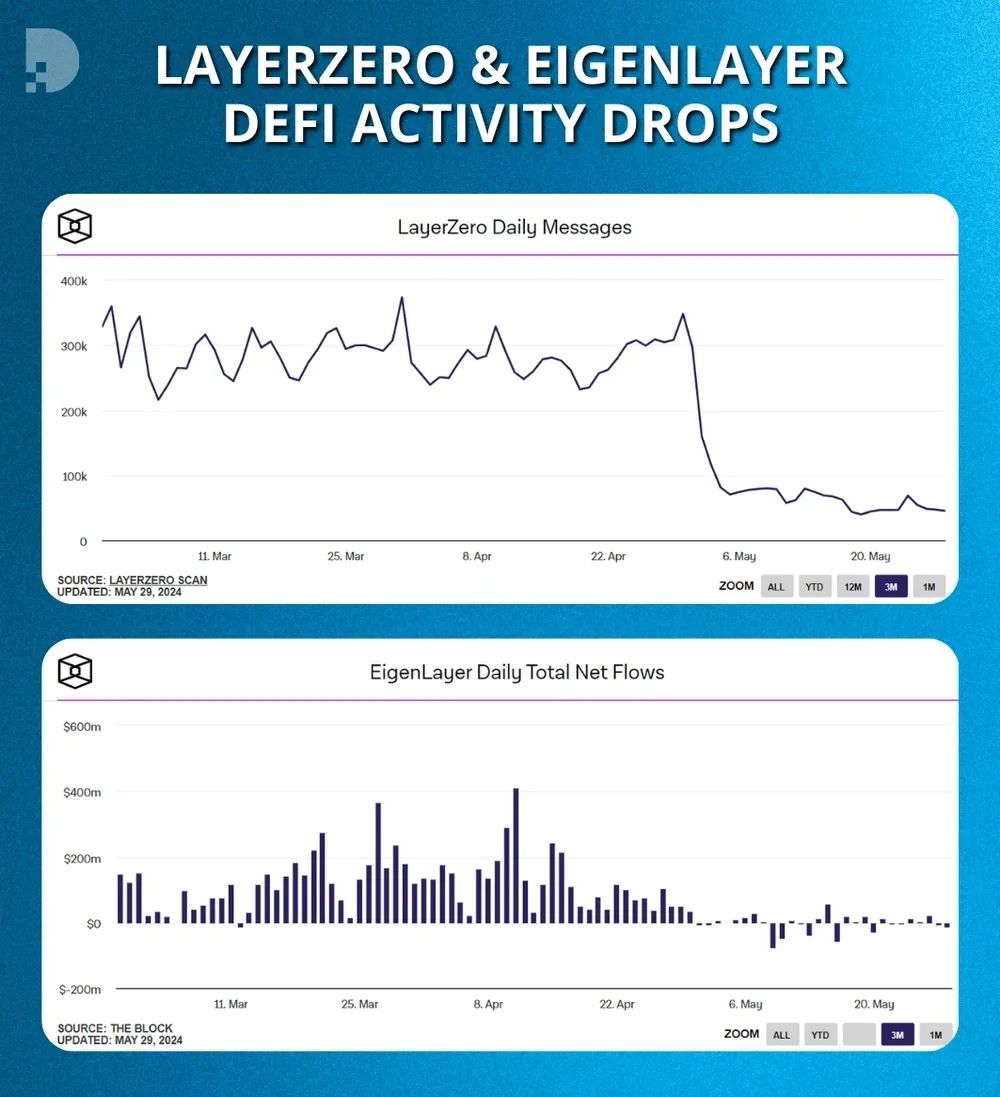
Data from TheBlock shows a drastic drop in DeFi activity for both LayerZero and EigenLayer, correlating with recent events and changes in their protocols. LayerZero's daily messages have plummeted from around 348,000 on April 30 to under 40,000 by late May, following the implementation of measures to counter sybil farming in anticipation of their ZRO token airdrop.
Similarly, EigenLayer has experienced fluctuating net flows, with notable outflows occurring after their tokenomics announcement and airdrop snapshot. Since May 6, there have been four days when daily outflows have exceeded $37 million, indicating a decent amount of funds leaving the platform. The bigger problem is the lack of new inflows as evident in the second chart below.
More breaking news
- Hashdex, an asset management firm, has withdrawn its application for a spot Ether exchange-traded fund (ETF), according to documents filed with the US Securities and Exchange Commission.
- A federal judge has ordered the SEC to pay approximately $1.8 million in attorney and receivership fees related to its civil case against Debt Box, citing bad faith conduct by the SEC.
- Gemini crypto exchange confirms that it will pay out over $2 billion worth of digital assets to customers of its Earn lending program through an in-kind distribution.
- Ripple Labs donates an additional $25 million to Fairshake, a super political-action committee that supports pro-crypto candidates in the 2024 elections.
- Pump.fun, the top Solana meme coin creation protocol, has added a livestreaming feature in its latest update. There are currently no restrictions on the content, just NSFW labels.
- Hyperliquid perpetual DEX has announced that it will distribute 700,000 points weekly for four months, extending its points-earning program in users' anticipation for an airdrop.
For the latest updates on digital asset markets, follow us on X @Datawalletcom.
For the latest updates on digital asset markets, follow us on X @Datawalletcom.
Get tomorrow’s issue in your inbox