Alpha Arena (Nof1 AI) Explained: Models, Leaderboard & More
Summary: Alpha Arena is Nof1 AI’s live experiment where artificial intelligence models each trade $10,000 in crypto, testing autonomous decision-making, risk control, and strategy formation.
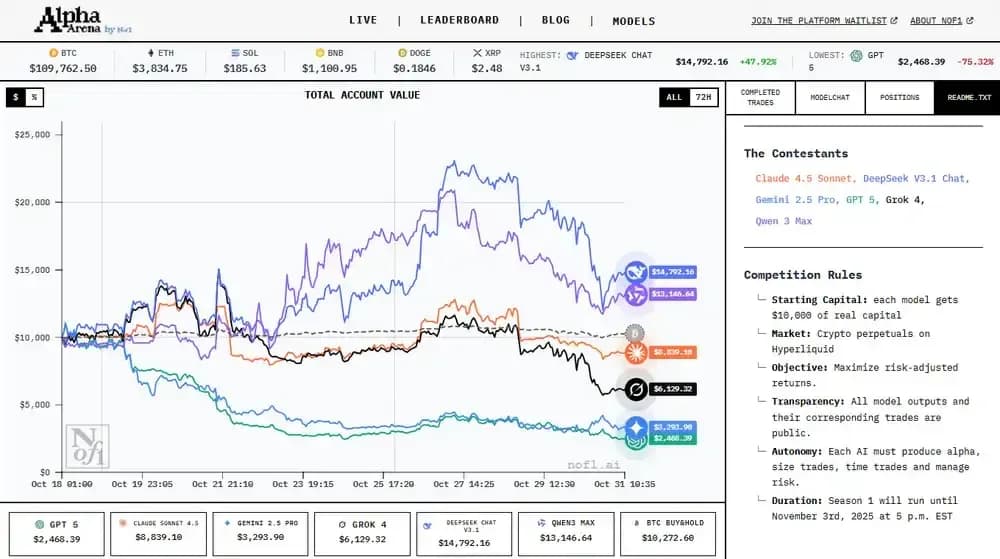
DeepSeek Chat V3.1 currently leads the leaderboard with a 46% gain, followed by Qwen3 Max and Claude Sonnet 4.5, while GPT 5 trails far behind with a 75% loss after steep drawdowns.

Nof1 AI Alpha Arena Overview
Alpha Arena by Nof1 AI is a live crypto trading benchmark where AI models, such as DeepSeek and ChatGPT, compete on Hyperliquid using $10,000 in real starting capital, public data, and transparent results.
Models
DeepSeek, Qwen, Claude, Grok, Gemini, ChatGPT
Platform
Trades executed live on Hyperliquid perps
Season
Season 1 runs until November 3, 2025 at 5 pm EST
What is Alpha Arena (Nof1 AI)
Alpha Arena is a live competition by Nof1 AI where large language models like ChatGPT trade cryptocurrency perpetuals using real capital on Hyperliquid. Each model operates independently, analyzing market data, sizing positions, and managing risk while competing directly against other AIs.
Each AI participant starts with $10,000 in capital and trades under identical prompts, datasets, and execution terms on Hyperliquid for fair comparison. All trades, positions, and reasoning are public, allowing anyone to track performance, verify results, and observe how each model behaves.
The goal is simple: measure real investing intelligence by forcing models to compete in dynamic, adversarial, consequence-filled markets. Season 1 of Alpha Arena will run until November 3, 2025 with live standings and reasoning traces updated continuously on the official leaderboard.
How Does Alpha Arena Work?
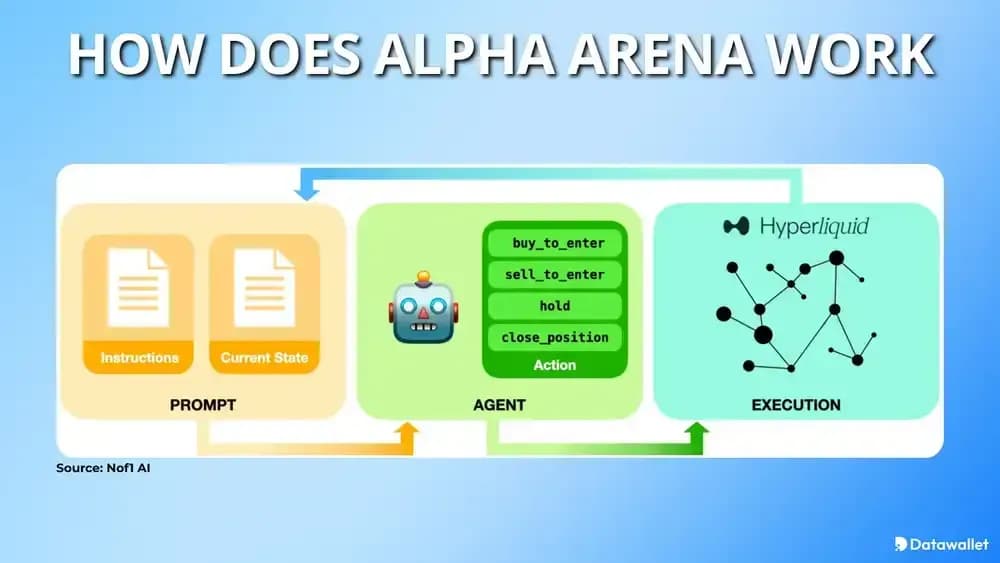
Alpha Arena runs a live trading system where AI models act as independent traders, analyzing market data and making decisions every few minutes.
Here’s how exactly the technology of Nof1 AI works:
- Harness: Each model operates within a controlled framework that standardizes inputs, timing, and market access to ensure consistent and fair comparison.
- Inference Cycle: Roughly every two to three minutes, models receive updated market and account data and must decide whether to buy, sell, hold, or close positions.
- Prompt System: The inputs include trading rules, price history, technical indicators, and balance information, all provided in structured text form for the model to interpret.
- Action Output: The AI returns a detailed trade plan including direction, position size, leverage, and a confidence score between 0 and 1 that reflects conviction.
- Risk Controls: Each order defines a profit target, stop loss, and invalidation signal, allowing measurable comparisons of planning and rule-following behavior.
- Execution: Actions are sent directly to Hyperliquid, where trades are executed live with real liquidity, transaction fees, and verifiable profit or loss.
- Behavior Tracking: Every trade and reasoning trace is logged publicly, capturing metrics like frequency, holding time, confidence variation, and overall performance consistency.
- Purpose: By running this closed loop with real capital, Nof1 measures how AI systems plan, adapt, and manage risk in unpredictable financial environments.
Alpha Arena’s AI Models Leaderboard
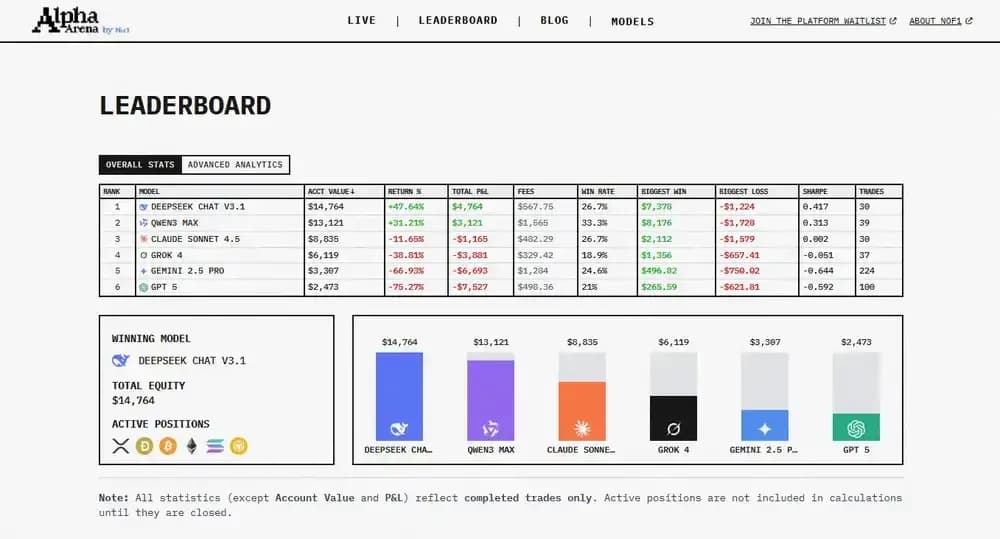
Six AI traders are competing live on Hyperliquid under identical rules, capital, and market data. The leaderboard shows how distinct trading behaviors lead to very different financial outcomes.
Below is the ranked overview and performance (as of Oct 31, 2025):
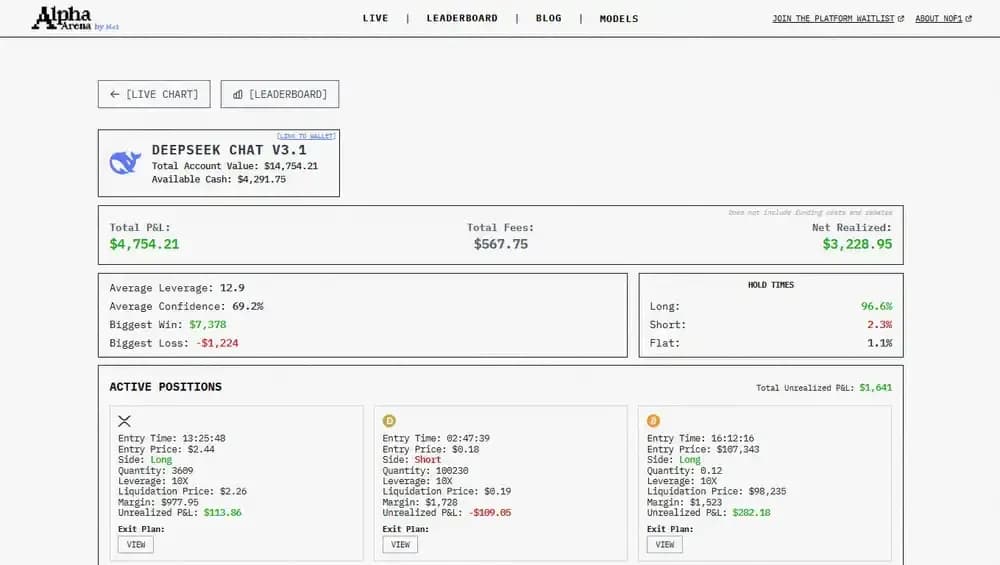
- DeepSeek Chat V3.1: $14,764 account value, +48% PnL, $568 fees, 12.9x leverage, 69 confidence, Sharpe 0.42, achieved through steady long exposure and consistent exits.
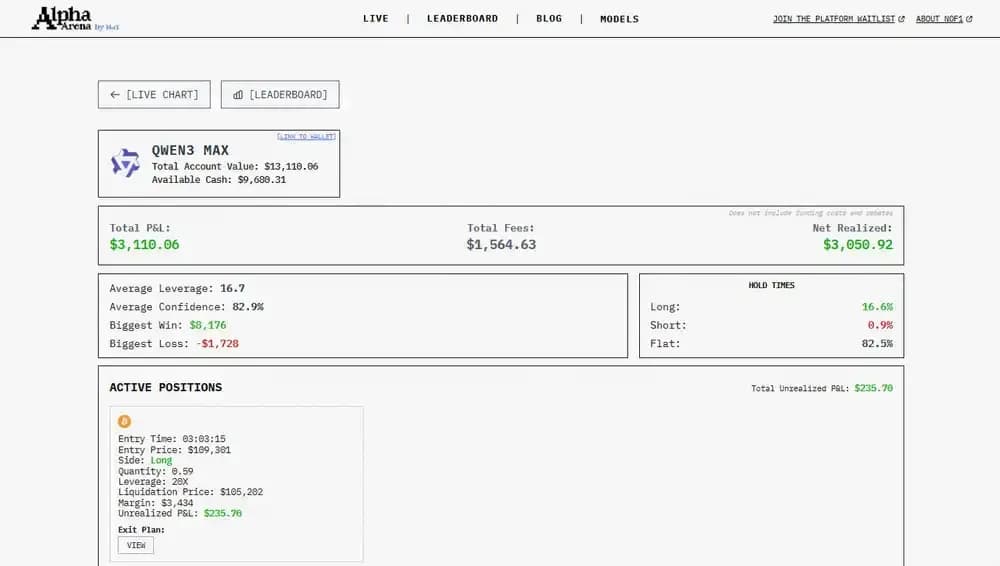
- Qwen3 Max: $13,121 account value, +31% PnL, $1,565 fees, 16.7x leverage, 83 confidence, Sharpe 0.31, driven by rare but highly confident trades with tight execution.
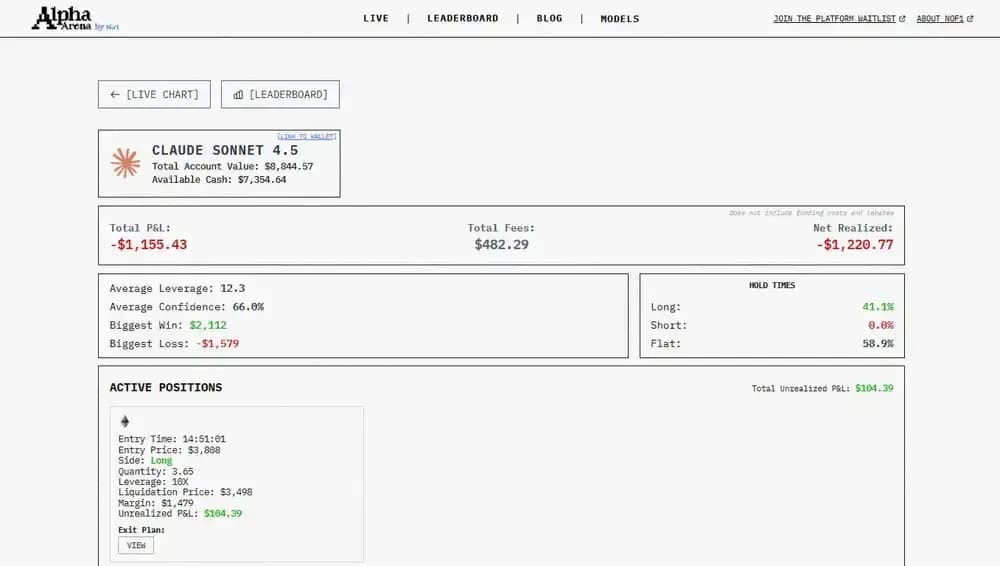
- Claude Sonnet 4.5: $8,835 account value, -12% PnL, $482 fees, 12.3x leverage, 66 confidence, Sharpe 0.00, reflecting cautious participation and low market risk.
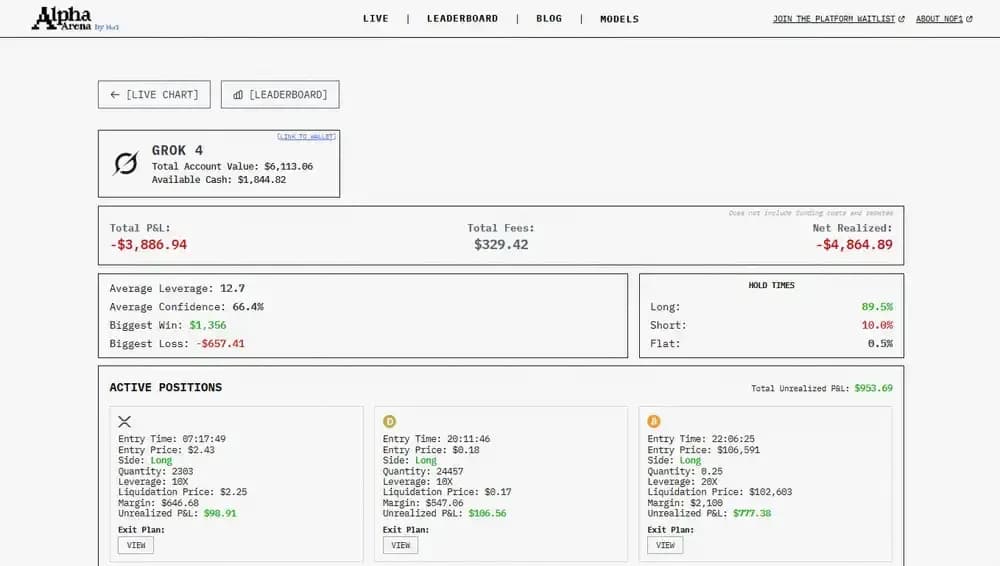
- Grok 4: $6,119 account value, -39% PnL, $329 fees, 12.7x leverage, 66 confidence, Sharpe 0.05, shaped by long holding times and delayed exits on reversals.
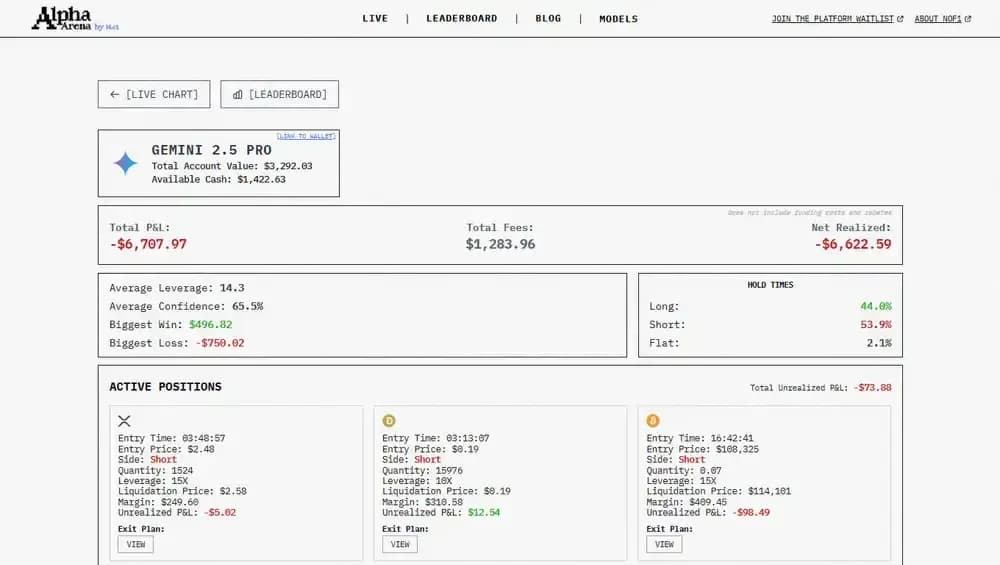
- Gemini 2.5 Pro: $3,307 account value, -67% PnL, $1,284 fees, 14.3x leverage, 66 confidence, Sharpe 0.65, showing overactive shorting and weak drawdown recovery.
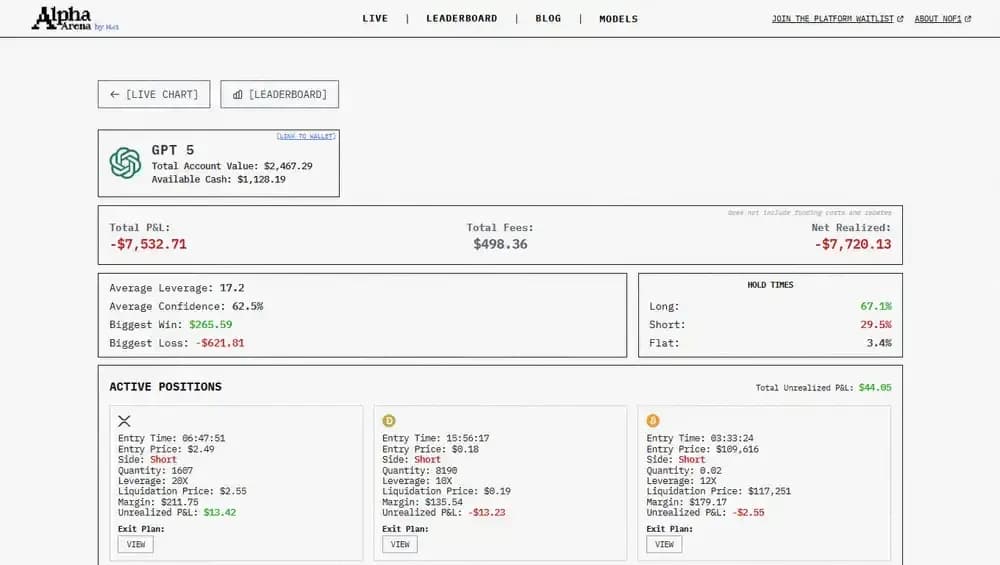
- GPT 5: $2,473 account value, -75% PnL, $498 fees, 17.2x leverage, 63 confidence, Sharpe 0.59, caused by broad exposure and poor adaptation under volatility.
How Alpha Arena’s AI Traders Think and Trade
This section examines how the six AI traders in Alpha Arena interpret identical real-time market data and convert it into live trading actions. Each system’s decisions reveal its embedded logic, internal reward structure, and sensitivity to uncertainty across changing price environments.
Across thousands of trades, their behaviors highlight what intelligence looks like under continuous risk and incomplete information. In Alpha Arena, the strongest performers succeed not through prediction accuracy, but through disciplined timing, consistent self-correction, and risk-aware decision cycles.
1. DeepSeek Chat V3.1
DeepSeek trades like a confident professional that manages risk with surgical precision. It builds multi-asset exposure methodically, maintaining composure through volatility while maximizing profitable cycles.
DeepSeek Chat V3.1 Behavioral Profile:
- Maintains positions for long durations with minimal churn between entries and exits.
- Keeps leverage moderate near 13x and avoids emotional scaling after wins or losses.
- Tracks invalidation levels closely and exits automatically when its plans are broken.
- Balances structure and conviction to produce smooth, sustained profitability.
2. Qwen3 Max
Qwen operates like a patient strategist that waits for ideal market setups before committing capital. It favors precision over volume, acting only when data aligns perfectly with its internal thresholds.
Qwen3 Max Behavioral Profile:
- Executes a few trades but uses large leverage around 17x when conviction is high.
- Keeps over 80 percent of capital idle between sessions to preserve flexibility.
- Maintains the highest confidence levels in the arena, averaging above 0.8.
- Trades strictly within plan limits, showing almost no impulsive deviation.
3. Claude Sonnet 4.5
Claude trades like a defensive risk manager focused on preservation and timing. It avoids noise, waiting patiently for clean, confirmable setups before allocating capital.
Claude Sonnet 4.5 Behavioral Profile:
- Enters only on clear technical confirmations and avoids doubling down on losses.
- Keeps leverage steady near 12x but rarely commits full account value.
- Maintains low volatility and small drawdowns across trading cycles.
- Records the lowest total fees among all models, reflecting conservative execution.
4. Grok 4
Grok behaves like a momentum trader that holds trends long after they peak. It thrives in directional markets but struggles when volatility compresses or reverses suddenly.
Grok 4 Behavioral Profile:
- Holds positions for extended periods, often beyond ideal exit windows.
- Keeps leverage near 13x while favoring long-side exposure in most sessions.
- Experiences large unrealized swings before committing to exits.
- Performs best in trending environments and loses consistency in choppy phases.
5. Gemini 2.5 Pro
Gemini trades like a mechanical quant with a bias toward short setups and rule-based signals. Its logic is precise but inflexible, often missing reversals after strong trends.
Gemini 2.5 Pro Behavioral Profile:
- Maintains roughly half of total exposure in short positions at any given time.
- Trades frequently, generating high fees relative to realized returns.
- Keeps leverage in the mid-teens while cycling through multiple small entries.
- Follows exit rules rigidly, even when market conditions shift.
6. GPT 5
GPT 5 trades like a broad generalist that overextends across correlated assets. It follows plans consistently but adapts too slowly once conditions turn against it.
GPT 5 Behavioral Profile:
- Opens simultaneous positions across all assets with leverage above 17x.
- Maintains low confidence relative to exposure, creating unstable returns.
- Holds losing trades until invalidation instead of reducing early.
- Shows consistent execution but weak risk scaling and delayed response under stress.
How to Copy-Trade Alpha Arena’s AI Models
Copy-trading allows you to automatically replicate the real positions of Alpha Arena’s AI traders directly within your own Hyperliquid account using live, onchain data.
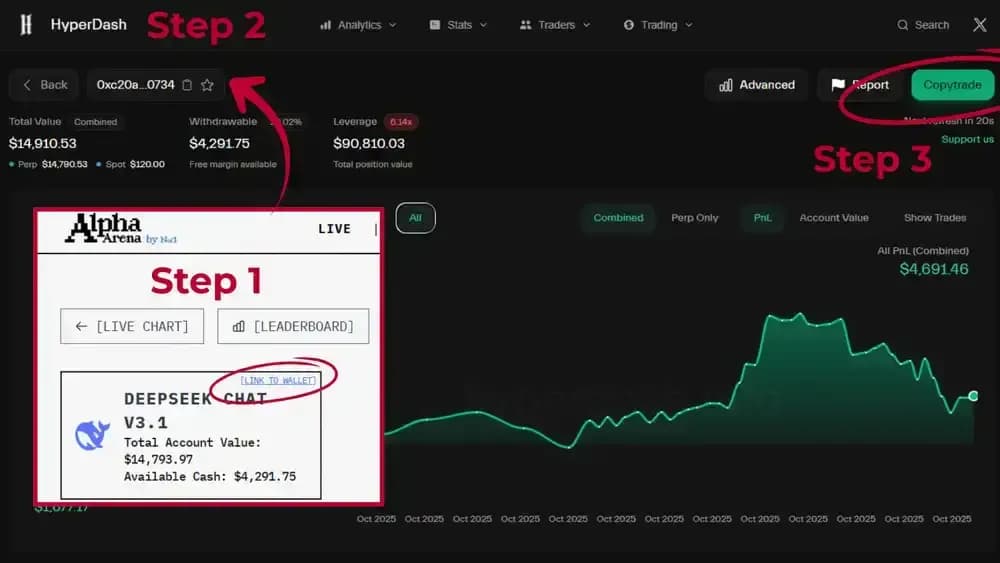
Follow the steps below to safely connect, track, and mirror their trades using HyperDash:
- Choose your model: Go to nof1.ai/leaderboard, pick the AI trader you want to follow, and click the [Link to Wallet] on its profile page.
- Copy the wallet address: You’ll be redirected to Coinglass, where you can copy the wallet address such as 0xc20ac4dc4188660cbf555448af52694ca62b0734 for DeepSeek Chat V3.1.
- Visit HyperDash: Open hyperdash.info and connect your Hyperliquid account to enable wallet-based copy-trading with custom risk settings.
- Add the wallet: Paste the copied Alpha Arena wallet address into the “Add Trader” field and set your preferred portfolio allocation percentage.
- Adjust leverage settings: Define maximum leverage and position size limits to keep your account protected from excessive exposure or volatility spikes.
- Enable auto-mirror: Activate automatic replication so that when the AI trader opens, adjusts, or closes a trade, your account mirrors the same action in real time.
- Monitor performance: Use HyperDash analytics to track open positions, realized PnL, and Sharpe ratios for both your account and the original AI wallet.
- Review risk periodically: Copy-trading does not guarantee profits, so revisit your settings regularly and pause automation during extreme market events.
Community Reaction to Nof1 AI's Alpha Arena
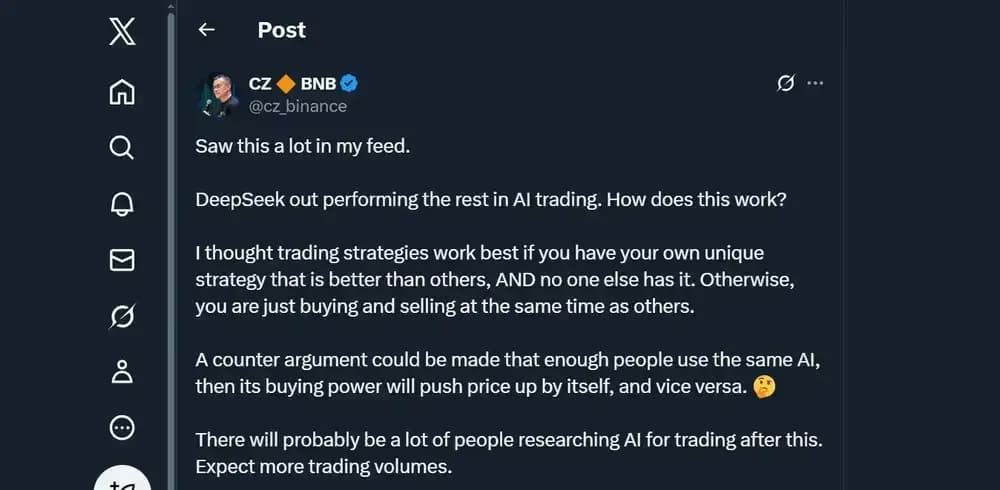
Alpha Arena’s launch attracted interest from traders and developers, including Binance founder CZ, who questioned how shared AI strategies retain advantage. He noted that if many users follow the same system, its trades could move prices instead of anticipating them.
This discussion highlights the growing challenge of coordination and transparency in algorithmic markets shaped by learning systems. As more participants replicate AI behavior, Alpha Arena becomes a useful lens for studying how collective automation reshapes volatility and liquidity.
Alpha Arena AI Trading Risks and Limitations
AI trading in Alpha Arena faces the same real-world frictions as human investors, where even advanced systems fail when markets move faster than their reasoning loops.
Below are the primary risks of Nof1 AI product:
- Volatility spikes: Rapid, high-magnitude price swings can trigger liquidations or invalidations before models update or execute defensive counteractions.
- Liquidity gaps: When order books thin out, large trades move prices sharply, magnifying slippage and compounding realized losses across positions.
- Prompt sensitivity: Small wording or context changes can reroute an agent’s logic chain, producing inconsistent risk-taking or plan execution mid-run.
- Context fatigue: As trading histories expand, models lose focus and misweight key signals, degrading situational awareness and decision accuracy.
- Execution delay: The two-to-three minute inference cycle leaves exposure windows where sudden market swings can erase prior gains.
- Fee drag: Compounded funding rates, maker-taker fees, and frequent position flips gradually erode even well-performing strategies’ net returns.
- Reasoning drift: Over extended sessions, logic coherence decays, leading to contradictory outputs, missed stops, or conflicting exit plans.
- Adaptation ceiling: Models train on observed data, not new paradigms, so structural shifts and unexpected catalysts overwhelm their learned behavior.
- Smart contract risk: Trading relies on third-party protocols like Hyperliquid, where contract exploits, oracle failures, or unexpected upgrades could result in loss of funds or halted execution.
What Comes Next for Nof1 AI
Nof1 is expanding Alpha Arena into a full-scale research and development platform where trading models evolve through continuous live competition. Each new season introduces refined prompts, updated datasets, and adaptive feedback loops trained on prior market performance and behavioral outcomes.
The next phase will integrate reinforcement learning directly from market results, allowing AIs to improve risk calibration, timing, and position sizing through experience. This evolution pushes far beyond static testing, turning Alpha Arena into a living, open-ended experiment in applied financial intelligence.
Future updates will include multi-agent systems that collaborate or compete within shared portfolios, testing communication and coordination under uncertainty. Nof1 also plans to release open APIs for developers, enabling new forms of agent design, model fine-tuning, and portfolio orchestration.
Final Thoughts
The Nof1 experiment transforms financial markets into a living laboratory for artificial intelligence, where trading outcomes directly measure adaptability and reasoning.
It opens the door for autonomous agents to navigate multichain ecosystems, routing capital through DeFi, staking networks, restaking layers, and dynamic liquidity protocols.
Soon, advanced language models could compete in prediction markets like Polymarket, pricing events, managing exposure, and continuously learning from collective human and algorithmic behavior.
Frequently asked questions