







Compare Top Brazilian Crypto Exchanges
1. Bybit
Bybit sits at the top because nothing else a Brazilian can open offers the same range under one login. Spot covers 2,800+ assets at a flat 0.1% fee, with perpetual futures, options, grid bots, copy trading, crypto loans, and Bybit Earn stacked alongside. The Bybit Card and tokenized US stocks round out a product set wider than anything the local exchanges carry. For anyone who has outgrown a simple trading app, that depth is the reason to be here.
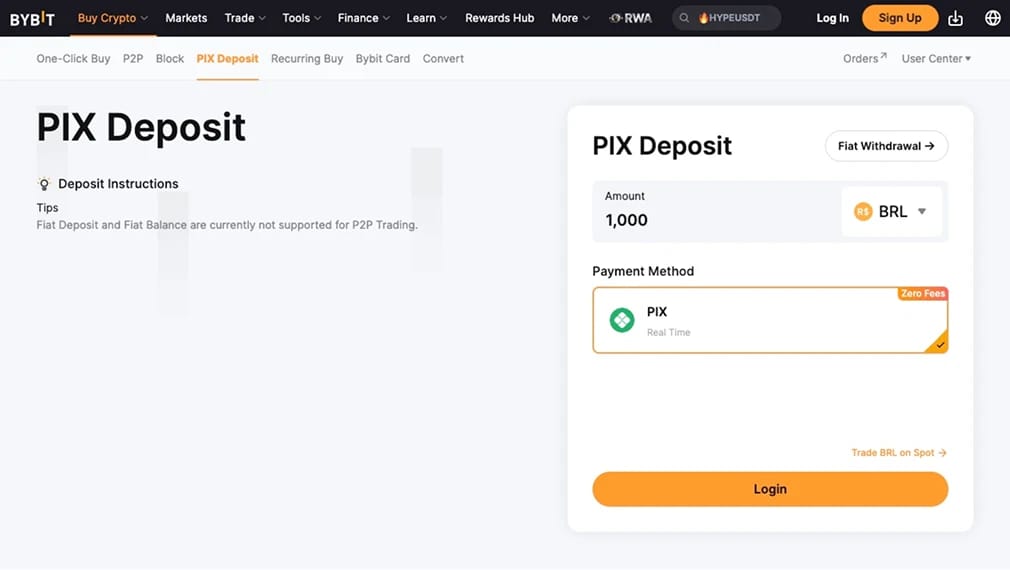
BRL deposits are free through PIX, with card and P2P funding available for a small fee. Our PIX deposit from a Banco do Brasil account was instantly credited to our account. Bybit does not yet hold a direct BCB license and is working through the transition window, so a Brazilian user trading here has no domestic regulator to escalate to. The full feature set is covered in our Bybit review.
There are some downsides to consider before signing up. The February 2025 hack was the largest in exchange history, though every affected user was reimbursed in full. The derivatives screen also sits one tap from spot, which can pull a newcomer into leverage before they mean to. The upside is that the interface is multilingual, including Portuguese, which keeps onboarding simple for residents.
Pros
- 2,800+ assets across spot, derivatives, copy trading, and earn at 0.1% spot fees.
- PIX and a BRL P2P desk that settles quickly, plus the Bybit Card.
- The deepest product range of any platform a Brazilian can open.
Cons
- No direct BCB authorization yet, so no local regulator to turn to.
- The February 2025 hack was the largest on record, although users were repaid.
- The margin entry sits next to spot, nudging beginners toward leverage.
2. Coinbase
Coinbase brings something no rival here can match: the accountability of a listed public company. It trades on NASDAQ under the ticker COIN and files audited results with the SEC each quarter, which makes its solvency the most externally scrutinized in the sector. Most client assets sit in cold storage, the custody record is clean, and Coinbase now holds a larger share of global crypto than any other company.
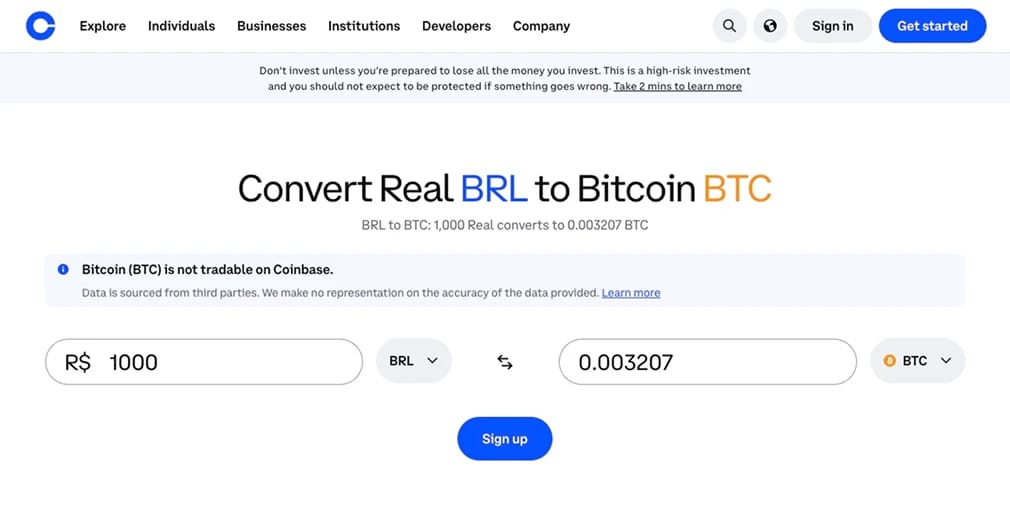
Brazilian users fund in reais over PIX through Coinbase's local payment integration, and a deposit from our Bradesco account cleared in seconds. The simple-buy screen prices in a markup that Advanced Trade strips out, dropping taker fees toward 0.60% on 250+ assets, with staking and one of the deepest USDC ecosystems anywhere. That dollar-token depth suits Brazil's stablecoin-heavy crowd.
The trade-offs are specific. The asset menu is among the shortest of the global names here, the default buy screen is expensive until you switch to Advanced Trade, and local products are thinner than on platforms built around Brazil. It works best as a security-first second account or a USDC hub rather than a venue for chasing the long tail. The fee tiers are unpacked in our Coinbase review.
Pros
- A NASDAQ listing brings quarterly audited financials and SEC oversight.
- Cold custody, a clean security history, and instant PIX deposits in reais.
- Advanced Trade fees drop well below the headline simple-buy rate.
Cons
- 250+ assets is one of the narrowest selections among the global names here.
- The one-click buy screen is among the priciest entry points until you switch tabs.
- Local product depth is lighter than the Brazilian platforms.
3. Binance
Binance is the platform most Brazilians reach for when they want copy trading backed by serious liquidity. Its copy trading desk lets a new user mirror an established strategy with allocation caps and stop losses, while beneath lies the deepest order book an investor here can access. On BTC/BRL and the dollar pairs, large fills barely move the price, and 350+ assets trade from 0.1% before BNB discounts, with Earn and Auto-Invest covering the passive side.
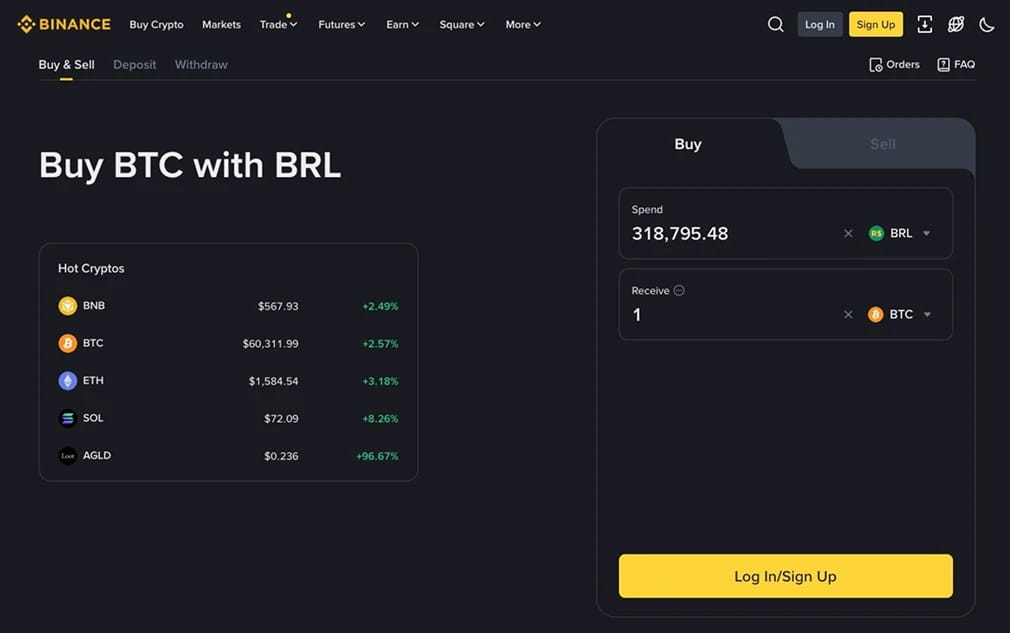
Reais come in free over PIX and through a deep P2P desk, with cards as a backup. We sent a PIX transfer from a Nubank account and had a tradable balance before the order book finished loading. The local entity gained real footing when the Central Bank approved Binance's acquisition of the Sim;paul brokerage, making it the first crypto exchange to hold a Brazilian broker-dealer and e-money license.
Similar to Bybit, Binance has had some negative headlines. The 2023 US settlement remains the heaviest compliance mark in the sector, the app packs in more products than a first purchase needs, and some advanced features are restricted locally. Keep your own CSV history, since the Receita Federal receives provider data regardless of what you log. The wider product set is in our Binance review.
Pros
- A large copy-trading network sitting on the deepest liquidity available in Brazil.
- A Central Bank-approved broker-dealer and e-money license through Sim;paul.
- Free PIX deposits, a busy reais P2P desk, and a broad Earn suite.
Cons
- The 2023 US settlement still shadows its global compliance record.
- The feature count is a lot to absorb on a first purchase.
- Some advanced products are limited for Brazilian accounts.
4. Gate
Gate earns its spot on range alone. With 3,800+ listed assets, it carries the widest catalog on this list by a clear margin, including small caps, fresh listings, and pre-market tokens that the conservative venues here will not touch for months. For the Brazilian trader hunting the long tail rather than stacking majors, no other option on this list comes close on breadth. The wider platform is in our Gate review.
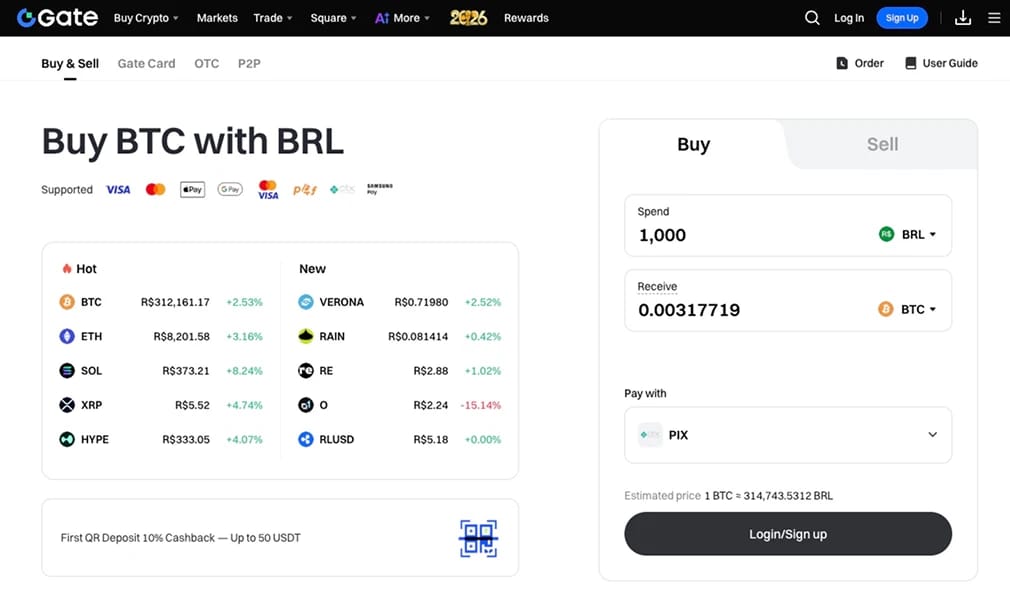
Reais funding is straightforward and local. Gate runs zero-fee PIX deposits tied to your CPF, settling in real time, alongside cards and a P2P desk. Spot fees start around 0.1% for standard users, with further discounts for GT token holders, plus futures, copy trading, grid bots, and a Launchpad. Gate's Malta arm holds a MiCA license, which adds an EU supervisor even though it lacks a Brazilian home regulator.
Unfortunately, Gate has no BCB authorization, so there is no local recourse, and while it reports a healthy reserve ratio today, it has weathered security incidents in the past. Treat it as a second account for breadth rather than your primary store, and remember the vast catalog includes thin, speculative tokens that demand careful position sizing.
Pros
- 3,800+ assets, the widest selection of any platform in this guide.
- Zero-fee PIX deposits in reais plus GT token and volume discounts.
- Pre-market, futures, bots, and a Launchpad for early access.
Cons
- No BCB authorization, so no Brazilian regulator standing behind it.
- A long tail of thin, speculative tokens that demand caution.
- A patchier security history than the cleaner records on this list.
5. Mercado Bitcoin
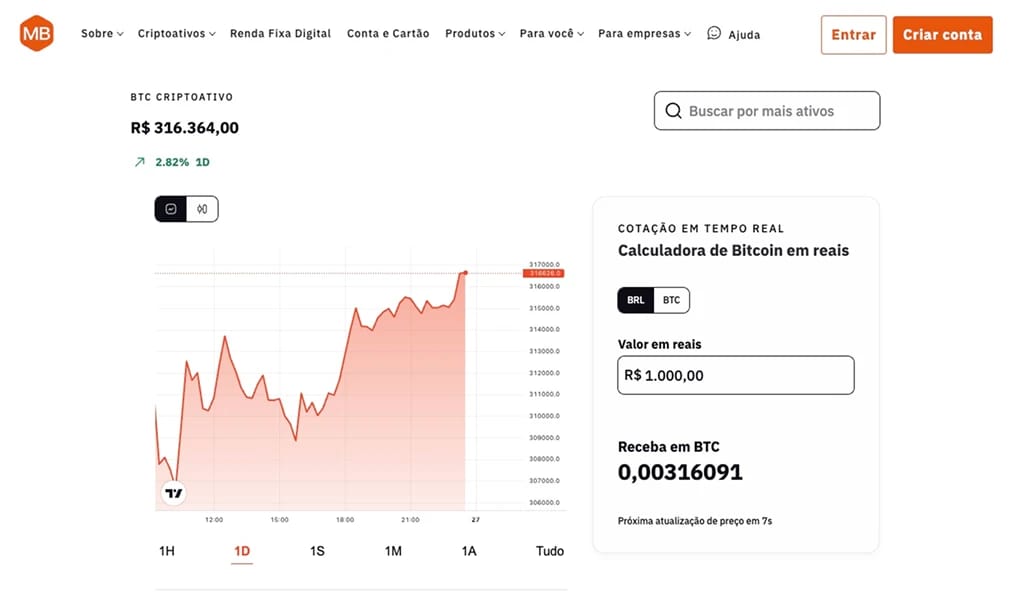
Mercado Bitcoin is the homegrown exchange most Brazilians open first, and the reasons are local through and through. Founded in São Paulo and now with over four million users, it holds a payment institution license from the Central Bank and runs the largest order books built around the reais. The annual report it generates does the work most residents dread, mapping disposals straight to a DIRPF filing.
PIX deposits are instant, and the catalog spans 800+ assets, including a digital fixed-income suite and tokenized real-world assets such as precatórios and football rights that no offshore venue offers. We funded via PIX from an Itaú account and traded within a minute, then exported a tax report that aligned with the GCAP entries we needed. CriptoCrédito lets holders borrow against crypto without selling, and MB One serves high-net-worth clients.
The cost is the catch. Standard commissions are tiered and run above the 0.1% you pay on Bybit or Binance, softened only by a zero-fee window for new accounts. The long tail of altcoins is shorter than that of global venues, and the simple-buy screen prices at a spread that heavier trading avoids. As a BCB-licensed local name with automated tax paperwork, it answers to a Brazilian authority that the offshore platforms cannot match.
Pros
- A Central Bank payment institution license and the deepest local reais books.
- Automated annual tax reports that map directly to a DIRPF filing.
- 800+ assets plus tokenized real-world assets and digital fixed income.
Cons
- Tiered fees that run higher than the global exchanges here.
- A shorter altcoin selection than Bybit, Binance, or Gate.
- The simple-buy screen carries a spread that active trading avoids.
6. Bitso
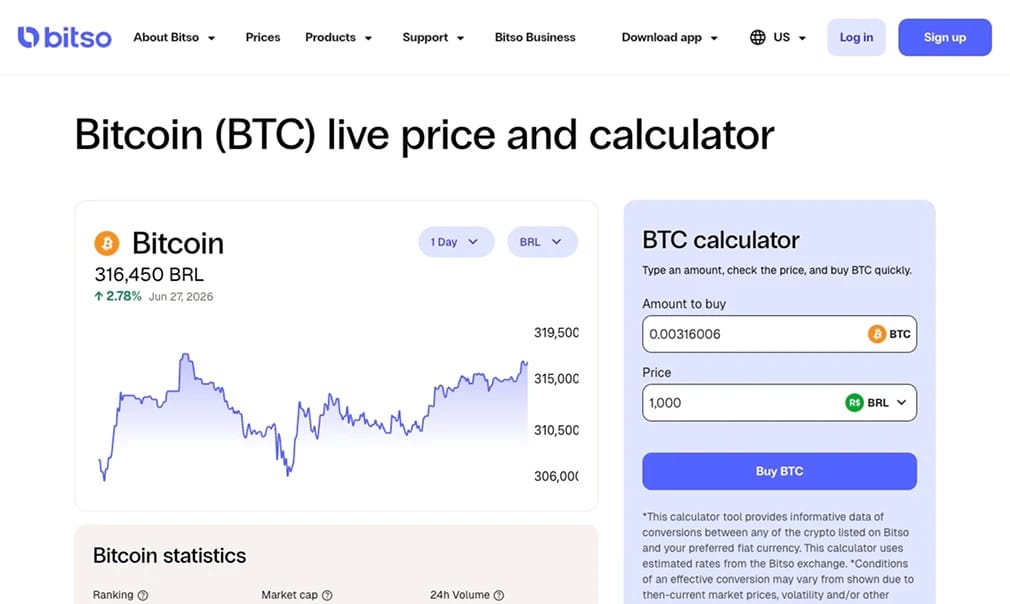
Bitso earns its place based on how Brazilians actually use crypto, which is overwhelmingly stablecoins. Roughly 90% of the country's on-chain value moves through dollar tokens, and Bitso is built around that demand, with native PIX, its own BRL-pegged stablecoin, and weekly yield on idle USDC, USDT, and other balances. It was among the first exchanges authorized by the Central Bank under the payment institution framework.
Funding is fast and local. A PIX deposit cleared in seconds in our test, and the app holds reais and dollar tokens side by side, which suits anyone parking value in stablecoins between trades or sending money across the Mexico and Argentina corridors Bitso specializes in. It also lists tokenized US equities, so a resident can hold AAPL or an index alongside crypto from one account.
The limits are about depth, not safety. The professional Bitso Alpha view carries thinner BTC/BRL liquidity than the global heavyweights, so market orders above R$50,000 can slip more than you would like. The asset list is shorter than Bybit's or Gate's, and the simple app prices through a spread that the pro screen tightens. For stablecoin-led use, no other licensed local name fits as neatly.
Pros
- A Central Bank payment institution license with native PIX and the BRL1 stablecoin.
- Weekly yield on stablecoin balances, ideal for the dollar-heavy Brazilian market.
- Tokenized US equities and strong cross-border rails across Latin America.
Cons
- Thinner BTC/BRL depth, so larger market orders can slip.
- A shorter asset list than the global exchanges here.
- The simple app prices through a spread that Bitso Alpha avoids.
How to Choose a Crypto Exchange in Brazil
The Brazilian decision turns on how your reais get in, what records you keep, and whether you want a local regulator behind the platform. Four checks we apply:
- Choose a local or global exchange: Mercado Bitcoin and Bitso hold Central Bank payment licenses, and Binance carries a local broker-dealer license, while Bybit, Coinbase, and Gate serve Brazilians without a domestic authorization. All are legal, but a BCB-licensed name is the only place to escalate a dispute at home.
- Test a small PIX transfer: Every serious platform here accepts PIX, usually free and instant. Send a small amount from your Nubank, Santander, or other Brazilian account and confirm it clears, since a name mismatch against your CPF is the usual cause of a stalled deposit.
- Keep acquisition records: The Receita Federal receives data from domestic exchanges, and self-reported filings cover offshore and self-custody. Export your CSV history monthly, because clear cost-basis evidence is what separates tax on your gain from tax on the whole disposal.
- Consider the fees: Run a small reais to crypto and back loop and measure the loss. The trading fee is the smallest part; the simple-buy spread plus any card markup is the real cost, and a platform advertising 0.1% can end up far higher all-in.
Crypto and Bitcoin Regulation in Brazil
Brazil regulates crypto through a dedicated framework that came into full force in 2026, run by the central bank alongside the securities regulator. The points that matter:
- The Central Bank is the lead regulator. Law No. 14,478/2022, the country's Virtual Assets Law, took effect in June 2023, and Decree No. 11,563/2023 handed the Banco Central do Brasil authority to license and supervise virtual asset service providers.
- VASP authorization is now mandatory. Resolutions 519, 520, and 521, published in November 2025, took effect on 2 February 2026. Providers must classify themselves as intermediaries, custodians, or brokers, hold between R$10.8 million and R$37.2 million in capital, segregate client reais in individual accounts, and publish monthly proof of reserves.
- A transition window closes in late 2026. Firms operating before 2 February 2026 may continue while they apply, but must comply by 30 October 2026 or cease and give clients 30 days to migrate. Foreign platforms must move their Brazilian users onto a locally authorized entity.
- Stablecoins and cross-border crypto fall under foreign exchange rules. Resolution 521 treats stablecoin transfers and crypto used for international payment as FX operations, requires identifying self-hosted wallet owners, and caps cross-border VASP transactions. Resolution 561, effective 1 October 2026, bars regulated electronic FX firms from settling overseas remittances in crypto, though buying, holding, and trading stay legal for individuals.
- The CVM and COAF play supporting roles. The Comissão de Valores Mobiliários oversees tokens that behave like securities, while the COAF monitors transactions for money laundering and receives suspicious-activity reports.
Using any of these platforms is legal for residents. The real remains the only legal tender, and a BCB-authorized provider answers to a Brazilian supervisor, whereas an unlicensed offshore venue owes nothing to local users.
How is Crypto Taxed in Brazil?
The Receita Federal administers Brazil's tax treatment, and the news for 2026 is that the older structure still stands. The rules for individuals:
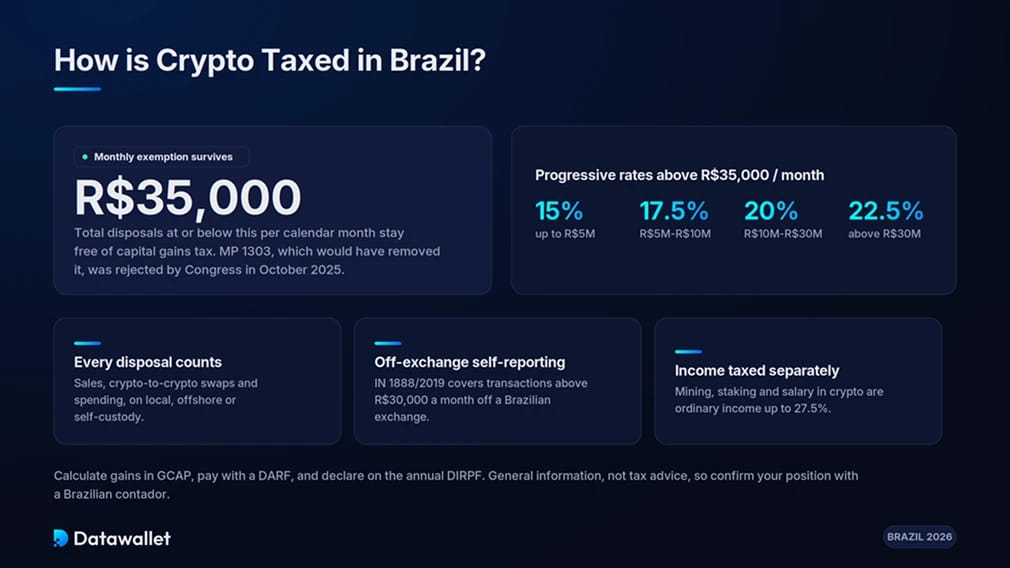
- The R$35,000 monthly exemption survived. Provisional Measure 1303 would have abolished it and set a flat 17.5% rate, but Congress rejected the measure in October 2025 and it expired. Total disposals at or below R$35,000 in a calendar month stay free of capital gains tax.
- Progressive rates apply above the threshold. Once monthly disposals cross R$35,000, gains are taxed at 15% up to R$5 million, 17.5% from R$5 million to R$10 million, 20% from R$10 million to R$30 million, and 22.5% above that.
- Every disposal counts toward the threshold. Selling crypto for reais, swapping one token for another, or spending it are all disposals, whether the assets sit on a local exchange, an offshore platform, or a self-custody wallet.
- Off-exchange activity is self-reported. Normative Instruction 1888/2019 requires individuals to report off-exchange transactions above R$30,000 a month, while domestic platforms report directly to the tax authority.
- Income is taxed separately. Crypto from mining, staking, or salary is ordinary income at its reais value on receipt, taxed on the progressive scale up to 27.5%.
Capital gains are calculated in the GCAP program and paid via a DARF by the last business day of the following month, with all amounts declared on the annual DIRPF.
Keep exchange CSVs, PIX confirmations, and transaction records for at least five years. This is general information, not tax advice, so confirm your position with a Brazilian contador. For how this compares globally, see our guide to the best low-tax crypto countries.
Cryptocurrency Adoption in Brazil
Brazil is the largest crypto market in Latin America and one of the most active in the world. The figures behind it:
- Top of the regional table: Brazil ranked fifth worldwide and first in Latin America on Chainalysis's 2025 Global Crypto Adoption Index, up from tenth a year earlier, with roughly $318.8 billion in value received between mid-2024 and mid-2025.
- A broad ownership base: Around 25 million Brazilians hold or transact in crypto, according to the central bank, built largely on smartphone access and the reach of PIX.
- A stablecoin-led market: Dollar tokens make up close to 90% of on-chain volume, with the market moving an estimated $6 billion to $8 billion a month, as residents use stablecoins as a hedge and a payment tool rather than only an investment. The wider numbers sit on our crypto adoption statistics page.
Bitcoin and Ethereum anchor the holdings, but the day-to-day story is stablecoins. With BCB licensing and FX reporting in force, the likely path is steadier, better documented growth rather than a retail rush.
.webp)
How to Buy Bitcoin in Brazil
The clean approach pairs free PIX funding with records that the Receita Federal will accept. Follow these steps to buy Bitcoin in Brazil:
- Pick a platform: Beginners and tax-record seekers open Mercado Bitcoin, stablecoin users open Bitso, copy traders use Bybit or Binance, breadth hunters use Gate, and security-first buyers use Coinbase.
- Clear KYC: A CPF, an ID document, and a selfie verify within hours on every platform we tested. Enter your details exactly as printed, since a mismatch stalls verification for days.
- Fund in reais: Send a PIX transfer from your bank for near-instant, usually free settlement, or use TED for larger planned buys. Keep the confirmation, since it anchors your acquisition cost.
- Buy BTC: On the order-book screen, place a limit order on BTC/BRL or BTC/USDT rather than the instant-buy tab, which prices through a spread of 1% or more.
- Move assets to self-custody: Anything you are not actively trading belongs in a wallet you control. Our best crypto wallets guide covers hardware and software options.
Exiting reverses the path on a local exchange: sell into reais, withdraw via PIX to your own bank, and declare the disposal on your DIRPF, paying any DARF due if your monthly disposals exceeded the R$35,000 threshold.
Final Thoughts
Brazil offers a rare mix for an emerging market with free reais funding through PIX, a maturing BCB licensing regime that brings real protections, and a tax system that still exempts smaller monthly disposals after Congress rejected the flat rate plan.
Bybit leads on overall capability and product range, Coinbase wins on public-company security, Binance pairs copy trading with the deepest liquidity, Gate offers the widest asset selection, Mercado Bitcoin is the local champion with the cleanest tax paperwork, and Bitso fits the stablecoin-heavy majority.
For the wider regional picture, our guide to the best crypto exchanges in Mexico covers Latin America's other heavyweight market.
Our Methodology
We assessed each platform by repeating the steps a Brazilian would take in practice: registering with a CPF, funding via PIX and TED from local banks, executing spot trades, and withdrawing reais where possible. Six criteria shaped the rankings:
- Trust Score: A 5-point rating weighing BCB authorization, security history, reserve transparency, and years of operation.
- BRL Funding Access: How cheaply and reliably reais move in and out, tested across PIX, TED, cards, and P2P.
- Fees: Headline maker and taker rates plus the all-in cost of a funded round trip, including spreads and card markups.
- Regulatory Standing: Whether the platform holds a Central Bank authorization and answers to a Brazilian supervisor.
- Asset Range: Coverage from majors and stablecoins through long-tail tokens, derivatives, and tokenized assets.
- Local Usability: App performance, KYC friction with Brazilian documents, tax-report quality, and the reais exit path.
Funding quality and regulatory standing carried more weight than raw coin counts, because in Brazil the cleanest platform is the one with working PIX rails, a regulator behind it, and records that keep you square with the Receita Federal. Testing ran from March to June 2026.
.webp)