







Compare Top Cambodian Cryptocurrency Exchanges
1. Bybit
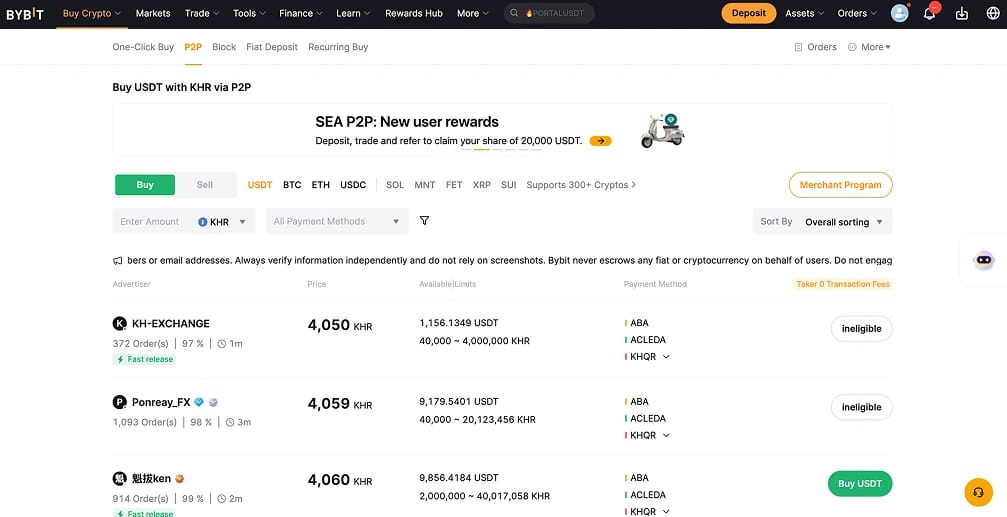
Bybit tops the list because it gets the two things that matter here right: the app loads without a VPN, and the P2P desk is deep in both currencies. Filtering for KHR showed a healthy merchant pool, and switching to USD the book was just as active, the detail that sets Cambodia apart from most emerging markets. Since the country runs on dollars, you can buy USDT straight out of your ABA account and skip the riel conversion.
ABA Pay funding was the smoothest part. We added ABA under P2P payment settings, picked a merchant above 95% completion, and paid by scanning the KHQR code in the ABA app. Escrow released the USDT in under ten minutes with no transfer fee. Wing, ACLEDA, and True Money also appear as merchant options, so you are not locked into one rail if a counterparty is slow.
The trading stack underneath is among the most credible anywhere. Bybit publishes regular proof-of-reserves showing assets backed 1:1, charges 0.1% spot fees, and adds copy trading, Bybit Earn, and the Bybit Card. For anyone who wants one reliable app, this is the one we would set up first.
Pros
- App loads without a VPN, and P2P runs in both USD and KHR through ABA, ACLEDA, Wing, and KHQR.
- USD P2P lets dollarized users buy USDT without a needless riel conversion.
- Regular proof-of-reserves, 0.1% spot fees, and a mature copy trading and earn suite.
Cons
- The main website faces the same intermittent blocking as other foreign exchanges, so the app is the reliable entry point.
- No Cambodian license, since no offshore exchange holds one yet.
- The product menu is heavier than a first-time buyer strictly needs.
2. Binance
Binance has the deepest P2P book of any platform Cambodians use, and on raw merchant count nothing else is close. Filter the Binance P2P desk for ABA Bank and you will find more active merchants at any hour than Bybit or OKX carry, in both USD and KHR. That depth means tighter spreads and faster fills, especially on larger orders where a thin book costs you.
The complication is access. Binance was one of 16 exchanges whose websites the Telecommunication Regulator blocked in November 2024 for lacking a SERC license. The app still works, which is how most users reach it, but the block signals a tightening mood. Binance even signed an MoU with the regulator in 2022 to help shape the rules, which makes it sting more.
The Khmer-language interface lowers the barrier for first-time buyers. Spot fees sit at 0.1%, the SAFU fund backs user balances, and the derivatives suite runs to 100x leverage once you graduate from spot. We keep Binance as our primary P2P venue and switch to Bybit when a merchant there looks better.
Pros
- Largest merchant pool for USD and KHR P2P, which means the tightest spreads on size.
- Khmer-language interface, SAFU fund, and the deepest global liquidity for clean withdrawals.
- 0.1% spot fees and a full derivatives suite once you move past spot.
Cons
- Website is blocked by Cambodian ISPs, so you depend on the app or a VPN.
- No local license despite an earlier regulatory partnership.
- Direct card or bank deposit outside P2P is generally unavailable in KHR.
3. OKX
OKX earns its slot on the Web3 wallet built into the main app. For anyone moving past USDT into DeFi, DEX swaps, or tokens that never list on a centralised venue, it folds two apps into one and bridges straight from your trading balance. That removes a headache for users already juggling app access and P2P.
Its P2P desk takes ABA and bank transfer in both USD and KHR, with spot fees from 0.08%, among the lowest here. The merchant pool thins out off-peak, so on small orders the spread can eat more than the headline fee, though larger orders hold up well. OKX was also caught in the November 2024 block, so plan on the app.
OKX publishes monthly proof-of-reserves and ranks among the more transparent operators on disclosure. The wallet covers a long list of chains, which matters here since USDT on Tron is the default way value moves. Our TRC-20 wallet guide helps if you plan to hold stablecoins on Tron.
Pros
- Built-in Web3 wallet for DeFi, swaps, and dApps without leaving the app.
- USD and KHR P2P through ABA, with spot fees from 0.08%.
- Monthly proof-of-reserves and broad chain coverage, including Tron for USDT.
Cons
- Website blocked in Cambodia, so the app is the practical entry point.
- Merchant depth trails Binance, and small-order spreads widen off-peak.
- The Web3 layer adds complexity that pure stablecoin savers will not need.
4. Bitget
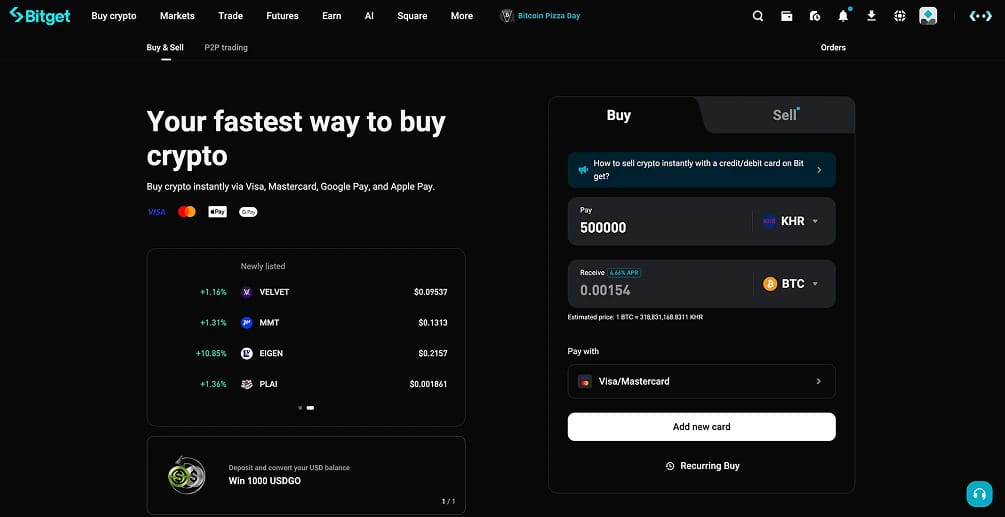
Bitget is the platform we point copy traders toward. It pairs a clean P2P desk with one of the better-funded safety nets in the industry, listing ABA and Wing for both USD and KHR. Our test buy through Wing cleared without friction, though the merchant count sat below Binance.
What sets Bitget apart is the protection layer. Its February 2026 proof-of-reserves showed a reserve ratio well above 100%, and the protection fund sits north of $400 million, a real cushion if something breaks. Spot fees are 0.1%, and its copy trading is among the deepest available, which suits younger traders who want to mirror experienced books.
The caveat matches every foreign venue here: no Cambodian license, app-first access, and a dense product menu. As a second app alongside Bybit or Binance, it is a strong choice.
Pros
- USD and KHR P2P via ABA and Wing, with zero P2P fees.
- Proof-of-reserves above 100% and a $400M+ protection fund.
- Deep copy trading and a polished mobile app.
Cons
- Merchant depth is thinner than Binance on both currencies.
- No local license, and the website faces the same access friction.
- The full product set is a lot for a first-time buyer.
5. MEXC
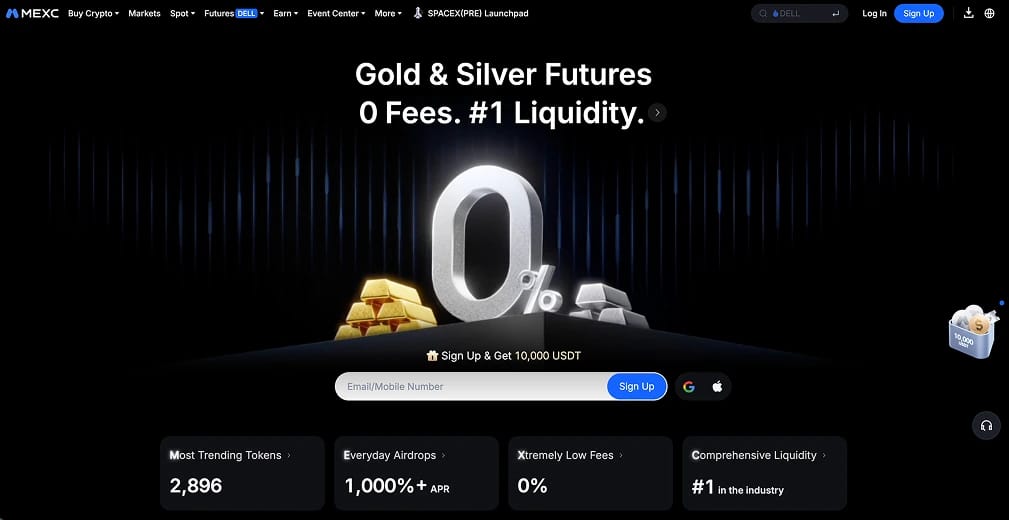
MEXC is the pick when fees and token selection drive the decision. It runs 0% maker and 0.02% taker fees, the lowest combination here, which adds up for anyone dollar cost averaging into BTC or ETH. It lists more than 2,800 assets, with new tokens often arriving before the larger venues.
The trade-off is the on-ramp. KHR P2P is patchy, so most users we know buy USDT elsewhere through ABA, then send it to MEXC over TRC20. Card payment exists but carries a 2 to 5% processor markup. A low-KYC tier allows smaller trades and withdrawals without full verification, which some privacy-minded users prefer.
The other caveat is transparency. MEXC discloses proof-of-reserves less consistently than Bitget or OKX. Treat it as a low-fee trading and altcoin venue, not your primary fiat on-ramp.
Pros
- 0% maker and 0.02% taker fees, the lowest combination on this list.
- 2,800+ assets with a fast listing pipeline for new tokens.
- Low-KYC tier for smaller deposits and withdrawals.
Cons
- KHR P2P is thin, so most users fund via TRC20 USDT from another platform.
- Proof-of-reserves disclosure is less rigorous than top-tier peers.
- Card funding carries a steep processor surcharge.
6. RGX (Royal Group Exchange)
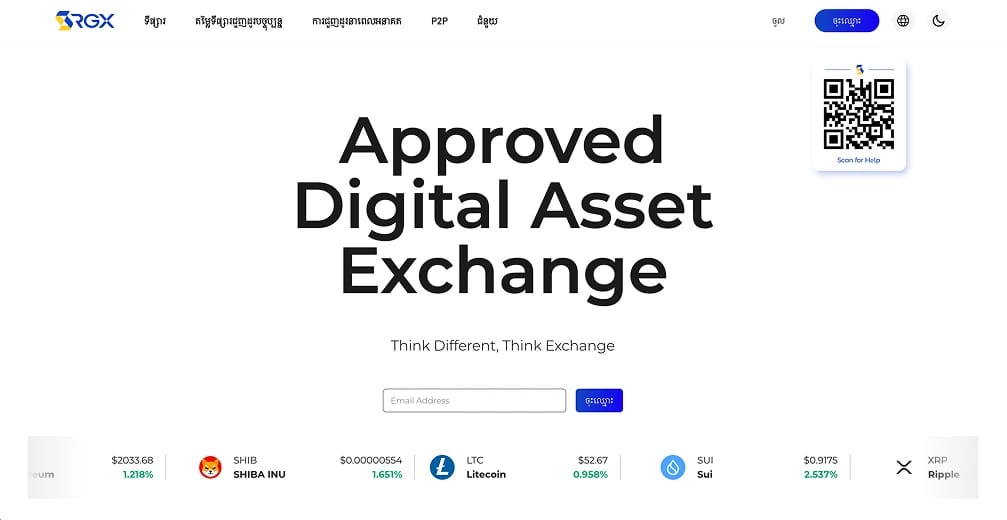
RGX is the only locally licensed option, which earns its place here. Launched in January 2024 by the Royal Group conglomerate, it operates under the Securities and Exchange Regulator of Cambodia's FinTech Sandbox, one of only two approved digital asset platforms in the country. It lists 100-plus assets including BTC, ETH, SOL, and BNB, runs spot, futures, and in-platform P2P, and works in Khmer with local support.
Set expectations on scale. About a year in, RGX reported roughly 3,500 users and monthly volume in the several-hundred-thousand-dollar range, modest next to the global apps. The bigger limit is the sandbox rule: licensed platforms cannot convert digital assets to and from fiat like the riel or dollar, so the regulated route does not give you a clean bank off-ramp the way an offshore P2P desk does.
If you value a domestically supervised, Khmer-language platform and want to back the local market forming under SERC oversight, RGX is worth knowing. For depth, liquidity, and a working fiat on-ramp today, the offshore apps still do more.
Pros
- The only SERC-sandbox-licensed exchange operating in Cambodia.
- Khmer-language platform with local support and 100+ listed assets.
- Domestically supervised, which appeals to users who want a regulated local venue.
Cons
- Small user base and modest trading volume compared with global apps.
- Sandbox rules restrict direct conversion between crypto and fiat.
- Liquidity and spreads cannot match Binance, Bybit, or OKX.
How to Choose a Crypto Exchange in Cambodia
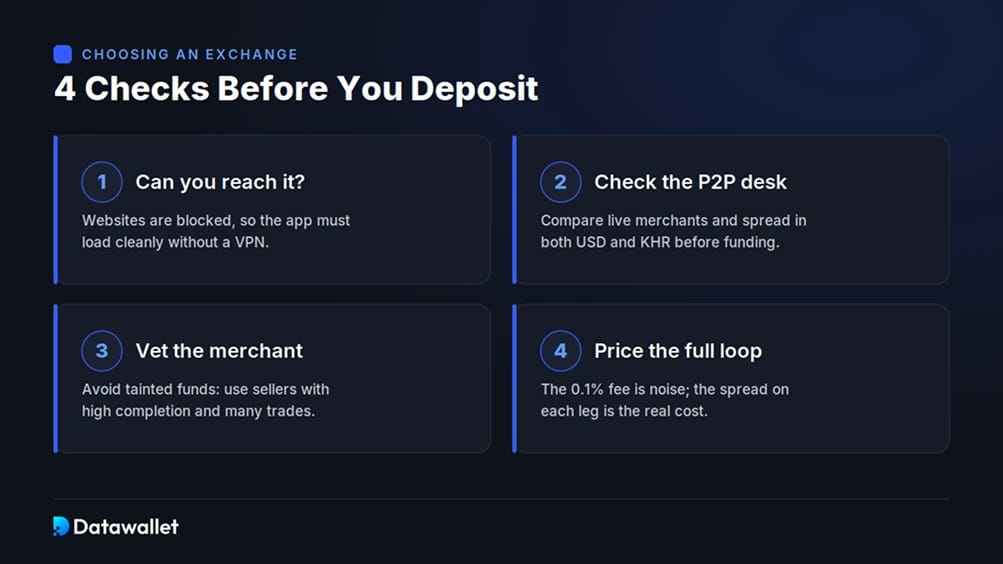
We screen every exchange here on four things before depositing, and features are not among them:
- Confirm you can reach it. The major exchange websites have been blocked since November 2024, so test the app first. If it runs reliably on your normal connection, you are set. If you prefer the web interface, you will need a reputable VPN, and that dependence should factor into your choice.
- Check the P2P desk before you commit. Open the ABA listings in both USD and KHR and see how many merchants are live and how far their rate sits from the global price. In daytime hours we want a busy board, sellers with completion in the high nineties, and a gap under one and a half percent. Buying in dollars usually beats KHR, since you skip a conversion the dollarized economy never forced on you.
- Pick merchants carefully given the scam-hub context. Cambodia's fraud reputation means banks watch these flows. The biggest avoidable risk is buying from a merchant whose funds turn out tainted, which can trigger a review on your account. Stick to verified merchants with 1,000+ trades and high completion, and avoid anyone offering rates well above market.
- Price the full loop, not the spot fee. Buy a small amount, sell it straight back, and look at what you lost. The 0.1% trading fee is noise. The money goes to the P2P spread on the way in, the spread on the way out, and the withdrawal charge, which together can run one to three percent on a platform that advertises almost nothing.
Crypto and Bitcoin Regulation in Cambodia
Cambodia's framework shifted in late 2024 from flat prohibition toward a tightly controlled licensing regime, but the practical position for individuals stayed murky. Several pieces matter:
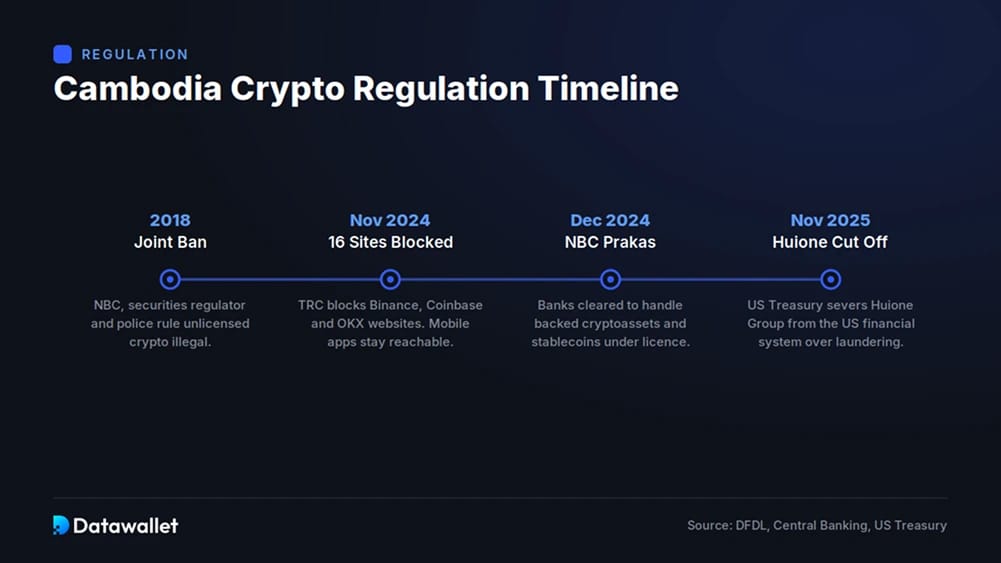
- The 2018 joint ban. The National Bank of Cambodia, the securities regulator, and the national police issued a joint statement in 2018 declaring that circulating, trading, or dealing in cryptocurrencies without a license was illegal. That stance defined the market for years.
- The November 2024 website blocks. The Telecommunication Regulator of Cambodia blocked 16 exchange websites, including Binance, Coinbase, and OKX, within a directive covering more than 100 domains, citing missing SERC licenses. Mobile apps were untouched, which is why they remain the practical entry point.
- The December 2024 NBC Prakas. On 26 December 2024, NBC Governor Chea Serey signed Prakas B7-024-735 on cryptoassets, letting commercial banks and payment institutions offer limited crypto services. It permits backed cryptoassets and stablecoins while keeping banks away from direct exposure to unbacked crypto. Legal entities can apply to the NBC for a license to act as crypto asset service providers.
- The Huione designation. In 2025 the US Treasury's FinCEN severed the Cambodia-based Huione Group from the US financial system under Section 311, effective 17 November 2025, after finding it laundered at least $4 billion between 2021 and early 2025. This is the backdrop that makes Cambodian banks cautious about crypto-linked transfers.
The practical reading: holding and trading crypto sits in a grey zone, no offshore exchange you use is licensed locally, and the only domestic venue cannot yet convert to fiat. Enforcement against retail users is rare, but your bank can and does review accounts showing crypto-linked patterns.
How Does Cambodia Tax Crypto?
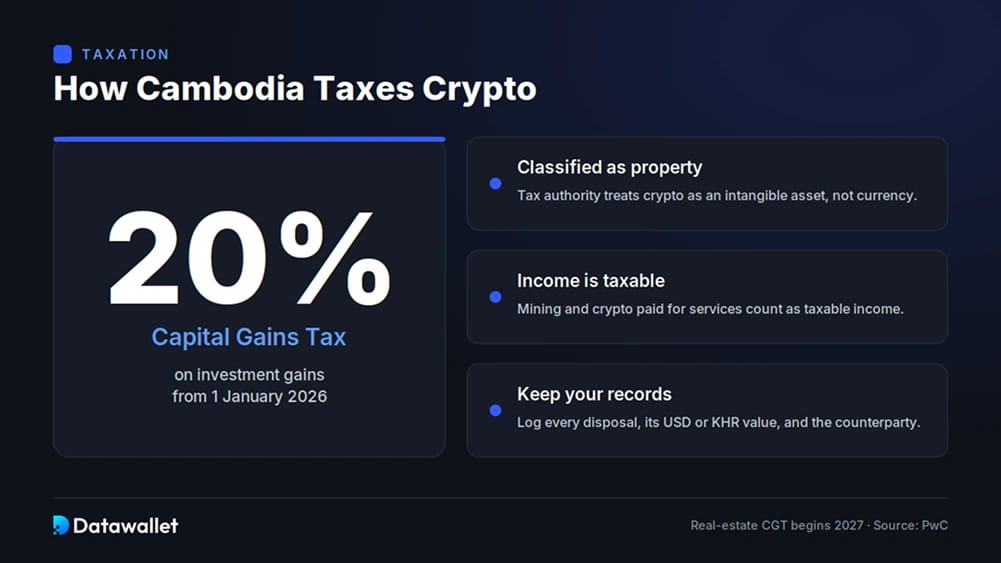
Cambodia has no dedicated crypto tax regime, but general capital gains rules now reach investment assets. The General Department of Taxation treats cryptocurrencies as intangible assets rather than currency, and the long-delayed capital gains tax has taken effect for investments.
- Capital gains tax. Under Prakas No. 1130 from the Ministry of Economy and Finance dated 31 December 2025, investment gains other than real estate became subject to a 20% capital gains tax from 1 January 2026, with real estate following on 1 January 2027. Crypto disposals are not named in crypto-specific terms, but 20% is the relevant reference point for investment gains.
- Income tax. Income from crypto activity such as mining or payment for services is included in taxable income at the applicable rates.
- Record keeping. Log every disposal, the USD or KHR value at the time, and the counterparty. Documentation is your only defence if the framework tightens.
For most retail holders in 2026 the exposure stays theoretical, and enforcement on individual disposals has been minimal. The more immediate risk is a bank review tied to a P2P counterparty, not a tax demand. None of this is tax advice; for anything material, speak with a Cambodian tax professional.
Cryptocurrency Adoption in Cambodia
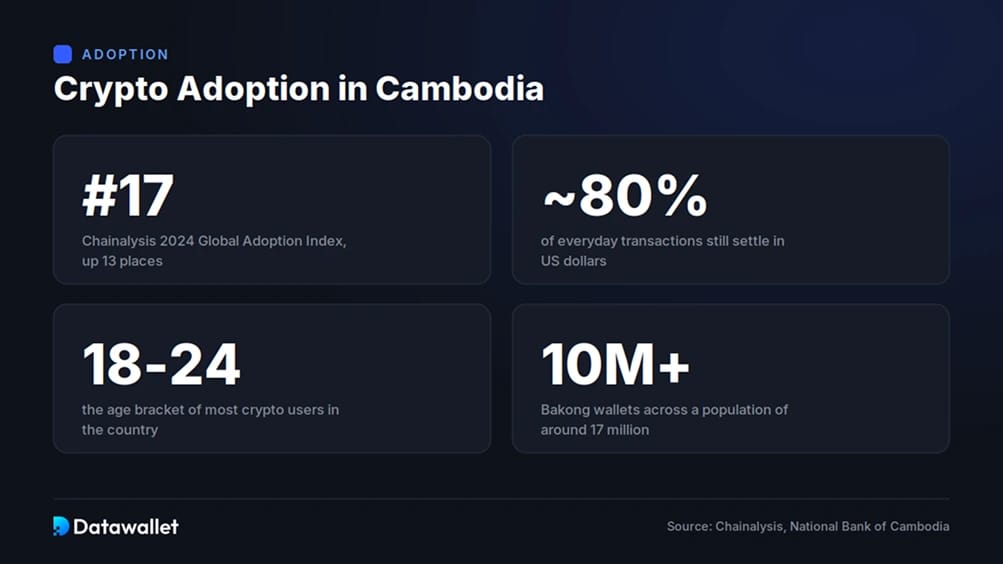
Cambodia ranked 17th on Chainalysis' 2024 Global Crypto Adoption Index, a jump of 13 places driven largely by centralised exchange usage, and sits among the top 20 countries for retail crypto use per capita. The drivers are specific to the country:
- Dollarization and stablecoins. Cambodia is one of the most dollarized economies in the world, with the US dollar historically handling around 80% of transactions. USDT feels like a natural extension of how people already hold value, which is why USD P2P books run so deep here.
- A young user base. Industry figures put most Cambodian crypto users between 18 and 24, a mobile-first generation comfortable moving money through apps.
- Bakong as the digital rail. The NBC's Bakong system, a tokenized deposit platform launched in 2020, processed hundreds of millions of transactions worth tens of billions of dollars in the first half of 2025, with more than 10 million wallets in a population near 17 million. It does not buy crypto directly, but the ABA and Wing rails that fund P2P sit on the same digital-payment habit Bakong normalised.
- The scam-hub paradox. Cambodia's crypto story is shadowed by its role in regional online fraud. Chainalysis documented Huione Group's central role in laundering proceeds for Southeast Asian scam networks before its 2025 shutdown, which is why legitimate users face extra bank scrutiny.
Cambodian demand is structurally tied to a dollarized economy, a young population, and a mature mobile-payment culture, not speculation alone. That base is unlikely to shrink regardless of how the licensing regime evolves.
How to Buy Bitcoin in Cambodia
The cleanest path in 2026 is to buy USDT in US dollars through P2P with an ABA transfer, then swap to BTC on the spot market. The sequence we use:
- Set up a reachable app and complete KYC. Install Bybit or Binance, register, and verify with a passport or Cambodian national ID. Verification usually takes a few minutes.
- Add your funding rail. Under P2P payment settings, add ABA Bank, and add Wing or ACLEDA as a backup. ABA Pay is the dominant rail, with instant transfers and no fee on the bank side.
- Buy USDT in USD. Open P2P, filter for USDT, set the currency to USD, and choose ABA. Pick a merchant with 1,000+ trades and 98%+ completion, place the order, pay by scanning the KHQR code in the ABA app, and mark it paid. Escrow usually releases in 5 to 15 minutes, and buying in USD avoids a riel conversion you do not need.
- Swap USDT for BTC on spot. Skip the one-click buy screen. Go to the spot market, choose BTC/USDT, and place a limit order. This typically saves 1 to 3% versus instant buy.
- Decide on custody. Active traders can leave BTC on the exchange. Long-term holders should move it to a hardware or mobile wallet. Our best crypto wallets guide covers the options, and double-check the network and address before sending.
This keeps your bank-side footprint small, avoids the card processor markup, and sidesteps the wide spreads on instant-buy screens.
Final Thoughts
For most people in Cambodia, Bybit is the one to set up first: it opens on the phone, its ABA and KHQR P2P runs in dollars, and the reserves are public. Keep Binance for when you are buying enough that merchant depth and spread start to matter, and reach for OKX when you want a Web3 wallet sitting next to the trading account.
The regulatory direction is tightening. Websites are blocked, the Huione action shows how seriously the scam-compound problem is treated, and the December 2024 Prakas points toward a licensed future where offshore apps may eventually need local authorisation. The grey zone that lets P2P function now may not last the year. Use that time to learn the apps, keep records, choose merchants carefully, and know the difference between holding USDT as a savings habit and anything that looks like a payment business to your bank.
Whatever you pick, move a small amount in and back out through ABA before you trust it with real size. Ten minutes of doing that beats any rating, including ours.
Our Methodology
To build this list we opened accounts on each platform, ran KYC with a passport and Cambodian ID, funded both USD and KHR over ABA, Wing, and KHQR P2P, placed trades, and pushed withdrawals back to local accounts. Six things decided the ranking:
- Trust Score: Our 0 to 5 rating, built from how a platform handles reserves disclosure, its security and operating history, how long it has run, and what oversight it answers to.
- Access and Reachability: Whether the app loads without a VPN given the November 2024 website blocks, and how reliably the platform functions for Cambodian users day to day.
- Cambodia Funding Methods: Confirmed ABA, ACLEDA, Wing, True Money, and KHQR support through P2P in both USD and KHR, with testing on settlement speed, merchant depth, and spread against mid-market USDT.
- Off-Ramp Reliability: Tested selling USDT back to fiat through P2P and measuring transit time and bank-side friction on the return leg.
- Freeze and AML Risk: Reviewed merchant verification programmes, completion rates, and the heightened bank scrutiny that comes with Cambodia's scam-hub context.
- Assets and Liquidity: Placed market and limit orders on BTC/USDT, ETH/USDT, and at least one mid-cap pair to measure spread, depth, and fill quality.
Platforms with no working Cambodian on-ramp, a thin P2P board, or that stayed unreachable even on a VPN did not make the list. We ran this testing across March to May 2026.
%20(1).webp)