







Compare Top Czech Crypto Exchanges
1. Kraken
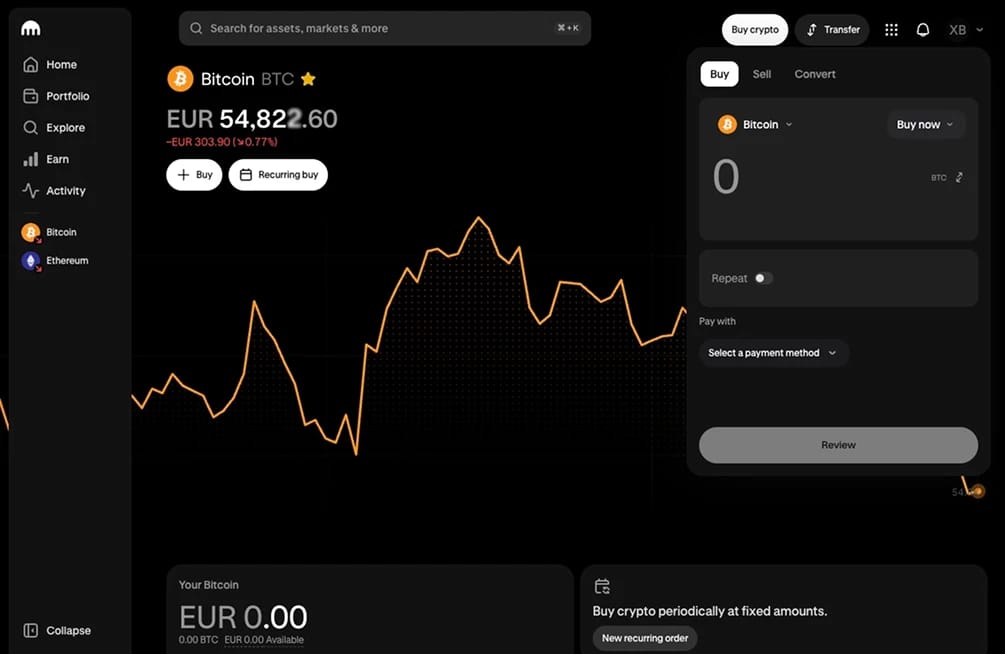
Kraken takes first place because no other exchange serving Czech users combines this level of supervision with this many products. Its MiCA license from the Central Bank of Ireland sits next to a MiFID license for regulated derivatives; it has published proof-of-reserves attestations since 2014, and in more than a decade of operation, it has never suffered a breach.
The trading side justifies the trust argument. More than 600 assets sit on some of the deepest euro order books in Europe, staking runs on the majors, and the MiFID arm opens regulated futures that Bybit EU cannot offer EEA retail clients. Funding is euro-based, and SEPA and SEPA Instant deposits are free on Kraken's end, which matters because your Czech bank already takes a spread when converting koruna.
Local convenience is the missing piece. There is no CZK balance, no koruna pair, and Kraken Pro shows a first-time investor far more interface than they need. Entry fees of 0.25% maker and 0.40% taker are higher than at OKX or Bybit EU, a premium we consider fair given the Irish supervisory and audit history, though fee-sensitive traders will notice it. Our Kraken review covers the platform in depth.
Pros
- Irish MiCA authorization paired with a MiFID license for regulated derivatives.
- Proof-of-reserves publication since 2014 and a clean breach record across more than a decade.
- Free SEPA and SEPA Instant deposits into deep euro markets with staking on major assets.
Cons
- Spot fees of 0.25% and 0.40% are higher than those on OKX and Bybit EU.
- No koruna support, so every deposit carries a conversion step.
- Kraken Pro is more screen than a casual investor wants.
2. Bybit EU
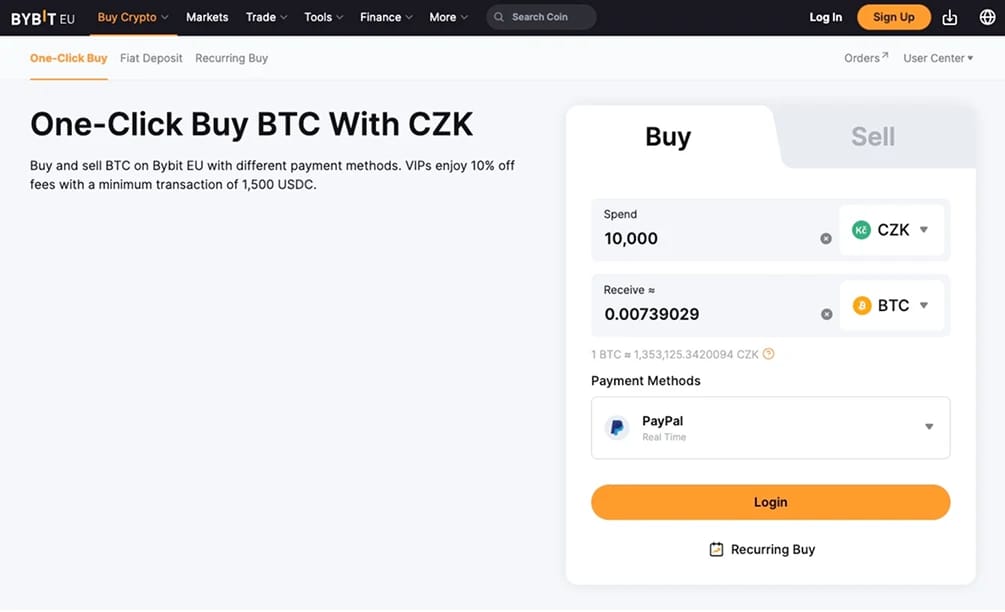
Bybit EU earns second place with the broadest licensed toolkit available to Czech users. Bybit EU GmbH carries a MiCA authorization from Austria's FMA that passports into the Czech Republic, and behind it sit 600+ cryptocurrencies, spot margin to 10x, trading bots, a full Earn shelf, and the Bybit Card, all at a flat 0.10% on spot. Nobody else in the licensed field stacks products this high.
Koruna handling is its practical edge over the other passported venues. Bybit EU accepts direct CZK deposits and withdrawals through ZEN.COM, a Bank of Lithuania-licensed payment institution, so CZK moves in and out without a euro conversion. We linked a ZEN account in a few minutes, and the deposit was credited instantly, while card and mobile wallet purchases charged in CZK cover quick buys without any linked account at all.
Know the boundaries before committing. Bybit EU is a separate Austrian entity, so migrating users must repeat KYC from scratch, and the perpetual futures the brand built its name on are unavailable to EEA retail investors. USDT is absent because Tether never sought EU approval, leaving USDC and euro stablecoins. The full platform breakdown is in our Bybit review.
Pros
- The widest licensed product range for Czech users, spanning margin, bots, Earn, and a card.
- Direct CZK deposits and withdrawals via ZEN.COM, plus koruna card and mobile wallet buys.
- 600+ assets at a flat 0.10% spot fee under an Austrian FMA authorisation.
Cons
- Perpetual futures are unavailable to EEA retail clients for now.
- Existing global Bybit users must complete a fresh KYC on the EU entity.
- The February 2025 hack sits in its history, even though customers were made whole.
3. Coinbase
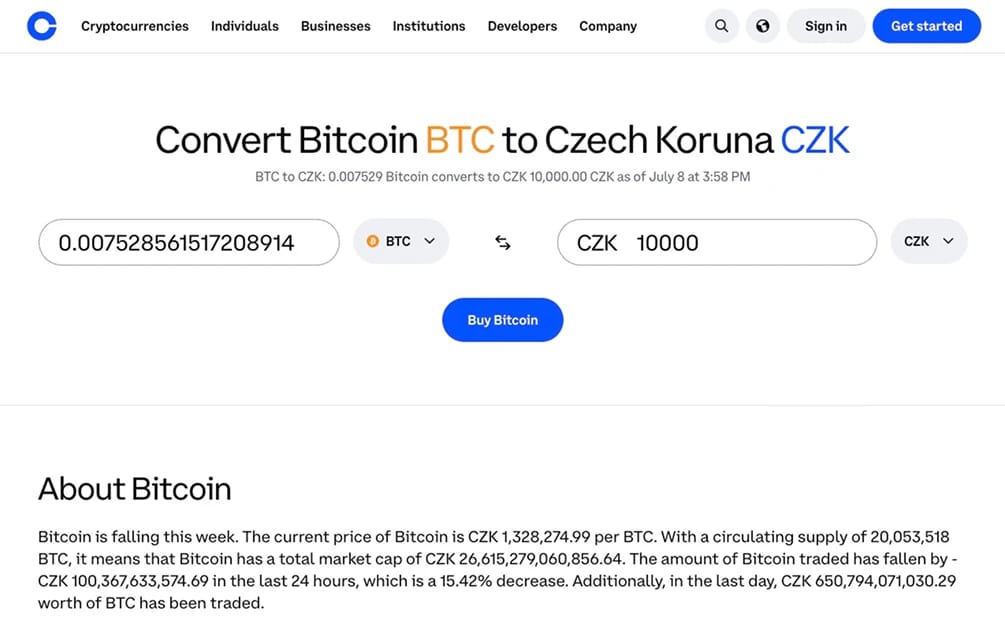
Coinbase holds third place on the strength of a record almost no crypto company can match. Across 14 years, no exchange breach has ever cost its customers their funds; the bulk of client assets sits in cold storage, and the Nasdaq listing means audited quarterly financials that no crypto-native rival publishes. Its European entity, Coinbase Luxembourg S.A., holds a MiCA license from the CSSF.
No platform in this lineup asks less of a first-time user either. Our passport verification cleared in a few minutes, simple buys work with a Czech card charged in koruna or from a euro balance funded by SEPA, and recurring purchases automate a monthly position without another thought. With USDT gone from licensed EU venues, USDC covers the stablecoin role, and the 250 assets include everything a mainstream investor is likely to hold.
Pricing is the weak spot, though a careful user can sidestep most of it. Instant buys stack a spread on top of the fee, while Coinbase Advanced hides behind a mode toggle and prices from roughly 0.40% maker and 0.60% taker at entry tiers. Switch to Advanced before your first order, and the platform charges fairly, though still more than the cheapest venues here. More details are in our Coinbase review.
Pros
- No customer funds have been lost to an exchange-level breach in 14 years, with cold storage custody.
- Luxembourg CSSF authorization backed by audited public-company disclosures.
- The easiest onboarding in this lineup, with Koruna card buys and automated recurring purchases.
Cons
- Instant buys are the most expensive purchases in this comparison.
- Advanced entry-tier fees still trail OKX, Gate, and Bybit EU.
- No CZK balance, so bank funding means converting to euros.
4. Coinmate
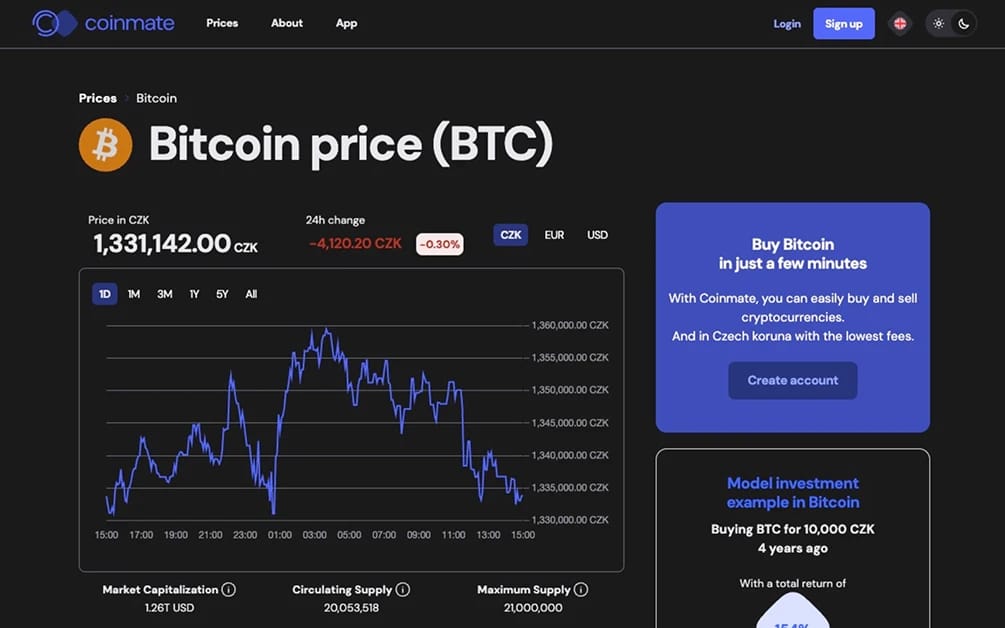
Coinmate is the account most Czech investors should hold regardless of what else they use. Founded in Prague as the country's first crypto exchange, it was among the first six firms the CNB authorized under MiCA on 11 February 2026, which puts it under direct Czech supervision rather than a passport from abroad. Backing from the Miton group and more than a decade of unbroken operation give it a pedigree no other domestic platform matches.
Everything about it is built for a Czech bank account. We registered with BankID in a couple of minutes, sent a koruna transfer that cost nothing, and watched the deposit credit almost immediately thanks to instant payment support with banks like Air Bank and Moneta. The BTC/CZK and ETH/CZK order books mean you trade in crowns from start to finish, with no hidden conversion spread eating the round trip.
The trade-offs are breadth and product depth. Roughly 26 assets cover the majors and little else, entry fees of 0.40% maker and 0.60% taker only become competitive once 30-day volume climbs, and there is no margin, no derivatives, and no earn shelf. Its role is the clean koruna base layer, with a passported venue alongside it for anything beyond the top of the market.
Pros
- CNB-authorised CASP supervised directly in Prague, among the first six licensed in the country.
- Free CZK deposits with instant crediting from major Czech banks and BankID onboarding.
- Native koruna order books remove the conversion spread entirely.
Cons
- Around 26 assets, so altcoin buyers need a second account.
- Entry-tier fees are high until trading volume unlocks lower tiers.
- Spot only, with no margin, futures, or yield products.
5. Gate
Gate solves the altcoin problem within the licensed field. The global platform has operated since 2013, serves more than 30 million users, and lists over 3,800 cryptocurrencies, while its European arm, Gate Technology Ltd, holds a MiCA authorization from Malta's MFSA covering custody, trading platform operation, exchange, and transfer services across the EEA.
Pricing and tooling hold up well for a catalog this size. Maker fees start at 0.10% and taker fees at 0.20%, GateToken holdings push them lower, and the platform adds copy trading, Earn products, and a zero-knowledge proof-of-reserves system that lets anyone verify assets against liabilities. Our SEPA deposit from a euro account converted at Česká spořitelna arrived within a day and cleared without questions.
A few details deserve attention before it becomes your primary venue. The license belongs specifically to Gate Technology Ltd, so confirm in the app that the EU entity holds your account, and that the compliant European catalog is smaller than the global headline figure. Liquidity also thins out fast in the long tail, where small listings carry genuine drawdown risk. The 2018 breach, repaid in full, and the rebuilt security stack are covered in our Gate review.
Pros
- The widest selection of assets of any licensed venue serving Czech users.
- MiCA authorization through Malta's MFSA plus verifiable zk proof of reserves.
- Competitive 0.10% maker pricing with GateToken discounts, copy trading, and Earn.
Cons
- The EU entity's compliant catalog is smaller than the global number suggests.
- Thin order books and elevated risk far down the listing range.
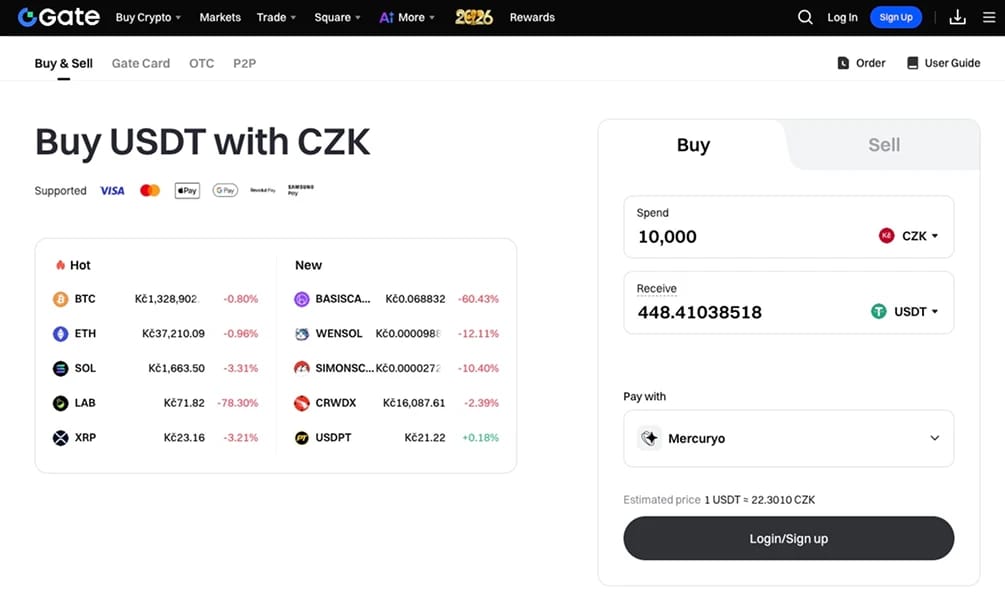
- No koruna balance unless via credit/debit card, so CZK converts to euros on the way in.
6. OKX
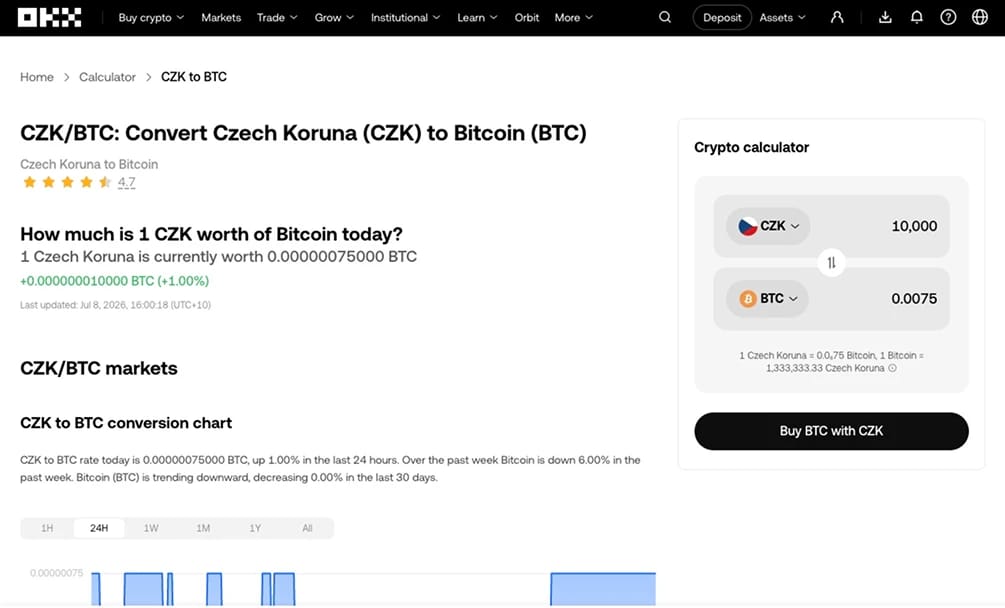
OKX wins on raw cost and on-chain reach. Spot pricing of 0.08% maker and 0.10% taker undercuts every major platform available to Czech users; the MiCA authorization comes from Malta's MFSA; and reserves are published monthly with Merkle-tree verification that anyone can independently verify.
The self-custodial OKX Wallet is the feature that separates it from the pack. It spans more than 100 chains, bundles a DEX aggregator, and turns a single app into both a regulated exchange and a working gateway to DeFi. Funding runs through SEPA in euros or by card, and our converted transfer settled the following morning without the bank flagging it.
Two caveats belong in the decision. ESMA's 2025 peer review questioned how rigorously Malta assessed its early authorizations, a shadow OKX shares with Gate, so the license works across the EEA while carrying slightly less supervisory weight than Ireland or Luxembourg. The product range can also pull a newcomer into instruments they do not yet understand. The complete picture sits in our OKX review.
Pros
- The cheapest spot pricing among large licensed venues is at 0.08% and 0.10%.
- Monthly Merkle-tree reserve attestations under a Maltese MiCA license.
- A self-custodial wallet covering 100+ chains with built-in DEX aggregation.
Cons
- Malta's supervisory reputation trails Ireland and Luxembourg after ESMA's peer review.
- Feature depth can overwhelm a buy-and-hold investor.
- No koruna balance, so CZK converts to euros on deposit.
How to Choose a Crypto Exchange in the Czech Republic
Since 1 July 2026, the shortlist begins with the license and ends with how your koruna gets onto the platform. Run these five checks before sending a single crown.
- Verify the CASP authorization: A license belongs to one legal entity, not a brand. Coinmate appears among the CNB's first authorized providers, while Bybit EU, Kraken, Coinbase, Gate, and OKX passport in from other EU regulators. Check the entity name against the CNB's records and ESMA's MiCA register before depositing.
- Decide how the koruna gets in: Coinmate accepts CZK directly through free bank transfers, and Bybit EU charges cards in crowns for instant buys. Kraken, Coinbase, Gate, and OKX hold euro balances, so your bank converts CZK on the SEPA leg. For regular euro funding, a multi-currency account usually beats the bank's posted conversion rate.
- Confirm that your bank processes the payment: Czech banks screen crypto transfers under AML rules, and payments to licensed venues clear far more reliably than payments to other recipients. Our guides for Erste Group banks, which include Česká spořitelna, Raiffeisenbank, and Revolut cover what each permits in practice.
- Check your assets survived the compliance filter: USDT is gone from licensed EEA venues because Tether skipped MiCA authorization, and EU front ends trim parts of global catalogs. If a specific token matters to you, confirm it trades on the compliant version of the platform before moving money.
- Plan for the tax office from the first trade: Every disposal is potentially taxable, but the three-year time test and the CZK 100,000 value test can zero out the bill entirely. Pick a platform with clean transaction exports, because proving a holding period to the Finanční správa is your job, not the exchange's.
Crypto and Bitcoin Regulation in the Czech Republic
Crypto is legal in the Czech Republic and now regulated under MiCA, with the Czech National Bank as the competent authority. The koruna remains the only legal tender, but owning, trading, and accepting crypto by private agreement are all lawful.
A short chain of dates explains the market Czech investors trade in today.
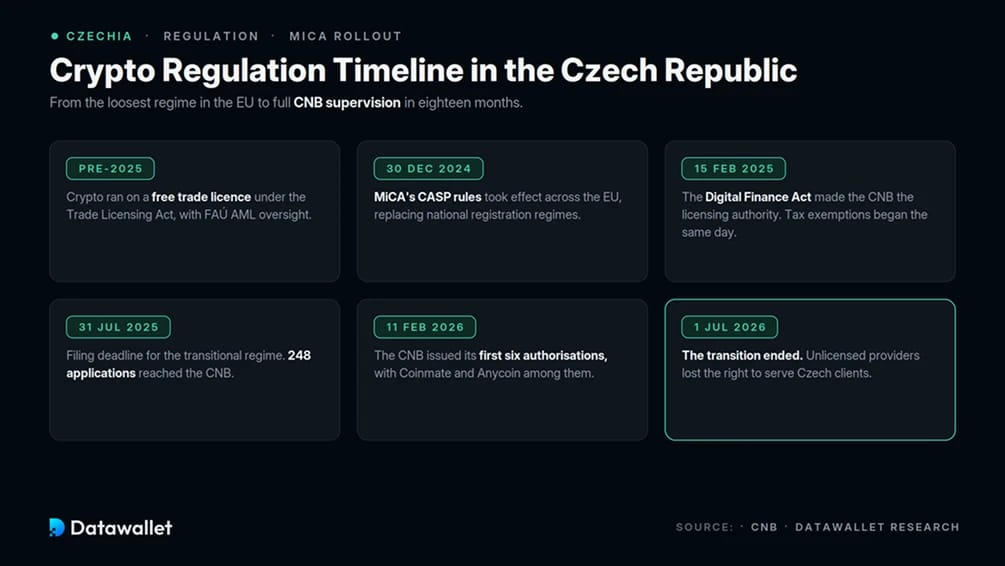
- Before 2025: Crypto exchange operated as an unqualified free trade under the Trade Licensing Act, with the Financial Analytical Office (FAÚ) handling AML oversight. Anyone with a živnostenské oprávnění could run a crypto business, which made the Czech regime the loosest in the EU.
- 30 December 2024: MiCA's CASP rules became applicable across the EU, replacing national registration regimes with a single authorization framework.
- 15 February 2025: The Digital Finance Act (Act No. 31/2025 Coll.) took effect, making the CNB the licensing and supervisory authority. The same date activated the new crypto tax exemptions, a rare case of regulation and tax relief arriving together.
- 31 July 2025: The deadline to file a CASP application and keep operating under the transitional regime. Most of the 248 applications landed in the final days, and from August 2025, natural persons could no longer provide MiCA-regulated services at all.
- 11 February 2026: The CNB issued its first six authorizations, with Coinmate and Anycoin among the early names, and warned that each remaining file would be assessed individually within MiCA's deadlines.
- 1 July 2026: The transition ended. Providers without a granted authorization lost the right to serve Czech clients, and the market consolidated around CNB-licensed locals and passported international platforms.
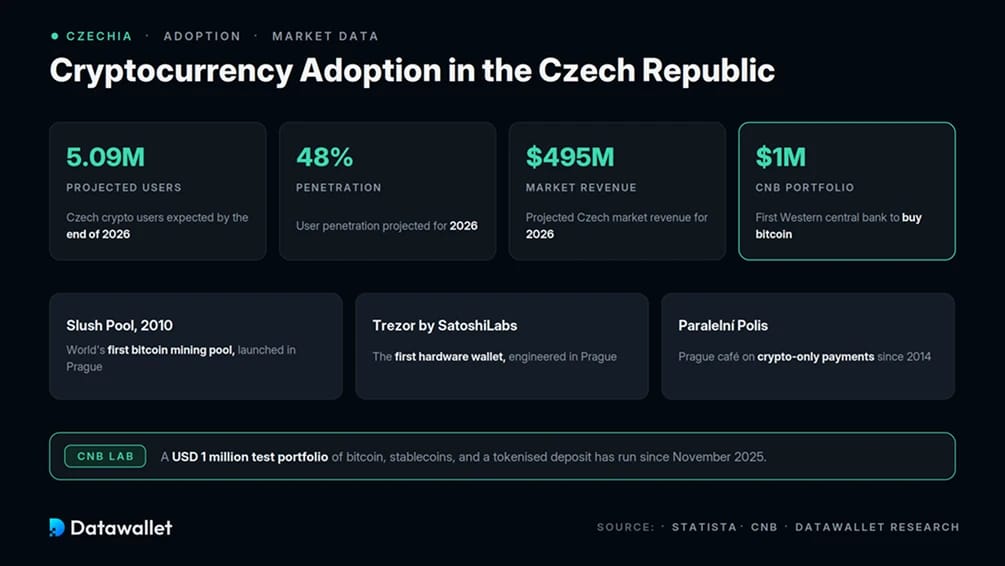
The CNB has also become the most closely watched central bank in crypto. In November 2025, it built a USD 1 million test portfolio of bitcoin, dollar stablecoins, and a tokenized deposit, the first direct crypto purchase by any Western central bank.
Governor Aleš Michl had floated putting up to 5% of reserves into bitcoin; the Bank Board declined in February 2026, but the test portfolio runs on as a live experiment in custody, key management, and accounting.
How Is Crypto Taxed in the Czech Republic?
Czech crypto taxation flipped from tedious to genuinely favorable on 15 February 2025, when new exemptions entered the Income Tax Act alongside the MiCA framework. Gains still count as other income under Section 10, but two tests now remove most ordinary investors from the net.
- The three-year time test: Sell or swap a crypto-asset you have held for more than three years and the gain is exempt, capped at CZK 40 million of income per year. The cap was abolished for shares from 2026 but deliberately kept for crypto, so large holders still need to stagger disposals across calendar years.
- The CZK 100,000 value test: If your total gross income from crypto disposals stays under CZK 100,000 in a calendar year, nothing is taxed, and nothing needs to be declared, whatever the holding period.
- Standard rates when neither test applies: Net gains are taxed at 15%, rising to 23% on the slice of total annual income above CZK 1,762,812 for 2026. Crypto-to-crypto swaps count as disposals, so rotating BTC into ETH inside the three-year window is a taxable event.
- Active income is different: Staking rewards, mining, and airdrops are taxed as income when received, and the time test does not shelter them. The three-year clock only starts once you hold the received tokens.
- No social or health insurance: Section 10 gains sit outside the insurance system, which keeps the effective rate exactly at 15% or 23% for private investors.
- Reporting went automatic: From 1 January 2026, DAC8 obliges exchanges, foreign ones included, to report Czech users' transactions to the Finanční správa each year. The paper filing deadline is 1 April, with electronic filings due in early May.
Records decide everything here. The exemptions only hold if you can prove acquisition dates and cost basis, so export transaction histories regularly and keep them for years.
The combination of the time test and the value test places Czechia among the most tax-friendly crypto countries anywhere, but none of this replaces advice from a Czech tax professional for staking, DeFi, or business-scale activity.
Cryptocurrency Adoption in the Czech Republic
Czech adoption runs deeper than the country's size suggests, built on one of the oldest grassroots crypto scenes in the world.
- The user base is large and still growing: Statista projects 5.09 million Czech crypto users by the end of 2026, with penetration rising from about 46% in 2025 to over 48% and market revenue approaching USD 495 million. Even discounting for how broadly such surveys define a user, the direction is unmistakable.
- Czech engineering shaped global crypto: Prague gave the industry Slush Pool, the world's first bitcoin mining pool, launched in 2010, and SatoshiLabs' Trezor, the first hardware wallet. The Paralelní Polis café has run on crypto-only payments since 2014. Long before MiCA, the Czech scene was exporting infrastructure that the whole market still uses.
- The central bank leads from the front: The CNB's bitcoin test portfolio and Governor Michl's public case for studying the asset put the Czech Republic in a category of one among Western central banks, and gave local investors an institutional signal no marketing campaign could buy.
The global comparison sits on our crypto adoption statistics page. What stands out locally is the pairing of a veteran self-custody culture with a newly licensed exchange sector, a combination few markets can claim.
How to Buy Bitcoin in the Czech Republic
Buying BTC here takes minutes once you decide whether to stay in koruna or accept a euro conversion. Here is the process we used.
- Pick a licensed venue for your funding style: Coinmate for koruna through a free bank transfer with BankID, or Kraken and Bybit EU for larger catalogs and deeper books. Confirm the entity against the CNB's list or ESMA's register before depositing.
- Clear verification: BankID gets you through Coinmate almost instantly. On passported platforms, upload a passport or ID card with a selfie, and enter your name exactly as printed, since mismatches cause most stalled applications.
- Fund in CZK or convert to EUR: A koruna transfer to Coinmate costs nothing and credits quickly from instant-payment banks. Bybit EU charges cards in crowns for immediate buys. For euro venues, either accept your bank's conversion on the SEPA transfer or pre-convert in a multi-currency account for a tighter rate.
- Buy with a limit order: On any order book, a limit order on BTC/CZK or BTC/EUR nearly always beats the quoted price of a one-tap instant buy. The convenience button is the most expensive feature on every exchange.
- Decide where the bitcoin lives: Licensed venues must segregate client assets under MiCA, so keeping coins on the exchange is defensible for active trading. For long-term holdings, withdraw to self-custody after double-checking the address and network. Our best crypto wallets guide compares the options, and a Czech-made Trezor is a fitting choice here.
Final Thoughts
Kraken is the account we would open first in the Czech Republic today. Irish supervision, a MiFID derivatives license, reserve audits stretching back to 2014, and a clean breach record make it the platform we trust with real size, and free SEPA funding keeps the euro leg cheap.
The register is the only opinion that counts now. Of 248 applicants, only a fraction held a license when the deadline arrived. Most Czech investors are best served by combining a koruna-native account with one large passported platform, then keeping records tidy enough that the three-year exemption never becomes a dispute.
For the wider region, our guide to the best crypto exchanges in Europe maps the neighboring markets.
Our Methodology
Each score in this guide comes from direct use under Czech conditions rather than from spec sheets. Accounts were verified with BankID and a passport, funded through domestic CZK transfers, cards, and converted SEPA payments, traded on, and emptied back into Czech bank accounts. Six criteria determined the final rankings.
- Trust Score: Our proprietary rating out of 5, weighting the CASP authorization and issuing regulator, custody and reserve transparency, breach history, platform longevity, and audit coverage.
- Czech Funding Methods: Confirmed CZK bank transfer, instant payment, card, and SEPA support, measuring settlement speed, conversion spreads where they apply, and withdrawal costs back to Czech accounts.
- Regulatory Standing: Verified each platform's authorization against the CNB's records and ESMA's MiCA register, which has separated legal operators from everyone else since 1 July 2026.
- Security Track Record: Weighed breach history, client asset custody arrangements, reserve disclosure frequency, and account-level protections like 2FA and withdrawal whitelists.
- Assets and Liquidity: Ran market and limit orders across BTC, ETH, and a mid-cap pair on each venue, recording spreads, book depth, and fill quality on both CZK and EUR pairs where available.
- Fee Structure: Compare maker and taker fees, deposit costs, and the all-in price of a koruna round trip, including the bank's conversion where applicable.
Platforms without a live MiCA authorization were excluded, which removed Binance after its withdrawal and every legacy trade-license operator that missed the cutover. Testing ran from April through July 2026.
%20(1).webp)